Minimum CIBIL Score for Credit Card: What Banks Look For
There's no single cut-off. Here's the indicative score for each kind of card, what banks weigh besides the number, and what to fix before you apply.

There's no single minimum CIBIL score for credit card approval in India. As an indicative guide, most banks look for 750 or above for a regular card. Some entry-level cards may consider scores in the 600 to 749 range, often with lower limits. Secured cards backed by a fixed deposit have no fixed minimum. Each bank sets its own cut-off and also checks your income, existing debt and recent applications.
Key TakeawaysGroScore treats 750+ as good and below 600 as the zone where approvals get hard (groscore.in).Each card issuer sets its own cut-off. Treat any number you read as indicative.Issuers must assess your repayment capacity independently, including limits you hold elsewhere (RBI).A card application is a hard enquiry. Checking your own score is a soft one.
Check your free Equifax score and report on GroScore before you apply. A soft check never lowers your score.
Before the Numbers: What GroScore Is and Isn't
GroScore is a free credit score app and personal credit coach from Vitrak Technologies (GroMo). It shows your Equifax credit score and full report with a soft check that never affects your score, explains in Hindi or English what is holding the score back, and gives a step-by-step plan to fix it. GroScore is not a lender, not a card issuer and not a credit bureau. It can show which cards your profile may suit, but the bank decides.
What about the word "CIBIL"? TransUnion CIBIL is one of four credit bureaus registered with the RBI. The others are Equifax, Experian and CRIF High Mark, according to the RBI's list of credit information companies. A card issuer may pull your report from any of them. Your scores across bureaus are usually close but rarely identical, and the number GroScore shows is your Equifax score, not a CIBIL score.
What Is the Minimum CIBIL Score for Credit Card Approval?
The minimum credit score for a credit card depends on the type of card. A regular credit card is unsecured: the bank lends you money with nothing to fall back on, so your credit report carries a lot of weight. A secured card is backed by your own deposit, so the score matters less.
Here's the indicative picture, as of October 2026:
| Card type | Indicative score banks look for | Why |
|---|---|---|
| Premium and rewards cards | 750+, plus higher income | Higher limits, more risk for the bank |
| Regular credit card | 750+ for most cards | Unsecured revolving credit |
| Entry-level card | Sometimes 600 to 749, often with lower limits | Smaller limits, smaller risk |
| Secured (FD-backed) card | No fixed minimum at many banks | Your fixed deposit is the security |
| No score yet (NH or -1) | Secured card is the usual first step | No history to judge |
These figures are indicative, compiled from GroScore's guidance bands (groscore.in), October 2026. These aren't lender-published cut-offs. Actual offers vary by lender, income and credit profile.
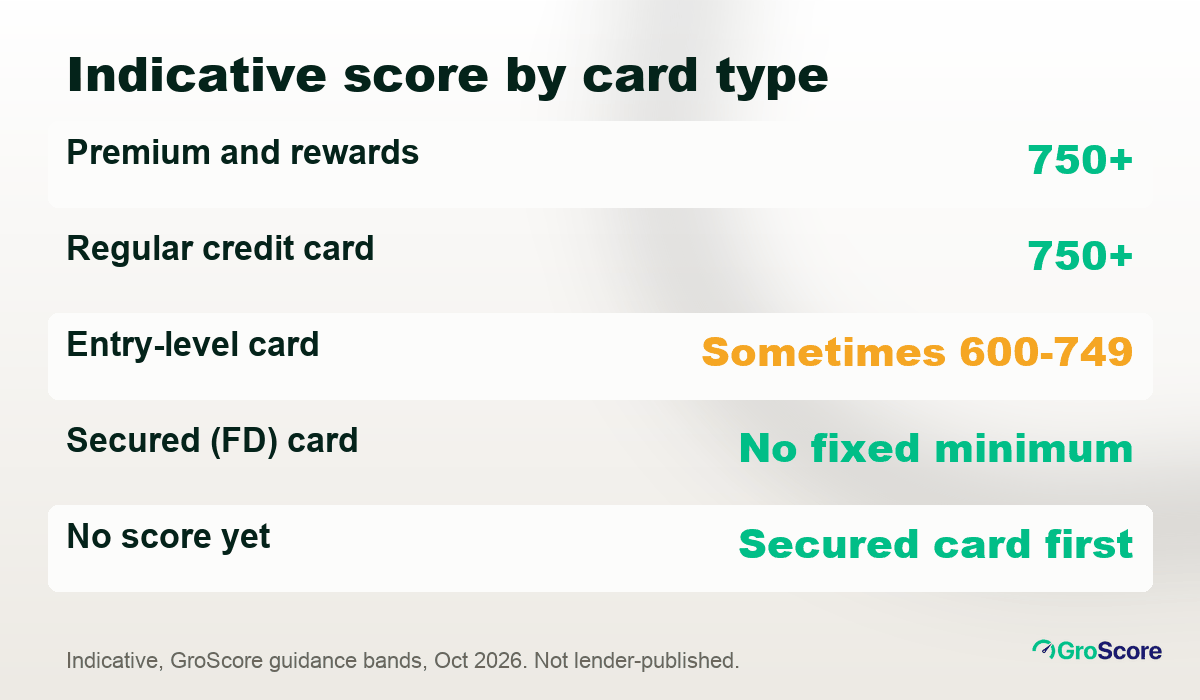
These ranges are indicative, and each issuer keeps its own cut-off.
So what credit score is required for a credit card? For the widest choice, 750 or above, as of October 2026 (indicative, groscore.in). Between 600 and 749, your options narrow but don't vanish. Below 600, a regular card gets hard, and a secured card is usually the realistic route.
A score in the good band isn't a ticket, though. A 780 can still be declined because of income or existing debt. Even a credit card for good credit score holders has to fit the income on your application.
What Do Banks Look At Besides Your Score?
Your score is the first filter. The rest of your credit card eligibility depends on what the bank finds when it reads your full report and your application.
Under the RBI's Master Direction on credit and debit cards, issuers must independently assess credit risk, taking your own financial means into account. They also have to consider the limits you already hold with other lenders when they set your limit. The decision to issue a card stays with the issuer alone.
In practice, banks usually look at:
- Income and job. Banks check whether you're salaried or self-employed, how much you earn and how steady it is. Higher-tier cards often carry income criteria.
- Existing EMIs. Lenders compare your monthly obligations with your income. This is often called FOIR (fixed obligations to income ratio). The lower it is, the more room you have.
- Your payment record. A good score with a recent DPD (days past due) on one account can still worry a bank.
- Cards and limits you already hold. Three cards with large limits can mean a smaller limit on the fourth.
- Recent applications. Several hard enquiries in a few weeks look like credit hunger.
- Identity and address. Banks verify your KYC documents and check whether they serve your PIN code.
Your relationship with the bank can help too. Many banks are more comfortable with customers whose salary or savings account they already hold, because they can see the money coming in. Once you have the card, it feeds your score every month, as our guide on how credit cards affect your credit score explains.
Can You Get a Credit Card With a 650 Score?
You possibly can, but not with every card or at every bank. A 650 sits in GroScore's fair band, 600 to 749 (groscore.in, as of October 2026). Here's what usually works better at that score:
- An entry-level card with a modest limit is worth trying, especially from the bank that holds your salary account.
- A secured card against an FD works because the deposit does most of the convincing.
- Becoming an add-on cardholder on a family member's card is an option, though the main cardholder is liable for what you spend.
Which credit card is easiest to get with an average score? It's usually a secured card, because the bank's risk is covered by your deposit. Our guide to a credit card for a low CIBIL score walks through how FD-backed cards work and what to check before you sign.
What doesn't work is applying to five banks hoping one says yes. Each rejection leaves a hard enquiry behind, and the next bank sees all of them.
What Would a Card Issuer See on Your Report?
Here's an illustrative example with the arithmetic shown. Say Ananya, 26, has an Equifax score of 690. She earns ₹45,000 a month and pays a ₹12,000 EMI on a two-wheeler loan. Her EMI-to-income ratio works out to ₹12,000 ÷ ₹45,000, or about 27%.
| What the issuer sees | Ananya's figure | How it reads |
|---|---|---|
| Score | 690 | Fair band |
| Monthly income | ₹45,000 | Fits entry-level cards |
| EMI to income | About 27% | Room for a card |
| Existing card utilisation | 85% of a ₹40,000 limit | Looks stretched |
| Card enquiries, last two months | 3 | Looks like credit hunger |
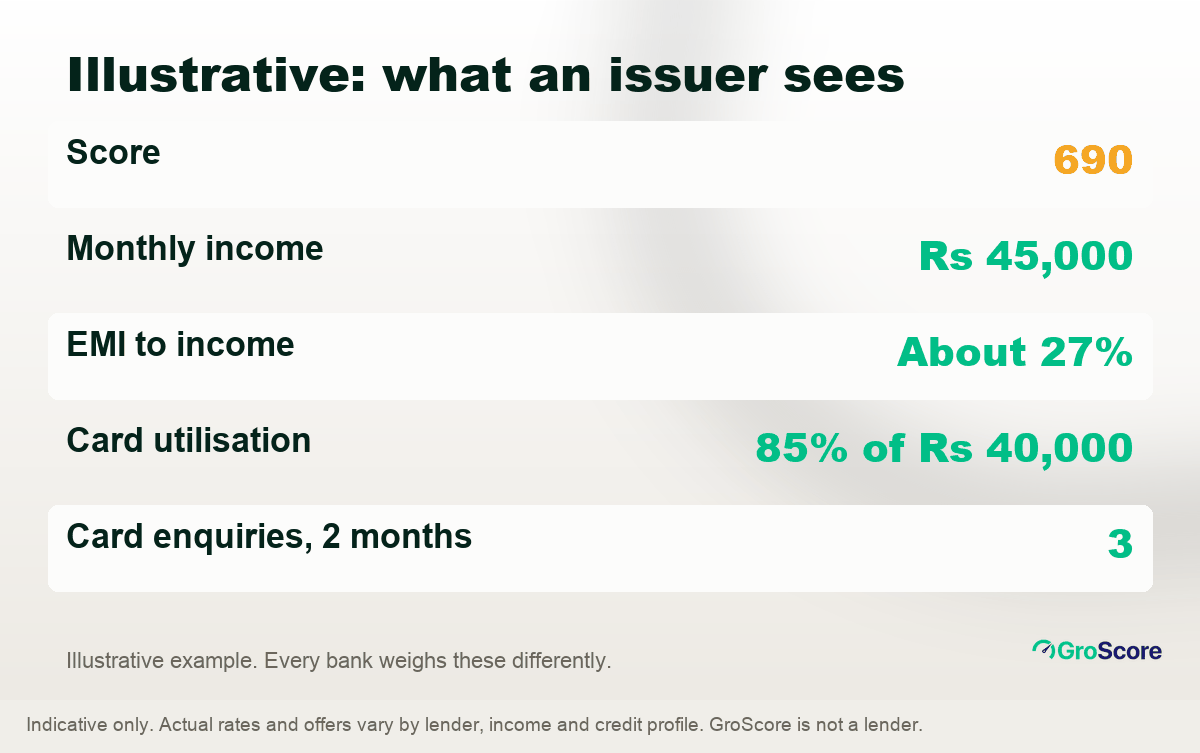
This is an illustrative example, and every bank weighs these factors differently.
Arjun, GroScore's credit coach, would flag three things before her next application, in this order:
- Stop applying. Three card enquiries in two months already sit on her report. A fourth adds to the pile.
- Bring the card balance down. An 85% balance on a ₹40,000 limit is ₹34,000. Paying it down to under ₹12,000 before the statement date brings it under GroScore's 30% line (groscore.in, retrieved 2026-10-05).
- Then apply once, to the right bank. An entry-level card from the bank that holds her salary account is a sensible first try.
None of this promises approval. It removes the two things on her report that a bank would question first. How much her score moves depends on the rest of her report, and results are not guaranteed.
Before You Apply for a Credit Card: A Checklist
Ten minutes of checking can save you a rejection and a hard enquiry.
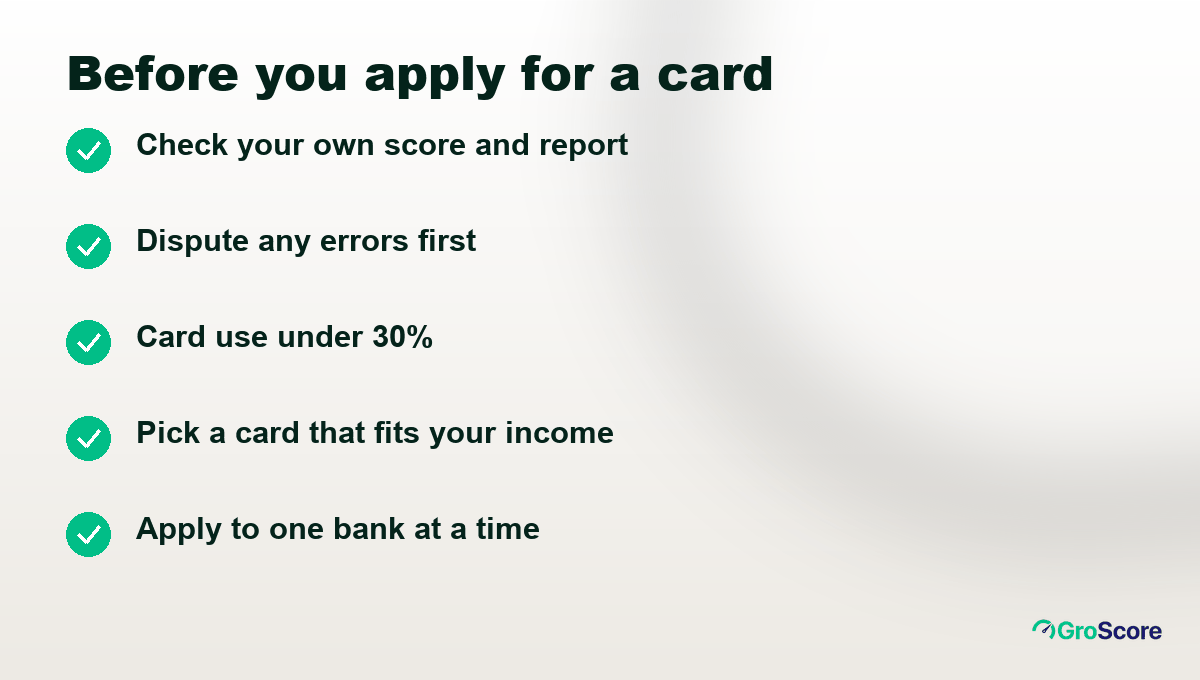
Run through this before any card application.
- Check your own score and report. It's a soft enquiry. Look at the score and at every account line.
- Fix errors first. A loan you never took or a DPD you didn't earn can be disputed with the bureau. Accurate entries can't be removed early.
- Bring card use under 30%. That's GroScore's guidance line (groscore.in, retrieved 2026-10-05), and it's the quickest thing to change.
- Match the card to your income. A premium card you don't qualify for is a wasted enquiry.
- Read the key fact statement. Check the annual fee, interest rate, late fee and any joining fee in the bank's own documents.
- Apply to one bank at a time. Wait for the answer before trying another.
Does Applying for a Credit Card Lower Your Score?
A card application usually triggers a hard enquiry, because the bank pulls your report to decide. One enquiry is normal and its effect is small. Several in a short time can lower your score and make the next bank cautious. The guide to hard vs soft enquiry explains which checks count.
Some "check your eligibility" tools use a soft check, and some don't. If a page asks for your PAN, ask whether it's a soft or hard pull before you submit.
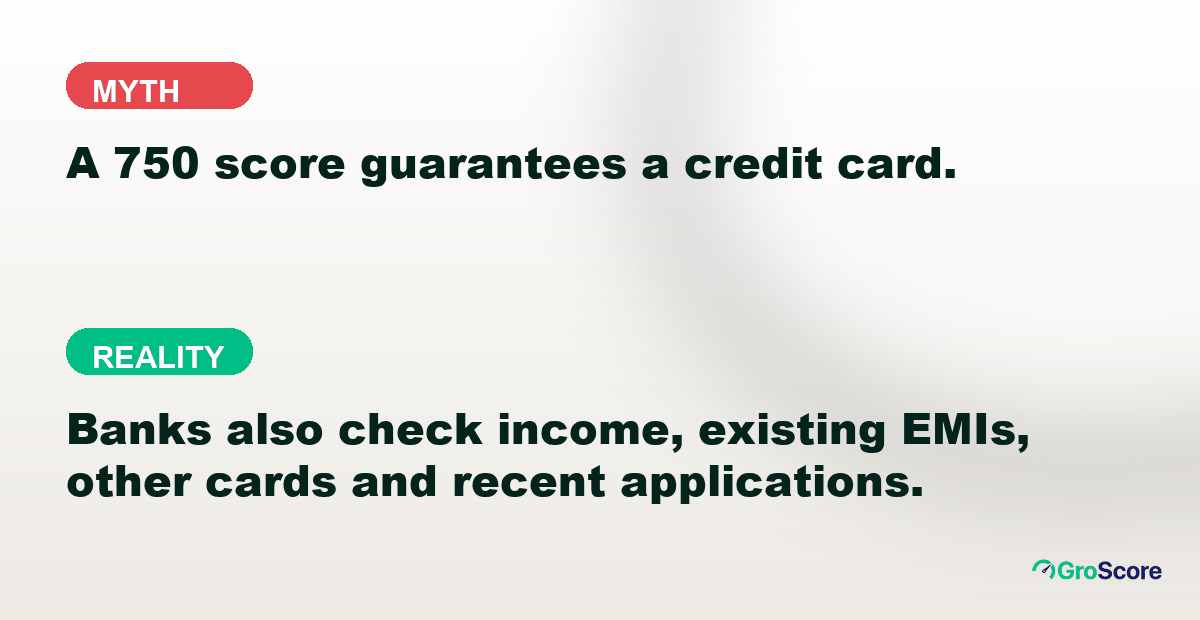
A score opens the door. Income and debt decide the rest.
Be wary of anyone who promises a card for a fee. Only RBI-regulated banks, and NBFCs with the RBI's approval, can issue credit cards. A "processing fee" before any card is issued, or a request for your OTP, is a red flag. You can verify an NBFC on the RBI's published NBFC list and report a suspicious entity on the RBI's Sachet portal (sachet.rbi.org.in). For a complaint against a bank, go to the bank first, then escalate to the RBI's complaint portal (cms.rbi.org.in) if it isn't resolved within 30 days.
Frequently Asked Questions
What CIBIL score do I need for a credit card?
Most regular cards look for 750 or above, as an indicative guide as of October 2026. Some entry-level cards consider the 600 to 749 range with lower limits, and secured cards against an FD often have no fixed minimum. Each bank sets its own cut-off.
Can I get a credit card with a 650 score?
You may, with an entry-level card from a bank that knows you, or a secured card against a fixed deposit. Premium cards are unlikely at 650. Lowering your card balance and pausing new applications can improve your chances, though no approval is guaranteed.
Which credit card is easiest to get with an average score?
A secured card backed by a fixed deposit is usually the easiest, because the deposit covers the bank's risk. Entry-level cards from your salary-account bank are the next best option.
Does applying for a card lower my score?
Applying usually means a hard enquiry, which can lower your score a little for a while. Checking your own score is a soft enquiry and has no effect. Space out applications and apply only for cards that fit your income.
The Bottom Line
The minimum CIBIL score for a credit card isn't one number. For most regular cards, 750+ gives you the widest choice (indicative, as of October 2026). In the 600 to 749 range, entry-level and secured cards are the realistic options. Below that, start with a secured card. Whatever your score, check your report first, fix errors, bring card use under 30% and apply to one bank at a time.
Disclaimer
This GroScore article is for general education and is not financial advice. GroScore provides credit scores and reports sourced from Equifax, an RBI-licensed credit bureau; scores differ between bureaus and change as lenders report new data. Credit score improvement depends on your individual credit behaviour and bureau reporting timelines, and results are not guaranteed. Loan and card decisions are made by lenders on their own criteria. GroScore is not a lender. Figures and rates shown are indicative.
