Credit Card for Low CIBIL Score: Secured and FD Cards
A low score doesn't have to mean no card. A fixed deposit can stand in for the trust a bank can't yet see in your report.

Need a credit card for low CIBIL score? Your most realistic option is a secured card, which a bank issues against a fixed deposit (FD) you open with it. The FD backs your limit, so the bank leans less on your score. Approval is still the bank's decision. Used well, the card reports to the bureaus and can help rebuild your score.
Key TakeawaysIn India, only RBI-regulated banks, and NBFCs with prior RBI approval, can run a credit card business (RBI Master Direction on credit cards, 2022).A secured card's limit is set as a share of your FD. The deposit stays with the bank as security.It reports to the credit bureaus like any other card, so on-time payments can help and late ones hurt.Below 600, approvals for regular cards get hard, per GroScore's guidance (groscore.in).
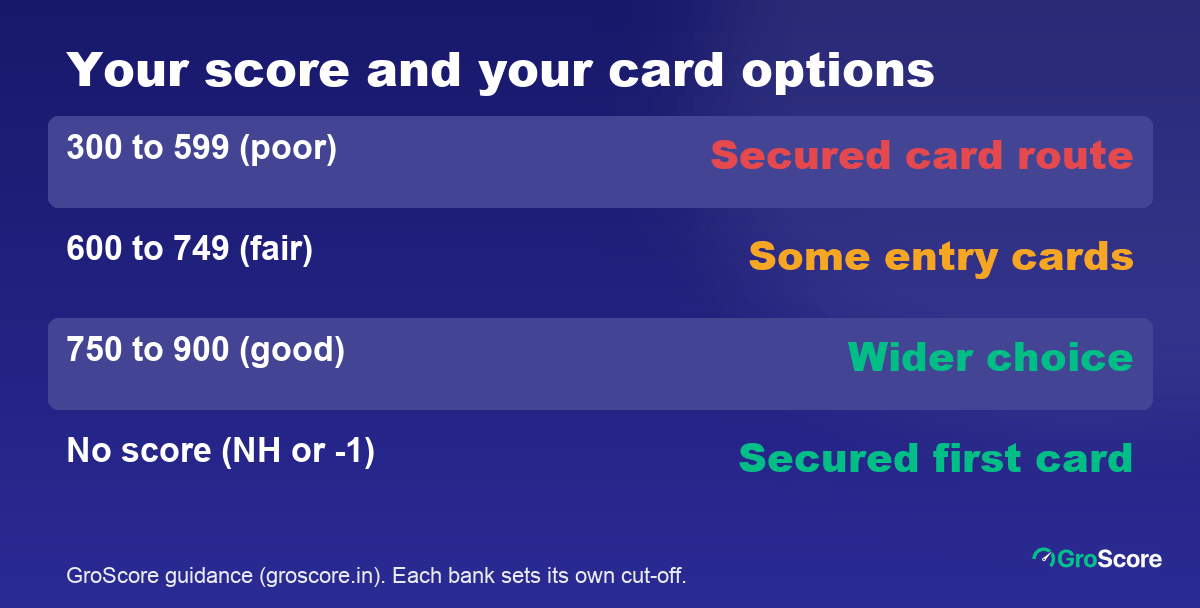
Where your score sits shapes which card a bank will consider.
Can You Get a Credit Card With a Low CIBIL Score?
Sometimes, but rarely a regular, unsecured one. A bank issuing a normal card is lending you money with nothing to fall back on. Your credit report is its main evidence that you'll pay it back.
Here's how GroScore reads the score bands (groscore.in):
| Score | Band | What it usually means for a card |
|---|---|---|
| 300 to 599 | Poor | Regular cards are hard to get. A secured card is the usual route. |
| 600 to 749 | Fair | Some entry-level cards may be possible, often with lower limits. |
| 750 to 900 | Good | Wider choice of cards and higher limits. |
| No score (NH or -1) | New to credit | No history yet. A secured card is a common first card. |
Each bank sets its own cut-off, and income, job and existing debt count too. A 620 doesn't mean rejection everywhere. A 760 doesn't guarantee approval.
GroScore is a free credit score app and personal credit coach from Vitrak Technologies (GroMo). It shows your Equifax credit score and full report with a soft check that never affects your score, explains what is holding the score back, and gives a step-by-step plan to fix it. GroScore is not a lender, not a card issuer and not a credit bureau. The score it shows is your Equifax score, not a CIBIL score. CIBIL is one of four RBI-registered bureaus, alongside Equifax, Experian and CRIF High Mark, and each calculates its own number.
Two very different people search for a credit card without a CIBIL score. One has a low score because of past missed payments. The other has no score at all, because they've never borrowed. A secured card can work for both. The new to credit guide covers the second case in more depth.
What Is a Secured Credit Card?
A secured credit card is a credit card backed by a fixed deposit. You open an FD with the bank, and the bank issues a card with a limit linked to that deposit. People also call it an FD card, an FD-backed credit card or a credit builder card.
How it works, step by step:
- You open an FD with the issuing bank, or pledge one you already hold there.
- The bank marks a lien on the FD. You can't break it while the card is active.
- Your card limit is set as a share of the FD amount. The bank decides the share.
- You use and repay the card like any other.
- If you don't pay, the bank can recover dues from the deposit under the card's terms. Late payments still get reported to the bureaus.
Point five matters most. The FD protects the bank, not your score. Under RBI rules, a card can be reported past due once a payment is more than three days late, and a secured card is no exception. Miss a Rs 2,000 bill on it and a DPD (days past due) entry lands on your report, exactly as it would on a regular card.
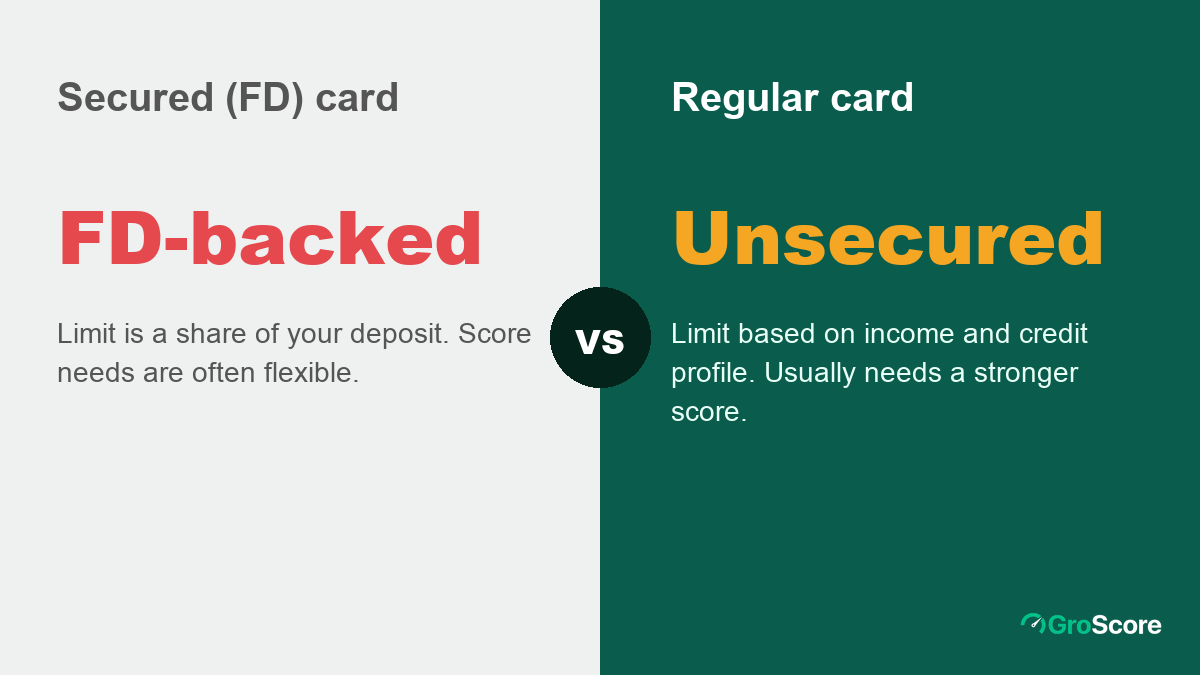
A secured card swaps your score for a deposit as the bank's main comfort.
| Secured (FD-backed) card | Regular credit card | |
|---|---|---|
| Security | Your fixed deposit, under lien | None |
| Limit | A share of the FD, set by the bank | Based on income and credit profile |
| Score needed | Often flexible; the bank decides | Usually a stronger score |
| Reports to bureaus | Yes, if the bank reports it | Yes |
| Risk to you | Unpaid dues can be recovered from the FD | Debt, charges and collection |
Who Issues Secured Credit Cards in India?
Banks do. Under the RBI's Master Direction on credit and debit cards, scheduled commercial banks with a net worth of at least Rs 100 crore can issue credit cards. NBFCs need the RBI's prior approval to run a card business. You can read the rules in the RBI's Master Direction on credit and debit cards.
Many public and private sector banks offer cards against FDs. Some fintech apps sell FD cards too. Behind every genuine one sits a bank that issues the card and holds your deposit.
Before you apply, check three things:
- The issuing bank's name. It should be printed on the application and the card. If an app won't tell you which bank issues the card, walk away.
- The key fact statement. Read the annual fee, interest rate, late fee and the FD interest rate in the bank's own documents.
- The bank's own website. Confirm the product exists there, not just inside an app.
Fees, limits and FD rates change, so treat any figure you read elsewhere as indicative. Actual offers vary by bank, income and credit profile.
How Does a Secured Card Build Your Score?
A secured card is reported to the bureaus as a credit card account. Each month it adds a line to your payment history and a utilisation figure. Since 1 July 2026, RBI rules make lenders report to the bureaus every week, so a well-run Rs 40,000 secured card shows up on your report quickly. Payment record and utilisation move a score most, as our guide to credit cards and your CIBIL score explains.
Here's a worked example, with indicative figures. Say you open an FD of Rs 50,000 and the bank sets the limit at 80% of it.
The numbers work out to:
- Card limit: Rs 40,000 (80% of Rs 50,000, indicative)
- 30% utilisation line: Rs 12,000
- Safe monthly spend: a phone bill and a few groceries, well under Rs 12,000
- Payment: the full statement, before the due date, every month
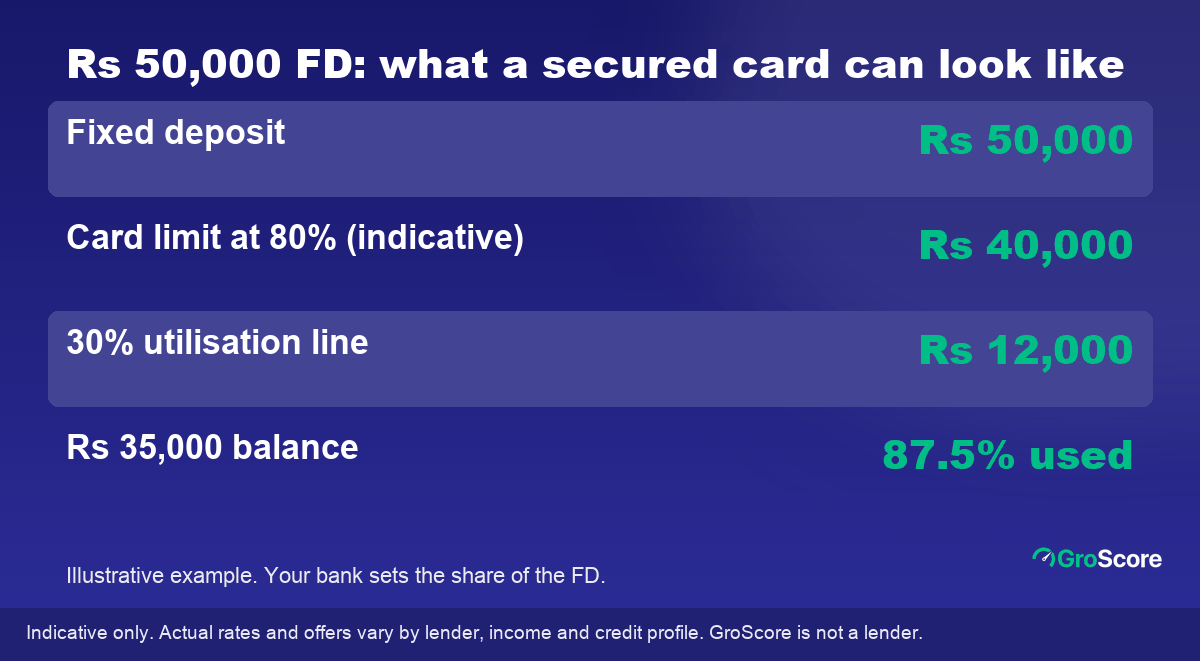
Illustrative example. Your bank sets the actual share of the FD.
Keeping card use under 30% of the limit is GroScore's guidance (groscore.in, retrieved 2026-10-05). On a Rs 40,000 limit, a Rs 35,000 balance is 87.5%. That reads as stretched, even on a secured card.
What would a credit coach flag?
An illustrative case. Karan, 27, has a 570 score after two missed personal loan EMIs in 2025. He wants a card. Arjun, GroScore's credit coach, reads his report and suggests this order:
- Check the report for errors first. One loan shows "overdue" after Karan says he closed it. If that's wrong, he can raise a dispute on the wrong entry with the bureau before applying anywhere.
- Clear the real overdue. The missed EMIs are accurate and will stay on record. Paying the arrears stops more DPD piling up.
- Open a small FD-backed card. Apply to one bank, not five. Each application is a hard enquiry.
- Use it for one bill and pay in full. Then let the months build.
Nobody can promise Karan a score or a date. GroScore says moving from 600 to 750 usually takes six to twelve months, and it depends on what's on the report (groscore.in). Results are not guaranteed.
When Can You Move to a Regular Card?
There's no fixed date. Banks look at your score, your payment record on the secured card, and your income. Our guide to the credit card CIBIL requirement covers what banks typically want for a regular card. Signs you may be ready:
- A clean payment record on the secured card for several months
- A score that has moved into the fair or good band
- Low utilisation, statement after statement
- No new missed payments elsewhere
Ask your bank whether it can move you to an unsecured card after a run of good use. When you do switch, keep the secured card open for a while if it's free, since closing it cuts your total limit.
Red Flags When Applying for a Credit Card for Low CIBIL Score
A secured card can be possible with a low score, because a deposit backs it. A card promised with no checks at all is a different thing. RBI-regulated banks check your identity and usually pull your report. Promises of "no CIBIL check, instant approval" are a myth for regulated issuers.
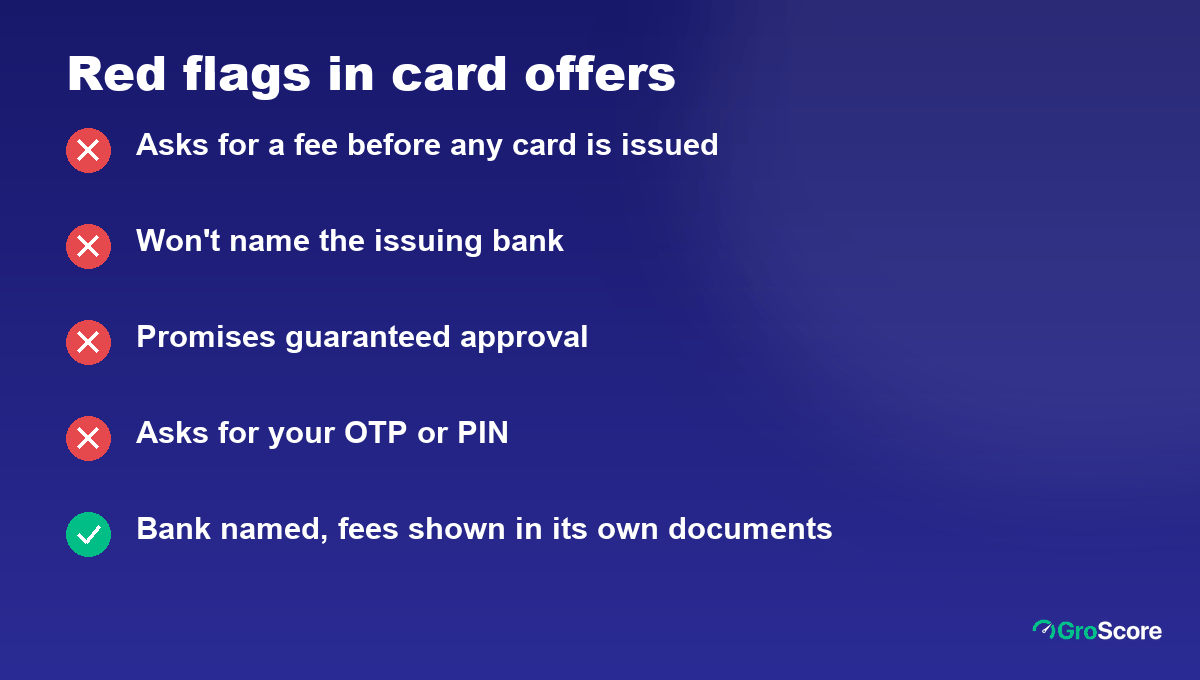
If an offer shows any of these, don't share your details.
Walk away if an offer:
- asks for a "processing fee" before any card is issued
- won't name the bank that issues the card
- promises guaranteed approval
- asks for your OTP, card PIN or net banking password
- comes from an agent who says they can "fix" your CIBIL score for a fee
Report a suspicious entity on the RBI's Sachet portal (sachet.rbi.org.in). For a complaint against a bank, go to the bank first. If it doesn't resolve the issue within 30 days, you can escalate to the RBI Ombudsman through the RBI's complaint portal (cms.rbi.org.in).
Safer alternatives exist too. You can become an add-on cardholder on a family member's card, though the main cardholder is liable for what you spend. Or you can borrow against your FD instead, if you need cash rather than a card.
Frequently Asked Questions
Can I get a credit card with a low CIBIL score?
Often yes, through a secured card backed by a fixed deposit. Regular unsecured cards are harder below 600. Each bank decides on its own criteria, so no card is guaranteed.
What is a secured credit card?
A secured credit card is issued against a fixed deposit you hold with the bank. The bank marks a lien on the FD and sets your limit as a share of it. You use and repay it like any credit card.
Does a secured credit card build my CIBIL score?
A secured card can help, because the bank reports it to the credit bureaus, including TransUnion CIBIL. On-time payments and low utilisation add positive history. Late payments hurt just as they would on a regular card.
How long before I can move to a regular card?
There's no fixed period. Banks usually want to see several months of clean payments and an improved score. GroScore says going from 600 to 750 usually takes six to twelve months, depending on your report.
Can I get a credit card with no CIBIL score?
Yes, a secured card is a common first card for people with no credit history. Because the FD backs the limit, the bank doesn't need a long record. Your first few statements then start your history.
The Bottom Line
A low score narrows your choices, but it doesn't close them. A secured card from an RBI-regulated bank, used for small bills and paid in full, is one of the steadiest ways to rebuild. Fix any report errors first, apply to one bank at a time, and ignore anyone who promises approval. To understand why your score dropped in the first place, read our guide to a low CIBIL score.

Disclaimer
This GroScore article is for general education and is not financial advice. GroScore provides credit scores and reports sourced from Equifax, an RBI-licensed credit bureau; scores differ between bureaus and change as lenders report new data. Credit score improvement depends on your individual credit behaviour and bureau reporting timelines, and results are not guaranteed. Loan and card decisions are made by lenders on their own criteria. GroScore is not a lender. Figures and rates shown are indicative.
