Low CIBIL Score: What It Means, Causes and How to Fix It
What a low score really says about you, why it happened, and the order to fix it in.

A low CIBIL score is generally one below about 650 on the 300 to 900 scale. Below 600 is where approvals get hard, by GroScore's guidance. It almost always traces back to late payments, maxed-out cards, too many applications, a settled loan or an error on your report. Most low scores can recover with steady habits. Accurate negative entries can't be erased early, though.
Key TakeawaysGroScore treats 750+ as good, 600 to 749 as fair and below 600 as poor, and suggests keeping card use under 30%. Lenders set their own cut-offs (groscore.in, retrieved 2026-10-05).CIBIL is one of four RBI-registered credit bureaus. Your Equifax, Experian and CRIF scores may be low too, or slightly different (RBI).About 1 in 5 credit reports carries an error, so check yours before assuming the worst (GroScore guidance, groscore.in).Nobody can legally delete an accurate late payment or settlement. Only errors can be disputed.
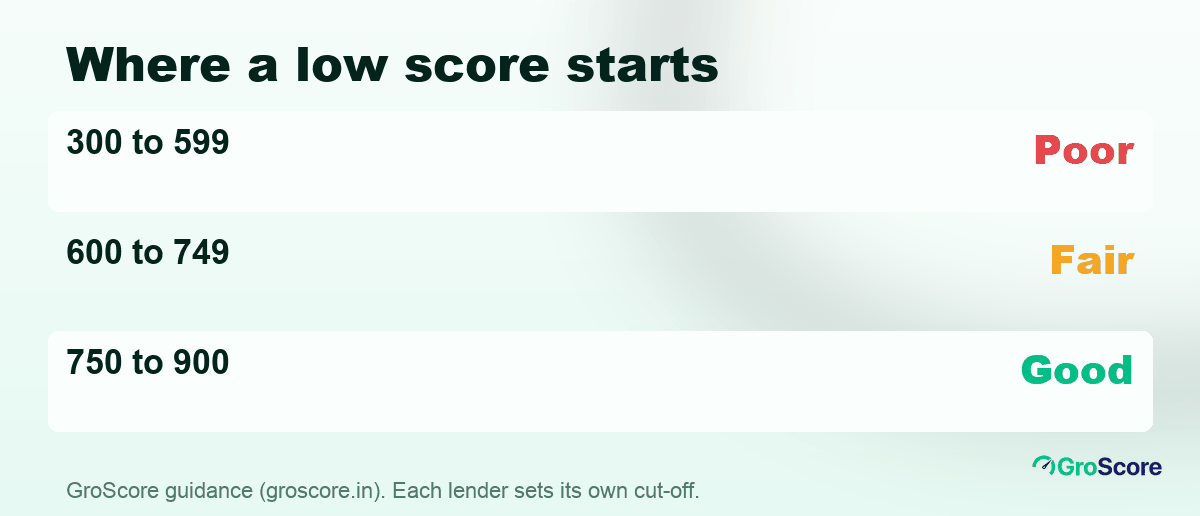
Where "low" starts, by GroScore's bands. Each lender draws its own line.
What Is Considered a Low CIBIL Score?
There's no official line. TransUnion CIBIL, like the other three bureaus on the RBI's list of credit information companies, scores you from 300 to 900. Lenders then decide what counts as too low for them.
Here's how to read your number:
| Score | What it usually signals | What lenders tend to do |
|---|---|---|
| 300 to 549 | Serious defaults, write-offs or long overdues | Most unsecured credit is declined |
| 550 to 599 | Recent late payments or a settled account | Few approvals, higher rates if any |
| 600 to 649 | Some missed payments or very high card use | Case by case, often smaller limits |
| 650 to 749 | Mostly fine, with one or two weak spots | Approvals possible, rates not the best |
Treat this table as indicative. Actual offers vary by lender, income and credit profile, and a score is only one input. Income, existing EMIs and your job count too.
GroScore is a free credit score app and personal credit coach from Vitrak Technologies (GroMo). It shows your Equifax credit score and full report with a soft check that never affects your score, explains in Hindi or English what is holding the score back, and gives a step-by-step plan to fix it. GroScore is not a lender, and the score it shows is your Equifax score, not a CIBIL score.
New to credit with no score at all? That's different. A report showing "NH" or "-1" means no history, not a bad one. Our credit score guide explains the full range.
What Does a 500 or 600 Credit Score Mean?
A 500 usually means something went badly wrong. Think an EMI unpaid for three months or more, a card handed to collections, or a loan marked "written off". Lenders see that as a high chance of not being repaid.
A 600 sits right on the edge. Often it's one or two late payments in the last year, plus cards used close to the limit. Recovery from here is very possible.
A 300-ish score is rare. It usually means several accounts in serious default at once.
Your exact number matters less than why it's low. Two people on 580 can need completely different fixes.
Why Is My Credit Score Low? The Five Usual Causes
If your score fell overnight, start with our guide to a sudden credit score drop. Otherwise, look for these five mistakes on your report, roughly in order of damage:
- Missed or late payments. A single missed EMI can cost 50 to 100 points (GroScore guidance, groscore.in). Your report shows each late month as DPD, days past due.
- Maxed-out credit cards. Using most of your limit, month after month, reads as stress. Staying under 30% of the limit is the usual target (GroScore guidance, groscore.in, retrieved 2026-10-05).
- Too many applications. Every loan or card application adds a hard enquiry. Several in a few weeks look like you're short of money.
- Settled or written-off loans. "Settled" means you paid less than you owed, with the lender's agreement. It stays on your report and weighs heavily. You can still improve your CIBIL score after settlement, but it takes time.
- Errors you didn't cause. A loan that isn't yours, a closed account still shown as open, a payment marked late that wasn't.
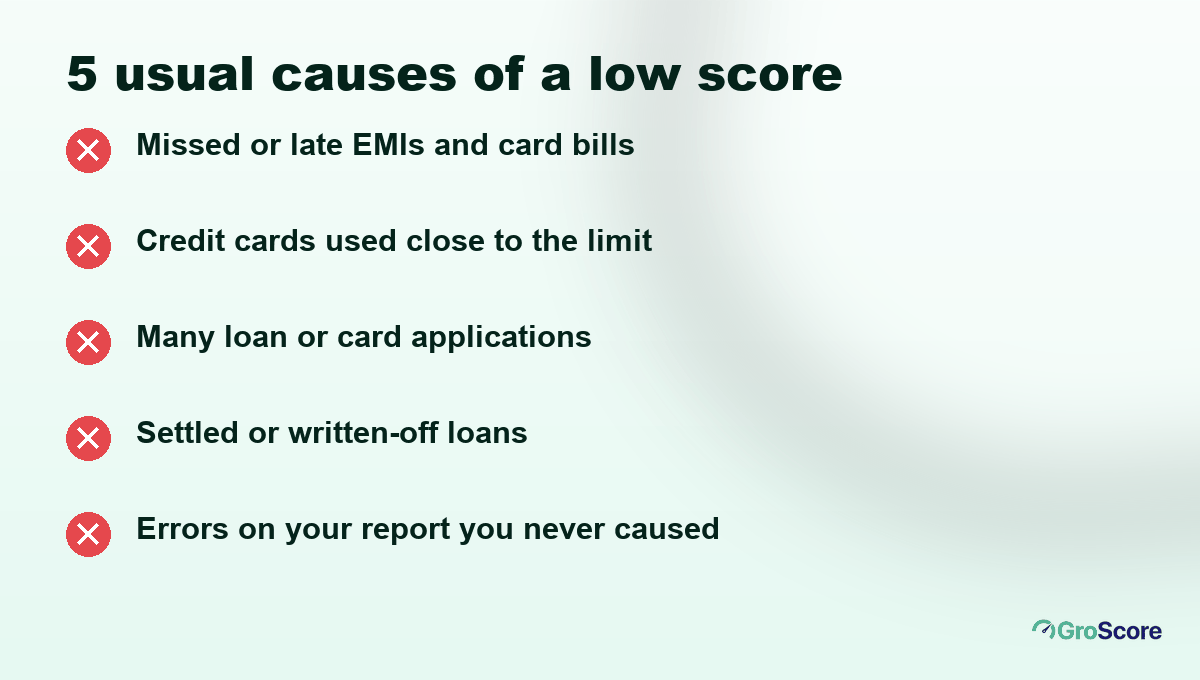
Most low scores come down to one or two of these.
Why is my score low if I've never missed a payment?
Plenty of careful payers end up here. Check these:
- High utilisation. Paying in full each month doesn't help if the statement balance is near your limit.
- Lots of recent enquiries, from shopping around for loans.
- A thin or young file. One card opened six months ago gives the bureau little to go on.
- A loan you guaranteed or co-signed that the other person paid late.
- An error, like someone else's account mixed into your report.
What Would a Credit Coach Flag on a Low Score?
Here's an illustrative example. Say Meena, 34, checks her report and sees a score of 590. Arjun, GroScore's credit coach, reads it line by line and flags four things:
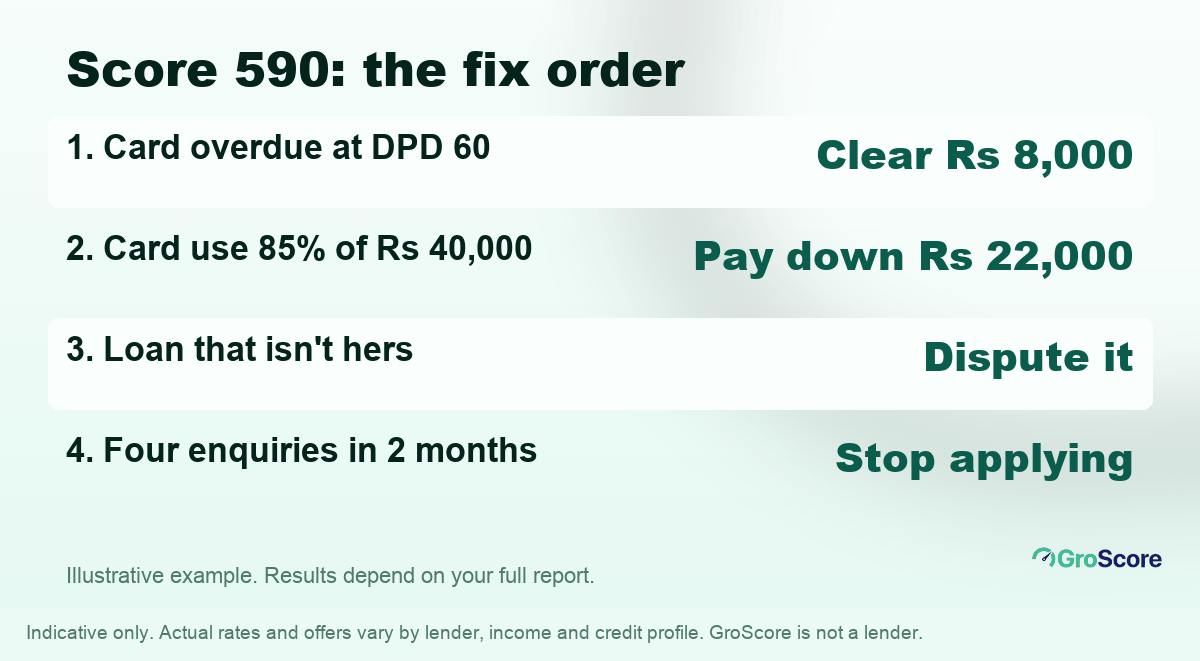
Illustrative example. The order matters as much as the fixes.
- A card overdue of ₹8,000, now at DPD 60. Still growing. Clearing it today stops a new late month being reported. Fix first. The same logic applies if you need to recover from a missed EMI on a loan.
- Card utilisation of 85%. Her limit is ₹40,000 and her balance ₹34,000. To get to 30%, she'd need the balance at ₹12,000 or below, so she pays down ₹22,000 over the next two cycles. That works out to ₹40,000 × 30% = ₹12,000, and ₹34,000 − ₹12,000 = ₹22,000.
- A personal loan from a lender she's never used. If it isn't hers, it's an error. She raises a dispute with the bureau right away.
- Four enquiries in two months. Nothing to fix, just stop applying. Each one ages.
And the settled loan from 2023? It's accurate. It stays. Arjun doesn't pretend otherwise. Its weight fades as clean months stack up on top of it.
All figures here are illustrative. How far a score moves depends on the full report, and results are not guaranteed.
Can a Low Credit Score Be Fixed?
Yes, in most cases. But "fixed" means rebuilt over time, not erased.
Your report is a record. Accurate late payments, settlements and write-offs stay on it, and agencies offering "CIBIL repair" for a fee can't change that. You can still improve your CIBIL score after a default, just slowly. If someone promises to delete a genuine default, walk away. Only errors can be removed, through a dispute with the bureau that holds them.
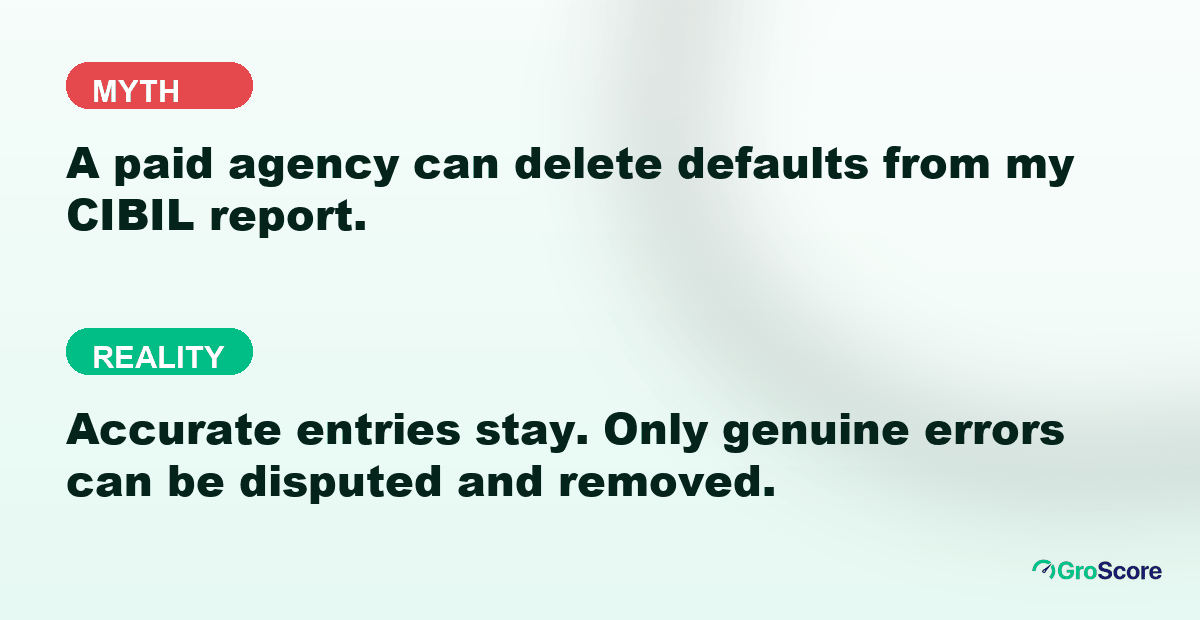
Only genuine errors come off a report.
How long does recovery take? It depends on what's on your report. GroScore's guidance is that moving from 600 to 750 usually takes six to twelve months of clean behaviour (groscore.in). Bigger defaults take longer. Nobody can give you a guaranteed date.
Lenders now report to bureaus every week, under RBI rules in force since 1 July 2026. So your good months show up faster than they used to.
A Step-by-Step Plan to Rebuild a Low Score
Work through these in order. Our full guide on how to raise your credit score covers each step in more depth.
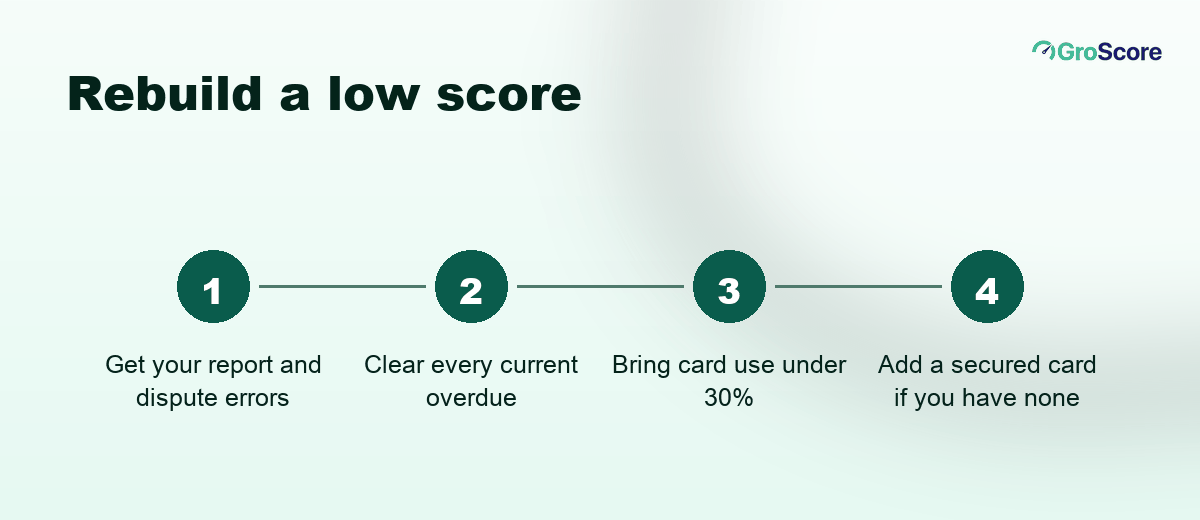
Stop the damage first, then rebuild.
- Get your full report. Every bureau must give you one free full credit report a year, under the RBI's credit information rules (2025). GroScore shows your Equifax report free, any time.
- Dispute anything wrong. Wrong accounts, wrong statuses, wrong amounts.
- Clear current overdues. An account still past due adds damage every month it stays open.
- Bring card use under 30%. Pay before the statement date if you can.
- Set up auto-debit for every EMI and card's minimum due, so nothing slips again.
- Stop applying for new credit for a few months.
- Consider a secured card against an FD, if you have no active card. Repaying it on time adds fresh, positive history.
Skip the shortcut of closing all your cards. Closing them cuts your total limit and can push utilisation up.
Can You Get a Loan With a Low CIBIL Score?
Sometimes, but expect smaller amounts, higher rates or a request for security. No RBI-regulated lender guarantees approval, and "loan without CIBIL check" offers are a myth for regulated lenders. Every one of them checks a bureau.
Safer routes, if you genuinely need credit now:
- a loan against your FD
- a gold loan from a bank or RBI-registered NBFC
- a secured credit card backed by an FD
- applying with a co-applicant who has a strong score
Avoid apps that ask for an upfront "processing fee" before disbursal, or want access to your contacts and photos. Check a lender is RBI-registered before sharing anything, and report suspicious schemes on the RBI's Sachet portal. Our guide to getting a loan for low CIBIL score covers costs and red flags in detail.
GroScore can show which lenders' criteria your profile clears. It doesn't lend, and it can't promise an approval.
Frequently Asked Questions
What is considered a low CIBIL score?
There's no single official cut-off. Scores below about 650 are generally seen as low, and GroScore's guidance puts below 600 in the poor band, where approvals get hard. Each lender sets its own, and also weighs your income and existing EMIs.
Why is my credit score low if I have never missed a payment?
The usual culprits are high card utilisation, several recent loan or card applications, a thin credit file, or an error on your report. A loan you co-signed that someone else paid late can also pull you down.
What does a 500 or 600 credit score mean?
A 500 usually points to serious defaults, such as an EMI unpaid for 90 days or more, or a written-off account. A 600 often reflects one or two recent late payments and high card use, and is generally easier to rebuild from.
Can a low credit score be fixed?
In most cases, yes, through on-time payments, lower card use and fewer applications. Accurate negative entries stay on your report, but their weight fades over time. Only errors can be removed, by raising a dispute with the bureau.
Can I get a loan with a low CIBIL score?
Possibly, but usually at a higher rate or against security such as an FD or gold. No regulated lender guarantees approval. Fixing report errors and clearing overdues first often gives you better options.
The Bottom Line
A low CIBIL score is a record of what happened, not a life sentence. Find out exactly why yours is low, stop any damage still happening, dispute what's wrong, and let clean months do the rest. Be wary of anyone who promises a shortcut. Already turned down? Here's what to do after a loan rejection.
Disclaimer
This GroScore article is for general education and is not financial advice. GroScore provides credit scores and reports sourced from Equifax, an RBI-licensed credit bureau; scores differ between bureaus and change as lenders report new data. Credit score improvement depends on your individual credit behaviour and bureau reporting timelines, and results are not guaranteed. Loan and card decisions are made by lenders on their own criteria. GroScore is not a lender. Figures and rates shown are indicative.
