Loan Rejected Due to Low CIBIL Score? What to Do Next
A rejection is information, not a verdict. Here's how to read it, and what to do in the next 90 days.

Loan rejected due to low CIBIL score? Don't apply again straight away. Ask the lender for the reason in writing, get your full credit report, fix or dispute what's dragging the score down, then wait before you reapply. The rejection itself doesn't lower your score. A burst of new applications does.
Key TakeawaysBanks and lenders are expected to tell you the main reason for rejecting a loan or credit card application in writing (RBI Fair Practices Code for Lenders).Credit bureaus don't report that a loan was declined. The hard enquiry from your application does show (RBI).GroScore treats 750+ as good and below 600 as the zone where approvals get hard. Every lender sets its own cut-off (groscore.in).About 1 in 5 credit reports carries an error, GroScore says. Check yours before you blame yourself (groscore.in).
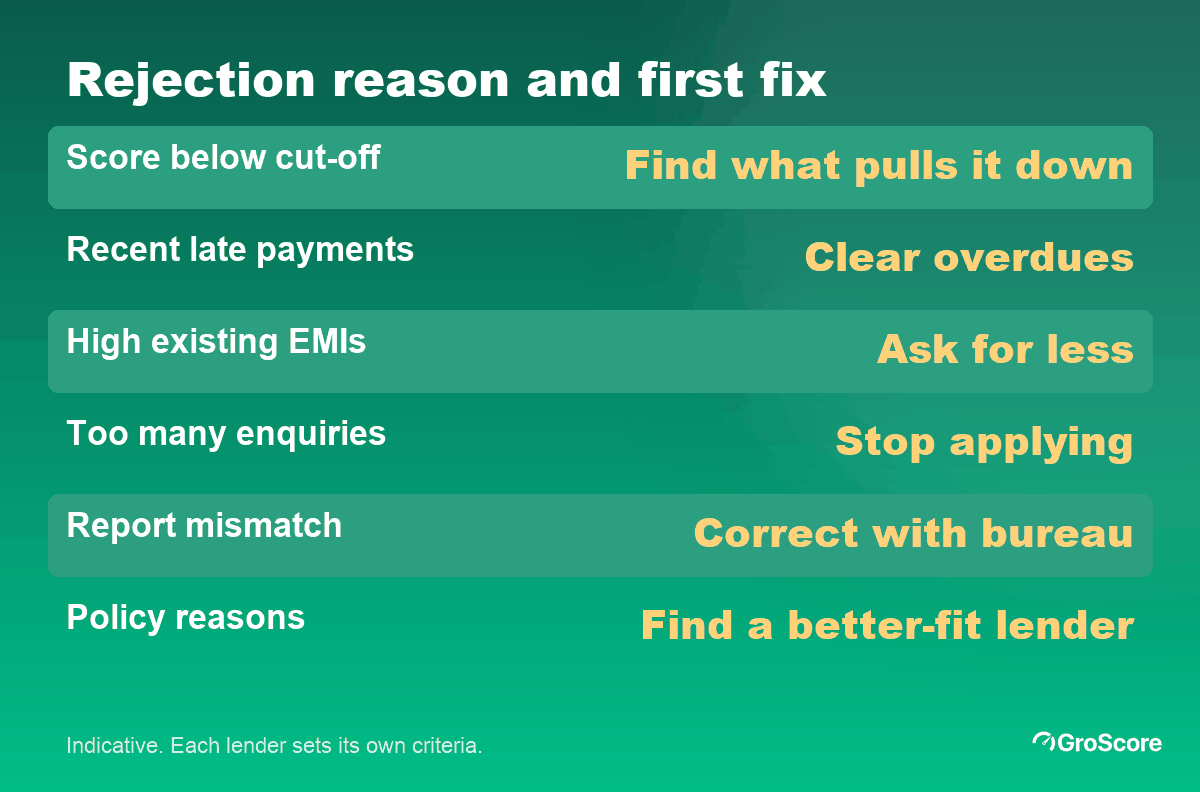
Every rejection reason points to a different fix.
GroScore is a free credit score app and personal credit coach from Vitrak Technologies (GroMo). It shows your Equifax credit score and full report with a soft check that never affects your score. GroScore is not a lender and doesn't approve or disburse loans. It can show which lenders' criteria your profile clears, but it can't promise an approval. The score it shows is your Equifax score, not a CIBIL score.
Step One: Ask the Lender Why You Were Rejected
Most people skip this, and it's the most useful thing you can do. A "low CIBIL score" is often the label on the message, not the whole story.
Under the RBI's Fair Practices Code, banks and financial institutions should convey the main reasons for rejecting a loan application in writing. That applies to all loan sizes, and to credit card applications too (RBI). So ask. Email the lender's customer care or grievance officer and request the reason for your rejection.
You'll usually get one of these:
| What the lender says | What it usually means | What to fix first |
|---|---|---|
| Score below our cut-off | Your bureau score missed their internal line | Find the entries pulling it down |
| Recent late payments | A DPD (days past due) in the last few months | Clear overdues, then pay on time |
| High existing obligations | Your EMIs already take a big share of income | Lower the amount or repay a loan |
| Too many recent enquiries | Several applications in a short time | Stop applying for a few months |
| Credit report mismatch | Name, PAN or an account doesn't match | Correct it with the bureau |
| Policy reasons | Income, job type or location outside their criteria | Look for a lender whose criteria fit |
The table is indicative. Actual offers vary by lender, income and credit profile. For how cut-offs differ between home, car and personal loans, see the minimum score for every loan type.
Does a Loan Rejection Affect Your Credit Score?
The rejection itself doesn't. The application can, a little.
Credit bureaus are told not to report that a loan was declined. The RBI's credit information rules (2025) says such information could be used by one lender as a ground to reject you again. So no "rejected" stamp sits on your report.
The hard enquiry does sit there. It's the record that a lender pulled your report because you applied. Each one can lower your score a little for a while. One enquiry is no crisis. Five in three weeks look like you're short of money, and every new lender sees all five. Our guide to the CIBIL enquiry explains how hard and soft checks differ.
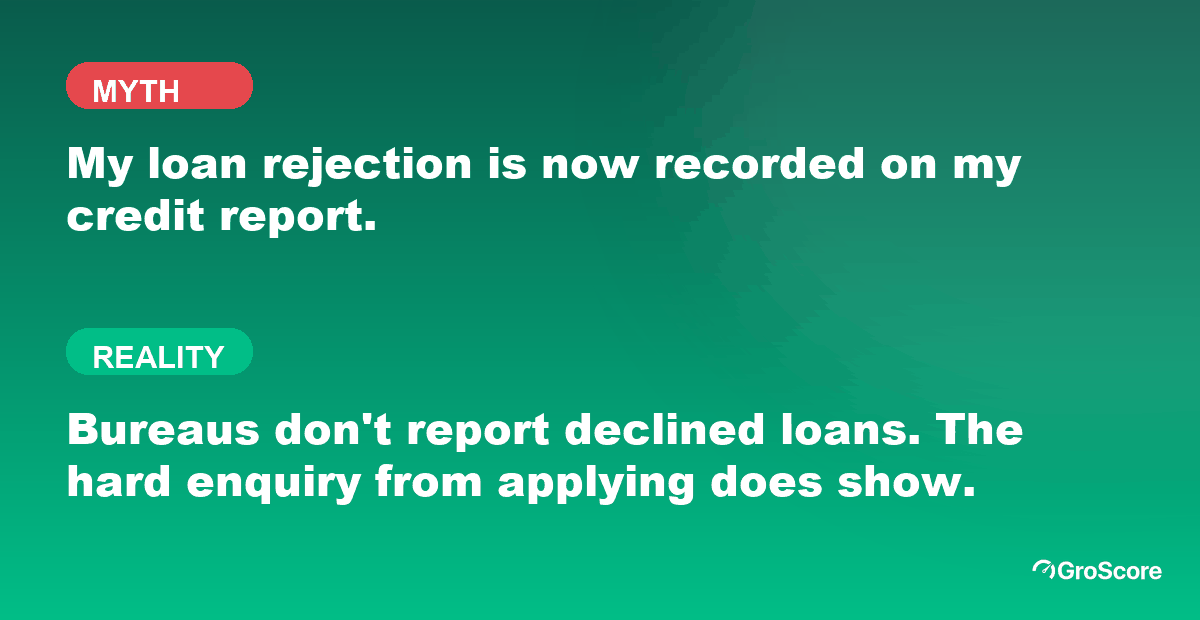
The enquiry stays. The rejection doesn't.
The worst response to a rejection is also the most common one: applying to five more lenders the same week, hoping one says yes.
Is Every Loan Rejected Due to Low CIBIL Score Really About the Score?
Often it isn't. Lenders weigh several things together. Your score is one input. Your income, your job, your existing EMIs and how much you're asking for count too. A 760 doesn't guarantee approval, and a 680 doesn't mean rejection.
The one people overlook most is FOIR, the fixed obligation to income ratio. It's the share of your monthly income already going to EMIs. Each lender sets its own FOIR limit, and a big new EMI can push you over it even with a fair score.
Why was my loan rejected even with a good score? Usually for one of these reasons:
- Your existing EMIs plus the new one are too high for your income.
- Your job, employer or income type falls outside the lender's policy.
- Several recent applications made you look credit hungry.
- Your report has an error, such as a loan that isn't yours or a closed account shown open.
- Your application details don't match your report.
If the lender's reason is the score itself, our page on why your credit score is low walks through the five usual causes and the order to fix them in.
What Would a Credit Coach Flag After a Rejection?
Here's an illustrative example, for instance after a personal loan rejection. Sneha, 31, earns Rs 45,000 a month and pays a Rs 14,000 EMI on an existing loan. She applies for a Rs 3 lakh personal loan over three years and is rejected. Her Equifax score is 668. Arjun, GroScore's credit coach, reads her report and flags three things, in order:
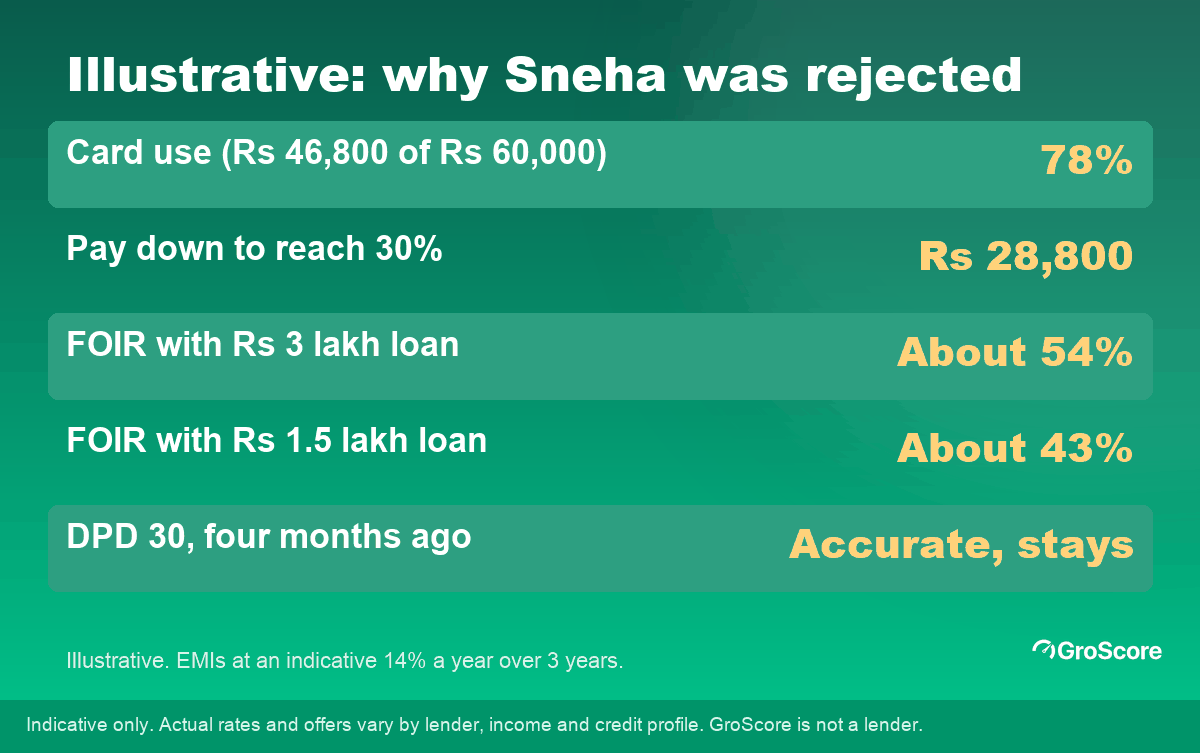
Illustrative example. The score was one of three problems.
- Card utilisation of 78%. Her card limit is Rs 60,000 and her balance Rs 46,800. The 30% target works out to Rs 18,000, so she pays down Rs 28,800 before the next two statement dates.
- FOIR of about 54%. At an indicative 14% a year, a Rs 3 lakh, three-year loan has an EMI of about Rs 10,250. Add her existing Rs 14,000 and that's Rs 24,250 of a Rs 45,000 income. Asking for Rs 1.5 lakh instead (an EMI of about Rs 5,130) brings it to roughly 43%.
- One DPD of 30 on her card, four months ago. She did pay late. It's accurate, so it stays. Its weight fades with every on-time month.
No errors on this report, so there's nothing to dispute. Her fix is all in her control: lower card use, a smaller ask and no new applications for now. All figures are illustrative. Actual offers vary by lender, income and credit profile, and results are not guaranteed.
A 90-Day Plan Before You Reapply
There's no official waiting period. A few months of clean behaviour, though, gives your report something new to show. Here's a plan you can follow.
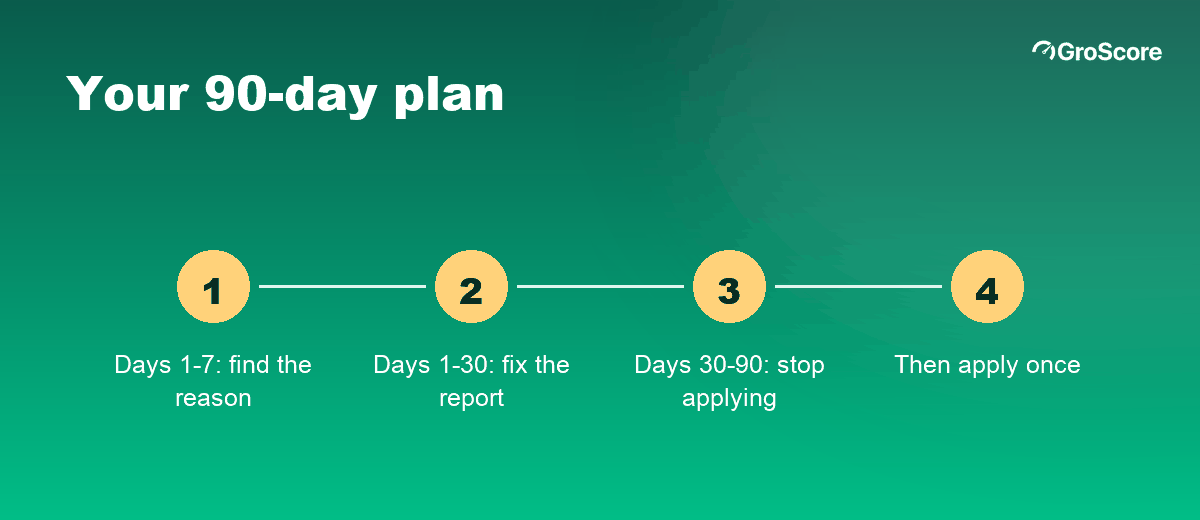
Fix first. Apply once.
Days 1 to 7: find the reason. Get the lender's written reason. Pull your full report. Each bureau must give you one free full credit report a year, and CIBIL is one of four bureaus on the RBI's list of credit information companies, along with Equifax, Experian and CRIF High Mark. Lenders may check any of them, so look at more than one. Our guide on how to read your credit report shows what each section means.
Days 1 to 30: fix what's wrong. Dispute any error with the bureau that shows it. Clear any overdue amount, because an account still past due adds damage every month. Pay card balances down before the statement date.
Days 30 to 90: let clean months build. Pay every EMI and card bill on time, ideally by auto-debit. Don't apply for anything new. Each month of on-time payments now reaches the bureaus faster, since lenders report weekly under RBI rules in force from 1 July 2026.
After about 90 days: check, then apply once. Look at your report again. If the problem was a default rather than a few late payments, the road is longer; see how to improve your CIBIL score after a default. Otherwise, pick the one lender whose criteria fit, and ask for an amount your income supports.
How far your score moves in 90 days depends on what's on your report. Nobody can promise a number.
Can I Find Out Why My Credit Card Was Rejected?
Yes, you can ask the same way. The Fair Practices Code covers credit card applications too, so ask the issuer for the reason in writing.
Card rejections often come down to a thin file, low income for that card, or high use on cards you already hold. If you have no card yet, a secured card backed by a fixed deposit is easier to get, because your FD is the security. Our guide to a credit card for low CIBIL score compares secured and FD cards.
Safer Options if You Need Money Now
Sometimes you can't wait 90 days. If so, look at credit that's secured, so the lender relies less on your score:
- You can borrow against your fixed deposit.
- You can take a gold loan from a bank or RBI-registered NBFC.
- You can ask for a smaller amount, or apply with a co-applicant who has a stronger profile.
Avoid "loan without CIBIL check" offers. No RBI-regulated lender skips the bureau check, and no lender can guarantee approval. Walk away from any app that asks for an upfront fee before disbursal or wants access to your contacts and photos. Check a lender on the RBI's list of NBFCs before you share anything, and report suspicious schemes on the RBI's Sachet portal. Our guide to a loan for low CIBIL score covers the real costs of each option.
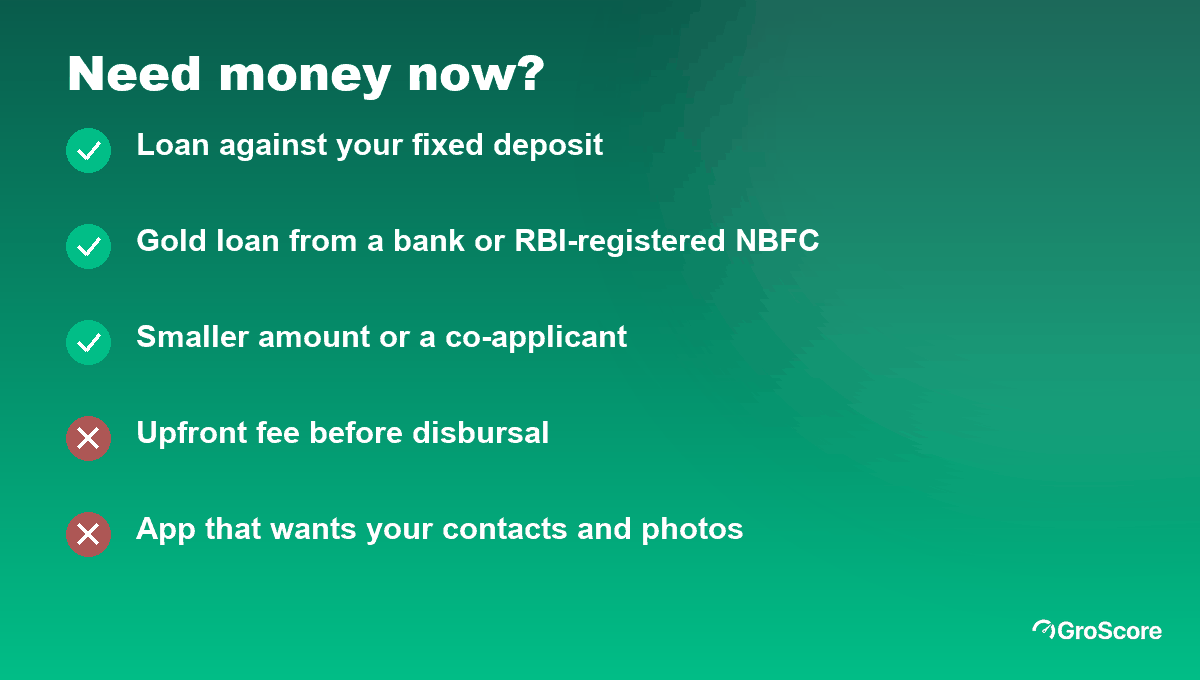
Secured options rely less on your score. Upfront fees are a red flag.
Frequently Asked Questions
Does a loan rejection reduce my CIBIL score?
No. Credit bureaus don't record that a loan was declined. The hard enquiry from your application does appear, and it can lower your score a little for a while. Several applications close together do more damage than the rejection ever could.
How long should I wait before reapplying after a rejection?
There's no fixed rule. Use the time to fix the reason you were rejected, whether that's high card use, an error or an EMI load that's too heavy. A few months of on-time payments, with no new applications, gives your report something better to show. Then apply once, to a lender whose criteria fit.
Why was my loan rejected even with a good score?
Lenders look beyond the score. High existing EMIs compared with your income, an employer or income type outside their policy, several recent applications, or a mismatch on your report can all lead to a rejection. Ask the lender for the main reason in writing.
Can I find out why my credit card was rejected?
Yes. The RBI's Fair Practices Code expects lenders to convey the main reasons for rejecting a loan or credit card application in writing. Contact the issuer's customer care or grievance officer and ask.
The Bottom Line
A rejection hurts, but it hands you useful information. Ask for the reason, read your full report, fix what's wrong, and give clean months time to show. When you apply again, apply once, for an amount your income supports. Ads for instant loan approval don't change that: a fast decision still rests on the same report.
Disclaimer
This GroScore article is for general education and is not financial advice. GroScore provides credit scores and reports sourced from Equifax, an RBI-licensed credit bureau; scores differ between bureaus and change as lenders report new data. Credit score improvement depends on your individual credit behaviour and bureau reporting timelines, and results are not guaranteed. Loan and card decisions are made by lenders on their own criteria. GroScore is not a lender. Figures and rates shown are indicative.
