CIBIL Score for Loan: Minimum Score for Every Loan Type
The score lenders look for differs by loan type. Here's the indicative range for each, and what to do if you fall short.

There's no single CIBIL score for loan approval in India. As a rough guide, most banks want 750 or above for unsecured loans like personal loans and credit cards, while home and car loans often start around 700. Gold loans and loans against an FD lean far less on the score. Every lender sets its own cut-off, so treat these numbers as indicative.
Key TakeawaysScores run from 300 to 900. GroScore's guidance treats 750+ as good and below 600 as the zone where approvals get hard (groscore.in).Unsecured loans need the highest scores. Secured loans, backed by a house, car, gold or FD, are more forgiving.Keeping card use under 30% of your limit is one of the quickest fixes before you apply (groscore.in).Lenders also check income, existing EMIs, job stability and recent applications. A score alone never decides a loan.No RBI-regulated lender skips the bureau check or promises approval. Ads that say otherwise are a myth, and often a scam.
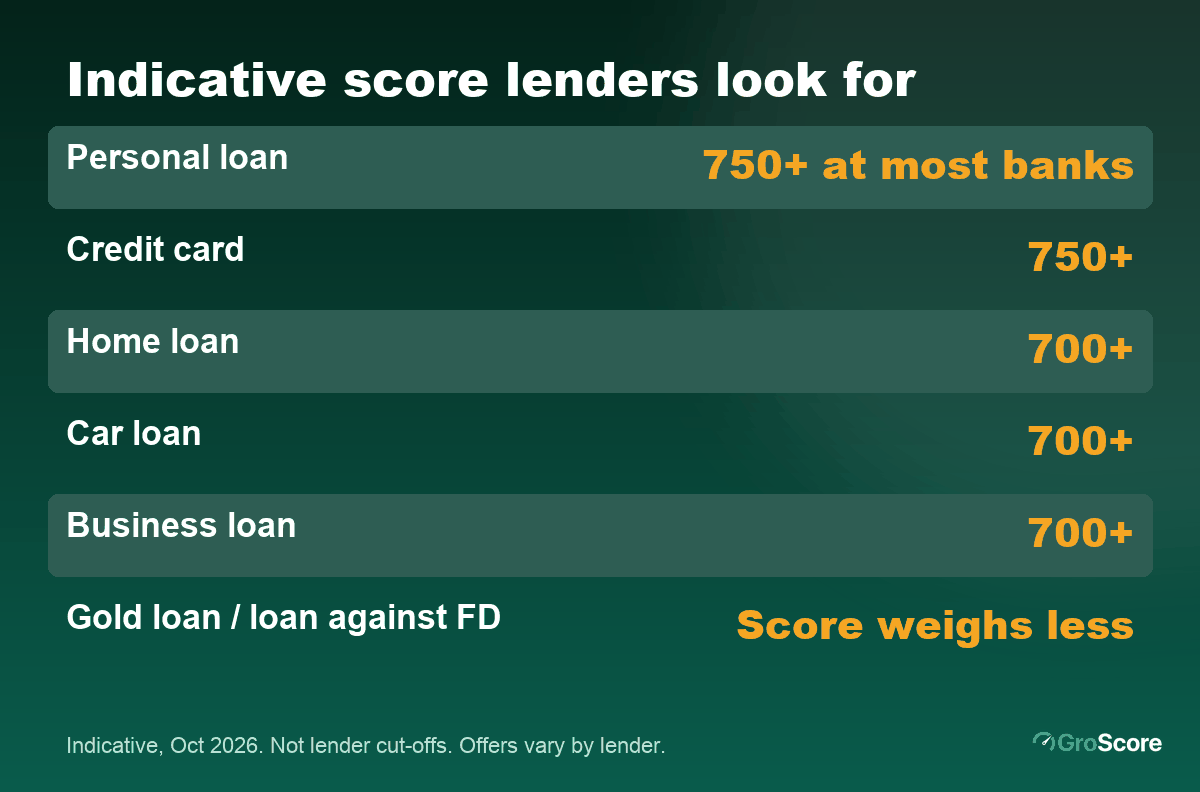
Indicative ranges only. Each lender publishes, or keeps, its own cut-off.
Before You Read the Numbers: What GroScore Is and Isn't
A quick, honest note first, because this page talks about loans. GroScore is a free credit score app and personal credit coach from Vitrak Technologies (GroMo). It shows your Equifax credit score and full report with a soft check that never affects your score, explains in Hindi or English what is holding the score back, and gives a step-by-step plan to fix it. GroScore is not a lender. It never approves, rejects or disburses a loan.
What about the word "CIBIL"? TransUnion CIBIL is one of four credit bureaus registered with the RBI. The others are Equifax, Experian and CRIF High Mark, as listed on the RBI's list of credit information companies. People say "CIBIL score" the way they say "Xerox". A lender may pull any of the four. Your scores across bureaus are usually close but rarely identical, and the number GroScore shows is your Equifax score, not a CIBIL score.
If you're new to all this, start with what a credit score is and come back.
What Is the Minimum CIBIL Score for Loan Approval?
Short version: the minimum credit score for loan approval depends on what's backing the loan.
When a loan is unsecured, the lender has nothing to sell if you stop paying. Your repayment record is its only comfort, so it asks for a higher score. When a loan is secured, there's collateral: the house, the car, the gold, the fixed deposit. The score still matters. It just carries less weight.
Here's the indicative picture, as of October 2026:
| Loan type | Indicative score lenders look for | Why |
|---|---|---|
| Personal loan | 750+ at most banks; some NBFCs consider lower | Unsecured, so the score carries the most weight |
| Credit card | 750+ for most cards | Unsecured revolving credit |
| Home loan | 700+, with 750+ for the better rates | Secured by the property, long tenure |
| Car loan | 700+ | Secured by the vehicle |
| Business loan | 700+, plus business vintage and ITRs | Often unsecured; the owner's score is checked too |
| Gold loan | No fixed minimum at many lenders | The gold itself is the security |
| Loan against FD | Score matters little | Your own deposit is the security |
Indicative, compiled from GroScore's guidance bands (groscore.in), October 2026. These aren't lender-published cut-offs. Actual offers vary by lender, income and credit profile.
Two things this table can't tell you. First, banks are usually stricter than NBFCs (non-banking financial companies), which often accept lower scores and charge more for it. Second, a lender may approve a 700 and reject a 780 if the 780 already pays half their salary in EMIs.
For the band-by-band view, see what counts as a good credit score.
Which Loan Can You Get at Your Score?
Find your band below. Then read what to do next, because a loan on CIBIL score alone is rarely the whole story.
750 to 900. This is the best CIBIL score for loan shopping, and loans for good credit score holders come with the most choice. Expect most loan types to be open to you, subject to income. Use the score as leverage: ask your bank for its best rate, and compare two or three offers before you accept.
700 to 749. Home, car and gold loans are usually workable. Personal loans and premium cards may come with higher rates or smaller amounts. If the loan can wait a couple of months, paying card balances down first can help.
650 to 699. Secured loans are your realistic route. Some NBFCs may consider a personal loan here, at a higher rate. Read your report before you apply anywhere, because one fixable item (an error, a high card balance) could be holding you back.
600 to 649. Banks will usually say no to unsecured credit. A gold loan, a loan against an FD or adding a co-applicant with a strong score are the safer options.
Below 600. Approvals get hard (groscore.in). Fix the report first. If the need is urgent, our guide to a personal loan with a low CIBIL score covers the safe options and the scams that target people in this band.
No score at all? A "-1" or "NH" means no history, not a bad history. Some lenders do lend to new-to-credit borrowers, usually smaller amounts first.
What Do Lenders Check Besides Your Score?
Your credit score for loan approval gets you through the first filter. Then the real assessment starts.
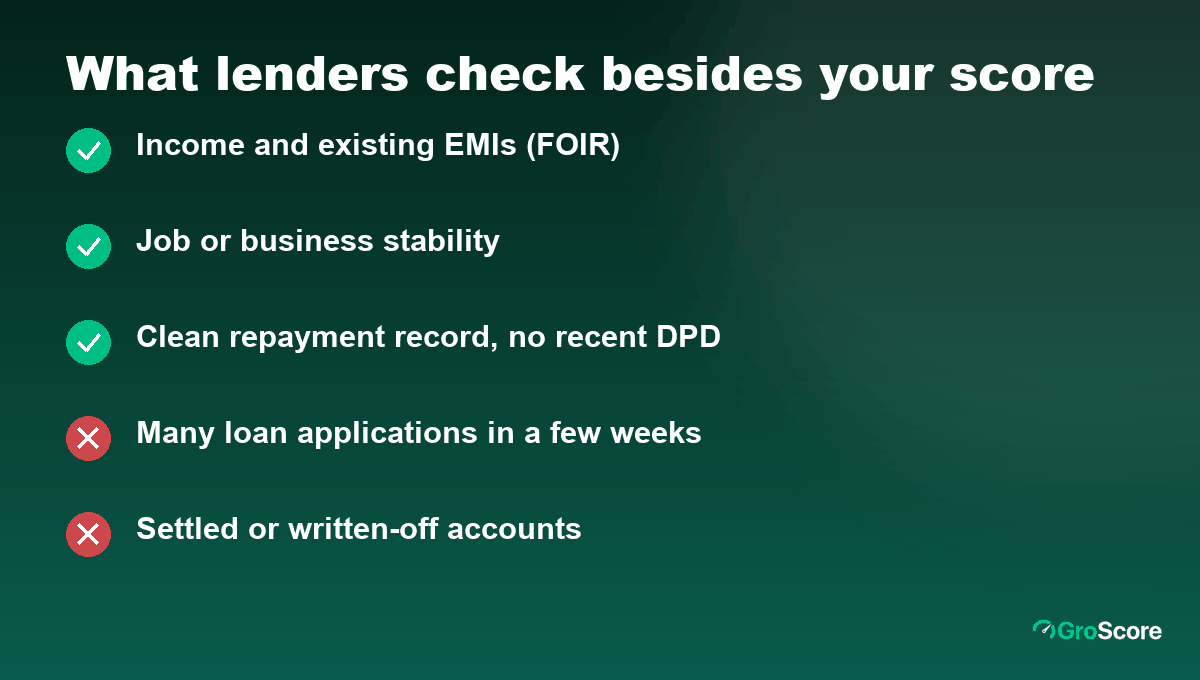
The score opens the door. These decide the amount and the rate.
Income and FOIR. FOIR, or fixed obligation to income ratio, is the share of your monthly income already going to EMIs. If you earn ₹60,000 and pay ₹24,000 in EMIs, your FOIR is 40%. Each lender sets its own FOIR limit, and a high one can sink an application even with a strong score.
Job and income stability. Salaried with a listed company? Self-employed with two years of ITRs? Each lender has its own preferences.
Recent enquiries. Every loan application adds a hard enquiry to your report. Five in a month reads as desperation. Our explainer on hard vs soft enquiries shows why.
What's in the report, not just the score. A written-off or settled account, even an old one, can sink an application that the score alone would pass. So can a DPD (days past due) entry from last quarter.
Does a Higher Score Get You a Lower Interest Rate?
Usually, yes. Most lenders use risk-based pricing: the safer you look, the less they charge. A better score won't guarantee a particular rate, but it moves you into a better pricing bracket.
Here's what that can be worth. For example, take an illustrative ₹8 lakh car loan over five years.
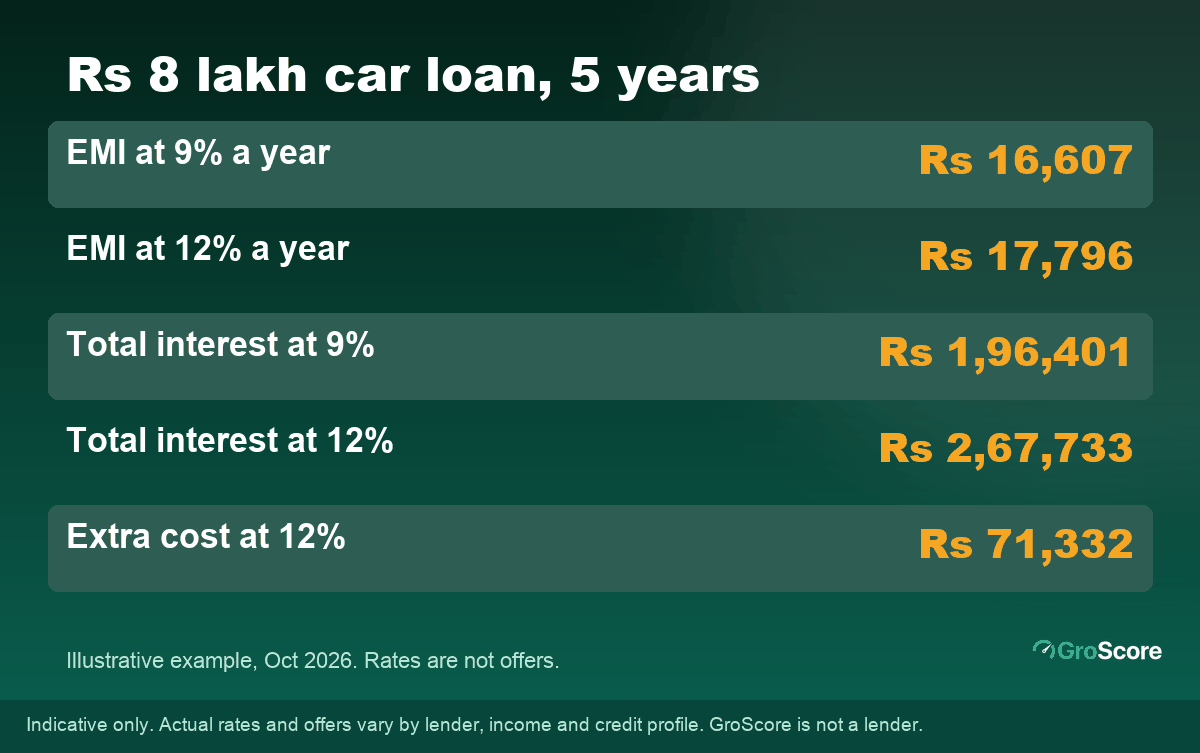
Illustrative example: same car, same tenure, a different rate.
At 9% a year, the EMI works out to ₹16,607 and total interest to ₹1,96,401. At 12%, the EMI is ₹17,796 and interest climbs to ₹2,67,733. That's ₹71,332 extra for the same car. These figures are illustrative, worked out with the standard EMI formula as of October 2026. They aren't offers. Actual offers vary by lender, income and credit profile. Whatever rate you're offered, RBI rules require the lender to show the all-in annual percentage rate (APR) in a Key Fact Statement before you sign (RBI).
Three percentage points. Seventy thousand rupees. Personal loans show this most clearly, as our guide to the CIBIL score for a personal loan explains.
What Would a Credit Coach Flag Before You Apply?
Here's an illustrative example, built on the kind of report GroScore reads every day; GroScore says it has analysed 1 lakh+ credit reports (groscore.in, retrieved 2026-10-05). Say Meera, 31, plans to apply for a car loan next month. Her Equifax score is 702. Arjun, GroScore's credit coach, reads her report and flags three things, in this order:
- A credit card at 78% utilisation (an indicative figure for this example). Paying it down before the statement date is the quickest win on her report.
- Three loan enquiries in six weeks, from pre-approved offers she clicked through. Nothing to fix now. The advice is to stop applying until the car loan is done.
- An old consumer-durable loan showing as "open" though she closed it. If the closure is real, that's an error she can dispute with the bureau, using her NOC (no objection certificate) from the lender. Our guide to loan closure and your credit score explains how a closed loan should look.
Why the card first? GroScore's guidance is to keep card use under 30% of the limit (groscore.in, retrieved 2026-10-05), and a card balance updates with every statement. Of the three items, it's the one Meera controls this month.
No coach can guarantee approval. What a review does is stop Meera walking into a lender's office with fixable problems on her file. Accurate late payments can't be removed early by anyone; only genuine errors can be corrected.
Is a Loan Without a CIBIL Check Real?
No, not from an RBI-regulated lender. Banks and NBFCs check at least one bureau report before they lend. Gold loans and FD loans may weigh it lightly, but the check still happens.
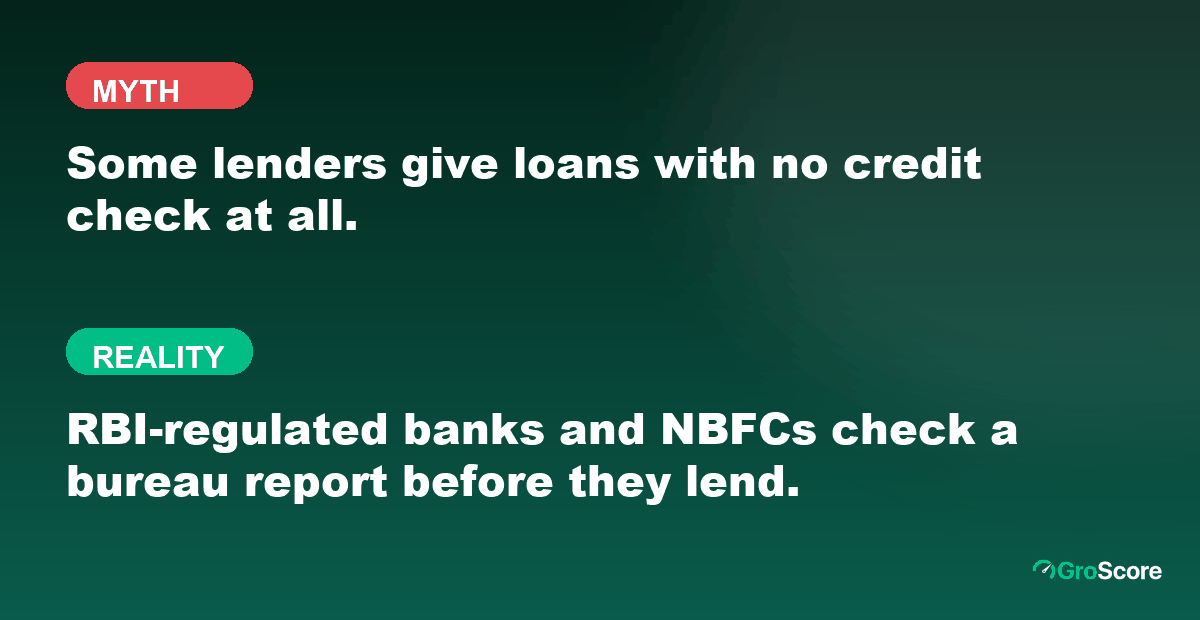
If someone promises a loan with no check, ask who is really lending.
Ads promising "no CIBIL check" or approval for everyone are a myth, and often a trap. Before you share PAN or Aadhaar with anyone:
- Check the lender is a bank or appears on the RBI's list of registered NBFCs.
- For an app, check that it appears in the RBI's directory of digital lending apps, on the RBI website since July 2025 (RBI).
Never pay a "processing" or "insurance" fee upfront to unlock a loan, however small. RBI-regulated lenders disclose every charge in a Key Fact Statement before you sign, and a processing fee is often deducted from the amount disbursed. It is not collected in advance to a personal UPI ID.
To report an unauthorised lender, use the RBI's Sachet portal. To complain about a regulated lender that hasn't resolved your issue, go to the RBI's Complaint Management System (cms.rbi.org.in).
How to Check Your Loan Eligibility Before You Apply
A rejected application costs you a hard enquiry and changes nothing. So do your own loan CIBIL score check first, then the homework.
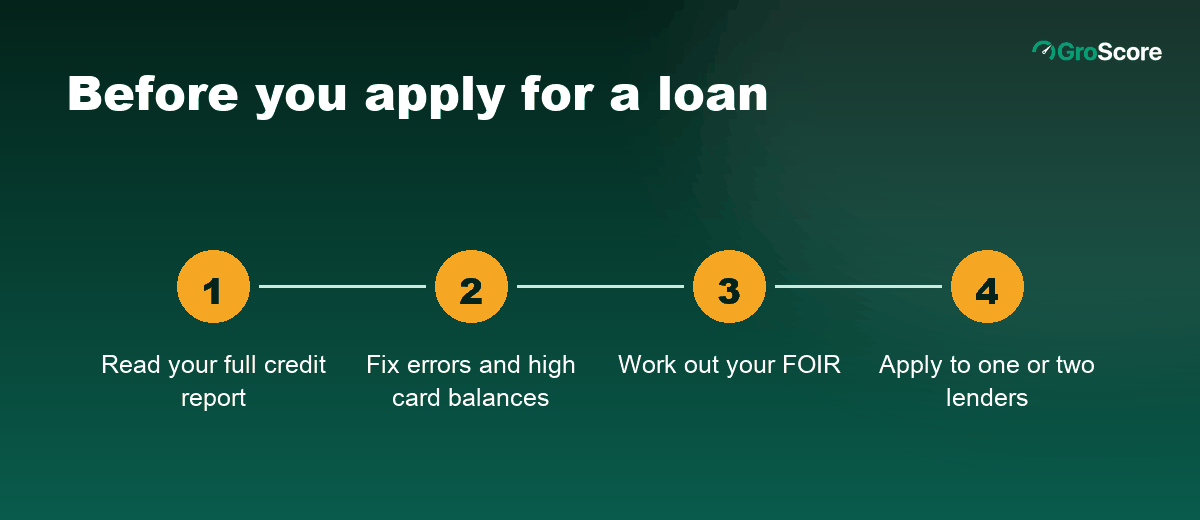
Check first, apply once.
- Check your report, not just the score. Look at every account, every DPD column and every enquiry. Our guide to reading your credit report explains each section.
- Fix what you can. Pay card balances down and dispute genuine errors.
- Work out your FOIR. Add the new EMI to your existing ones and divide by monthly income.
- Apply to one or two lenders, not ten.
Timing helps more than it used to. Lenders have reported to bureaus every week since July 2026 (RBI), so a card paid down below 30% of its limit can reach your report within weeks rather than a month or more.
GroScore can help with step one. It shows your Equifax report free, and shows which lenders' criteria your profile clears across 100+ loans and cards from 60+ banks and NBFCs (groscore.in). The decision stays with the lender.
Frequently Asked Questions
What is the minimum CIBIL score for a loan?
There's no single minimum. For unsecured loans like personal loans, many banks look for 750 or above, and some NBFCs consider lower scores at higher rates. Secured loans are more flexible. Treat every figure as indicative, because each lender sets its own cut-off.
Which loan can I get with a 650 CIBIL score?
At 650, secured loans are usually the realistic route: a gold loan, a loan against an FD, or a home or car loan with a strong co-applicant. Some NBFCs may offer a personal loan, but expect a higher rate and a smaller amount. Read your report first, since one error or a maxed-out card could be costing you points.
Does a higher CIBIL score get me a lower interest rate?
Usually, yes, because most lenders price by risk. For example, on an illustrative ₹8 lakh, five-year car loan, the gap between 9% and 12% is about ₹71,000 in interest. A better score won't guarantee a rate, but it puts you in a better bracket. Compare offers on the all-in APR shown in the Key Fact Statement that RBI rules require.
Is CIBIL checked for a gold loan?
Most regulated lenders still check your bureau report for a gold loan, but the gold itself is the security, so a lower score is less of a barrier. A missed gold-loan payment still gets reported, and it can hurt your score like any other loan.
Do banks and NBFCs have different cut-offs?
Yes. Banks tend to be stricter on scores and offer lower rates. NBFCs often accept lower scores but charge more. Check that any NBFC is registered on the RBI's list before you apply.
The Bottom Line
The right CIBIL score for a loan depends on the loan. Aim for 750+ if you want unsecured credit at a good rate. Below that, secured options and a cleaner report are your best levers. Whatever your number, read the report before you apply, apply to as few lenders as you can, and walk away from anyone who promises approval without a check.
Disclaimer
This article is for general education and is not financial advice. GroScore provides credit scores and reports sourced from Equifax, an RBI-licensed credit bureau; scores differ between bureaus and change as lenders report new data. Credit score improvement depends on your individual credit behaviour and bureau reporting timelines, and results are not guaranteed. Loan and card decisions are made by lenders on their own criteria. GroScore is not a lender. Figures and rates shown are indicative.
