What Is a Good CIBIL Score? Credit Score Range Chart (300-900)
750 and up is good. Here's the full 300 to 900 chart, and what a lender really reads in each band.

A good CIBIL score is 750 or above on India's 300 to 900 scale. Scores from 600 to 749 are fair, and below 600 approvals get hard, according to GroScore's guidance. Lenders still set their own cut-offs, so treat 750 as a strong target, not a guarantee.
Key TakeawaysCredit scores in India run from 300 to 900. GroScore treats 750+ as good, 600 to 749 as fair and below 600 as poor (groscore.in).The maximum CIBIL score is 900. Past the good band, income and existing EMIs usually matter more than extra points.A 700 is fair, not bad. You can usually get credit, often at a higher rate or lower limit.All four RBI-registered bureaus use the same 300 to 900 range, so the same chart works for every score (RBI).
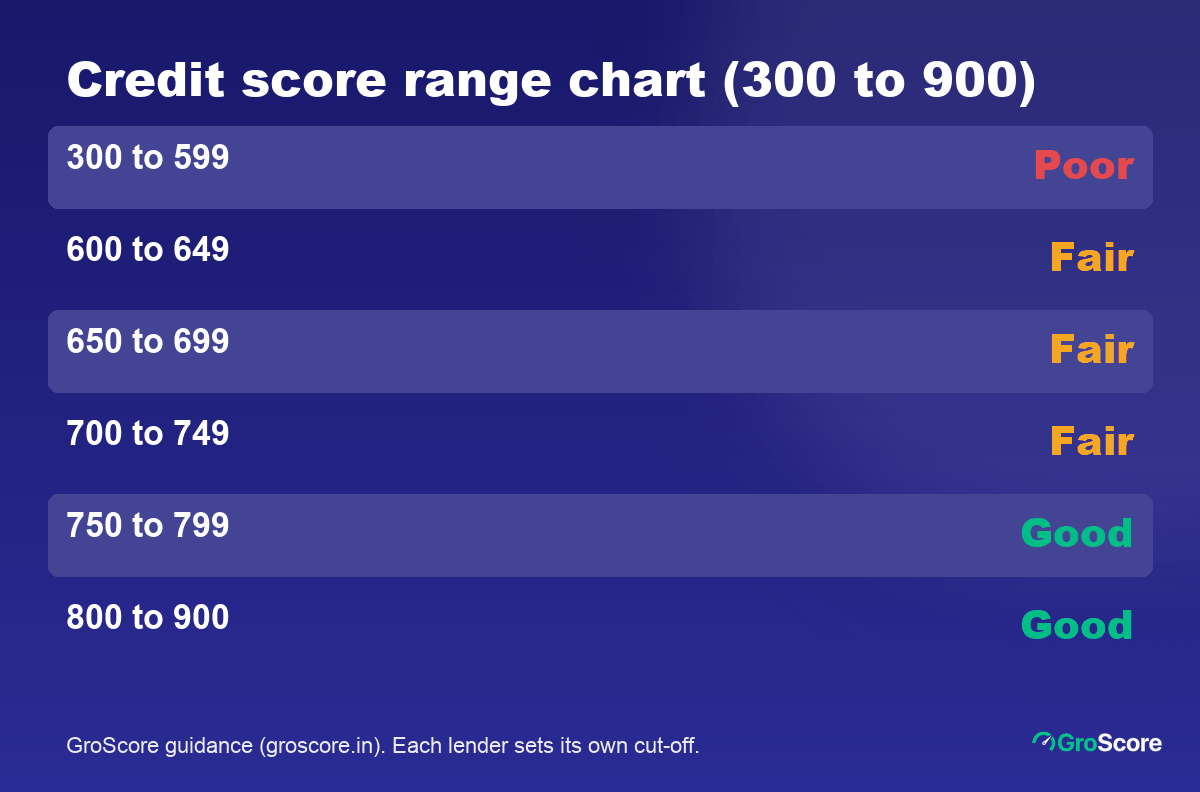
The full 300 to 900 range, in GroScore's colours.
Credit Score Range Chart: What Each Band Means
How much CIBIL score is good enough? Here's the whole credit rating scale, broken into 50-point steps. The three colours follow GroScore's guidance (groscore.in). The notes show what a borrower in that range usually runs into. All four bureaus use this 300 to 900 scale, and our guide to the CIBIL score explains how that one is built.
| Score | Band | What you'll usually find |
|---|---|---|
| 300 to 549 | Poor | Most unsecured loans and cards get declined. Secured options are the realistic route. |
| 550 to 599 | Poor | A few lenders may consider you, at high rates and with tight limits. |
| 600 to 649 | Fair | Approvals are possible, but expect more questions and a higher rate. |
| 650 to 699 | Fair | Credit is within reach. Pricing is usually not the best on offer. |
| 700 to 749 | Fair | Close to good. Small fixes often matter most here. |
| 750 to 799 | Good | Better rates and faster decisions are common. |
| 800 to 900 | Good | Strong. Extra points now change less than income and existing debt. |
Two things to notice. First, the steps inside a band aren't official. They're a practical way to read where you sit. Second, a band describes your odds, not your result. Every lender decides for itself.
What if you see no number at all? A new borrower may get "NA" or "NH" instead of a score. That's a blank file, not a bad one.
If you're new to all this, here's what a credit score is and where it comes from.
Is 750 the Ideal CIBIL Score for Most Loans?
For most people, yes. A 750 puts you in the good band, and that's where lenders tend to compete for you. Many borrowers treat it as the ideal CIBIL score to aim for before a big application.
But "good" doesn't mean "approved". A score is one input. Lenders also look at:
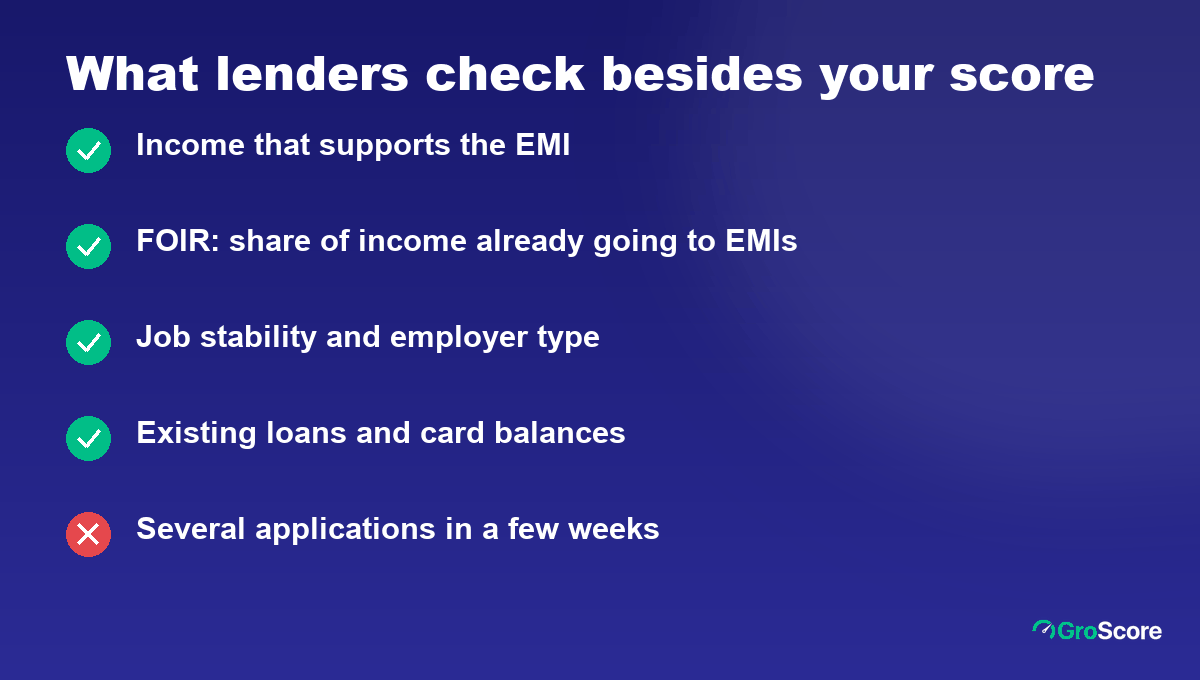
Your score opens the door. These decide the offer.
- Income. Can you afford the EMI?
- FOIR, or fixed obligations to income ratio. That's the share of your monthly income already going to EMIs. A high FOIR can sink an application even with a strong score.
- Your job. How long you've been there, and what kind of employer.
- Existing debt. Loans and card balances you already carry.
- Recent applications. Several in a few weeks can worry a lender.
So the best CIBIL score for a loan is the one that clears that lender's cut-off, with an income that supports the EMI. Cut-offs differ by lender and loan type. Our guide to the minimum CIBIL score for a loan breaks those down.
GroScore is a free credit score app and personal credit coach from Vitrak Technologies (GroMo). It shows your Equifax credit score and full report with a soft check that never affects your score, explains in Hindi or English what is holding the score back, and gives a step-by-step plan to fix it. GroScore is not a lender, and the score it shows is your Equifax score, not a CIBIL score.
Is 700 a Good Credit Score?
A 700 is a fair score, not a bad one. On GroScore's scale it sits in the 600 to 749 band. You'll usually still get credit. The catch is the price: offers at 700 often come with higher rates or lower limits than they would at 760. Our guide to a 710 credit score shows what the 700 to 749 range means for loans.
Here's the useful part. At 700, you're often one or two fixes away from the good band. High card use and a recent cluster of applications are the usual suspects. Both can change faster than an old late payment, which only fades with time.
How fast? It depends on what's on your report. GroScore's guidance says moving from 600 to 750 usually takes six to twelve months (groscore.in). Nobody can promise a number of points, or a date.
What Would a Credit Coach Flag at 712?
Here's an illustrative example. Ankit, 27, has a score of 712. He wants a better rate on a car loan next year. Arjun, GroScore's credit coach, walks through his report and flags three things, in this order:
- Card use of 64%. Ankit has two cards with a combined limit of ₹1.5 lakh and carries ₹96,000 across them. That's 64% utilisation. GroScore suggests keeping it under 30% (groscore.in, retrieved 2026-10-05). Under 30% of ₹1.5 lakh means a balance of ₹45,000 or less, so he'd need to pay down ₹51,000 before the statement dates.
- Three hard enquiries in two months. He shopped for a personal loan and applied at three places. Nothing to do now except stop applying. Enquiries carry less weight as they age.
- One DPD of 30 from two years ago. A card bill paid a month late. It's accurate, so it stays. It matters less with every on-time month. Left unchecked, these three can pull a 712 down toward a 650 credit score, where pricing is rarely the best on offer.
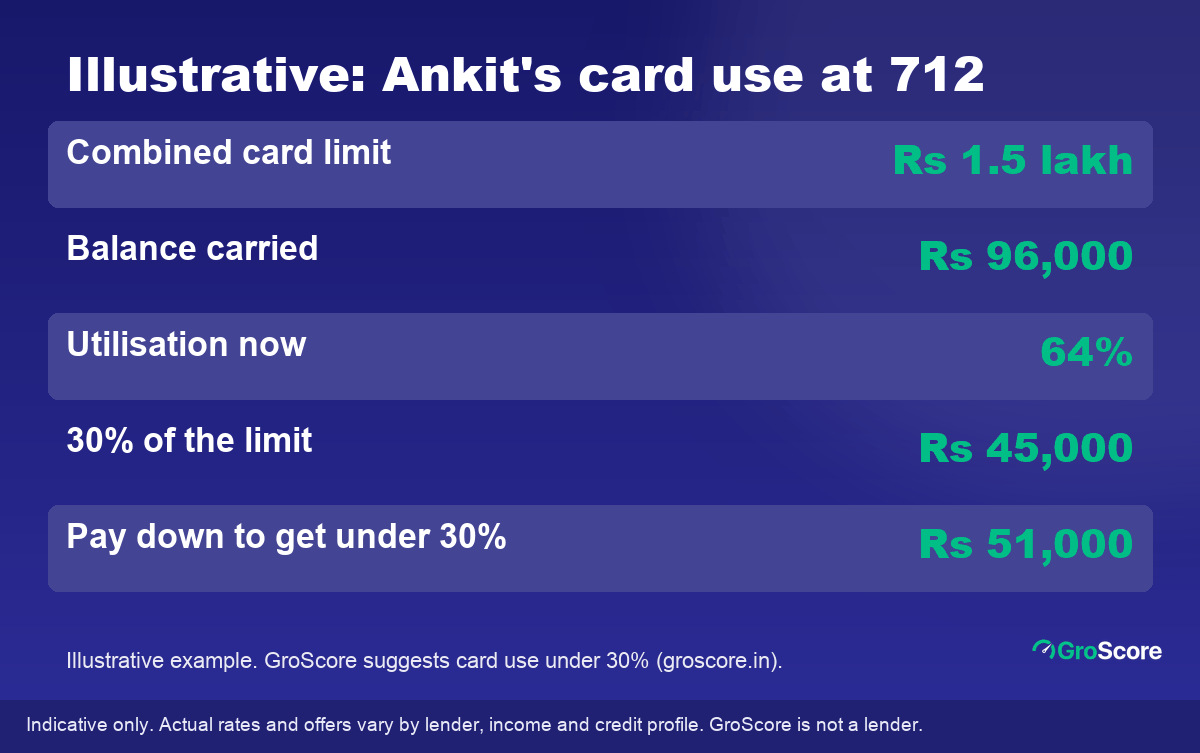
Illustrative example: the arithmetic behind fix number one.
Notice the order. The fix Ankit controls this month comes first. The ones only time can solve come last. All figures here are illustrative, not a real customer's.
What Is the Maximum CIBIL Score, and Can You Hit 900?
The maximum CIBIL score is 900. That's also the maximum credit score at Equifax, Experian and CRIF, since all four bureaus use the same range. You'll find all four on the RBI's list of credit information companies.
Can you reach 900? It's on the scale, so in principle yes. In practice, chasing it isn't worth much. A high credit score in the 800s already sits well inside the good band. Above that, the things that move your offer are usually income, FOIR and existing debt, not another 30 points. For most borrowers, a 750 credit score is already where the better offers start.
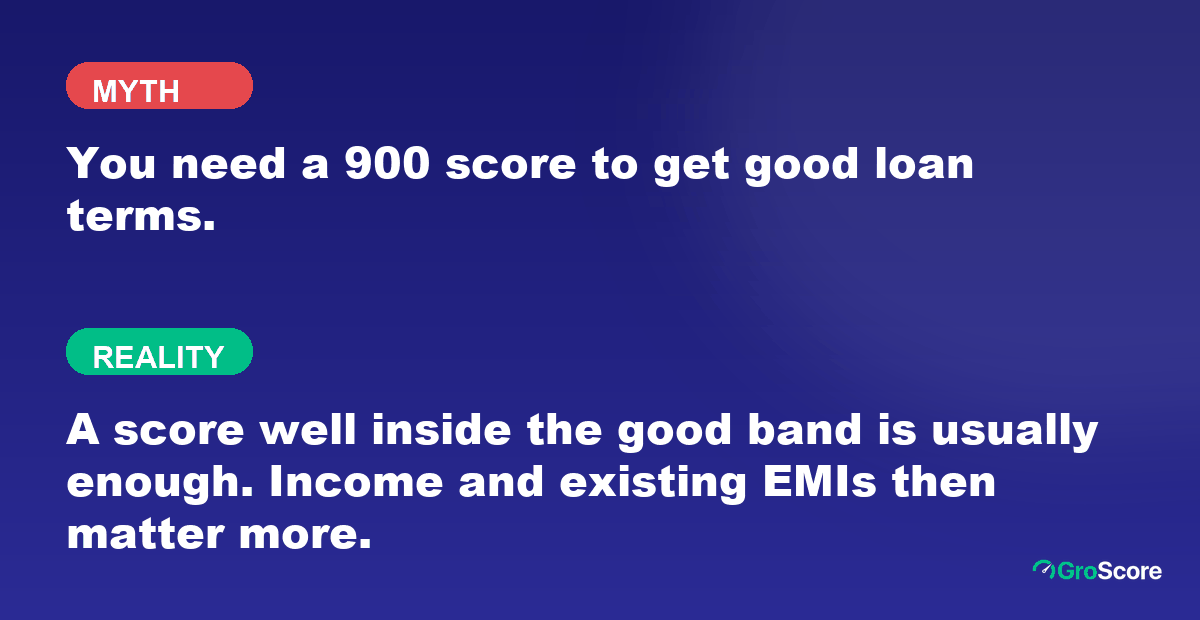
A score well inside the good band is usually enough.
Why Is Your Score Good on One App and Fair on Another?
Because each bureau scores you separately. TransUnion CIBIL, Equifax, Experian and CRIF each keep their own copy of your history and run their own model. A 752 at one bureau and a 741 at another is normal. One lands in the good band and the other doesn't, but the person is the same.
Timing explains a lot of it. Since 1 July 2026, the RBI has required lenders to report to bureaus every week (RBI). Even so, one bureau may get an update before another.
So check the band, not the exact number. If one score is far below another, compare the two reports. A missing or wrong account is the usual cause, and genuine errors can be disputed. Accurate late payments can't be removed early, whatever a "credit repair" agency claims.
How Do You Get a Good CIBIL Score?
The same handful of habits work for every bureau. Our step-by-step guide shows how to improve your CIBIL score, but here's the short version:
- Pay every EMI and card bill on time. GroScore says a single missed EMI can cost 50 to 100 points (groscore.in).
- Keep card use under 30% of your limit (groscore.in, retrieved 2026-10-05).
- Space out applications for new credit.
- Keep your oldest card open if it's free.
- Read your report for errors. GroScore says about 1 in 5 reports carries one (groscore.in).
You can also get one free full credit report from each bureau every year, under the RBI's credit information rules (2025). GroScore shows your Equifax score and report for free, with a soft check that doesn't lower your score. It doesn't show your CIBIL score; for that, go to CIBIL's own website.
Frequently Asked Questions
What is a good CIBIL score in India?
A good CIBIL score is 750 or above out of 900. GroScore's guidance treats 600 to 749 as fair and below 600 as poor. Lenders set their own cut-offs, and they also check income, existing EMIs and your job.
Is 700 a good credit score?
A 700 is fair rather than good. You can usually still get loans and cards, but often at a higher rate or lower limit than with a 750+. Lowering card use and pausing new applications are often the quickest things to work on.
What is the maximum CIBIL score?
The maximum CIBIL score is 900, and the minimum is 300. Equifax, Experian and CRIF use the same 300 to 900 range.
What CIBIL score do banks consider excellent?
There's no official "excellent" band that every bank uses. Each lender sets its own cut-offs and labels. Scores well above 750 put you in a strong position, and from there income and existing debt usually decide the offer.
Can you have a 900 credit score?
Yes, 900 is on the scale, but you don't need it. Once your score is comfortably in the good band, extra points tend to change little. Your income, FOIR and recent applications usually matter more.
The Bottom Line
Aim for 750 or above. That's where GroScore's guidance puts a good CIBIL score, and where lenders tend to offer their better terms. If you're at 700, you're closer than you think. Check your report on GroScore or any bureau, bring card use under 30%, fix the item you control first, and let time handle the rest.

Disclaimer
This GroScore article is for general education and is not financial advice. GroScore provides credit scores and reports sourced from Equifax, an RBI-licensed credit bureau; scores differ between bureaus and change as lenders report new data. Credit score improvement depends on your individual credit behaviour and bureau reporting timelines, and results are not guaranteed. Loan and card decisions are made by lenders on their own criteria. GroScore is not a lender. Figures and rates shown are indicative.
