No Credit Score? What NH or -1 on Your CIBIL Report Means
A blank where your score should be isn't a black mark. Here's what each code means and what to do about it.

No credit score means the bureau doesn't have enough credit data on you to calculate one. Instead of a number between 300 and 900, your report shows a code such as NH, NA or -1. It isn't a bad score and it isn't a penalty. It usually means you've never had a loan or card in your own name, or none that's been active recently.
Key TakeawaysNH (no history), NA (not applicable) and -1 all mean "not enough data to score", not "bad credit".TransUnion CIBIL's own FAQ gives three common reasons: you're new to credit, you've had no credit activity for a couple of years, or you only hold add-on cards (cibil.com).Many lenders hesitate on unsecured loans and cards without a score. A secured card against an FD is the usual safe first step.CIBIL is one of four RBI-registered bureaus. Each shows a missing score in its own way (RBI).
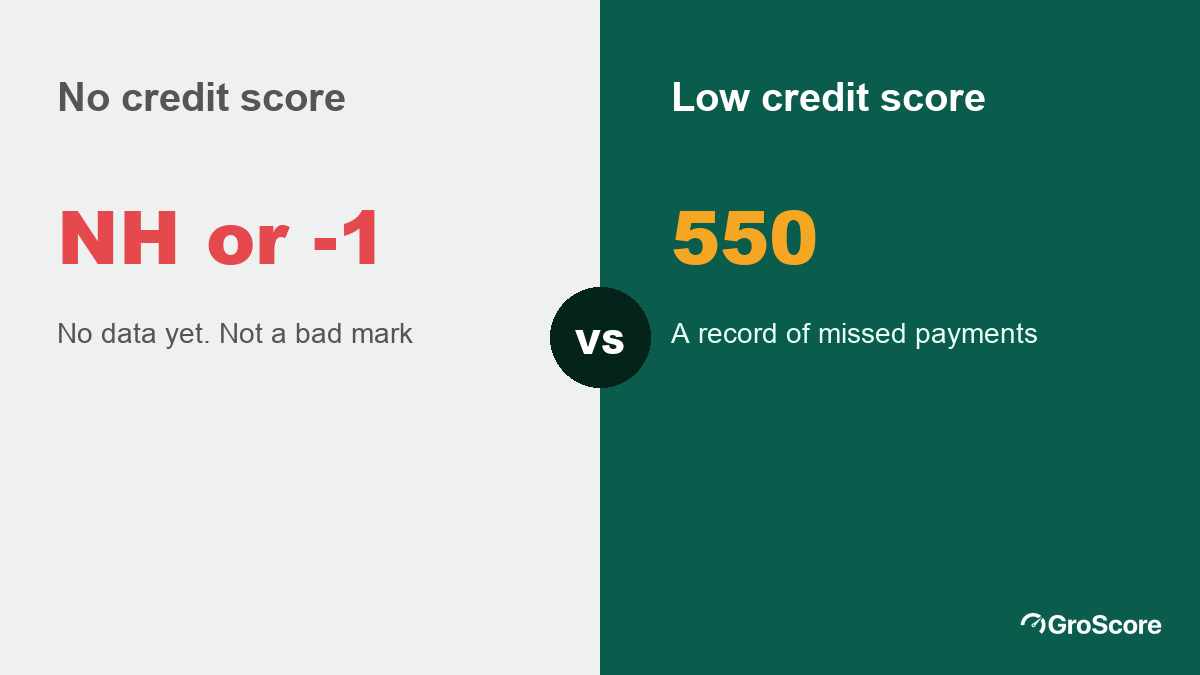
A blank file and a bad file are not the same thing.
What Do NH, NA, -1 and 0 Mean on a Credit Report?
Each code is a bureau's way of saying "we can't score you yet". The exact label depends on the bureau and on the version of its scoring model, so treat this as a guide, not a rulebook. Once you do get a number, our range chart shows what counts as a good CIBIL score. For now, here's what the codes mean:
| What you see | What it usually means | Is it a bad sign? |
|---|---|---|
| NH | No history. The bureau has no credit accounts in your name | No |
| NA | Not applicable. There's some data, but not enough, or not recent enough, to score | No |
| -1 | Another way some reports display "no history" | No |
| 0, or a small risk number | A very new file, often under about six months old. Some newer CIBIL score versions show a 1 to 5 risk index here | No, but it's early |
| 300 to 900 | Enough history for a full score | Depends on the number |
TransUnion CIBIL's consumer FAQ says a score of NA or NH can mean one of three things: you don't have enough credit history to be scored, you've had no credit activity in the last couple of years, or all your cards are add-on cards and you have no credit exposure of your own (cibil.com). The site blocks automated access, so look it up directly if you'd like to read it. A 0 CIBIL score works the same way: it marks a file too new to rate, not a failing grade.
CIBIL isn't the only bureau. The RBI's list of credit information companies names four: TransUnion CIBIL, Equifax, Experian and CRIF High Mark. You might show NH with one and a score with another, if your only lender reports to just some of them. Our explainer on CIBIL vs credit score covers why the four differ.
GroScore is a free credit score app and personal credit coach from Vitrak Technologies (GroMo). It shows your Equifax credit score and full report with a soft check that never affects your score, explains in Hindi or English what is holding the score back, and gives a step-by-step plan to fix it. GroScore is not a lender, and the score it shows is your Equifax score, not a CIBIL score.
Is Having No Credit Score Worse Than a Low Score?
Usually it isn't. A low score, say 550, is evidence that something went wrong: missed EMIs, a settled loan, a maxed-out card. No credit score is just an absence of evidence.
Think of two job applicants. One has a reference saying "often late". The other has no references at all. Most employers would rather take a chance on the second.
Lenders reason the same way, with one catch. Without a score, many of them can't run you through their automated checks at all. So in practice:
- Unsecured personal loans are hard to get. Many lenders want some repayment record first.
- Regular credit cards are often declined, unless you already bank with the issuer.
- Secured products, such as a card against an FD or a loan against an FD or gold, are much easier, because the lender holds security.
A low score, on the other hand, follows you. Accurate late payments stay on the report and fade only as good months pile up. A blank file can turn into a good one within months of careful use. Our credit score guide explains what each band from 300 to 900 means once you get there.
Why Does My Report Say NH When I've Borrowed Before?
The bureau may simply not see your borrowing. Here's an illustrative example of how that plays out.
Neha, 27, has used a credit card for four years. She checks her report and sees NH. Arjun, GroScore's credit coach, walks through the likely reasons in this order:
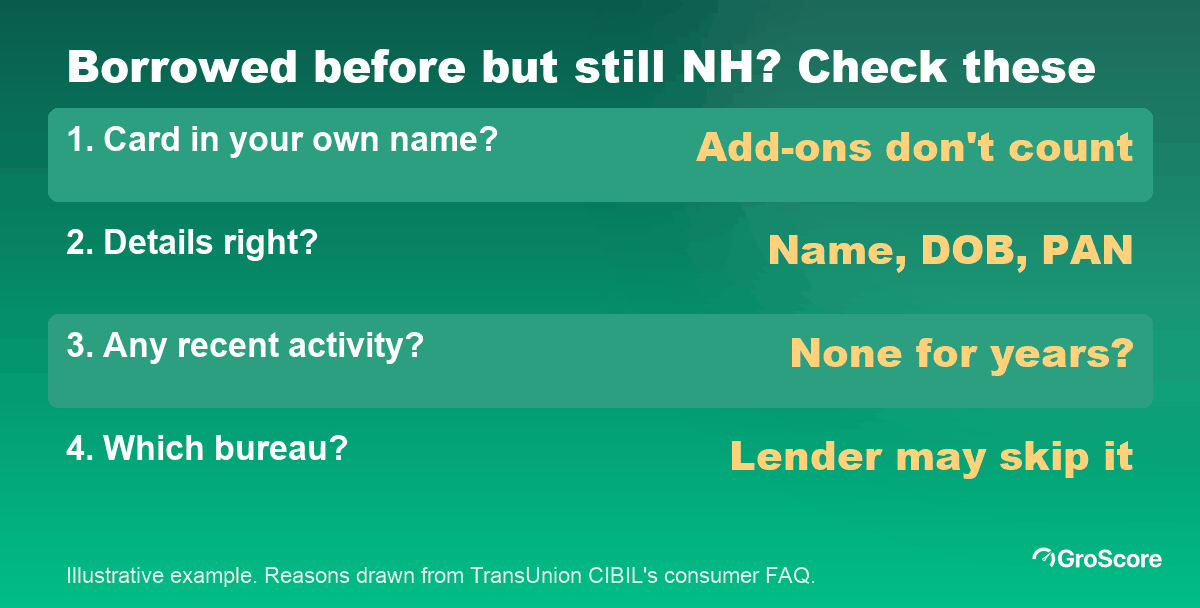
Illustrative example. Work down the list in order.
- Is the card hers? It turns out to be an add-on on her father's account. He's the one liable, so it builds his history, not hers. This alone explains the NH.
- Are her details right? A misspelt name, an old address or a wrong date of birth can stop a lender's data matching her file. A mismatch is an error she can raise with the bureau. GroScore says about 1 in 5 reports, roughly 20%, carries an error (groscore.in, retrieved 2026-10-05).
- Has anything been active lately? A loan she closed more than a couple of years ago may not be enough on its own, going by CIBIL's FAQ.
- Which bureau is it? Her only other borrowing, a small consumer loan, may have been reported to a different bureau from the one she checked.
Neha's fix is simple. She opens a card in her own name, against an FD, and keeps using it lightly. What Arjun won't promise is a date. When her first score shows up depends on the lender's reporting and the bureau's own threshold.
How Do You Get a First Credit Score Safely?
Open one credit product in your own name, use it lightly, and repay it in full and on time. That's the whole method. The details are in our new to credit guide, which walks through a six-month plan.
Three rules keep it safe:
Borrow from regulated lenders only. Use RBI-regulated banks and NBFCs, or apps that name an RBI-registered lending partner. You can check an NBFC on the RBI's NBFC list.
Apply once, not five times. Every application leaves a hard enquiry. A burst of them on a thin file looks like desperation.
Keep use small. GroScore's guidance is to stay under 30% of your card limit (groscore.in, retrieved 2026-10-05). For a first card, far less is fine.
How long until a score appears? Usually a few months after your first account is reported, often around six. Since 1 July 2026, lenders report to bureaus every week under RBI rules, so new accounts reach your file faster than before. Each bureau still has its own threshold, so there's no fixed date. Until then, a lender reading your file sees an empty credit history, which is why that first account matters so much.
Credit Card for No Credit History: What Are Your Options?
A card is what most people with no credit score are really asking about. It's the most common first credit product, and also the one most often declined without a score. Here's how the usual routes to a first credit card with no credit history compare:
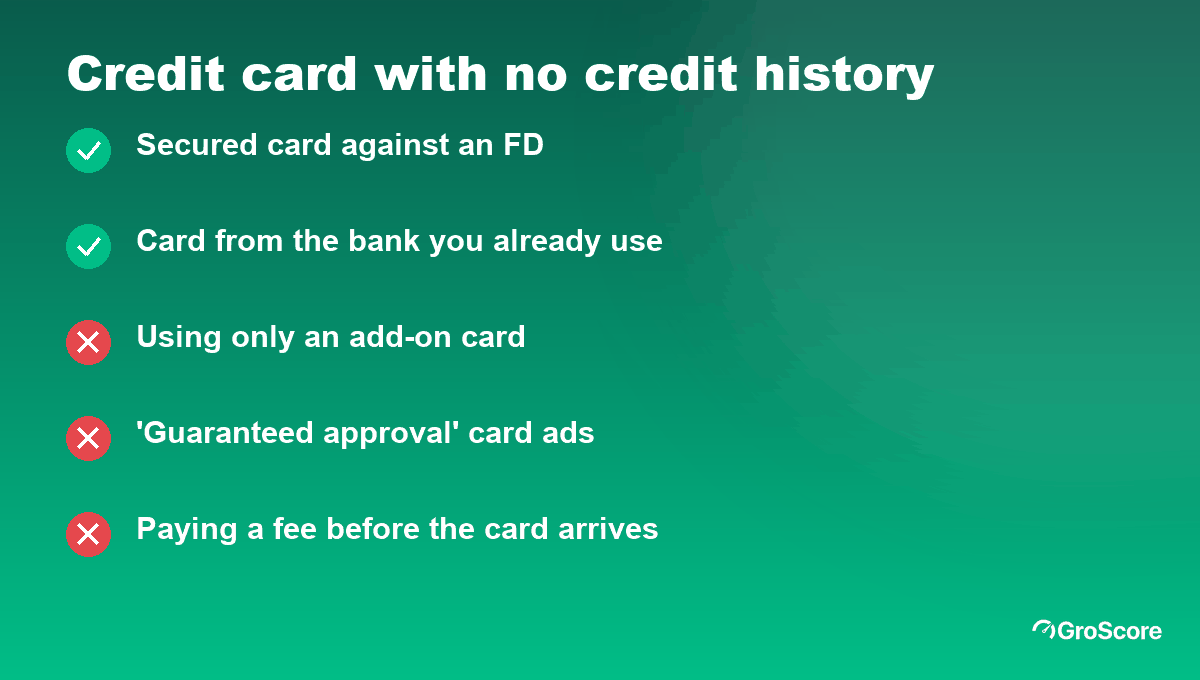
Only a card in your own name builds your own history.
| Option | How it works | Builds your history? | Watch out for |
|---|---|---|---|
| Secured card against an FD | The bank sets a limit against your fixed deposit | Yes | The FD stays locked while the card is open |
| Card from your own bank | Some banks offer cards to existing account holders based on the relationship | Yes | Not every bank does this. Approval is still the bank's call |
| Add-on card on a parent's account | You spend on their card and limit | No, it sits on their file | The main cardholder is liable, so the history is theirs |
| "No credit check" card offers | Promises approval without checking anything | Treat with suspicion | RBI-regulated issuers generally check bureau data before issuing |
A secured card is the usual answer to "which credit card for someone with no credit history?" The FD covers the limit, so the bank doesn't need a score to say yes. It reports to the bureaus like any other card. Fees and the share of the FD offered as a limit vary by bank. Actual offers vary by lender, income and credit profile. For a fuller comparison of secured and FD-backed cards, see our guide to a credit card for a low CIBIL score.
Ads for a "credit card without credit score" with guaranteed approval are a myth, because no RBI-regulated issuer can promise approval. Upfront "processing fees" before a card arrives are a classic scam sign.
Can You Get a Loan With an NH Score?
You sometimes can, but rarely an unsecured loan on good terms. Loans against an FD or against gold are the most realistic options, because the security does the work a score would. Some lenders also offer small first loans to new-to-credit borrowers, at their own discretion.
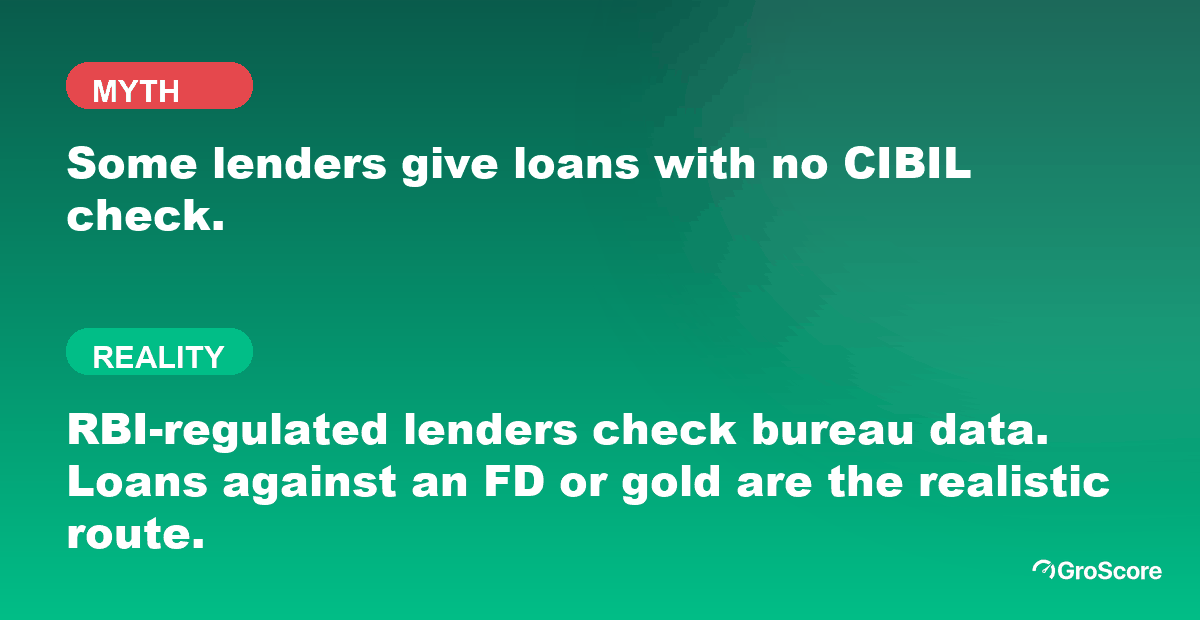
A real lender checks a bureau, even when you have no score.
What you won't find is a genuine RBI-regulated lender that skips the bureau check entirely. "Loan without CIBIL check" offers are a myth with regulated lenders, and often a front for illegal apps. Our guide to an instant loan without CIBIL separates what's possible from what's a scam.
GroScore can show which lenders' criteria a new profile clears. It doesn't lend, and it can't promise approval.
Frequently Asked Questions
What does NH or -1 mean on a CIBIL report?
Both mean CIBIL doesn't have enough credit data to calculate a score. Usually you've never had a loan or card in your own name, or nothing has been active for a couple of years. Neither is a negative mark.
Is having no credit score worse than a low score?
Usually it isn't. A low score records missed payments or defaults, and those take years to fade. No score is a blank file, which careful use of one secured product can turn into a positive record within months.
Can I get a loan with an NH score?
Unsecured loans are hard, because many lenders want a repayment record first. Secured options such as a loan against an FD or gold are more realistic. Approval is always the lender's decision.
How long after my first loan will I get a score?
Often around six months after the account is first reported, though some bureaus may score a newer file. Each bureau has its own threshold, and weekly reporting since July 2026 means new accounts show up faster.
Does an add-on credit card give me a credit score?
Usually it doesn't. The primary cardholder is liable for an add-on card, so the account builds their history. TransUnion CIBIL's FAQ lists "all add-on cards" as one reason a report shows NA or NH.
The Bottom Line
No credit score is a starting line, not a red mark. Check which code you have and with which bureau, make sure your personal details are right, then open one product in your own name and use it carefully. If your first score lands high, here's what an 800 credit score can do for you down the line.

Disclaimer
This GroScore article is for general education and is not financial advice. GroScore provides credit scores and reports sourced from Equifax, an RBI-licensed credit bureau; scores differ between bureaus and change as lenders report new data. Credit score improvement depends on your individual credit behaviour and bureau reporting timelines, and results are not guaranteed. Loan and card decisions are made by lenders on their own criteria. GroScore is not a lender. Figures and rates shown are indicative.
