Is a 710 Credit Score Good? What 700-749 Means for Loans
Approved, but not always at the best rate. What a 710, 722 or 746 really costs you, and whether to apply now or wait.

A 710 credit score is fair, and close to good. On GroScore's guidance it sits in the 600 to 749 band, 40 points short of the 750 line. Most lenders will still consider you for loans and cards. The usual catch is price: at 700 to 749 you're often approved, but not at the lender's best rate.
Key TakeawaysGroScore's guidance treats 750+ as good and 600 to 749 as fair (groscore.in). A 710, a 722 and a 746 are all in the fair band.The gap to 750 is usually about pricing, not approval. On a ₹30 lakh home loan, an illustrative half-point rate gap (8.5% versus 9.0%) adds about ₹2.3 lakh of interest over 20 years.Small, fixable items often hold a 700s score down: a forgotten overdue, a cut card limit, a reporting error.Under RBI rules, a bureau that doesn't resolve your complaint within 30 days owes you ₹100 a day (RBI).
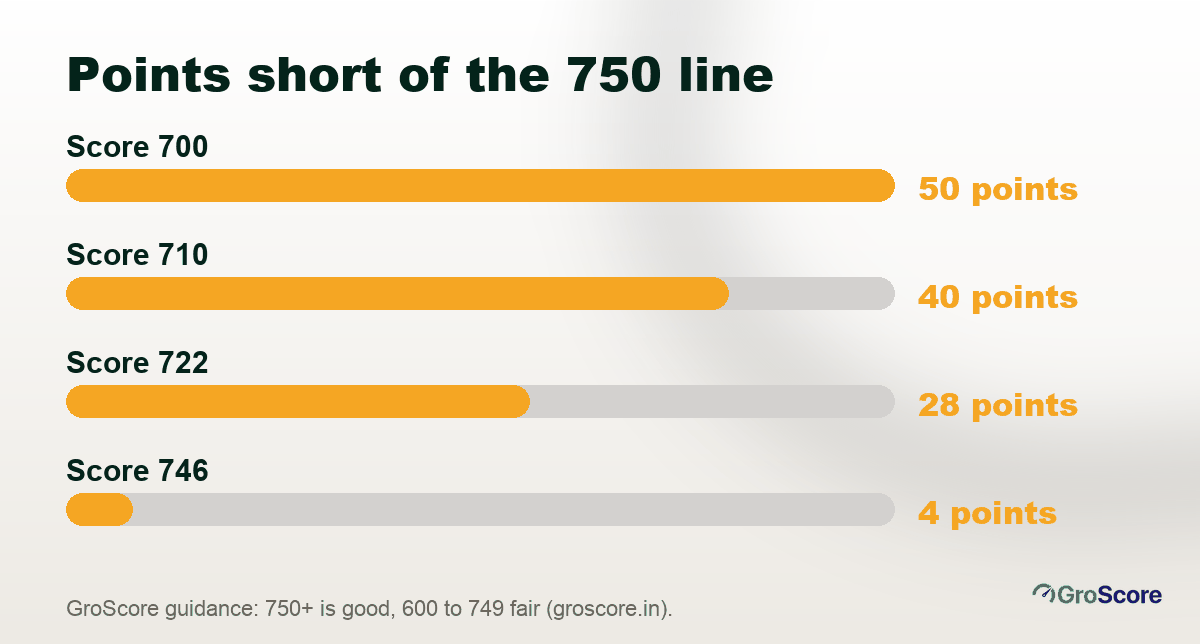
Every score in this band is a different distance from the good line.
Where Do 700, 722 and 746 Sit?
Scores from 700 to 749 share a band, but sit at very different distances from the next one. If you want the basics of how a credit score works first, start there. Here's what each exact number tends to mean in practice.
- 700 to 709. You've just crossed 700, into the upper part of the fair band. Lenders will look closely at income and existing EMIs.
- 710 to 729. This is where most people searching "722 credit score" land. You're a solid fair-band borrower, a couple of fixes away from good.
- 730 to 749. You're nearly there. A 746 credit score is four points short, which one statement cycle can sometimes change in either direction.
Is 700 a good CIBIL score, then? It isn't quite good. It's fair. CIBIL is one of four RBI-registered credit bureaus, along with Equifax, Experian and CRIF, and all four use the same 300 to 900 range. Your 710 CIBIL score could be a 702 or a 719 elsewhere, so read the band, not the exact digit. If the term is new to you, here's what a CIBIL score is and how it differs from other bureau scores.
GroScore is a free credit score app and personal credit coach from Vitrak Technologies (GroMo). It shows your Equifax credit score and full report with a soft check that never affects your score, explains in Hindi or English what is holding the score back, and gives a step-by-step plan to fix it. GroScore is not a lender, and the score it shows is your Equifax score, not a CIBIL score. A 710 Equifax score and a 710 from another bureau mean the same band.
Can You Get a Loan With a 710 Credit Score?
Usually you can. Here's how 700 to 749 tends to play out, loan by loan.
| Product | What usually happens at 700 to 749 (indicative) |
|---|---|
| Home loan | Often approvable, since the property secures it. The rate may sit above the lender's best. |
| Car loan | Usually approvable. A bigger down payment can improve the terms. |
| Personal loan | Often approved, sometimes for a smaller amount or at a higher rate than at 750+. |
| Credit card | Entry and mid-range cards are often within reach. Premium cards are harder. |
Indicative, based on GroScore's guidance bands (groscore.in), October 2026. These aren't lender-published cut-offs. Actual offers vary by lender, income and credit profile.
None of this is a promise. Lenders decide on their own criteria, and income, job stability and existing EMIs count alongside the score. Our page on the minimum CIBIL score for a loan breaks down the indicative lines by loan type. Before you apply, check the lender is a bank or an RBI-registered NBFC, and read the full cost, not only the headline rate.
What Does the Gap to 750 Cost You?
The gap costs less than a rejection, but more than people expect. Here's an illustrative 710 credit score home loan, where the only thing that changes is the rate.
Take a ₹30 lakh home loan over 20 years, for example. Say one borrower gets 8.5% a year and another gets 9.0%. Those are illustrative figures for October 2026, not offers.
| At 8.5% | At 9.0% | |
|---|---|---|
| Monthly EMI | ₹26,035 | ₹26,992 |
| Total interest over 20 years | ₹32,48,327 | ₹34,78,027 |
| Extra cost at 9.0% | ₹2,29,700 |
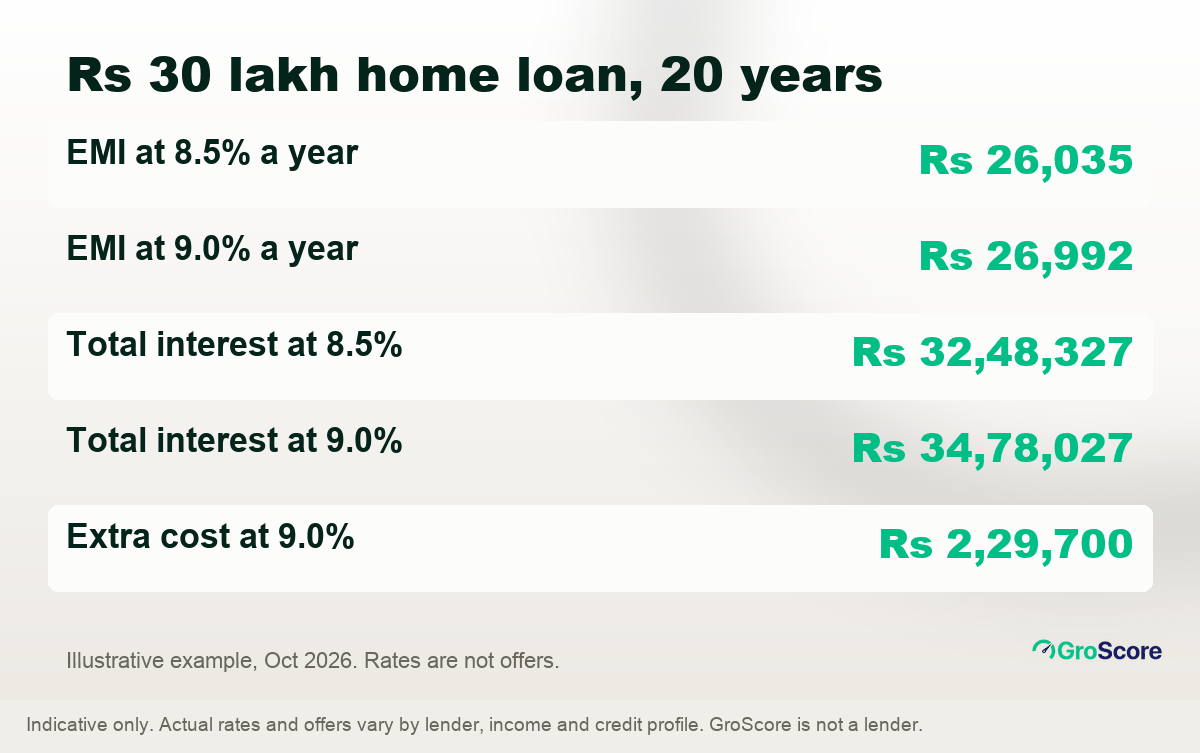
Illustrative example: half a percentage point, stretched over 20 years.
The difference works out to ₹957 a month, every month, for 20 years, using the standard EMI formula. Your real gap could be bigger, smaller or zero, because a lender prices on more than your score. Actual offers vary by lender, income and credit profile.
The same logic applies to a 710 credit score car loan, just over five years instead of twenty. Shorter loans shrink the rupee gap. To see how the same loan reads on the other side of the line, here's what a 750+ score means.
Why Do Lenders Treat 740 Differently From 750?
Lenders work with lines, not curves. Many lenders decide with score bands: one set of terms above a line, another below it. A 749 and a 751 are almost the same borrower. On a pricing grid they can land in different rows.
Is that fair? It isn't entirely, but it's how automated credit decisions work. As of October 2026, most banks look for around 750 for their better personal loan rates (indicative), which matches where GroScore's guidance starts "good" (groscore.in).
There's a practical upside. If you're at 740 to 749, a small fix can sometimes move you across that line. At 710, plan on a few months instead.
What Would a Coach Flag at 722?
Here's an illustrative example, not a real customer. Karan, 34, has a 722 credit score. He wants to buy a car in about four months. Arjun, GroScore's credit coach, reads his report and ranks three items, in this order:
- A ₹2,400 overdue on a phone EMI. Karan changed banks, and the auto-debit stopped. The account shows a DPD (days past due) of 30, and that number grows every month it stays unpaid. Paying it now stops a 30 from becoming a 60 or a 90. The 30 itself stays on the record, because it's accurate.
- A card limit cut from ₹1.5 lakh to ₹75,000. His usual ₹30,000 balance was 20% of the old limit. On the new limit it's 40%. GroScore suggests keeping card use under 30% (groscore.in, retrieved 2026-10-05). Paying ₹7,500 more before the statement date brings him to ₹22,500, or 30%. Going a little lower clears the line.
- The same credit card listed twice. One card shows up as two entries. That's a reporting error, and errors can be disputed. Our guide to a CIBIL dispute shows how, bureau by bureau.
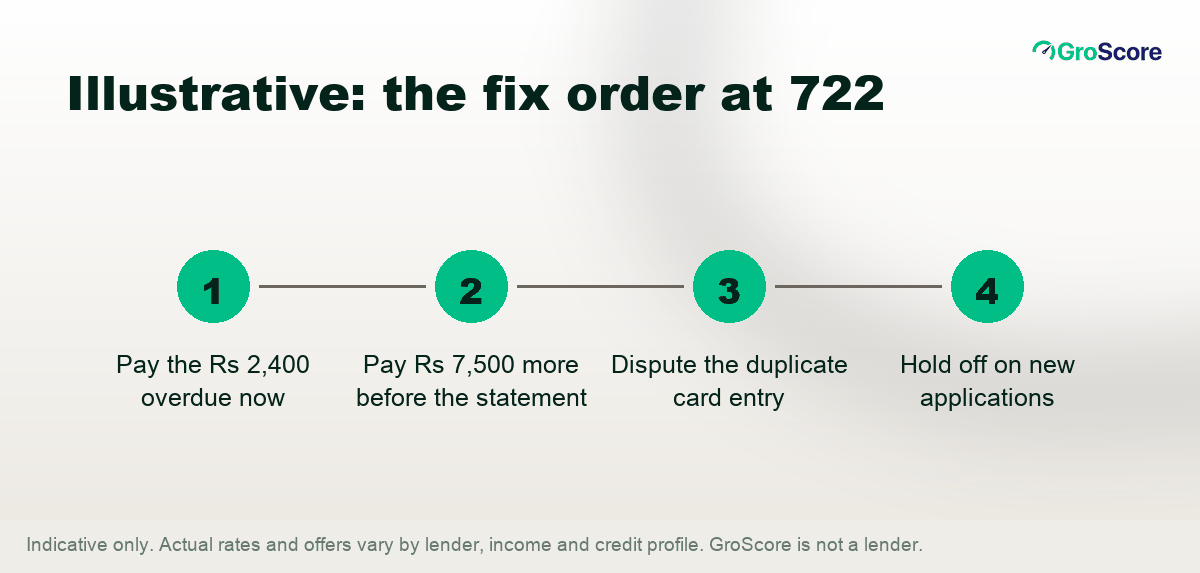
Illustrative example: the fixes, ranked by urgency.
Why that order? The overdue gets worse every month, so it goes first. The limit cut is fixable this cycle. The dispute takes time, so it should start now, but in parallel. Under the RBI's credit information rules (2025), if a complaint isn't resolved within 30 days, you're owed ₹100 for each extra day.
Notice what's absent: there's no "credit repair" agency and no new card to dilute utilisation. Neither is needed.
Should You Apply Now or Wait Until 750?
The answer depends on the loan, how urgent it is and how close you are. If you've slipped under 700, the call is different, so read what a 650 credit score means for loans instead. Otherwise, here's a simple way to decide.
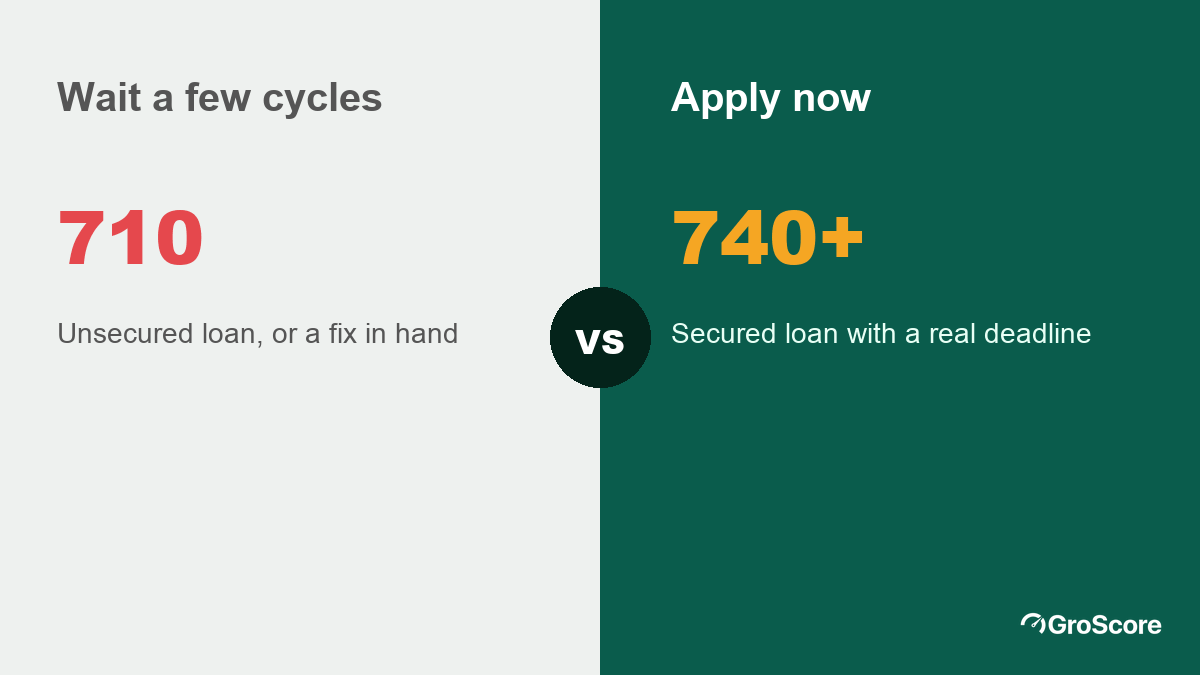
A rough guide to the apply-or-wait decision.
Applying now usually makes sense when:
- The loan is secured, like a home or car loan, and the need has a real deadline.
- Your score is 740 or above and nothing on the report is getting worse.
- You've compared at least two RBI-regulated lenders' full costs.
Waiting a few statement cycles usually makes sense when:
- It's an unsecured personal loan or a premium card, where the score carries more weight.
- You have a fix in hand, like Karan's overdue or limit cut.
- You've applied elsewhere in the last few weeks, since each application adds a hard enquiry.
How long to wait? That depends on what's on your report. GroScore's guidance says going from 600 to 750 usually takes six to twelve months (groscore.in). From 710, with the right fixes, it may take less, but nobody can promise a date. For the full stage-by-stage plan, see how to increase your CIBIL score from 600 to 750.
Frequently Asked Questions
Is 700 a good CIBIL score in India?
A 700 is fair, not good, on GroScore's guidance. Lenders will often approve you, but you may not get their best rate or highest limit. Crossing 750 is where better pricing usually starts.
Can I get a home loan with a 710 score?
Often you can. A home loan is secured by the property, so many lenders consider scores in the 700s. Your rate may be higher than at 750+, and income, the property's value and existing EMIs still decide the final offer.
Why do lenders treat 740 differently from 750?
Many lenders decide with score bands, so terms change at a line rather than gradually. A 740 and a 750 are nearly the same borrower, but they can land in different pricing rows.
What is the quickest fix to cross 750?
The answer depends on your report. Paying off an overdue and bringing card use under 30% before the statement date can usually be done fastest. Disputing a genuine error helps too, but takes longer.
The Bottom Line
A 710 credit score gets you through most doors, just not always at the best price. Read your report for the small things first: an overdue you missed, a limit that was cut, an entry that isn't yours. Fix those and give it a few cycles. Once you're past 750, the benefits of an 800+ score are smaller than you'd think.

Disclaimer
This GroScore article is for general education and is not financial advice. GroScore provides credit scores and reports sourced from Equifax, an RBI-licensed credit bureau; scores differ between bureaus and change as lenders report new data. Credit score improvement depends on your individual credit behaviour and bureau reporting timelines, and results are not guaranteed. Loan and card decisions are made by lenders on their own criteria. GroScore is not a lender. Figures and rates shown are indicative.
