What Is a CIBIL Score? Meaning, Range and CIBIL vs Credit Score
CIBIL is one bureau, not the whole system. Here's what its score measures and why your other scores look different.

A CIBIL score is the three-digit credit score, from 300 to 900, that TransUnion CIBIL calculates from your credit report. It's one bureau's view of how you repay loans and cards. India has four RBI-registered credit bureaus, so your CIBIL score is one of four credit scores you can have, not the only one.
Key TakeawaysCIBIL stands for Credit Information Bureau (India) Limited. Today it's TransUnion CIBIL Limited, one of four credit information companies registered with the RBI (RBI).The CIBIL score runs from 300 to 900. Closer to 900 is better, and each lender sets its own cut-off.Equifax, Experian and CRIF each calculate their own score from their own data, so your scores rarely match exactly.Every bureau, CIBIL included, must give you one free full credit report a year under RBI rules (RBI).
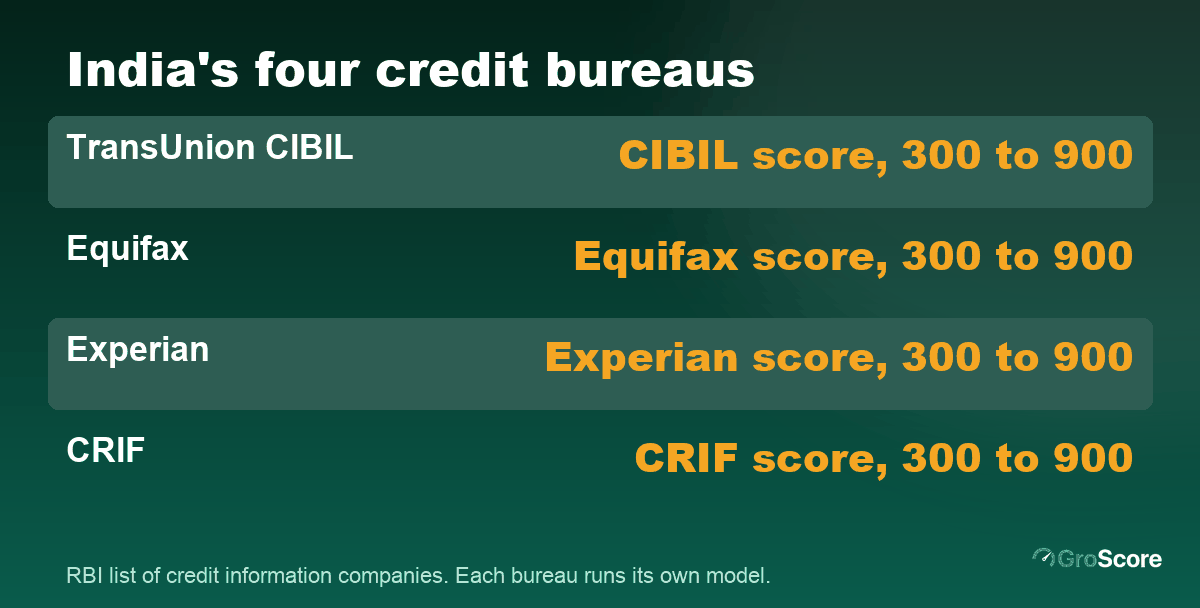
Four bureaus, four scores. CIBIL is the best-known one.
What Does CIBIL Stand For?
CIBIL is short for Credit Information Bureau (India) Limited. It was India's first credit bureau, and the company behind it is now called TransUnion CIBIL Limited. Its corporate identification number on the RBI's list shows it was registered in 2000.
The CIBIL bureau, like any credit bureau, collects repayment data. Banks and NBFCs (non-banking finance companies) send it details of every loan and card they give you, and how you repay. The bureau stores that as your credit information report, or CIR. Then it turns the report into a score.
Because CIBIL came first, its name stuck, and so did phrases like "CIBIL rating". People say "CIBIL score" the way they say "Xerox" for a photocopy. Bank staff do it too. So when a loan officer asks for your bank CIBIL score, they often just mean your credit score from whichever bureau the bank uses.
Swapping the names causes real confusion, and it's why this page exists. If you want the general idea of a credit score first, start there. Here we stick to CIBIL itself.
Is a CIBIL Score the Same as a Credit Score?
No, not exactly. "Credit score" is the general term. A CIBIL credit score is the specific one that TransUnion CIBIL produces.
India's four credit information companies are listed on the RBI's list of credit information companies:
- TransUnion CIBIL Limited
- Equifax Credit Information Services
- Experian Credit Information Company of India
- CRIF Credit Information Services (formerly CRIF High Mark)
Each one is licensed under the Credit Information Companies (Regulation) Act, 2005. Each keeps its own copy of your history, and each runs its own scoring model.
| CIBIL score | Equifax score | "Credit score" | |
|---|---|---|---|
| Who makes it | TransUnion CIBIL | Equifax | Any of the four bureaus |
| Scale | 300 to 900 | 300 to 900 | 300 to 900 |
| Built from | Data lenders report to CIBIL | Data lenders report to Equifax | That bureau's data |
| Where to get it free | CIBIL's website, once a year | Equifax's website, once a year, or GroScore | Each bureau's website |
So every CIBIL score is a credit score. The reverse doesn't hold: your Equifax number is a credit score too, just not a CIBIL one. Our guide to the credit bureaus in India compares all four.
GroScore is a free credit score app and personal credit coach from Vitrak Technologies (GroMo). It shows your Equifax credit score and full report with a soft check that never affects your score, explains in Hindi or English what is holding the score back, and gives a step-by-step plan to fix it. GroScore is not a lender, and the score it shows is your Equifax score, not a CIBIL score.

How Does TransUnion CIBIL Calculate Your Score?
CIBIL doesn't publish its formula. What it does publish is the raw material: your CIR. The score comes from what sits in that report.
Here's how the pipeline works:
Step 1: Lenders report. Your bank or NBFC sends CIBIL your account data. That covers the loan type, the limit or amount, the balance and whether you paid on time. Since 1 July 2026, the RBI has required lenders to report every week (fortnightly before July 2026, monthly before that) (RBI).
Step 2: CIBIL updates your report. New data lands in your CIR and becomes part of your credit history. Late payments show up as DPD (days past due). A "30" means a payment came a month late.
Step 3: The model reads it. Expect the usual inputs: your payment record, how much of your card limits you use, how old your accounts are, your mix of loans and cards, and how many times you've applied for credit lately. Card use is a big one. Spend ₹45,000 on a card with a ₹1 lakh limit and you're using 45% of it; GroScore suggests staying under 30% (groscore.in, retrieved 2026-10-05).
Step 4: You get a number. Between 300 and 900.
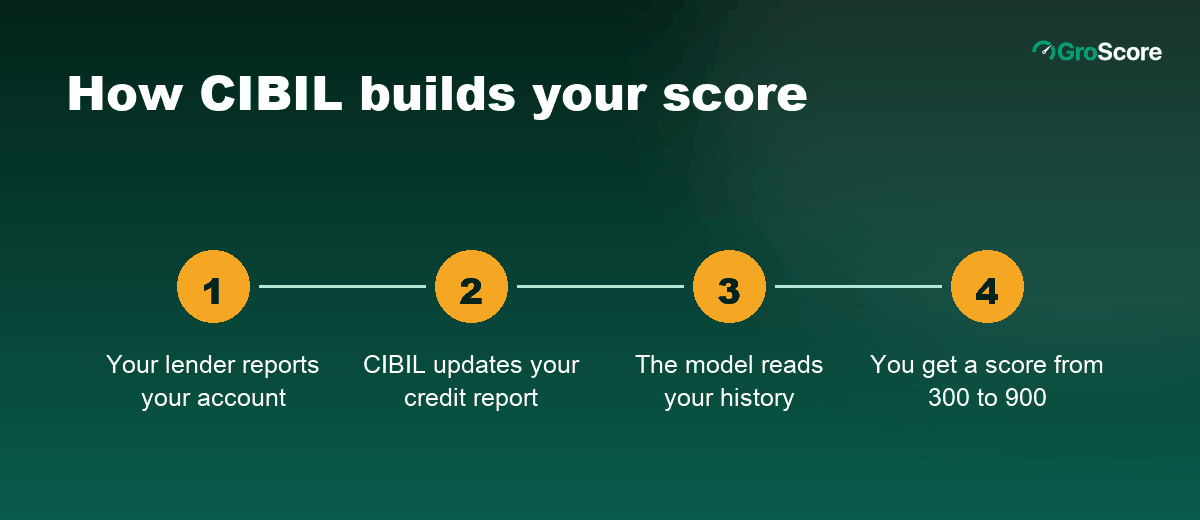
From your repayment to a three-digit number, in four steps.
Two things aren't in it at all. Your salary isn't. Neither is your savings balance.
What if you have almost no history? CIBIL can't score what it can't see. A thin or brand-new file shows NA (not applicable) or NH (no history) instead of a number. That isn't a bad score. It's a blank one. Here's what to do if you have no credit score yet.
What Is the CIBIL Score Range?
The CIBIL score rating scale runs from 300 to 900. Higher means you look less risky to a lender. GroScore's guidance reads the bands like this (groscore.in):
| Score | Band | What it usually means |
|---|---|---|
| 300 to 599 | Poor | Approvals get hard. Offers that do come cost more. |
| 600 to 749 | Fair | Credit is possible, often at higher rates or lower limits. |
| 750 to 900 | Good | Better rates and faster decisions are common. |
GroScore's bands apply to every bureau's 300-900 score, not just CIBIL's. Each lender still sets its own cut-off. For what each band means in practice, see our credit score range chart.
Why Is My CIBIL Score Different From My Equifax Score?
Most people with a CIBIL score in India also have scores at Equifax, Experian and CRIF. Those numbers are usually close. They're rarely identical. Three reasons explain the gap.
Different data. A lender may report an account to one bureau before another, or a small lender may not report to all four. One report can be missing an account the other shows.
Different timing. Reports update as lenders send data. If a card payment reached Equifax this week but CIBIL's next batch hasn't arrived, the two scores differ for a while.
Different models. Each bureau weighs the same habits in its own way. Same history, slightly different maths.
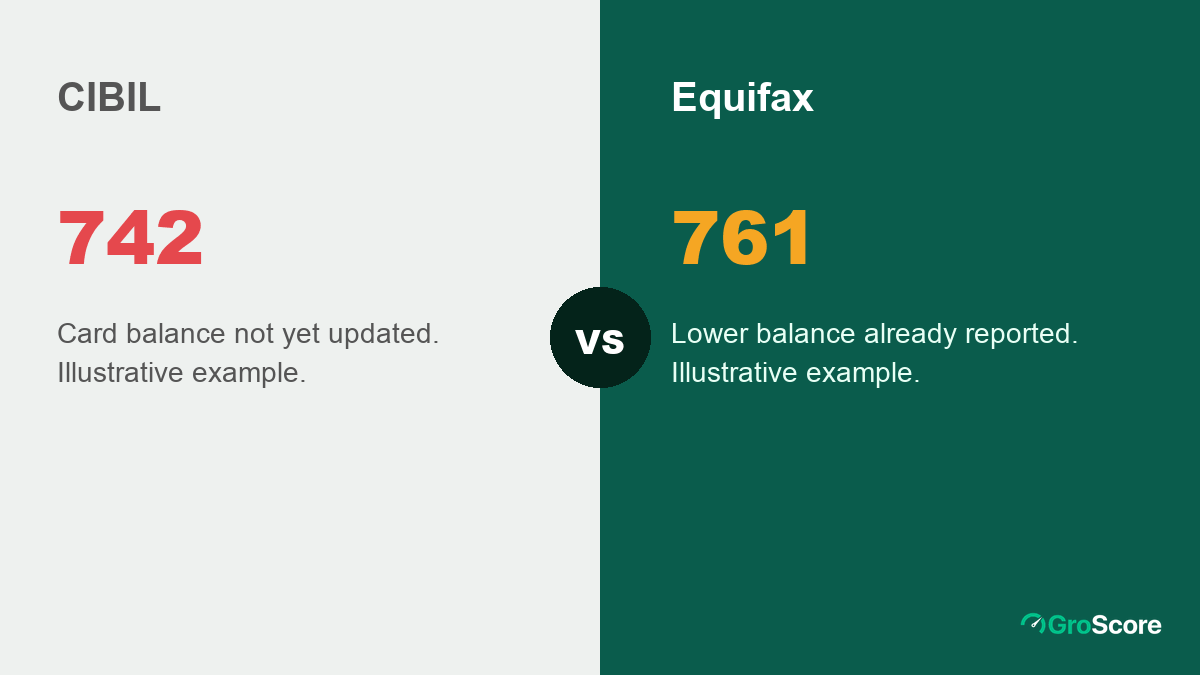
Illustrative example: one borrower, two bureaus, a 19-point gap.
Here's an illustrative example. Meera, 31, checks both. CIBIL shows 742. Equifax shows 761. Arjun, GroScore's credit coach, walks through her Equifax report and flags three things, in order:
- A card balance she cleared last month. Equifax already has the lower balance. CIBIL may not yet, which can explain much of the gap. No action needed; it usually evens out as lenders report.
- Card utilisation of 45% on her second card (an indicative figure for this example). Paying it down below the 30% GroScore suggests (groscore.in, retrieved 2026-10-05) before the statement date is the fix she controls this month.
- An enquiry from a lender she doesn't recognise. She should check it on both reports. If it isn't hers, it's a possible error or fraud, and errors can be disputed with each bureau.
The lesson: a gap between bureaus isn't proof of a mistake. It's a reason to read both reports. If your own number sits between 700 and 749, like Meera's CIBIL 742, here's what a 710 credit score means for loans.
Do Banks Check Only CIBIL?
No. A CIBIL score is common in lending, but banks and NBFCs can pull a report from any of the four bureaus, and some pull more than one. Each lender picks its own bureau, or bureaus. You usually won't be told in advance.
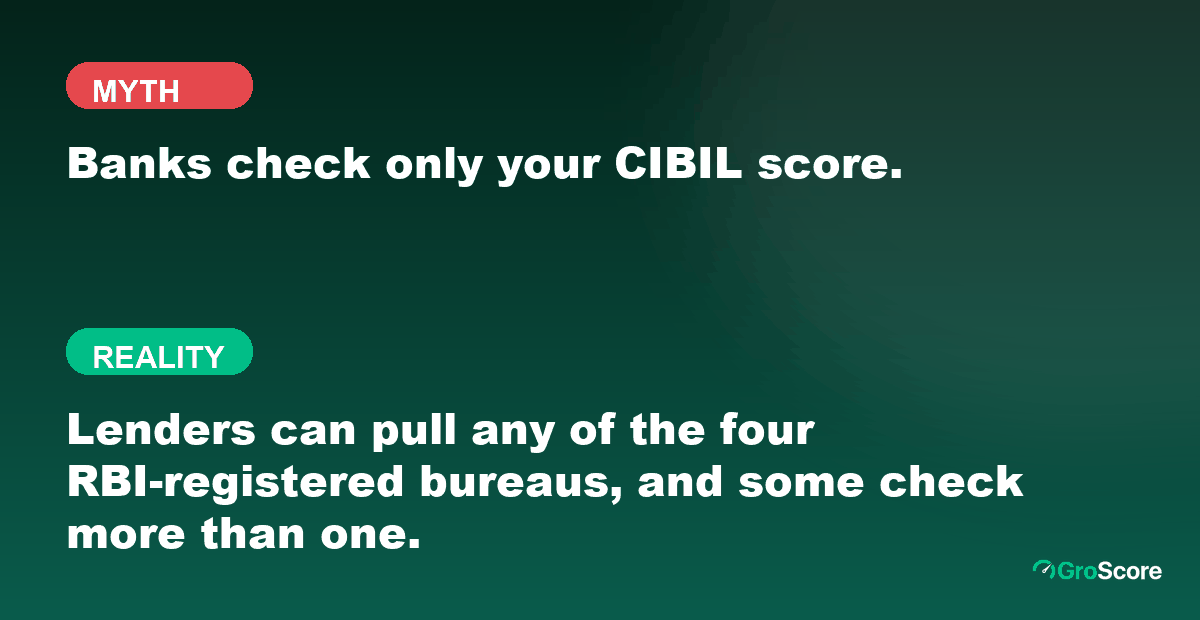
A lender may read your Equifax, Experian or CRIF report as well.
So look after all four reports instead of chasing one number. The habits that lift a CIBIL score lift the others too:
- pay every EMI and card bill on time
- keep card use under 30% of the limit
- apply for new credit only when you need it
- keep your oldest card open if it costs you nothing
- check each report for accounts you don't recognise
Errors are more common than people expect. GroScore says about 1 in 5 credit reports carries one, roughly 20%. Fixing a real error on one report doesn't fix it on the others. You raise the dispute with each bureau that shows it. One honest note, too: nobody can remove accurate late payments early. Agencies that promise "CIBIL repair" for a fee are selling something the law doesn't allow.
How Can You See Your CIBIL Score and Your Other Scores?
To see your CIBIL score itself, go to CIBIL's official website (cibil.com). The RBI's credit information rules (2025) requires every bureau to give you one free full credit report, with your score, each calendar year. CIBIL also sells paid plans with more frequent updates.
To see your Equifax score, you can use Equifax's own site or a free app. GroScore shows your Equifax score and full report with a soft check, so checking never lowers your score. It does not show your CIBIL score, and it never calls the Equifax number one.
Our guide to a CIBIL score check walks through every free route, bureau by bureau.
Checking your own score, on any bureau, is a soft enquiry. Only a lender's check after you apply is a hard enquiry.
Frequently Asked Questions
What is the full form of CIBIL?
CIBIL stands for Credit Information Bureau (India) Limited. The company now operates as TransUnion CIBIL Limited and is one of four credit information companies registered with the RBI.
Is CIBIL score the same as credit score?
A CIBIL score is one type of credit score, the one TransUnion CIBIL calculates. Equifax, Experian and CRIF calculate their own credit scores on the same 300 to 900 scale, and the numbers usually differ by a few points.
What is the CIBIL score range?
The CIBIL score range is 300 to 900. GroScore's guidance treats 750 and above as good, 600 to 749 as fair, and below 600 as poor, though every lender sets its own cut-off. A new borrower may see NA or NH instead of a number.
Do banks check only CIBIL?
No. Lenders can pull a credit report from any of the four RBI-registered bureaus, and some check more than one. That's why it helps to keep an eye on all your reports, not only the CIBIL one.
Why is my CIBIL score different from my Equifax score?
Each bureau gets data from lenders at slightly different times, may hold slightly different accounts and uses its own scoring model. A gap of a few points is normal. A large gap is worth checking: compare the two reports for a missing or wrong account.
The Bottom Line
A CIBIL score is one bureau's reading of your credit history. It's the best-known score in India, but it isn't the only one lenders look at. Get your free CIBIL report from CIBIL once a year, keep an eye on your other reports too, and fix the habits that move every score: on-time payments, low card use and fewer applications.

Disclaimer
This GroScore article is for general education and is not financial advice. GroScore provides credit scores and reports sourced from Equifax, an RBI-licensed credit bureau; scores differ between bureaus and change as lenders report new data. Credit score improvement depends on your individual credit behaviour and bureau reporting timelines, and results are not guaranteed. Loan and card decisions are made by lenders on their own criteria. GroScore is not a lender. Figures and rates shown are indicative.
