750 Credit Score: Is It Good? What 750-799 Means for Loans
You're in the good band. Here's what 750, 775 and 790 each mean, and how to stop a 750 sliding back to 740.

Yes, a 750 credit score is good. It's the first number in GroScore's good band (750 to 900), and most lenders treat a 750 to 799 score as a strong application. The catch is position: at exactly 750 you have no buffer, so one heavy card statement can drop you back into the fair band just before you apply.
Key TakeawaysGroScore's guidance treats 750+ as good, 600 to 749 as fair and below 600 as poor, on India's 300 to 900 scale (groscore.in).A 750, a 775 and a 790 sit in the same band, but they don't carry the same safety margin before a big loan.Lenders have reported to bureaus every week since 1 July 2026, so changes reach your report faster than they used to (RBI).No lender publishes a rate for each score. Income, existing EMIs and your job still shape the offer.
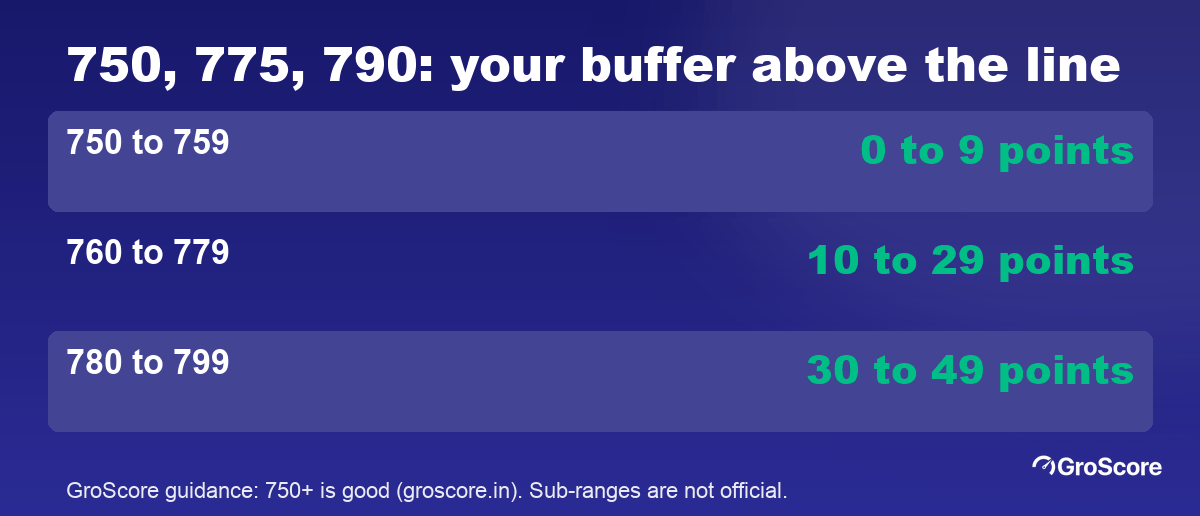
All three scores sit in the same band, with different safety margins.
Is 775 a Good Credit Score? Reading 750, 775 and 790
All three are good. The difference is how far each one sits above the line. If you're new to the scale, our credit score guide explains where the 300 to 900 range comes from. Here's the band read one score at a time.
| Your score | Points above 750 | What it usually means | What to watch |
|---|---|---|---|
| 750 to 759 | 0 to 9 | Good, but on the edge | One high card statement can tip you to the 740s |
| 760 to 779 | 10 to 29 | Solidly good | Keep applications spaced out |
| 780 to 799 | 30 to 49 | Close to 800 | Little to gain from new credit; protect what you have |
Indicative, based on GroScore's guidance bands (groscore.in), October 2026. The sub-ranges aren't official and every lender draws its own lines.
So is 775 a good CIBIL score? A 775 is good at any of the four bureaus, because all of them use the same 300 to 900 range. Remember that CIBIL is only one of four RBI-registered credit bureaus, alongside Equifax, Experian and CRIF, so a CIBIL score is one bureau's view of you. Your 775 at one bureau might be a 768 or a 781 at another. That's normal.
Most lenders read a 760 credit score and a 780 credit score the same way. The 60 days before you apply matter more.
GroScore is a free credit score app and personal credit coach from Vitrak Technologies (GroMo). It shows your Equifax credit score and full report with a soft check that never affects your score, explains in Hindi or English what is holding the score back, and gives a step-by-step plan to fix it. GroScore is not a lender, and the score it shows is your Equifax score, not a CIBIL score.
What Does a 750 to 799 Score Get You on Loans and Cards?
Usually you get a strong shot at most mainstream products. Here's how the band tends to play out, product by product.
| Product | What usually happens at 750 to 799 (indicative) |
|---|---|
| Personal loan | Most banks and NBFCs will consider you. Pre-approved offers become more likely. |
| Home loan | You clear the usual score bar. Income, property value and existing EMIs then drive the rate. |
| Car loan | Usually straightforward, since the car secures the loan. |
| Credit card | Mainstream cards are within reach. The limit depends on income. |
Indicative, not lender-published. Actual offers vary by lender, income and credit profile.
Two things this table can't promise. First, approval: a score is one input, and a lender can still decline you on income or a high FOIR (fixed obligations to income ratio). If ₹40,000 of your ₹80,000 salary already goes to EMIs, your FOIR is 50%, and that can sink an application at 790. Second, a specific price. Our guide to the CIBIL score for a personal loan shows how lenders price across bands.
Does a 760 get you pre-approved offers? Often it does, but not by score alone. Banks mostly send pre-approved offers to existing customers whose salary or spending they already see. A 760 with no relationship at that bank may get nothing. A 740 with a salary account there might.
What Interest Rate Can You Get With a 750 Credit Score?
Nobody can give you that number honestly. Lenders don't publish a rate for each score. They price in broad bands, then adjust for your income, employer, loan size and existing debt.
Most lenders treat 750 as the point where better pricing becomes available, so the interest rate with a 750 credit score is usually close to what a 790 gets. The bigger jump is the one from the fair band into this one. If you're asking whether 780 is enough for the lowest home loan rate, the score usually is. The rest of your file decides the final rate.
For a 750 credit score home loan, then, put your effort into the parts you control. Keep existing EMIs low, because every ₹10,000 of EMI you already pay is ₹10,000 a month the bank won't count toward the new one. Keep your documents in order, and don't let your score dip just before the bank pulls it. A home loan underwriter reads your whole credit history, not only the number, so a clean recent record counts.
Why Can a 750 Slip Below the Line?
A credit score is a snapshot. Bureaus recalculate it from whatever lenders last reported, and since 1 July 2026 lenders report every week under the RBI's 2025 amendment directions on credit reporting. A bad week now shows up quickly. A card balance at 65% of your limit can reach your report within days of the statement date.
At 790, a 15-point dip is a non-event. At 752, it lands you at 737, which is fair, not good.
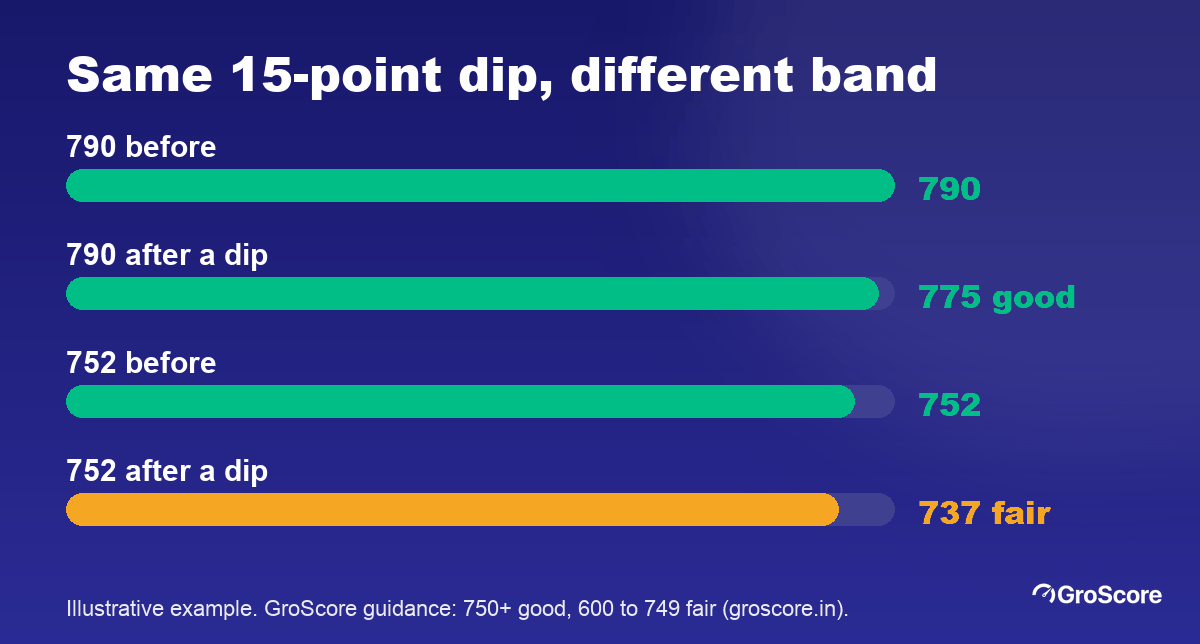
Illustrative example: the same dip leads to two very different outcomes.
Three things usually cause that dip:
- A card statement with a big balance. Your card company reports the balance on your statement, even if you pay it in full a week later.
- A burst of applications. Each loan or card application adds a hard enquiry.
- One late payment. GroScore says a single missed EMI can cost 50 to 100 points (groscore.in). At 752, that's the whole band gone. Our guide to a 710 credit score covers what the 700 to 749 range means for loans.
What Would a Coach Flag at 752 Before a Home Loan?
Here's an illustrative example, not a real customer. Neha, 31, has a score of 752 and plans to apply for a home loan in two months. She also has a family wedding next month and plans to pay for it on her credit card. Arjun, GroScore's credit coach, looks at her report and flags three things, in this order:
- The wedding spend. Her card limit is ₹2 lakh. She expects to spend ₹1.3 lakh, which is 65% utilisation. GroScore suggests keeping card use under 30% (groscore.in, retrieved 2026-10-05). If she pays ₹1 lakh before the statement date, only ₹30,000 gets reported, which is 15%.
- A pre-approved card offer she was about to accept. A new card now means a fresh hard enquiry and a younger average account age, right before the bank looks. It can wait until after the home loan.
- An old loan showing as "active". She closed it last year. If the lender never reported the closure, that's an error, and errors can be disputed with the bureau. It also inflates the debt a home loan underwriter sees.
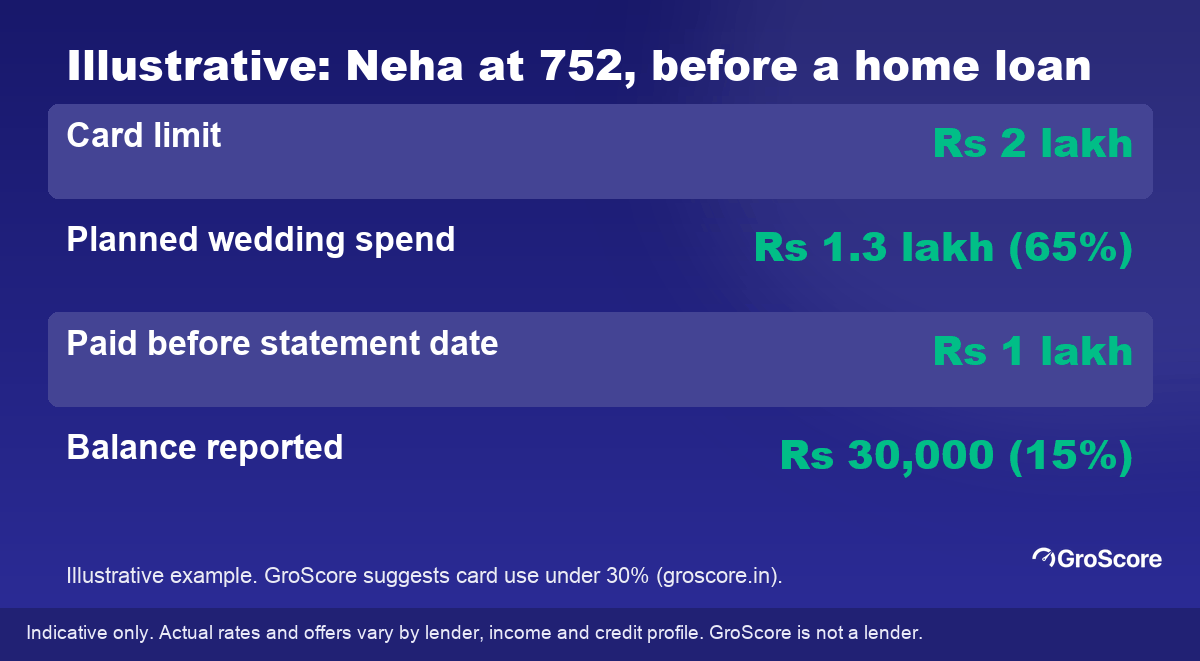
Illustrative example: timing the payment changes what gets reported.
Look at what Arjun didn't suggest. He didn't push new credit to "build" the score, and he didn't suggest closing old cards. At 752, the job is protecting the band, not growing it. Accurate entries can't be removed early, either. Only genuine errors can.
How Do You Go From 750 to 800?
You mostly get there by doing nothing new, for a long time. The habits that got you to 750, like paying on time and keeping card use under 30%, are the same ones that move you higher. They just work more slowly at this end of the scale. Our guide on how to increase your CIBIL score from 600 to 750 covers the stage after this one too.
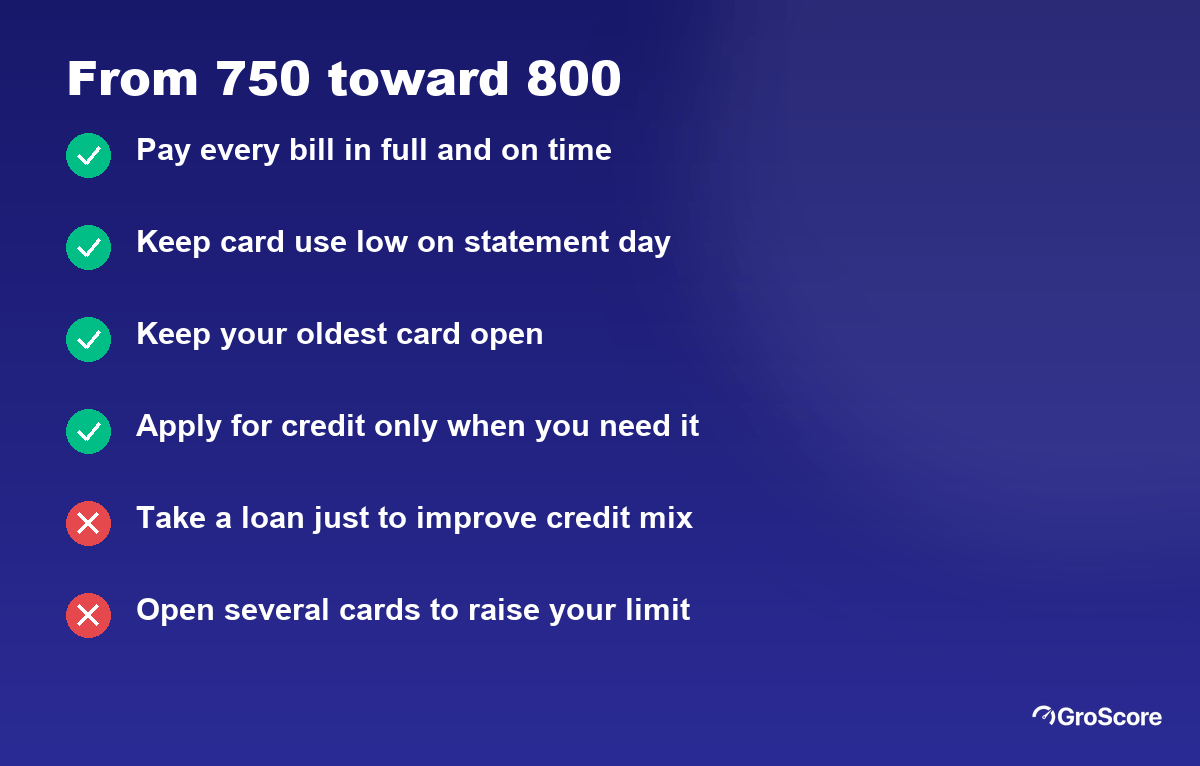
At this end of the scale, the score grows with time.
What tends to help:
- Pay every bill in full and on time, month after month.
- Keep card use well under 30%, and lower still on statement day.
- Leave your oldest card open, because a long history counts in your favour.
- Apply for new credit only when you actually need it.
Two moves don't help: a small loan taken just for credit mix, and several new cards to raise your total limit. Both add hard enquiries first, for an uncertain gain.
How long will it take? That depends on what's on your report, and nobody can promise a date. Should you even chase it? Our page on the 800 credit score answers that honestly.
Frequently Asked Questions
Is 750 a good CIBIL score?
Yes. A 750 is the start of the good band on the 300 to 900 scale, and that holds at all four bureaus. GroScore shows your Equifax score, which may sit a few points above or below your CIBIL score.
What interest rate can I get with a 775 credit score?
No lender publishes a rate per score. A 775 usually qualifies for a lender's better pricing, but your income, employer, loan amount and existing EMIs set the final rate. Compare offers from RBI-regulated lenders before you accept one.
Is 780 enough for the lowest home loan rate?
The score usually is. The lowest rates also depend on your income, the loan-to-value ratio and whether you're salaried or self-employed. Getting from 780 to 800 rarely changes a home loan offer as much as cutting an existing EMI does.
Does a 760 score get me pre-approved offers?
A 760 can bring pre-approved offers, but they depend more on your relationship with the bank than on the score alone. Banks usually send them to customers whose salary, deposits or card spending they already see.
How do I go from 750 to 800?
Keep paying on time, keep card use low, keep old accounts open and avoid unnecessary applications. Progress at this end of the scale is slow and depends on your report, so there's no fixed timeline.
The Bottom Line
A 750 credit score is good, and a 775 or 780 is good with room to spare. If you're near the bottom of the band and a big loan is coming, protect the number: pay the card before statement day, hold off on new credit and check your report for stale accounts. Then let time do the rest. If a missed payment has already pushed you lower, our 650 credit score guide explains what the 600 to 699 range means.

Disclaimer
This GroScore article is for general education and is not financial advice. GroScore provides credit scores and reports sourced from Equifax, an RBI-licensed credit bureau; scores differ between bureaus and change as lenders report new data. Credit score improvement depends on your individual credit behaviour and bureau reporting timelines, and results are not guaranteed. Loan and card decisions are made by lenders on their own criteria. GroScore is not a lender. Figures and rates shown are indicative.
