800 Credit Score: Benefits, and Is It Worth Chasing?
An 800 is excellent. Here's what it really buys you, and why another 50 points usually matter less than your EMIs.

An 800 credit score is excellent. It sits well inside GroScore's good band (750 to 900), and lenders will see you as a low-risk borrower. The honest part: past roughly 780, extra points rarely change your offer much. At 800, your income and existing EMIs usually matter more than the next 50 points.
Key TakeawaysGroScore's guidance treats 750+ as good on India's 300 to 900 scale (groscore.in). An 800 is comfortably inside that band.The benefits are real but modest: more choice of lenders, a stronger hand when you negotiate and quicker decisions. None of them is guaranteed.Most lenders' better pricing starts around 750. Above about 780, FOIR (the share of income already going to EMIs) often decides more than the score.GroScore says a single missed EMI can cost 50 to 100 points (groscore.in). Protecting an 800 is mostly about never missing one.
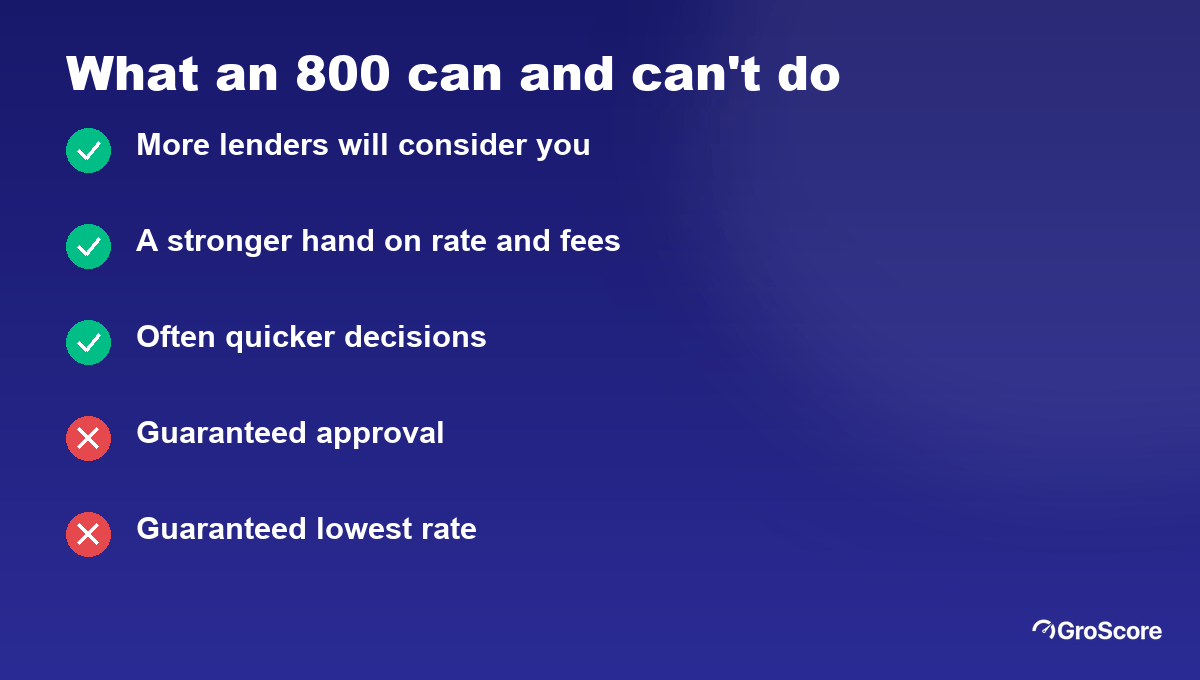
What an 800 can and can't do for you.
What Are the Real Benefits of an 800 Credit Score?
Think of 800 as a strong position, not a special status. Here's what it usually changes. If you're new to what a credit score is and how lenders read it, start there.
More lenders say yes. Lenders' minimum scores usually sit well below 800, so the score itself rarely rules you out. Your choice of lenders widens.
You can negotiate. With a high score, you're in a better position to ask for a lower rate or a waived processing fee, especially on a home loan. Lenders don't have to agree, but they're more likely to listen.
Decisions can be faster. A clean report gives an underwriter fewer questions to ask.
Card limits can be higher. The limit still depends mostly on income, though.
An 800 doesn't guarantee approval or the lowest rate, and it doesn't replace income. Pre-approved offers mostly go to people who already bank with the lender. An 812 with no relationship may see fewer offers than a 770 with a salary account there. Many lenders still ask for your CIBIL score by name, and they read it as a band, not a trophy.
GroScore is a free credit score app and personal credit coach from Vitrak Technologies (GroMo). It shows your Equifax credit score and full report with a soft check that never affects your score, explains in Hindi or English what is holding the score back, and gives a step-by-step plan to fix it. GroScore is not a lender, and the score it shows is your Equifax score, not a CIBIL score.
Is There Any Difference Between 800 and 900 for Lenders?
Usually there's very little. Lenders sort applicants into bands, and the top band often starts below 800. A score of 810 and a 900 credit score tend to land in the same row of a pricing grid.
The scale itself runs to 900 at every bureau, and some people do reach it. In practice, a 900 rarely buys a better offer than an 820, because both sit in the top band. Our guide to a good CIBIL score shows the whole 300 to 900 chart, band by band.
One more reason not to fixate on the exact number: your score differs between bureaus. CIBIL, Equifax, Experian and CRIF each run their own model, so a "score 800" at one bureau could be a 791 or an 806 at another. Lenders know this, which is another reason they work in bands.
Is Chasing 800+ Worth It?
Sometimes it is, often it isn't. It comes down to where you are now and what chasing would cost. If your card use is above 30%, bringing it under GroScore's suggested 30% (groscore.in, retrieved 2026-10-05) is worth doing whatever your score.
| Where you are | Worth chasing 800? |
|---|---|
| Below 750 | Yes, but the real target is 750. That's where pricing usually changes. |
| 750 to 779, card use above 30% | Yes. Lowering card use helps anyway, and the score follows. |
| 780 to 799, big loan in 3 months | No. Protect the score; don't open anything new. |
| Already 800+ | No. Work on your FOIR and income instead. |
Indicative, based on GroScore's guidance bands (groscore.in), October 2026. Lenders set their own bands and cut-offs.
The moves people make to chase 800 are where it goes wrong. Taking a small personal loan "to improve credit mix" adds a hard enquiry and a new EMI. Opening two cards to raise your total limit adds two enquiries. Closing an old card to "tidy up" shortens your history. Each can cost you points in the short term, for a gain nobody can promise. If you're nearer a 650 credit score, the basics matter far more than any of this.
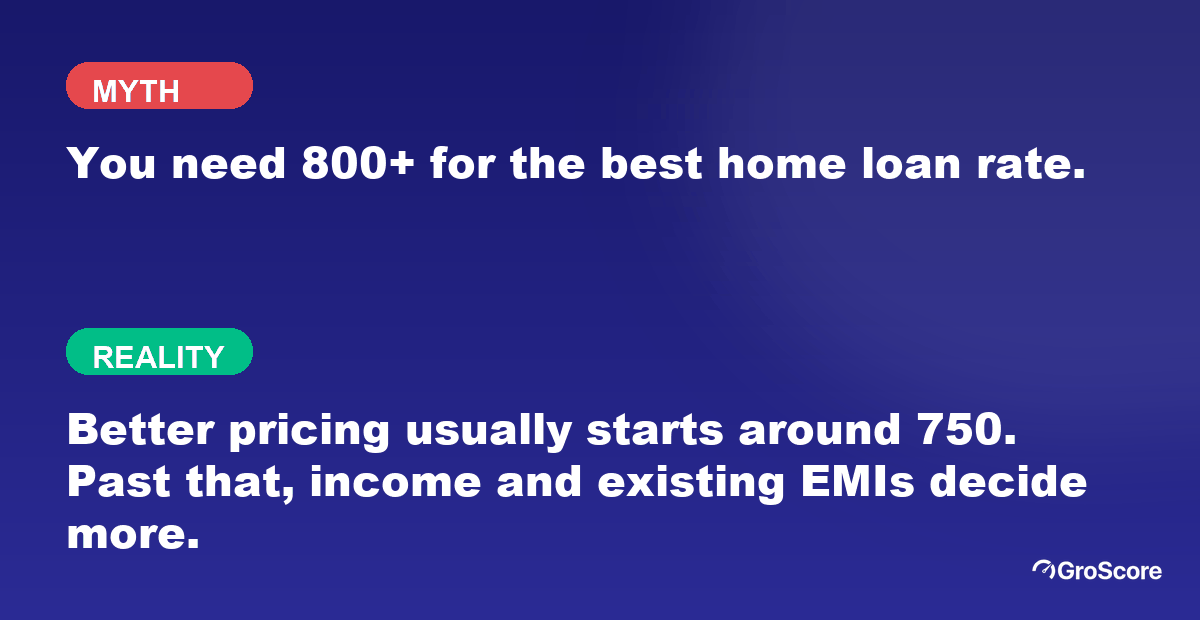
A high score helps, but it isn't the whole application.
What Matters More Than the Score at 800?
Your FOIR usually matters more. FOIR, or fixed obligations to income ratio, is the share of your monthly income already committed to EMIs. Here's an illustrative example of why it can outweigh 40 points.
Suppose two people apply for a home loan top-up with the same ₹15,000-a-month EMI: - Priya has an 812. She earns ₹1,00,000 a month and already pays ₹55,000 in EMIs, so her FOIR is 55%. The new loan takes it to 70%. - Rahul has a 776. He earns ₹80,000 a month and pays ₹16,000 in EMIs, so his FOIR is 20%. The new loan takes it to about 39%.
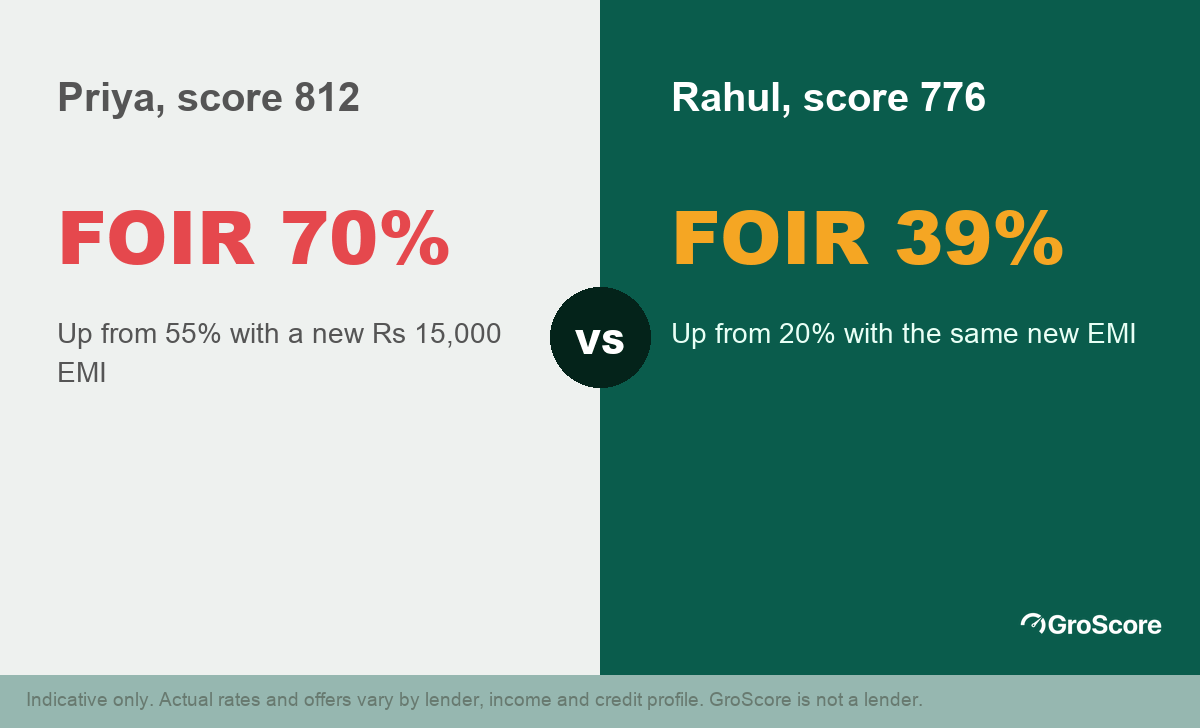
Illustrative example: the lower score, the lighter load.
Rahul's 776 is already past the line where, as our page on is 750 a good credit score explains, better pricing usually starts. Many lenders would see him as the easier approval, because a FOIR of 70% leaves Priya little room for a missed month. Each lender sets its own FOIR limits, so there's no single cut-off to quote. If Priya asked Arjun, GroScore's credit coach, the advice would be about her EMIs, not her score: prepay or close the smallest loan first, then apply. These figures are illustrative, not a real customer's. Actual offers vary by lender, income and credit profile.
How Do You Keep Your Score Above 800?
You keep it mostly by not giving it a reason to drop. At this level, a single bad month costs more than a good month earns.
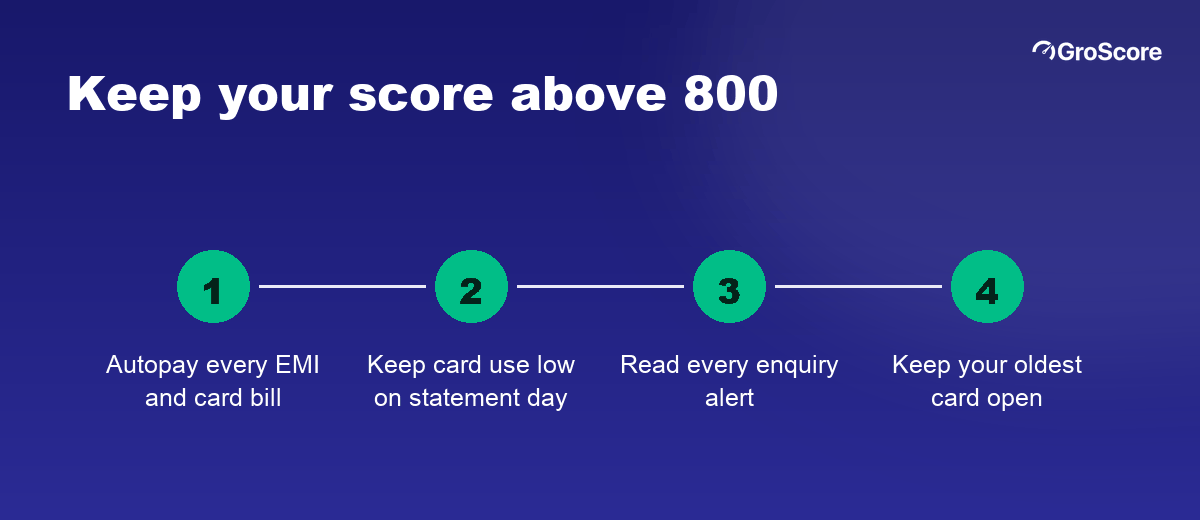
Keeping a high score is mostly routine.
- Automate every payment. GroScore says a single missed EMI can cost 50 to 100 points (groscore.in). At 810, that could put you back in the 700s.
- Watch card use on statement day. A big month on the card gets reported even if you pay in full later.
- Read every enquiry alert. Under the RBI's credit information rules (2025), you get an SMS or email when your credit report is accessed. An enquiry you don't recognise could be fraud. Checking your own score is a soft enquiry, though, as our guide to hard vs soft enquiries explains.
- Think before you stand guarantor. If the borrower misses EMIs, it can show on your report too.
Keep your oldest card open if it's free. A long history is part of what got you here.
How Do You Build an 800 Credit Score From the 700s?
You build it slowly, and without shortcuts. There's no fastest way to an 800 credit score that's also safe. Most of the benefit arrives at 750, so anything past that is a bonus.
To increase your credit score to 800 from the high 700s, the levers are the ones you already know: on-time payments, low card use, few applications and time. An old late payment doesn't rule out 800 forever. Its weight usually fades as on-time months pile up, but how fast depends on your report, and nobody can promise a date. Your credit history keeps that record, so steady months are what move it.
Frequently Asked Questions
Is 800 a good CIBIL score?
Yes. An 800 is an excellent score at any of the four bureaus, which all use the 300 to 900 range. GroScore shows your Equifax score, which may differ slightly from your CIBIL score.
Is there any difference between 800 and 900 for lenders?
Usually there's very little difference. Most lenders' top pricing band starts below 800, so an 810 and a 900 tend to get the same treatment. Income, existing EMIs and job stability then decide the offer.
What benefits do I get with an 800+ score?
You can expect more lenders to consider you, a stronger position to negotiate rates and fees, and often quicker decisions. Approval, the lowest rate and pre-approved offers still aren't guaranteed.
How do I keep my score above 800?
Automate every EMI and card payment, keep card use low on statement day and read every enquiry alert. Avoid applying for credit you don't need, and keep your oldest card open if it's free.
The Bottom Line
An 800 credit score is worth protecting and rarely worth chasing. If you're already there, put your effort into your FOIR and your savings, not the next 50 points. If you're in the high 700s, keep doing what you're doing, avoid "score hacks" that add enquiries, and let time do the work. If you're in the low 700s, see what a 710 credit score means for your next loan.

Disclaimer
This GroScore article is for general education and is not financial advice. GroScore provides credit scores and reports sourced from Equifax, an RBI-licensed credit bureau; scores differ between bureaus and change as lenders report new data. Credit score improvement depends on your individual credit behaviour and bureau reporting timelines, and results are not guaranteed. Loan and card decisions are made by lenders on their own criteria. GroScore is not a lender. Figures and rates shown are indicative.
