What Is a Credit Score? Meaning, Range and How It Works
The 300 to 900 number that decides how much your next loan costs, explained in plain English.

A credit score is a three-digit number, from 300 to 900 in India, that sums up how you've handled loans and credit cards. Credit bureaus calculate it from your credit report. Lenders read it to decide whether to lend to you, and at what interest rate. Higher is better, and 750 or above is generally treated as good.
Key TakeawaysA credit score runs from 300 to 900 in India. GroScore's guidance treats 750+ as good and below 600 as the zone where approvals get hard (groscore.in).Four credit bureaus are licensed by the RBI to calculate it: TransUnion CIBIL, Equifax, Experian and CRIF High Mark (RBI).Paying on time and keeping card use under 30% of your limit do most of the work. Missed payments do the most damage (groscore.in, retrieved 2026-10-05).Checking your own score is a soft enquiry. It never lowers your score.
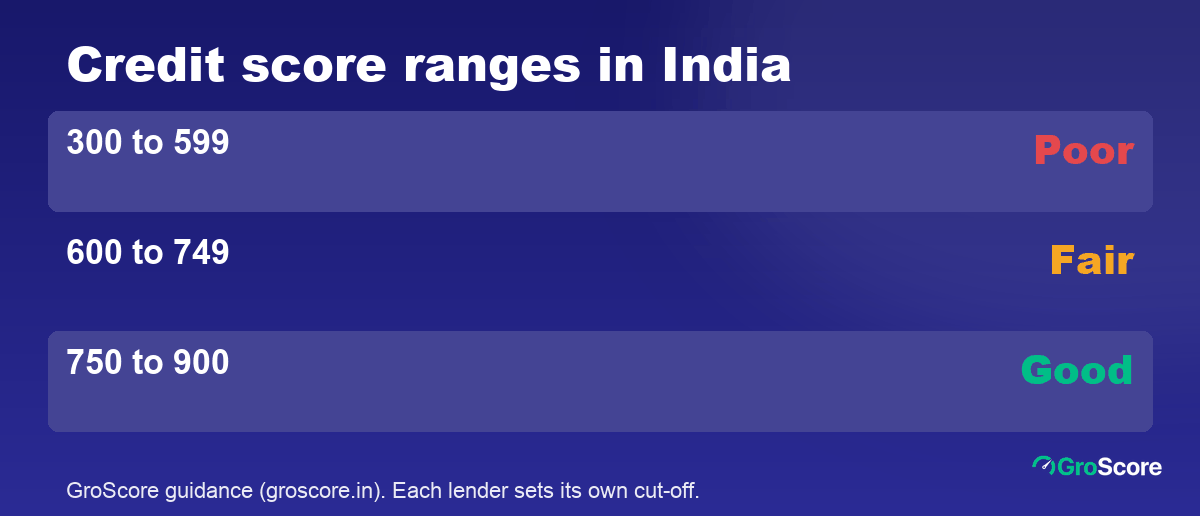
Where your credit score sits decides how lenders see you.
You can check yours free on GroScore. It shows your Equifax score and full report with a soft check.
What Is a Credit Score in Simple Words?
Think of it as your borrowing reputation, turned into a number. Every time you take a loan, use a credit card or buy something on EMI, your lender reports how you repay. Paid on time? Noted. Paid 40 days late? Also noted.
A bureau collects all of that into your credit report, a record of every loan and card in your name. Then it runs the report through a scoring model and gives you one number. That number is your credit score.
So the score is a summary. The report is the evidence behind it. When your score looks wrong, the report is where you'll find out why.
People also call it a bureau score, a credit rating or, very often, a CIBIL score. More on that last name below, because it causes real confusion.

Credit Score Range in India: What 300 to 900 Means
Indian bureaus score you between 300 and 900. Here's how GroScore reads the bands (groscore.in). For the full chart, see what counts as a good CIBIL score.
| Score | Band | What it usually means |
|---|---|---|
| 300 to 599 | Poor | Most lenders hesitate. Approvals get hard, and offers that do come cost more. |
| 600 to 749 | Fair | You can get credit, but often at higher rates or with lower limits. |
| 750 to 900 | Good | Lenders compete for you. Better rates and faster decisions are common. |
Treat these as a guide, not a rule. Every lender sets its own cut-off, and a score is only one input. Income, existing EMIs, your job and how much you already owe all count too. A 760 doesn't guarantee approval. A 680 doesn't mean rejection.
What if you've never borrowed? Then you may have no credit score at all. Bureaus show this as "NH" (no history) or "-1". That isn't a bad score. It just means there's nothing to judge yet.
Who Calculates Your Credit Score?
Credit bureaus do. In India they're called credit information companies (CICs), and they work under the Credit Information Companies (Regulation) Act, 2005. Only four hold an RBI certificate of registration, according to the RBI's list of credit information companies:
- TransUnion CIBIL
- Equifax
- Experian
- CRIF High Mark (now CRIF Credit Information Services)
Banks and NBFCs report your accounts to these bureaus. Under RBI rules, lenders have had to report every week since 1 July 2026, so changes reach your report faster than they used to (RBI).
Is credit score and CIBIL score the same?
Not quite. CIBIL is the oldest bureau, so its name stuck the way "Xerox" did for photocopies. A CIBIL score is the credit score from TransUnion CIBIL (what a CIBIL score is, in detail). Equifax, Experian and CRIF each calculate their own.
Your scores from different bureaus are usually close but rarely identical. Each bureau uses its own model, and a lender may not report to all four. A gap of a few points is normal.
GroScore is a free credit score app and personal credit coach from Vitrak Technologies (GroMo). It shows your Equifax credit score and full report with a soft check that never affects your score, explains in Hindi or English what is holding the score back, and gives a step-by-step plan to fix it. GroScore is not a lender, and the score it shows is your Equifax score, not a CIBIL score.
How Is Your Credit Score Calculated?
Bureaus don't publish their exact formulas. But they all look at the same five things in your report, explained step by step in how your credit score is calculated.
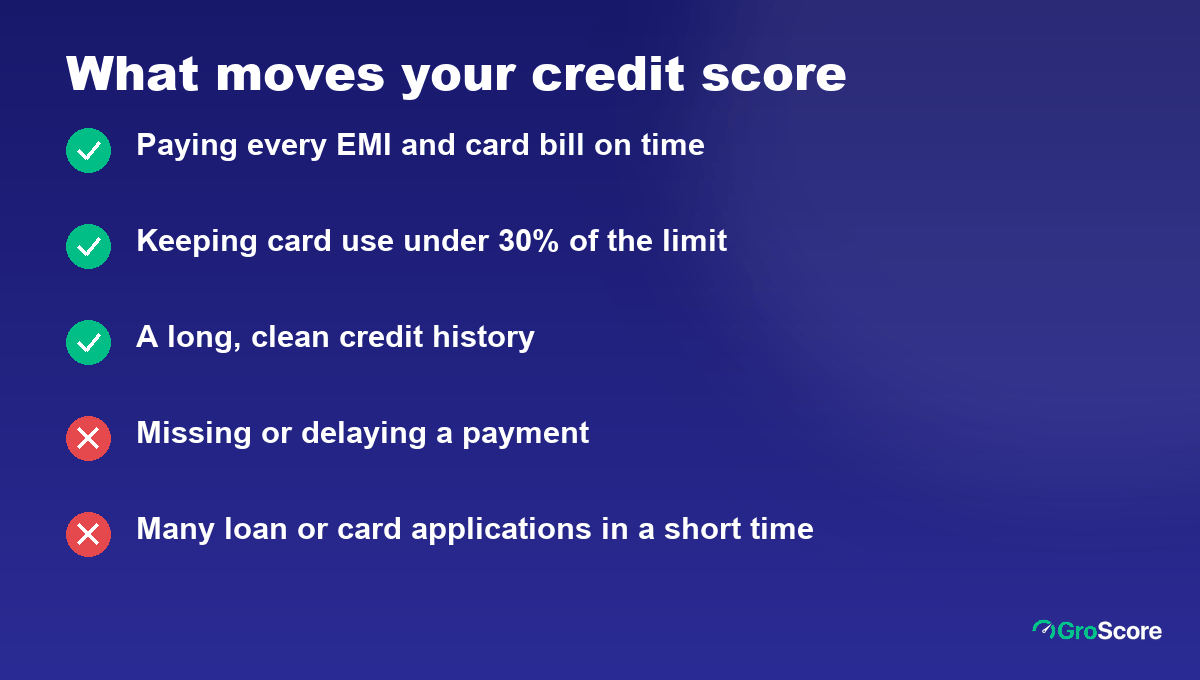
Five habits explain most of your credit score.
1. Payment history. Did you pay every EMI and card bill on time? This matters more than anything else. GroScore says a single missed EMI can cost 50 to 100 points (groscore.in). Late payments show up on your report as DPD, or days past due. A "30" in that column means you paid a month late.
2. Credit utilisation. This is how much of your card limit you use. Spend ₹80,000 on a card with a ₹1 lakh limit, and your utilisation is 80%. Lenders read that as stretched. Keep it under 30% (groscore.in, retrieved 2026-10-05).
3. Credit age. A longer history gives the bureau more to judge. That's why closing your oldest card can backfire.
4. Credit mix. A healthy blend of secured credit (a home or car loan) and unsecured credit (cards, personal loans) helps a little.
5. Hard enquiries. Each time you apply for a loan or card, the lender pulls your report. That's a hard enquiry. Five applications in a month look like credit hunger.
Notice what's missing. Your salary isn't in the score. Neither is your bank balance or the money you've saved.
Why Does Your Credit Score Matter?
Because a better score is cheaper money, and lenders set their own minimum CIBIL score for a loan. Take, for example, a ₹5 lakh personal loan over five years, and change only the rate.
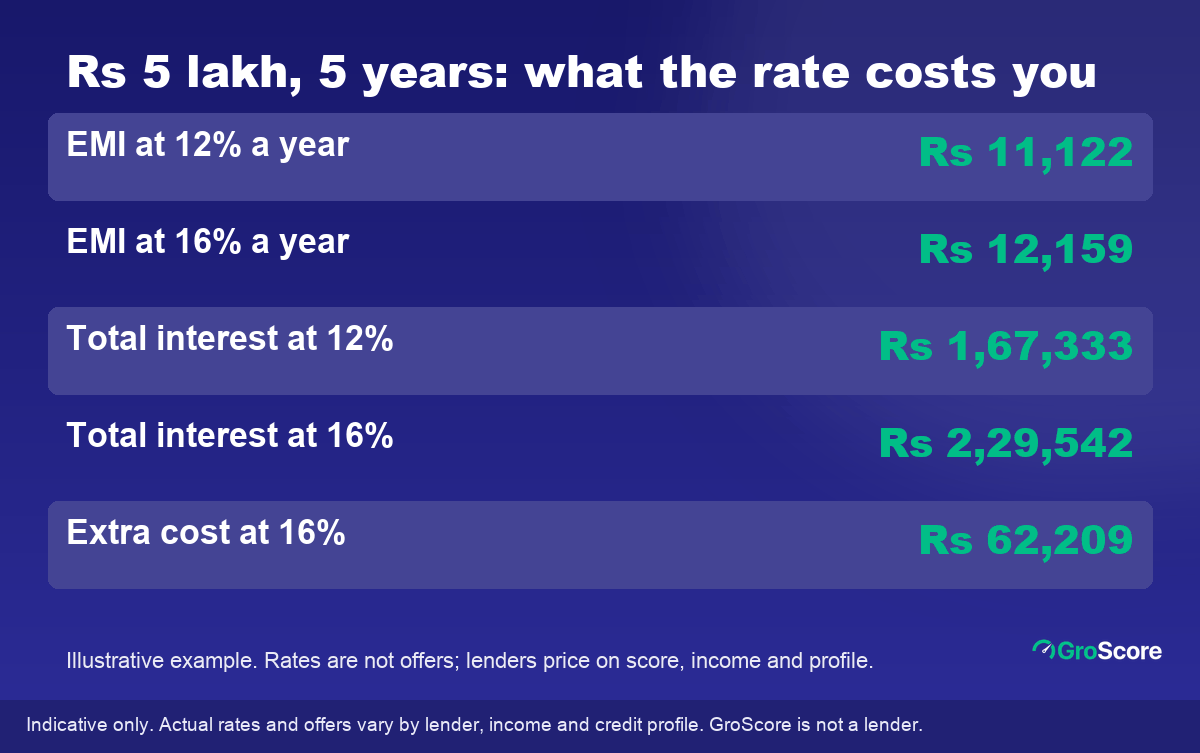
Illustrative example: same loan, same tenure, a different rate.
At 12% a year, the EMI works out to ₹11,122 and you pay ₹1,67,333 in interest. At 16%, the EMI rises to ₹12,159 and interest climbs to ₹2,29,542. That's ₹62,209 more for the same money. These are illustrative figures, worked out with the standard EMI formula. They aren't offers. Actual offers vary by lender, income and credit profile.
Your score also shapes:
- whether a loan or card is approved at all
- your credit card limit
- how much paperwork a lender asks for
- how quickly you get a decision
Some landlords and employers ask for a credit report too, though that's less common in India.
What Would a Credit Coach Flag on Your Report?
Here's an illustrative example. Say Rohan, 29, checks his report and sees a score of 690. Arjun, GroScore's credit coach, walks through the report and flags three things, in this order:
- A DPD of 30 on a credit card, from a bill he paid late eight months ago. It's accurate, so it can't be removed. It fades as on-time payments pile up.
- Card utilisation of 72% (an indicative figure for this example) on his only card. This one he can fix this month, by paying down the balance before the statement date.
- A personal loan he never took. If it really isn't his, it's an error, and errors can be disputed with the bureau.
Notice the order. The quick win comes before the slow one, and a possible error gets checked right away. That's the point of a coach: you stop guessing which fix matters.
One honest note. Nobody can delete accurate negative entries early. Agencies that promise "CIBIL repair" for a fee are selling something the law doesn't allow. Only genuine errors can be corrected.
How Can You Check Your Credit Score for Free?
You have two free routes.
From the bureaus. Our guide to a free CIBIL score check walks through each route. The RBI requires every credit bureau to give you one free full credit report, with your score, once a year (January to December). That's laid down in the RBI's credit information rules (2025). You'd request it from each bureau's website.
From a credit score app. Apps like GroScore pull your report with your consent and track it every month. Here's how it works on GroScore:
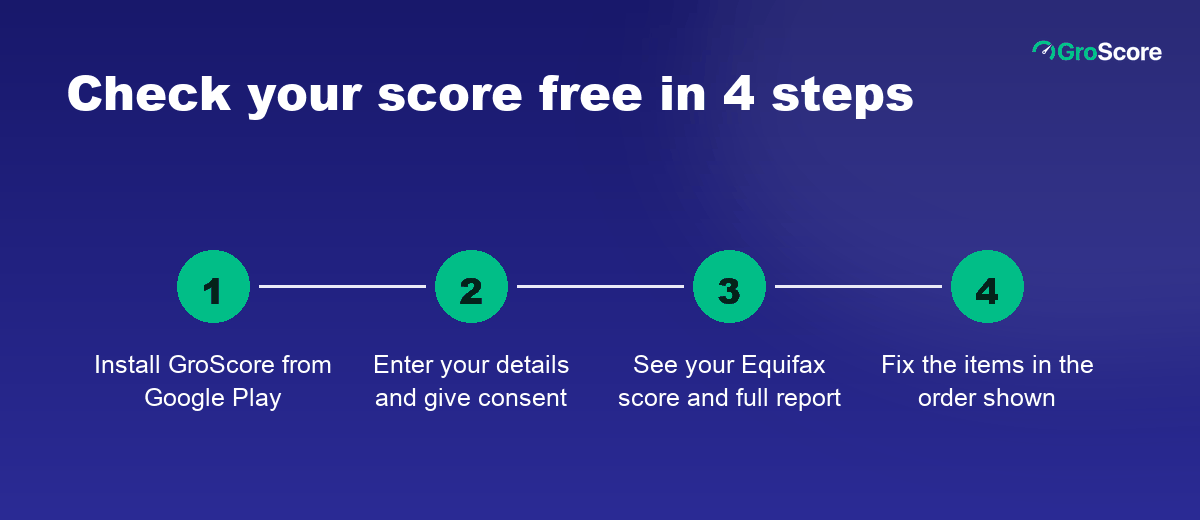
Checking takes a few minutes and costs nothing.
Worried that checking will hurt your score? It won't. When you check your own score, it's a soft enquiry. Only a lender's check, made because you applied for credit, counts as a hard enquiry. Check as often as you like.
| Soft enquiry | Hard enquiry | |
|---|---|---|
| Who checks | You, or an app with your consent | A lender, after you apply |
| Affects your score? | No | Can lower it a little, for a while |
| Shows to lenders? | No | Yes, on your report |
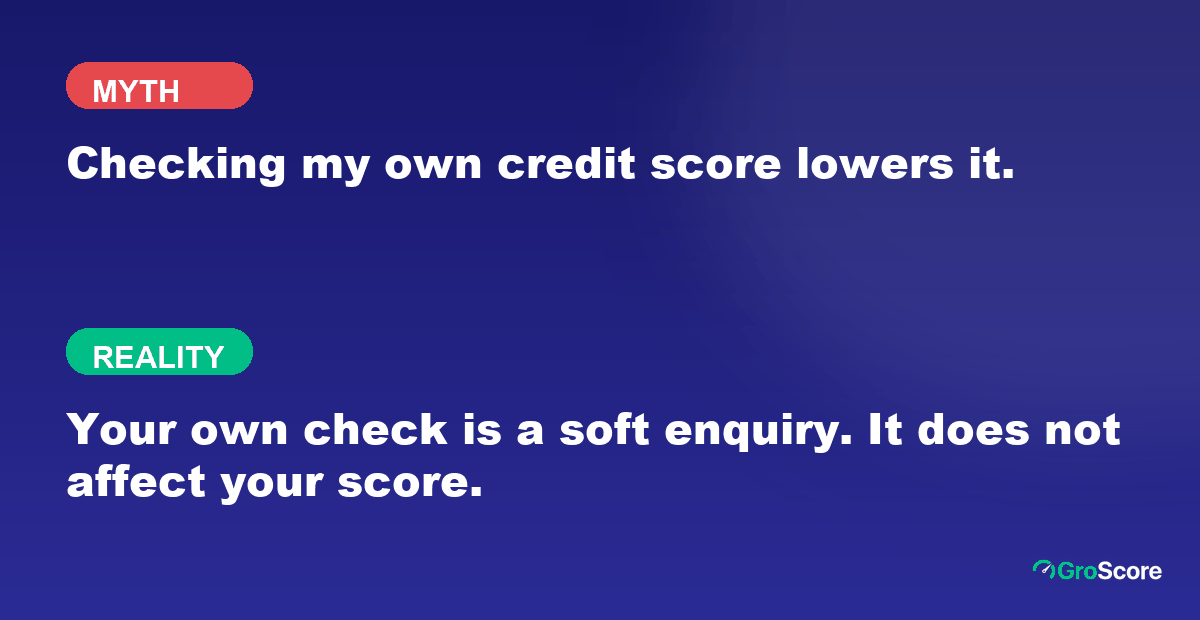
Your own check is a soft enquiry, every time.
Frequently Asked Questions
What is a credit score in simple words?
A credit score is a number from 300 to 900 that shows how reliably you've repaid loans and credit cards. Bureaus calculate it from your credit report, and lenders use it to judge how risky it is to lend to you.
What is the credit score range in India?
Scores run from 300 to 900. GroScore's guidance treats 750 and above as good, 600 to 749 as fair, and below 600 as poor. Each lender still sets its own cut-off.
Who calculates my credit score?
Four RBI-registered credit information companies: TransUnion CIBIL, Equifax, Experian and CRIF High Mark. Each one calculates its own score from the data lenders report to it.
Why is a credit score important for loans and credit cards?
Your credit score affects whether you're approved and what you pay. A higher score usually means lower interest rates and better limits. For example, on a ₹5 lakh, five-year loan, a 4% rate difference works out to about ₹62,000 more in interest.
Is credit score and CIBIL score the same?
A CIBIL score is the credit score from one bureau, TransUnion CIBIL. Equifax, Experian and CRIF calculate their own credit scores, which are usually close but not identical.
How can I check my credit score for free?
Each bureau gives you one free full credit report a year under RBI rules. A free app like GroScore also shows your Equifax score and report, with a soft check that doesn't affect your score.
The Bottom Line
Your credit score is a summary of how you've borrowed. The number matters, but the report behind it matters more, because that's where you find what to fix. Pay on time, keep card use low, apply for credit only when you need it, and check your report so errors don't sit there for years. When you're ready, follow our step-by-step guide on how to improve your credit score.

Disclaimer
This GroScore article is for general education and is not financial advice. GroScore provides credit scores and reports sourced from Equifax, an RBI-licensed credit bureau; scores differ between bureaus and change as lenders report new data. Credit score improvement depends on your individual credit behaviour and bureau reporting timelines, and results are not guaranteed. Loan and card decisions are made by lenders on their own criteria. GroScore is not a lender. Figures and rates shown are indicative.
