How to Calculate CIBIL Score: 5 Factors That Decide It
Five things in your credit report decide the number. Here's how each one works and which to fix first.

Only TransUnion CIBIL can calculate CIBIL score exactly, because its formula is private. You can still work out what drives yours. Every bureau reads five things in your credit report: payment history, credit utilisation, credit age, credit mix and new enquiries. Payment history and utilisation usually move the number most. Salary and savings don't count at all.
Key TakeawaysNo Indian bureau publishes exact factor weights. Any precise percentage split you see online is an estimate, not a bureau's formula.Four RBI-registered bureaus each run their own model, so your CIBIL, Equifax, Experian and CRIF scores differ a little (RBI).A single missed EMI can cost 50 to 100 points, and card use should stay under 30% of the limit (GroScore guidance, groscore.in, retrieved 2026-10-05).Income, bank balance, FDs and your job are not inputs to the score.
Want to see which factor is holding yours back? Check your free Equifax score and report on GroScore. A soft check never lowers your score.
Can You Calculate CIBIL Score Yourself?
Not exactly. A bureau takes your full credit report, every loan and card in your name, and runs it through a private scoring model. Out comes a number between 300 and 900.
TransUnion CIBIL, Equifax, Experian and CRIF High Mark are the four credit information companies registered with the RBI, according to the RBI's list of credit information companies. Each built its own model. None shares the maths.
So what about a "CIBIL score calculator" online? Most ask a few questions and estimate a range. Fine for a rough idea. But an estimate can't see a forgotten overdue on an old card, and that's exactly what drags real scores down.
Here's what you can calculate yourself:
- your credit utilisation, to the rupee
- the age of your oldest account
- how many times you've applied for credit this year
- whether any account shows a late payment
Four numbers like these tell you more than any credit score estimator.
GroScore is a free credit score app and personal credit coach from Vitrak Technologies (GroMo). It shows your Equifax credit score and full report with a soft check that never affects your score, explains in Hindi or English what is holding the score back, and gives a step-by-step plan to fix it. GroScore is not a lender, and the score it shows is your Equifax score, not a CIBIL score.
The 5 Credit Score Factors, in Order of Weight
Every bureau reads the same five things. GroScore's coaching uses the order below. Treat the weight column as approximate.
| Factor | What the bureau reads | Approximate weight | Fastest fix |
|---|---|---|---|
| Payment history | On-time vs late EMIs and card bills, shown as DPD | Highest | Never miss a due date again |
| Credit utilisation | Card balances as a share of limits | High | Pay down before the statement date |
| Credit age | How long your accounts have been open | Medium | Keep old cards open |
| Credit mix | Secured loans vs unsecured cards and loans | Lower | Don't borrow just for mix |
| New enquiries | Recent applications for credit | Lower | Space out applications |
Why no percentages? Because the bureaus don't publish them. Those neat pie charts online borrow figures from a US scoring model, and Indian bureaus have never confirmed the splits.
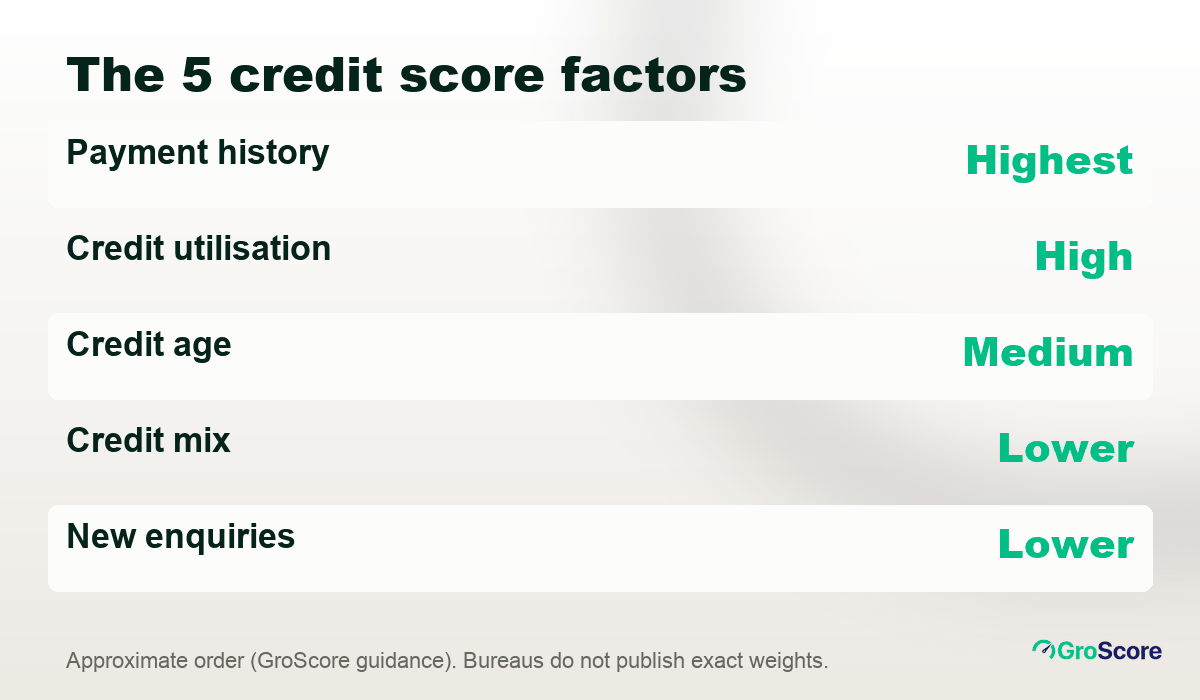
Approximate order of importance. Bureaus don't publish exact weights.
1. Payment history
Here's the big one. Did you pay every EMI and card bill by its due date?
Late payments land on your report as DPD, or days past due. A "30" means you paid a month late. A "90" is far worse. A single missed EMI can cost 50 to 100 points (GroScore guidance, groscore.in), though the real hit depends on the rest of your report.
Settled and written-off accounts also sit here. Both tell a lender you didn't repay in full. Our guide to payment history goes deeper on how late payments affect your score.
2. Credit utilisation
Utilisation is the share of your card limit you're using. For example, spend ₹30,000 on a card with a ₹1 lakh limit and you're at 30%, right on GroScore's suggested ceiling.
Lenders read high utilisation as stress, even when you pay in full. Why? The bureau usually sees the balance on your statement date, not after you pay.
How Does Utilisation Change the Maths? A Worked Example
Utilisation is the factor you can change fastest, so do the arithmetic.
Here's an illustrative example. Say Priya, 31, has two credit cards. Arjun, GroScore's credit coach, adds up her balances on statement day:
| Card A | Card B | Total | |
|---|---|---|---|
| Limit | ₹50,000 | ₹1,00,000 | ₹1,50,000 |
| Balance on statement day | ₹40,000 | ₹20,000 | ₹60,000 |
| Utilisation | 80% | 20% | 40% |
Her overall utilisation works out to ₹60,000 ÷ ₹1,50,000 = 40%. That's above GroScore's 30% line.
Now suppose she pays ₹15,000 on Card A three days before its statement date. Her new balance works out to ₹45,000, and utilisation to ₹45,000 ÷ ₹1,50,000 = 30%. A credit limit increase would lower the ratio too, as long as her spending stays the same.
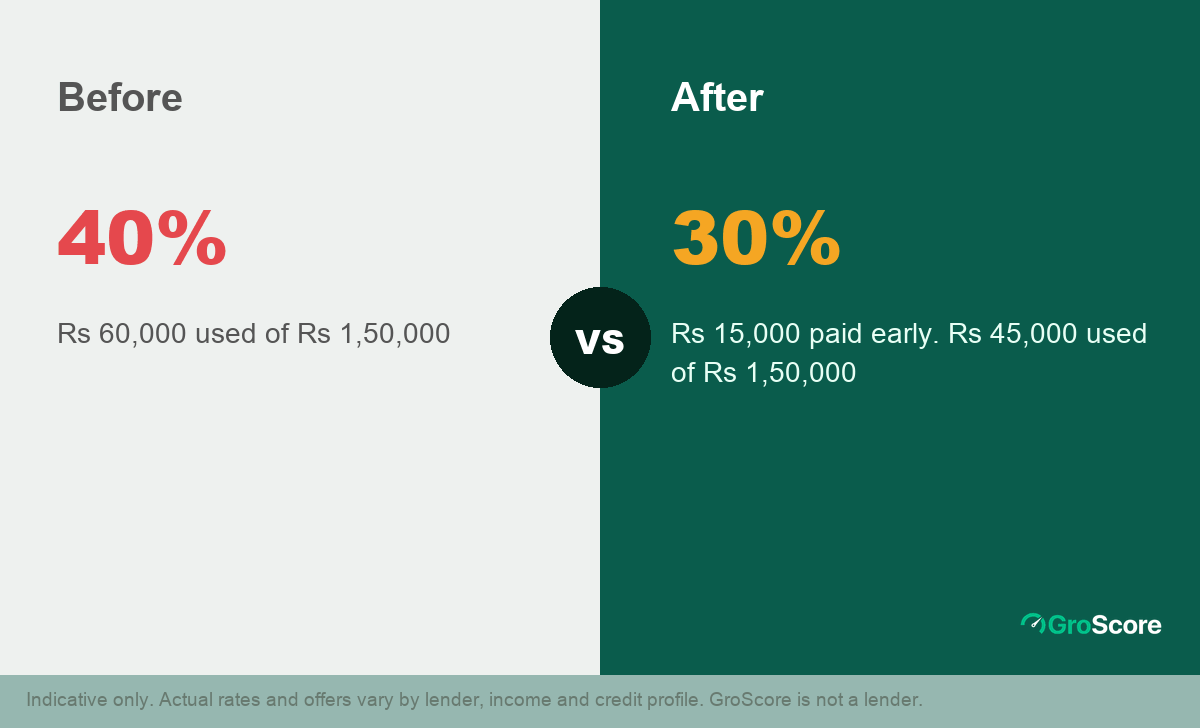
Illustrative example: two cards, one early payment.
Card A alone still sits at 50%, which works out from ₹25,000 ÷ ₹50,000. Some models look at each card as well as the total, so Arjun flags Card A as the one to keep paying down.
Arjun would warn about one more thing. Suppose Priya closed Card B to "simplify". Her total limit would drop to ₹50,000, and the same ₹45,000 balance works out to 90% utilisation. Closing an unused card can raise your ratio overnight.
All of these figures are illustrative. How many points a lower ratio adds depends on your full report, and results are not guaranteed. For the full method, see how to keep utilisation under 30%.
Credit Age, Credit Mix and Enquiries
The last three factors carry less weight. They still decide close calls.
3. Credit age
Bureaus like a long track record. Your oldest card, maybe the one from college, quietly stretches your average account age. Don't close it just because you rarely use it. Put one small bill on it each month and pay it off.
4. Credit mix
A blend of secured credit (home, car or gold loan) and unsecured credit (cards, personal loans) shows you can handle different types. Small factor.
Never take a loan just to improve your mix. The interest costs more than the mix earns you.
5. New enquiries
Each time you apply for a loan or card, the lender pulls your report. That pull is a hard enquiry, and other lenders can see it. Several in a few weeks can look like credit hunger.
Checking your own score is different: a soft enquiry, with no effect. Our guide to hard vs soft enquiry explains which checks count.
What Doesn't Affect Your Credit Score?
People are often surprised here. Bureaus only see credit data, so most of your money life is invisible to them.
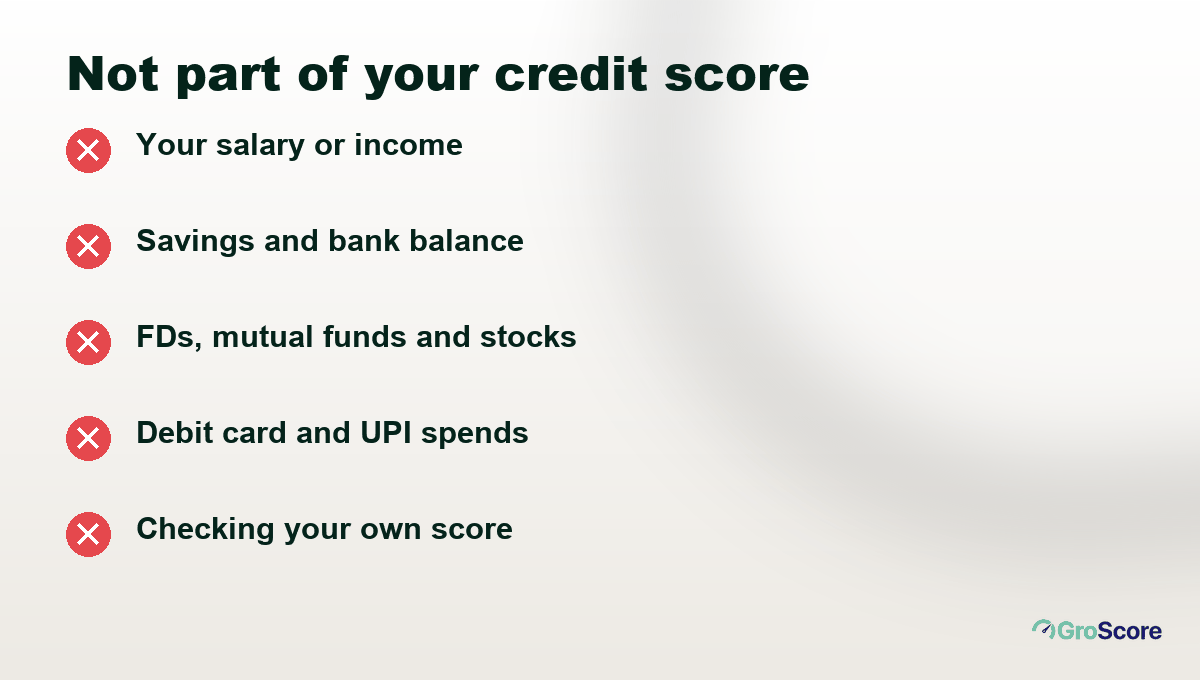
Your score only reads credit accounts.
- Income. A high salary and a modest one start from the same place. Lenders check income separately when you apply.
- Savings and FDs. A big balance doesn't raise your score. An FD only helps if it backs a secured credit card that you repay well.
- Debit card and UPI spends. They aren't credit, so lenders don't report them.
- Investments. Mutual funds, stocks and gold don't feature.
- Checking your own score. Soft enquiry, zero effect.
Rent and utility bills generally aren't reported to Indian bureaus either. Paying them on time is a good habit. It won't build a score.
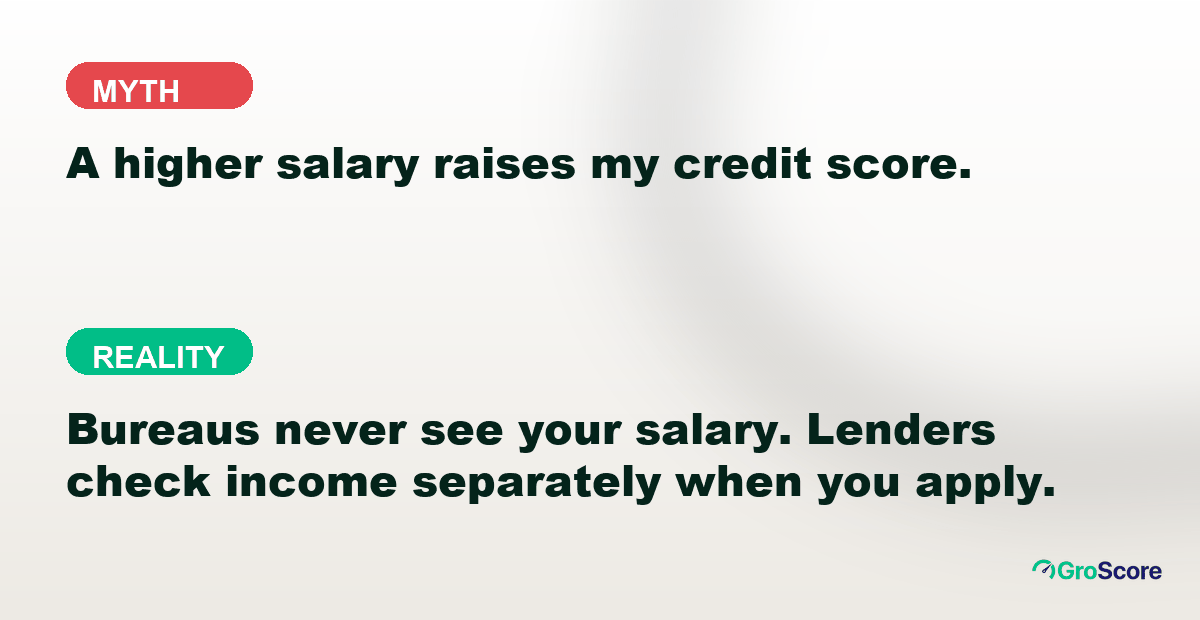
Lenders look at income. The bureau score doesn't.
Why Do Your CIBIL and Equifax Scores Differ?
You might see 742 on one app and 758 on another. Neither is wrong.
Each bureau runs its own model. Lenders don't always report to all four, so one report may hold an account another lacks. Timing matters too. Since 1 July 2026, lenders have had to report credit data every week, under the RBI's credit information rules (2025). A payment may reach one bureau a few days before another.
If the bureaus are new to you, our credit score guide explains who they are and what the range means.
A gap of a few points is normal. A gap of 80 usually means the reports differ, and that could be an error worth checking.
GroScore shows your Equifax score. For your CIBIL score, use the free full report every bureau must give you once a year under RBI rules, on CIBIL's own site.
What Should You Fix First?
Work in order of weight, but start with whatever changes quickest. GroScore's coach usually sequences it like this:
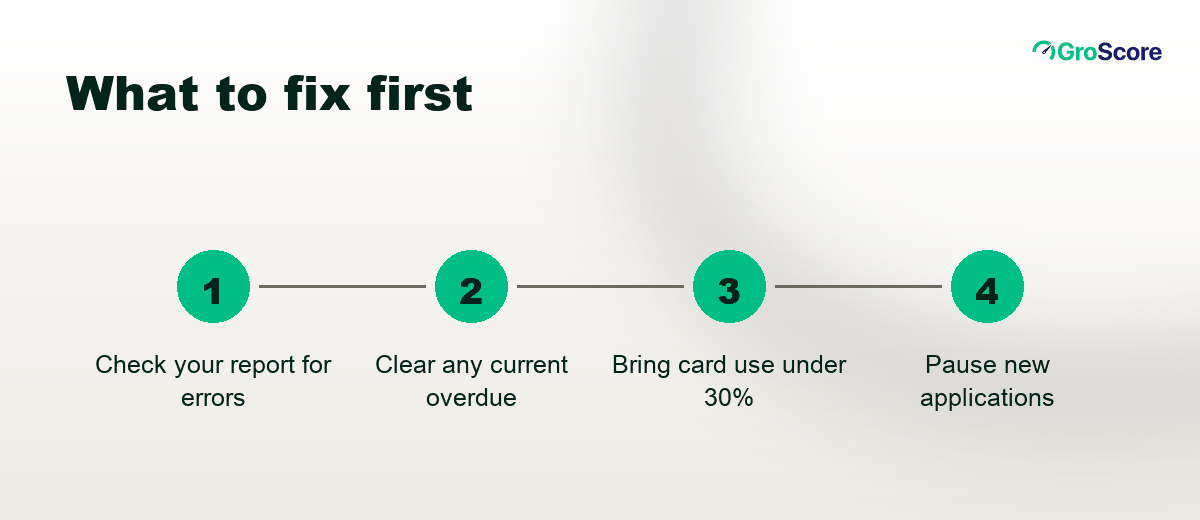
Fix the heaviest factor you can change this month.
- Check the report for errors. About 1 in 5 reports carries one (GroScore guidance, groscore.in). A loan that isn't yours is a dispute, not a habit to fix.
- Clear any current overdue. An account still past due keeps adding DPD every month.
- Bring utilisation under 30%. That's GroScore's guidance line (groscore.in, retrieved 2026-10-05). Pay before the statement date, or spread spends across cards.
- Pause new applications. Give enquiries time to age.
Nobody can remove accurate late payments early. Their weight fades as on-time months pile up. Agencies that promise to delete them for a fee are selling something the rules don't allow.
When you're ready for the full plan, our guide on how to raise your credit score walks through each step.
Frequently Asked Questions
How is a CIBIL score calculated?
TransUnion CIBIL runs your credit report through its own private model, weighing payment history, utilisation, credit age, credit mix and recent enquiries. It doesn't publish the formula or the weights. Payment history is widely treated as the heaviest factor.
Which factor affects my credit score the most?
Payment history. A single missed EMI can cost 50 to 100 points by GroScore's guidance, and the DPD stays visible on your report for years. Utilisation comes next, and you can usually change it within one billing cycle.
Can I calculate my own credit score?
Not the exact number, since only bureaus run their models. You can calculate the inputs: your utilisation, your oldest account's age and your enquiries this year. Then check the real score with a soft enquiry, which doesn't affect it.
Does income affect my credit score?
No. Bureaus don't receive your salary, so it plays no part. Lenders look at income separately, along with your existing EMIs, when they decide on a loan.
Do savings or FDs affect my credit score?
Not directly. Bank balances and FDs aren't credit, so nobody reports them. An FD helps only indirectly, if it backs a secured card that you repay on time every month.
The Bottom Line
You can't run the bureau's formula, and you don't need to. Pay every bill on time, keep card balances low on statement day, leave old cards open and apply only when you need credit. Those habits cover all five factors. If cards make up most of your credit, our guide to your credit card score shows how each habit plays out. Then check your report regularly so an error doesn't quietly cost you.

Disclaimer
This GroScore article is for general education and is not financial advice. GroScore provides credit scores and reports sourced from Equifax, an RBI-licensed credit bureau; scores differ between bureaus and change as lenders report new data. Credit score improvement depends on your individual credit behaviour and bureau reporting timelines, and results are not guaranteed. Loan and card decisions are made by lenders on their own criteria. GroScore is not a lender. Figures and rates shown are indicative.
