How Do Late Payments Affect Your Credit Score? Payment History
Payment history is the heaviest factor in your score. Here's how every on-time EMI helps, and how a late one is recorded, graded and slowly outweighed.

How do late payments affect your credit score? They hurt it more than almost anything else, because payment history is the heaviest factor in every bureau's model. Each late EMI or card bill is recorded as days past due (DPD), and the longer it stays unpaid, the worse the entry. GroScore says one missed EMI can cost 50 to 100 points. Every on-time month adds weight back on your side.
Key TakeawaysPayment history moves your score most. One missed EMI can cost 50 to 100 points (groscore.in).DPD grades lateness. A loan unpaid for over 90 days can turn non-performing (RBI).A card can be reported past due only once it's more than three days late (RBI).Accurate late payments stay on your report, but their weight fades.
See your payment record month by month with your free Equifax score on GroScore. A soft check never lowers your score.
What Is Payment History in Your Credit Score?
Payment history is the record of whether you paid each EMI and card bill by its due date. Your lender reports each account's status to the credit bureaus, including whether you paid late and by how many days.
Bureaus don't publish their exact weights. Still, every model puts payment history first. Lenders want to know if you'll repay on time, and your past is their best evidence. Each on-time month is a small positive, and a late month is a large negative.
GroScore is a free credit score app and personal credit coach from Vitrak Technologies (GroMo). It shows your Equifax credit score and full report with a soft check that never affects your score, explains in Hindi or English what is holding the score back, and gives a step-by-step plan to fix it. GroScore is not a lender, and the score it shows is your Equifax score, not a CIBIL score. CIBIL is one of four RBI-registered bureaus, alongside Equifax, Experian and CRIF High Mark.
For how payment history fits with utilisation, credit age, credit mix and enquiries, see how your credit score is calculated.
DPD 30, 60, 90: How Do Late Payments Affect Your Credit Score?
DPD, or days past due, counts the days since the oldest unpaid due date on an account. That's how late payments are calculated on a credit report. The longer a payment stays unpaid, the higher the number, and the more it hurts.
| DPD on your report | What it usually signals | How lenders classify a loan (RBI) |
|---|---|---|
| 000 | Paid on time | Standard |
| 1 to 30 | A slip, often a missed date | SMA-0 |
| 31 to 60 | A second month unpaid | SMA-1 |
| 61 to 90 | Serious stress | SMA-2 |
| Over 90 | Default risk | Can become an NPA |
SMA means special mention account, an early-warning tag. NPA means non-performing asset. Classes follow the RBI's prudential norms for lenders.
On your report, a clean month usually shows as 000 or STD (standard). For every other code, see what STD means in CIBIL.
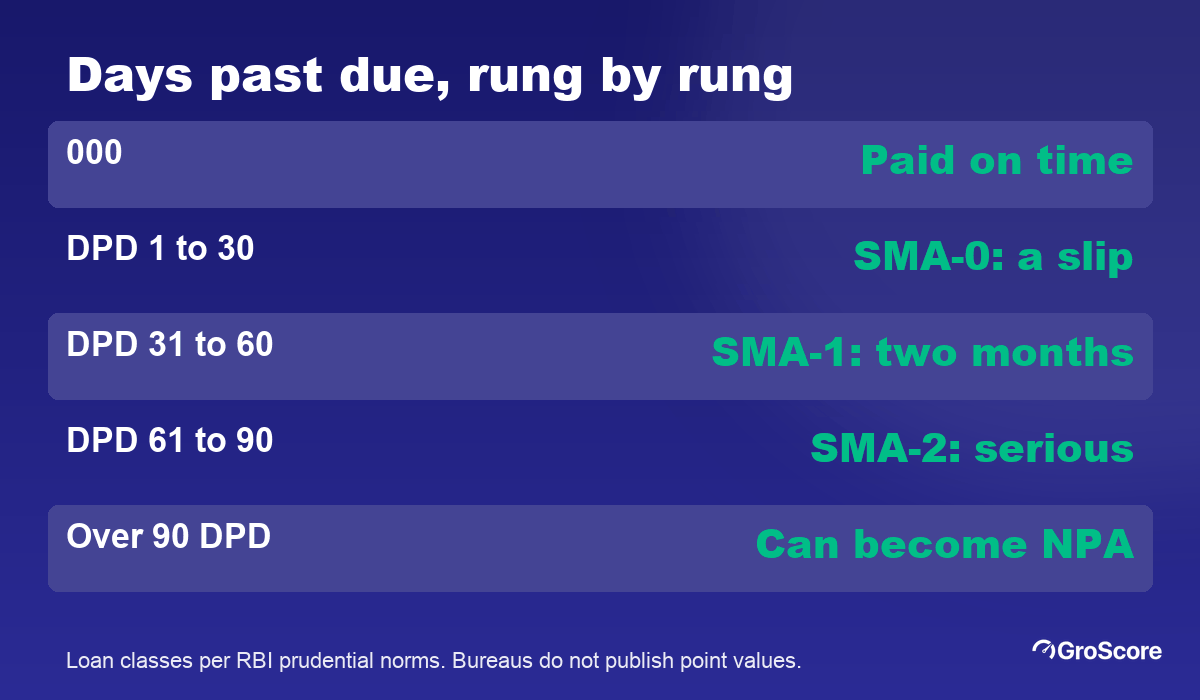
Each extra month unpaid moves you a rung down.
So how badly does a missed payment affect credit? Three things decide it:
- Severity. A 30 is a warning. A 90 tells lenders you stopped paying.
- Recency. A late payment last month weighs more than one from years ago.
- Frequency. One slip in five years reads very differently from a late payment every few months.
On a thin file with one card, a single late payment carries more weight than on a file with ten years of clean history. Nobody can promise a fixed number of points. GroScore's own guidance is that one missed EMI can cost 50 to 100 points (groscore.in, retrieved 2026-10-05).
The words "settled" and "written off" also sit in payment history. Both tell a lender the account wasn't repaid as agreed.
Is a Payment One Day Late Reported to CIBIL?
A card payment one day late shouldn't be reported. Under the RBI's Master Direction on credit and debit cards, issuers may report a card as past due, or charge a late fee, only when it stays past due for more than three days. Once that happens, DPD is counted from the original due date.
So how does a late credit card payment affect credit score? Take a ₹10,000 bill due on the 5th. Paid on the 7th, it shouldn't reach the bureaus. Paid on the 10th, it can, with DPD counted from the 5th (RBI). Don't plan around those three days. Treat the due date as the deadline.
Loans don't get that three-day cushion. If your EMI bounces, the lender can charge for it, and the account can show as overdue at the next report. Lenders have had to report to the bureaus every week since 1 July 2026, under the RBI's 2025 amendment directions on credit reporting. A missed date can show up on your report within days.
What counts as paid on time for a card? Paying at least the minimum amount due by the due date keeps the account current. You'll still pay interest on the rest, and your utilisation stays high, but no DPD is reported.

What Does One Late Month Look Like on Your Report?
Here's an illustrative example on a personal loan. Say Rahul's EMI bounces in March because his salary came in late. He doesn't notice. In April, the second EMI goes unpaid too. In May, he clears both EMIs and the charges.
| Month | What happened | What his report may show |
|---|---|---|
| January | EMI paid on time | 000 |
| February | EMI paid on time | 000 |
| March | EMI bounced, not noticed | DPD in the 1 to 30 range |
| April | Second EMI missed | DPD in the 31 to 60 range |
| May | Both EMIs and charges cleared | 000 |
| June onward | Paid on time | 000 |
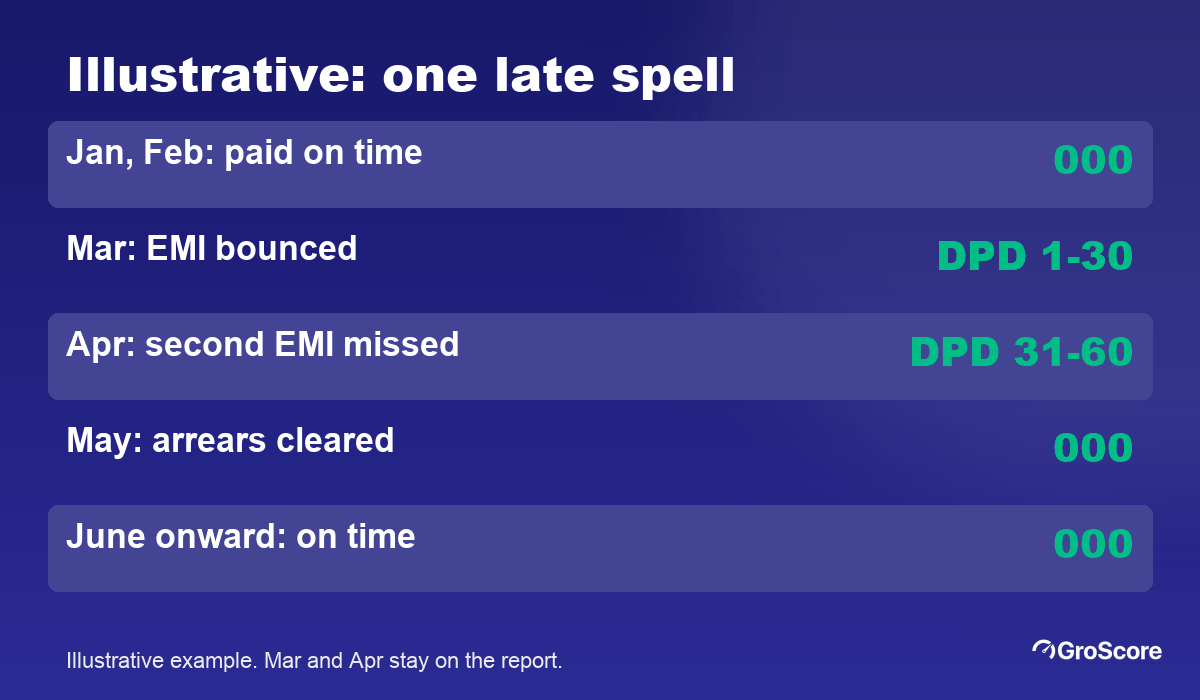
In this illustrative example, the late months stay while the clean ones keep adding up.
In May the account went back to current, and DPD stopped climbing. Every month you stay unpaid, the number grows, so clearing arrears fast matters.
March and April don't change. They stay on the report, and paying later doesn't rewrite them as on time.
What would a credit coach flag here?
Arjun, GroScore's credit coach, would read Rahul's report and flag three things, in this order:
- Confirm the account is current now. If May still shows an overdue amount, a charge may be unpaid. Clear it before anything else.
- Fix the cause. The EMI date fell before salary day. Rahul can ask the lender whether the EMI date can move after it.
- Leave the rest to time. Accurate late entries can't be removed. What helps now is a long run of 000s behind them.
He doesn't need a dispute, an agency or a shortcut. For the step-by-step recovery after a missed EMI, see missed EMI and your CIBIL score.
How Long Do Late Payments Affect Your Credit Score?
Late payments affect your score for longer than people hope, but less each month. Your report keeps a month-by-month payment record for each account, and an accurate late payment stays in it. Bureaus don't publish when the effect ends.
The weight changes, though. Recent behaviour counts for more than old behaviour. A single 30 DPD from two years ago, followed by clean months, usually matters far less than the same entry last month. GroScore says moving from 600 to 750 usually takes six to twelve months, depending on what's on the report (groscore.in). Results are not guaranteed.
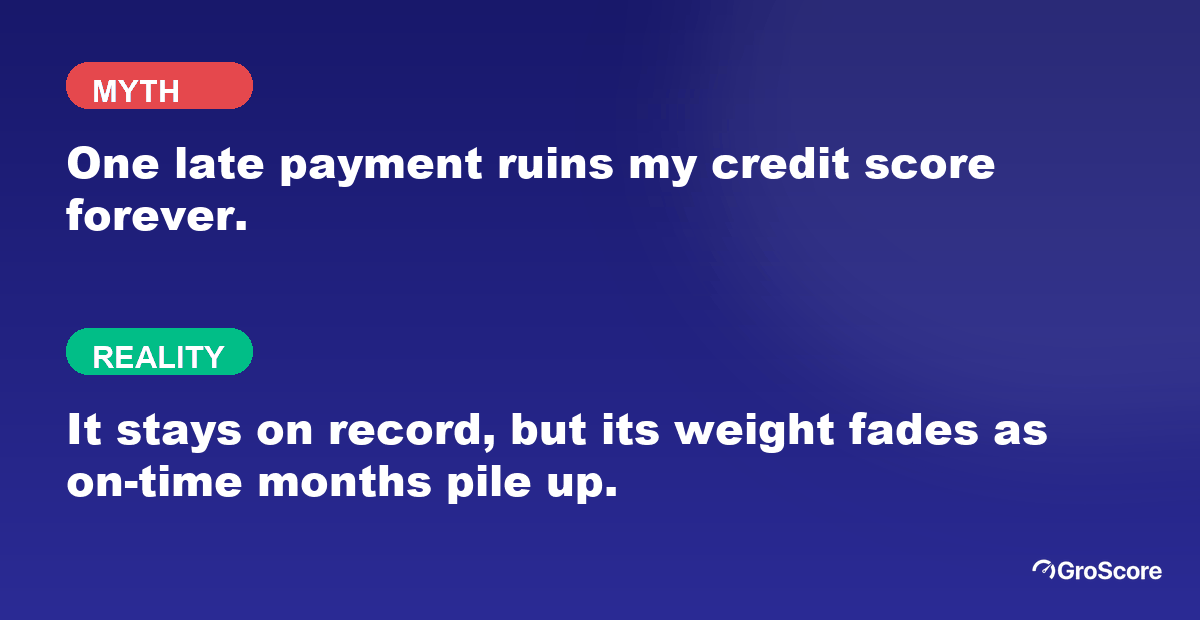
The entry stays. Its weight fades.
Can you remove missed payments from a credit report? Only if they're wrong. GroScore says about 1 in 5 reports, or roughly 20%, carries an error (groscore.in, retrieved 2026-10-05). A late payment you didn't make, or a DPD on a loan you'd already closed, is an error. You can dispute it with the bureau, and the lender has to check its records. Anyone who promises to delete accurate late payments for a fee is selling something the rules don't allow.
Does Paying EMIs on Time Improve Your Credit Score?
Paying on time improves your score slowly and steadily. Each on-time EMI and card bill adds another clean month to your record. That steady run is what outweighs an old slip, and it's what lets a new borrower build a score from nothing.
Paying credit card bills on time builds credit in the same way. A card adds a payment record every month, plus a utilisation figure. Keep both clean: pay by the due date, and keep your credit utilisation ratio low. For example, a ₹20,000 statement balance on a ₹1,00,000 limit is 20%, under GroScore's 30% line (groscore.in, retrieved 2026-10-05).
Paying early earns no extra points over paying on the due date. For cards, though, paying before the statement date can lower the balance that gets reported.
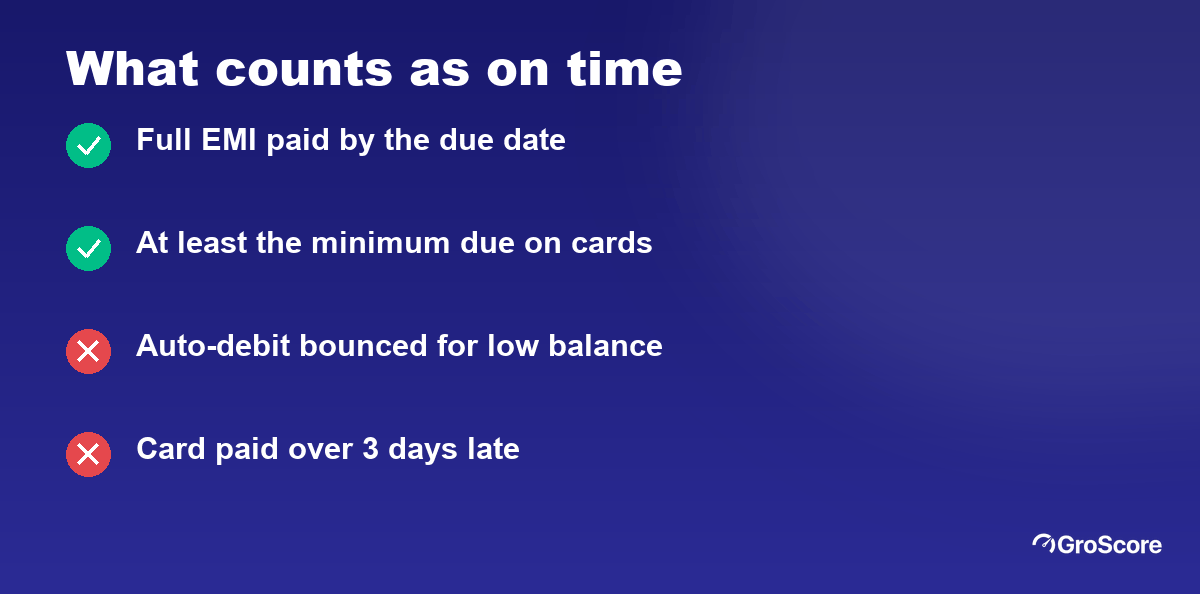
Here's what the bureau records as on time, and what it doesn't.
How to Make Sure You Never Pay Late
The best payment history is boring, so set it up once.
- Set up auto-debit. Link your salary account to every EMI and to at least each card's minimum due.
- Align due dates with salary day. Ask your lender or issuer if the date can move.
- Set two reminders. Put one a week before and one two days before.
- Keep a buffer. One EMI's worth of spare money stops a bounce when salary is late. If you're thinking of a higher card limit as a cushion instead, read whether increasing your credit limit affects your score first.
Check your report every month too. A surprise DPD is easier to fix in week one than in month three. GroScore tracks the report monthly and flags overdue payments inside the app (groscore.in).
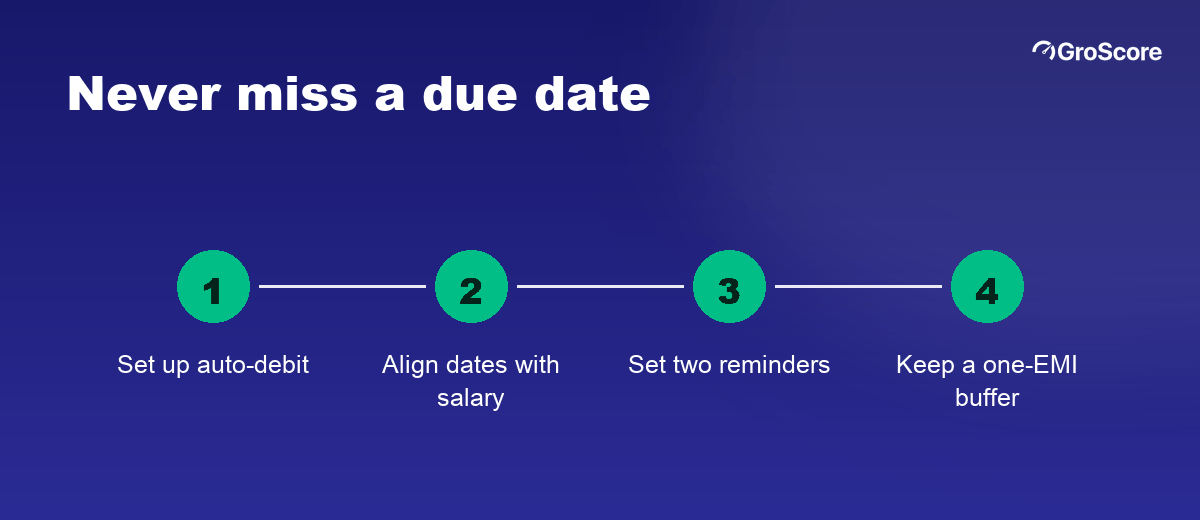
These four habits protect the heaviest factor in your score.
Frequently Asked Questions
How many points does one late payment cost?
GroScore's guidance is that one missed EMI can cost 50 to 100 points. The real effect depends on how late it was, how recent it is and how much clean history surrounds it.
Does paying EMIs on time improve my credit score?
Paying EMIs on time builds your score slowly. Each on-time month adds to your payment history, the heaviest factor in your score, and a long clean run is what outweighs older late payments.
Is a payment one day late reported to CIBIL?
For credit cards, RBI rules let issuers report a card as past due only once it's more than three days late. Loans have no such cushion in that rule, so an unpaid EMI can show as overdue when the lender next reports. Lenders now report weekly.
How long does a late payment stay on my report?
An accurate late payment stays on your report's payment record. Its effect on your score fades as newer on-time months build up. Only incorrect entries can be disputed and removed.
Does paying credit card bills on time build credit?
Yes. Paying at least the minimum due by the due date keeps the account current, and paying the full bill also avoids interest and keeps utilisation low. Both feed your score every month.
The Bottom Line
Payment history is the factor that moves your score most, in both directions. A late payment is graded by how long it stays unpaid, so clear any overdue fast. The entry stays, but each clean month after it carries weight. Set up auto-debit, align your dates with salary day and check your report monthly.

Disclaimer
This GroScore article is for general education and is not financial advice. GroScore provides credit scores and reports sourced from Equifax, an RBI-licensed credit bureau; scores differ between bureaus and change as lenders report new data. Credit score improvement depends on your individual credit behaviour and bureau reporting timelines, and results are not guaranteed. Loan and card decisions are made by lenders on their own criteria. GroScore is not a lender. Figures and rates shown are indicative.
