How to Improve Credit Utilization Ratio: The 30% Rule
The one credit score factor you can change this month, with the arithmetic shown.

Your credit utilisation ratio is the share of your credit card limit you're using: balance divided by limit, times 100. Here's how to improve credit utilization: keep that ratio under 30% on each card and overall, as GroScore advises (groscore.in, retrieved 2026-10-05). Pay down before your statement date, pay twice a month and spread spends across cards.
Key TakeawaysUtilisation = card balance ÷ credit limit × 100. Keep it under 30% (groscore.in).Lenders see each card and your total. One maxed-out card can stand out.The balance that reaches the bureau is usually the one on your statement, so paying before the statement date matters.Utilisation changes once your lender reports the new balance. Since 1 July 2026, lenders report every week (RBI).
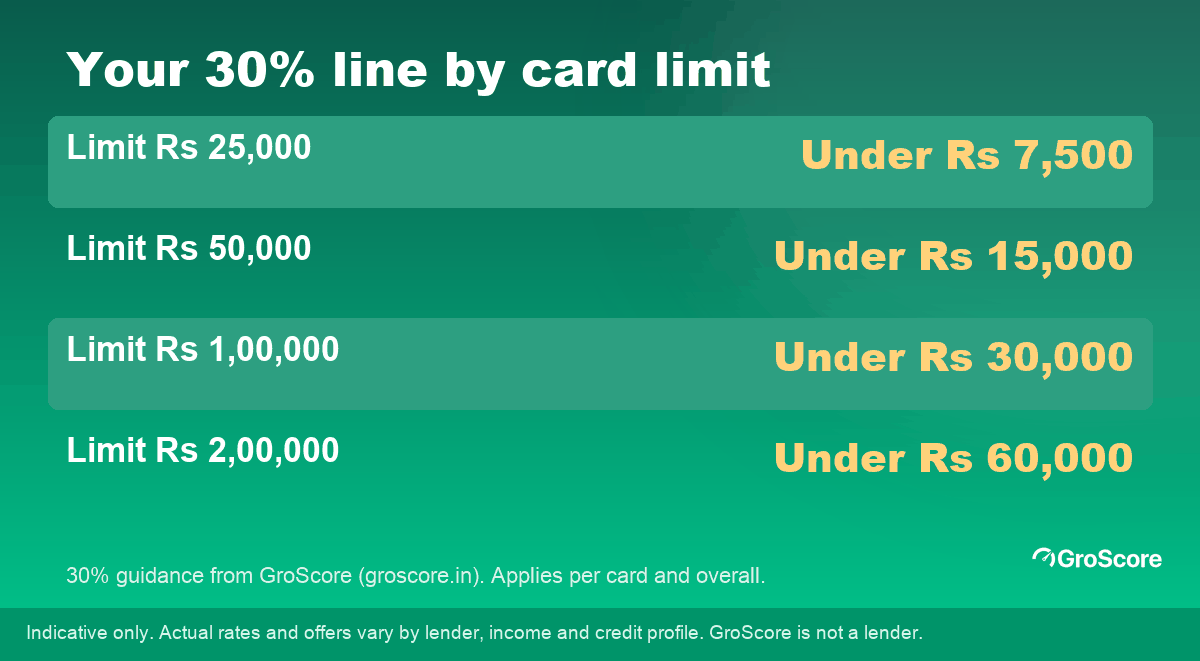
Your 30% line, worked out for common card limits.
What Is a Credit Utilisation Ratio?
Credit utilisation is how much of your available card credit you're using right now. For example, spend ₹30,000 on a card with a ₹1,00,000 limit and your utilisation on that card is 30%.
Bureaus look at it because it shows how stretched you are. For example, someone using 90% of every limit, month after month, looks like they're leaning on credit to get by. Someone using 15% looks comfortable. Your salary isn't in your credit report, so this ratio is one of the few signals a lender has about how much room you have.
Utilisation is mostly about credit cards and other revolving credit. A home loan or personal loan has a fixed repayment schedule, so it's judged on whether you pay on time, not on a ratio. For how utilisation fits with payment history, credit age, credit mix and enquiries, see the guide to credit score factors.
How to Calculate Your Credit Utilisation Ratio
The formula is simple:
Utilisation (%) = total card balance ÷ total card limit × 100
Do it twice: once for each card, and once for all your cards together. Here's the 30% line for common limits, using GroScore's guidance (groscore.in, retrieved 2026-10-05):
| Card limit | 30% of limit | Keep your balance under |
|---|---|---|
| ₹25,000 | ₹7,500 | ₹7,500 |
| ₹50,000 | ₹15,000 | ₹15,000 |
| ₹1,00,000 | ₹30,000 | ₹30,000 |
| ₹2,00,000 | ₹60,000 | ₹60,000 |
Your limit and current balance are printed on every card statement. They're also listed against each card in the account section of your credit report. If you've never looked, the guide to reading your CIBIL report shows where.
Is Utilisation Counted Per Card or Overall?
Both can show. Your credit report lists every card with its own balance and limit, so a lender sees each one. Bureaus don't publish their formulas, but a lender reading your report can spot, for example, a single card running at 95% even if your total looks healthy.
The 30% line works best applied twice, per card and overall. Here's an illustrative example with the arithmetic shown.
For example, say Neha has two cards: - Card A: limit ₹50,000, balance ₹40,000. That's 80%. - Card B: limit ₹1,50,000, balance ₹5,000. That's about 3%. - Overall: ₹45,000 ÷ ₹2,00,000 = 22.5%.
Her overall ratio is under 30%. Card A isn't. So she pays ₹25,000 towards Card A before its statement date. That works out to ₹15,000 ÷ ₹50,000 = 30% on Card A, and her overall drops to ₹20,000 ÷ ₹2,00,000 = 10%.
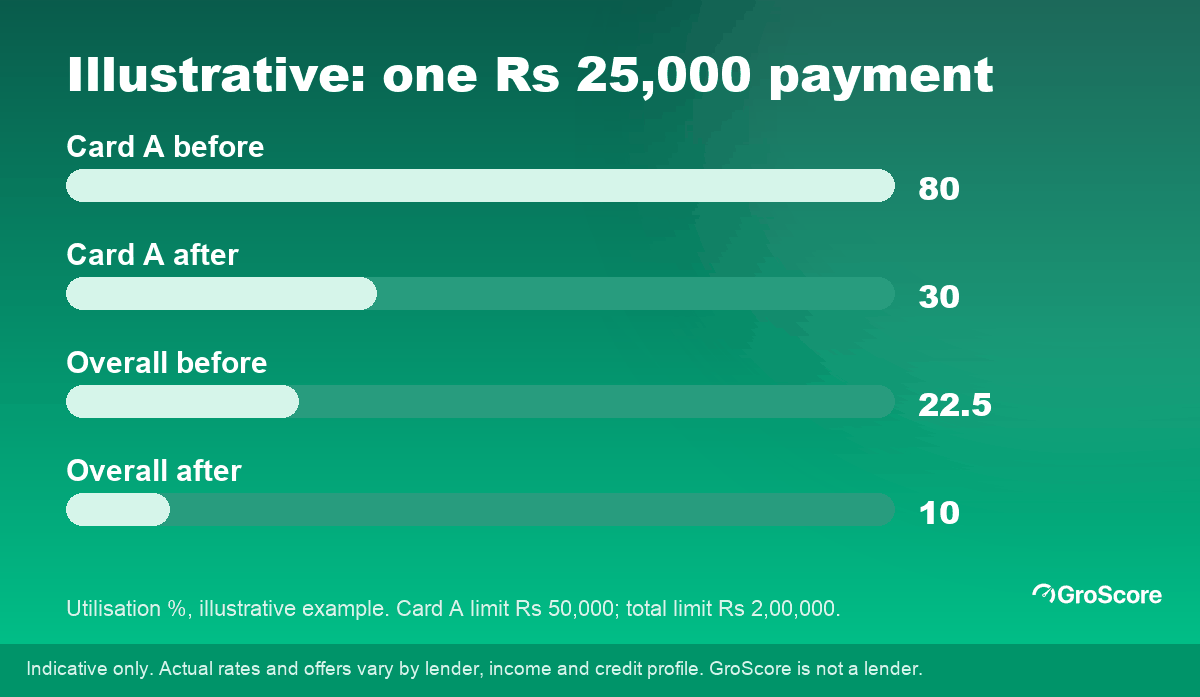
Illustrative example: one payment, timed right, fixes both numbers.
Same money she'd have paid anyway. She just paid it before the statement instead of after.
7 Ways: How to Improve Credit Utilization Without Spending Less
Start with the ones that cost nothing.
1. Pay before the statement date, not just the due date. Your due date is when the bill must be paid. Your statement date comes earlier, and the balance on it is usually what gets reported. Paying down before that date means a lower number reaches the bureau.
2. Make two payments a month. Pay once mid-cycle and again on the due date. Your spending doesn't change. The balance on your statement does.
3. Spread big spends across cards. A ₹40,000 purchase on a ₹50,000 card is 80%. Split across two cards, it can stay under 30% on each.
4. Keep old cards open. Closing a card removes its limit. Your total limit shrinks, so the same spending becomes a higher ratio. Closing your oldest card can also shorten your credit history.
5. Ask for a higher limit, carefully. A higher limit lowers the ratio if your spending stays the same. Ask your card issuer whether the request involves a credit check first, and only do it if you won't treat the extra limit as extra money. Our guide on whether a higher limit helps your score covers the trade-offs.
6. Pay down the fullest card first. If you're carrying a balance month to month, clear the card with the highest balance-to-limit ratio first. It's usually the one hurting most.
7. Don't park big expenses on cards for months. Card interest is steep. If a large expense will take months to repay, a lower-cost loan from an RBI-regulated lender may cost less, but it adds a new account and a hard enquiry, so weigh that first.
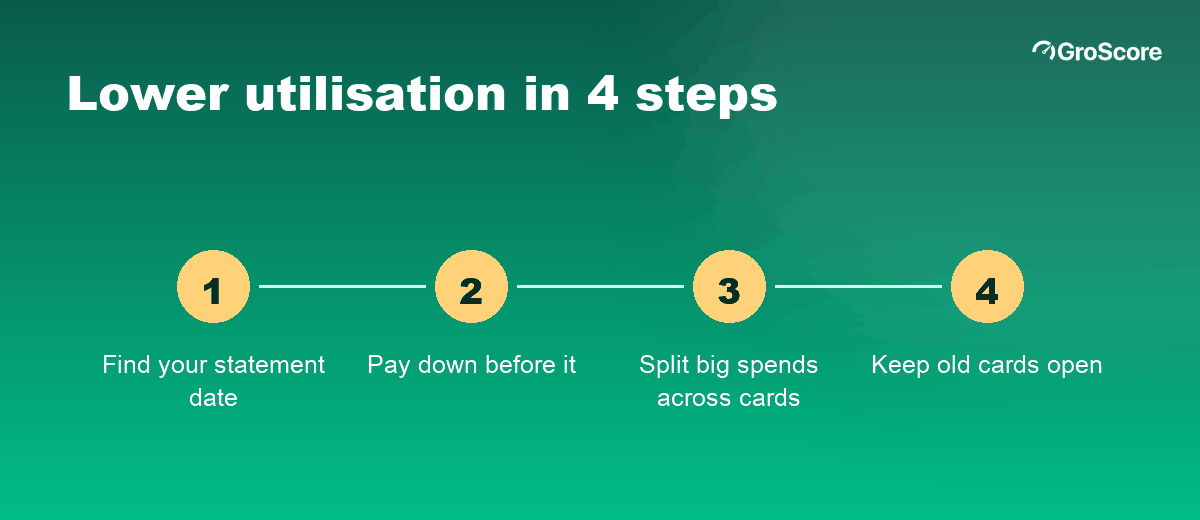
Four habits that keep utilisation low without spending less.
Does Paying in Full Mean 0% Utilisation?
Not always. This one surprises people who pay every bill in full.
For example, if you spend ₹70,000 on a ₹1,00,000 card and pay it all on the due date, you never pay interest. But the ₹70,000 balance may already have been on your statement, and that's the figure that usually reaches the bureau. So your report can show 70% even though you're a perfect payer.
The fix is the same as before: pay part of it before the statement date. You keep your perfect payment record and report a lower balance.
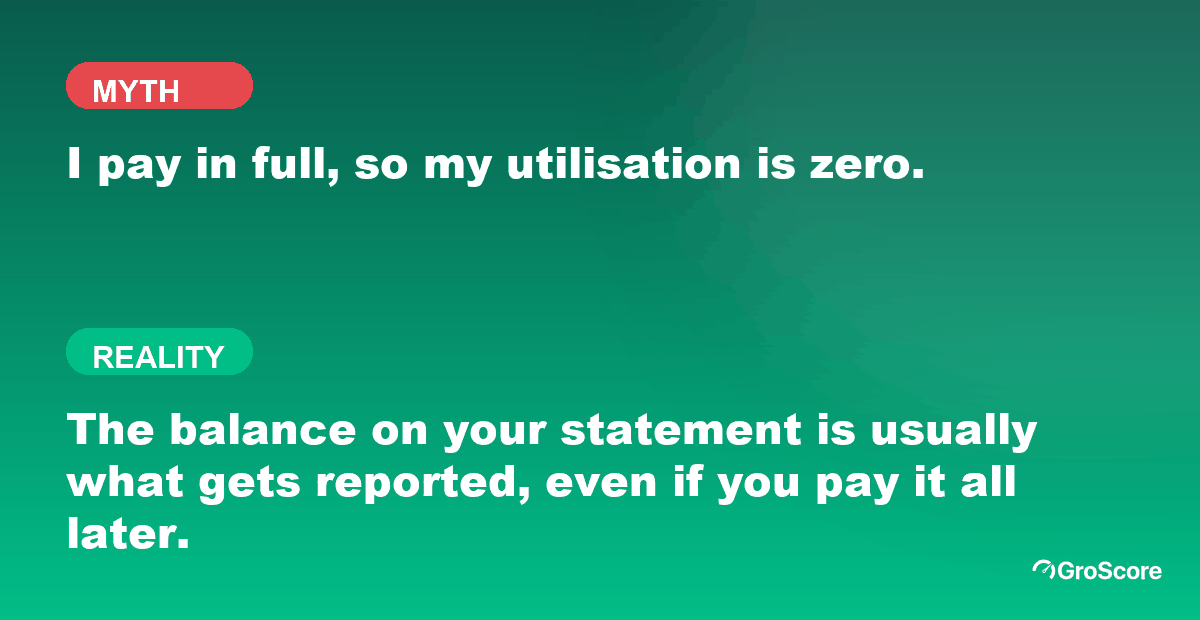
Paid in full and reported at 70% can both be true.
What Would a Credit Coach Flag on Your Report?
Here's an illustrative example of how Arjun, GroScore's credit coach, would read a report like Neha's:
- Card A at 80%, which is the quickest win. Pay it down before the next statement date.
- Card B barely used. Fine. Don't close it. Its limit is helping her overall ratio.
- No late payments. Good. That protects the factor that matters most, so she shouldn't miss a due date while juggling payments. See how late payments affect your score for why.
Utilisation is one of the few credit score factors you can change within a single billing cycle. Payment history and credit age take years. That doesn't make a score jump certain, though. How much your score moves depends on what else is on your report, and results are not guaranteed.
GroScore is a free credit score app and personal credit coach from Vitrak Technologies (GroMo). It shows your Equifax credit score and full report with a soft check that never affects your score, explains in Hindi or English what is holding the score back, and gives a step-by-step plan to fix it. GroScore is not a lender. It ranks the fixes for your profile and shows the points each one can gain you (groscore.in), working from your Equifax report, not a CIBIL report.
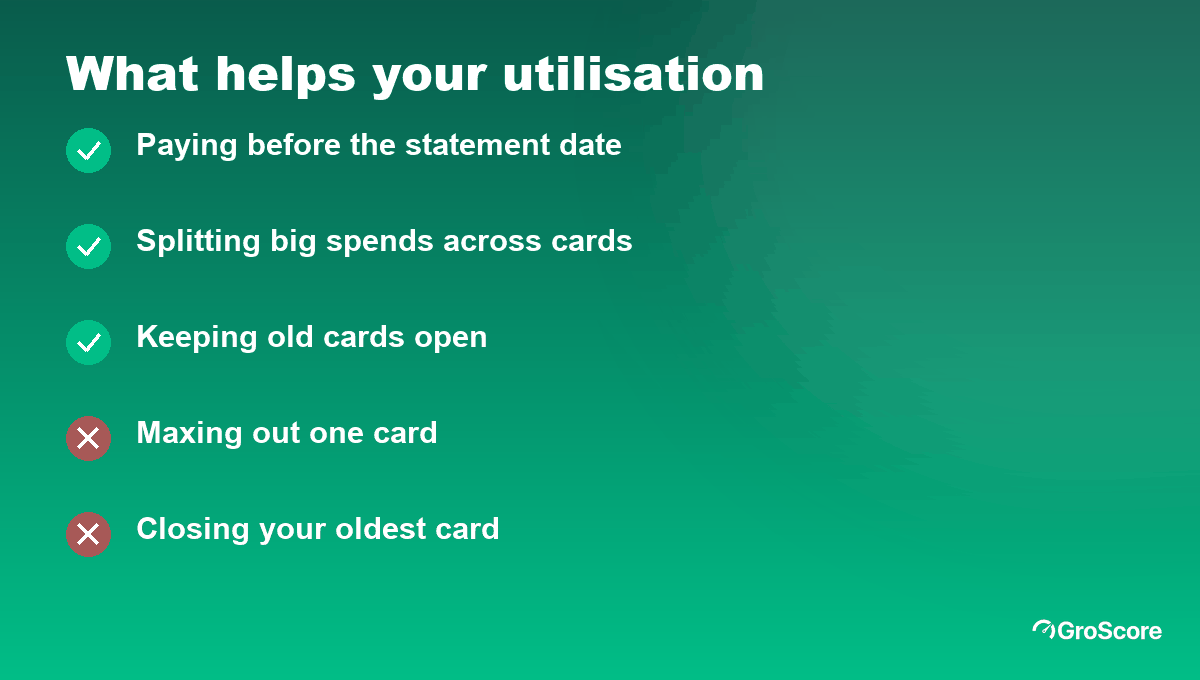
What helps your utilisation, and what quietly hurts it.
How Fast Does Lower Utilisation Show Up?
As fast as your lender reports. Under the RBI's 2025 amendment directions on credit reporting, lenders have had to update credit bureaus every week since 1 July 2026. So a lower balance usually reaches your report within a few weeks, depending on when your card issuer reports.
Your score then recalculates from the new data. Because utilisation reflects your current balance, it can also climb back up the moment you run the card high again. Keeping it low is a habit, not a one-time fix. For more on what can change in a month or three, see what changes in 30-90 days.
Frequently Asked Questions
What is a good credit utilisation ratio?
Under 30% of your limit, per card and overall, is GroScore's guidance. Lower is generally read as more comfortable. On a ₹1,00,000 limit, that means keeping the balance under ₹30,000.
Does using 100% of my credit limit hurt my score?
Using your full limit usually hurts, because a maxed-out card signals you're stretched. Even if you pay it in full, the high balance can be reported. Pay part of it before the statement date to bring the reported figure down.
Is utilisation counted per card or overall?
Your report shows each card's balance and limit, so lenders can see both. Keep every card under 30%, not just the total. One maxed-out card can stand out even when the overall ratio looks fine.
Does paying before the statement date lower utilisation?
Yes. The balance on your statement is usually what's reported to the bureaus. Paying before that date means a lower balance shows up, while the due date still protects your payment record.
How fast does lower utilisation raise my score?
Once your card issuer reports the lower balance, which RBI rules require every week since 1 July 2026. The size of any change depends on the rest of your report, and no score increase is guaranteed.
The Bottom Line
Credit utilisation is the score factor you control fastest. Work out your ratio for each card, find your 30% line, and pay down before the statement date rather than after. Keep old cards open and spread big spends. For how cards affect the rest of your score, read credit cards and your CIBIL score.

Disclaimer
This GroScore article is for general education and is not financial advice. GroScore provides credit scores and reports sourced from Equifax, an RBI-licensed credit bureau; scores differ between bureaus and change as lenders report new data. Credit score improvement depends on your individual credit behaviour and bureau reporting timelines, and results are not guaranteed. Loan and card decisions are made by lenders on their own criteria. GroScore is not a lender. Figures and rates shown are indicative.
