How to Improve Credit Score Fast: What Changes in 30-90 Days
Some fixes show up within a reporting cycle or two. Others take years. Here's which is which.

Here's how to improve credit score fast: pay anything overdue, bring card balances down before the statement date, and dispute genuine errors. Those are the fixes that can show within one or two reporting cycles. Late payments, settlements and write-offs can't be rushed, and no one can raise your score overnight. How far you move in 90 days depends on what's on your report.
Key TakeawaysBanks and NBFCs have reported to credit bureaus every week since 1 July 2026, so a paid-down balance reaches your report sooner (RBI).Card use under 30% of your limit is the quickest lever most people have (groscore.in).A wrong entry should be fixed within 30 days of your complaint, or you're owed compensation (RBI).GroScore says going from 600 to 750 usually takes six to twelve months. Results aren't guaranteed (groscore.in).
What Can Change in Your First 30 Days?
Three things, and all of them depend on your lender reporting the change.
Overdue amounts. If an EMI or a card's minimum due is unpaid, pay it now. On your report, a late account carries a DPD (days past due) figure. Paying stops that number climbing from 30 to 60 to 90. The late mark itself stays, but it stops getting worse. Clearing dues is step 3 of the wider plan for how to improve your credit score, and the one with no waiting.
Card balances. Your credit utilisation is your total card balance divided by your total card limit. It's measured fresh every time a lender reports. Pay the card down before the statement date, since that's usually the balance that gets reported, and the next report reflects it.
Errors you've disputed. A loan that isn't yours, or a closed card shown as active, can be corrected once the bureau confirms it with the lender.
Why does this happen faster than it used to? Because of the RBI's credit information rules (2025). Lenders used to report monthly, then every fortnight from 1 January 2025. Since 1 July 2026, under RBI's amended reporting rules, they report every week. So a payment you make today can reach the bureau within weeks, not a month or more. Our guide to credit score update time explains how often each bureau refreshes your score.
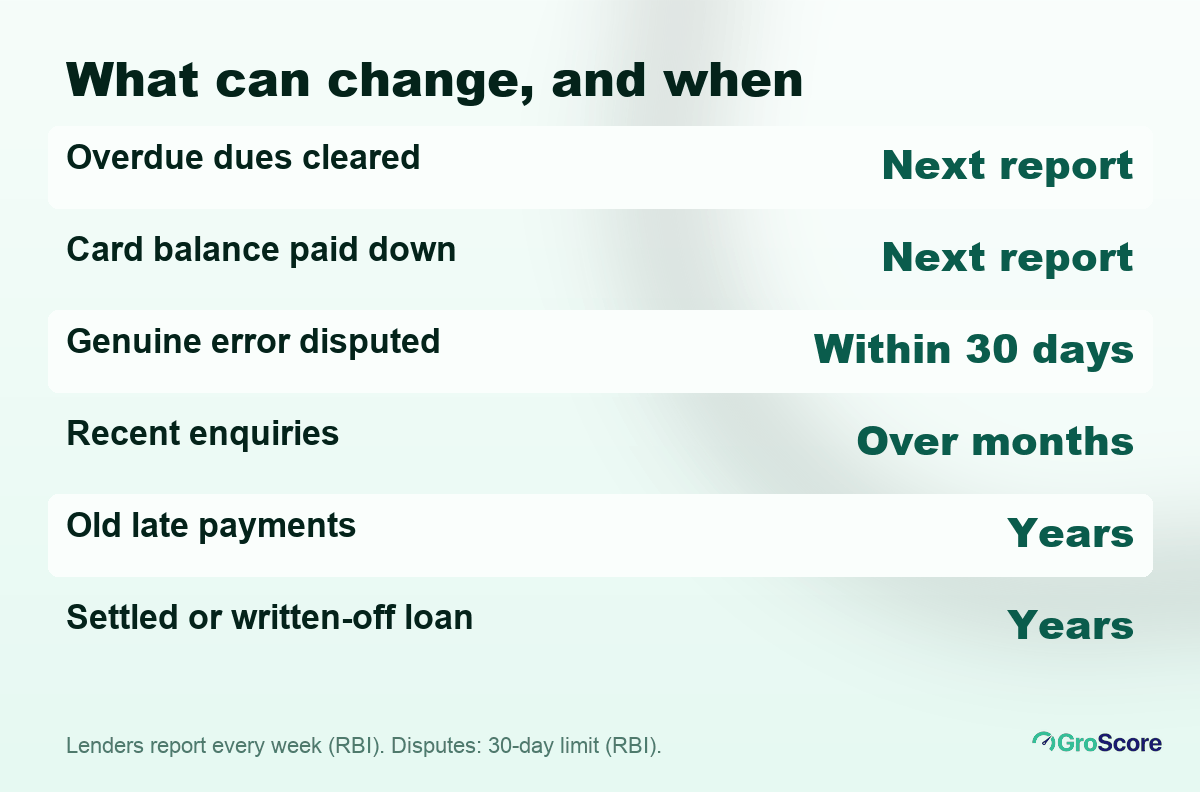
Fast fixes depend on the reporting cycle. Old history doesn't.
What Can Change in 60 to 90 Days?
By the second and third month, slower signals start to count.
A dispute should be closed by now. Under RBI rules, a complaint about wrong credit data should be resolved within 30 calendar days, or the lender or bureau owes you Rs 100 for every day of delay (RBI).
Your recent enquiries also start to age. A hard enquiry is a check a lender runs when you apply for a loan or card. Several in a short spell look like credit hunger, so if you stopped applying three months ago, that cluster is now less recent.
Two or three months of on-time payments also start to stack up. That won't erase an old late payment. It does show a lender the problem has stopped.
If you've cleared overdues, cut utilisation and fixed an error, you could see real movement in this window. You might also see very little, if the main problem is an old default. Both are normal.

What Can't Be Rushed?
Some entries are simply history. Paying now helps your future record, but it doesn't rewrite the past.
| On your report | Can it improve fast? | Why |
|---|---|---|
| Card balance above 30% | Yes, after the next report | Utilisation is recalculated each time |
| Overdue EMI or card due | Partly | Paying stops the DPD growing; the late mark stays |
| Genuine error | Yes, once corrected | The wrong data is removed |
| Recent hard enquiries | Over months | They age gradually |
| Old late payments | Slowly | Accurate history stays on the report |
| Settled or written-off loan | Slowly | Lenders read it as a loss |
A "settled" status is the hardest to shake. It means the lender accepted less than you owed. If you settled in the past and can now pay the waived amount, ask the lender whether it will update the status to "closed". Get any promise in writing.
Credit history length is the other slow one. A two-year-old file can't become a ten-year-old file in a quarter. Keeping your oldest card open protects what you have.
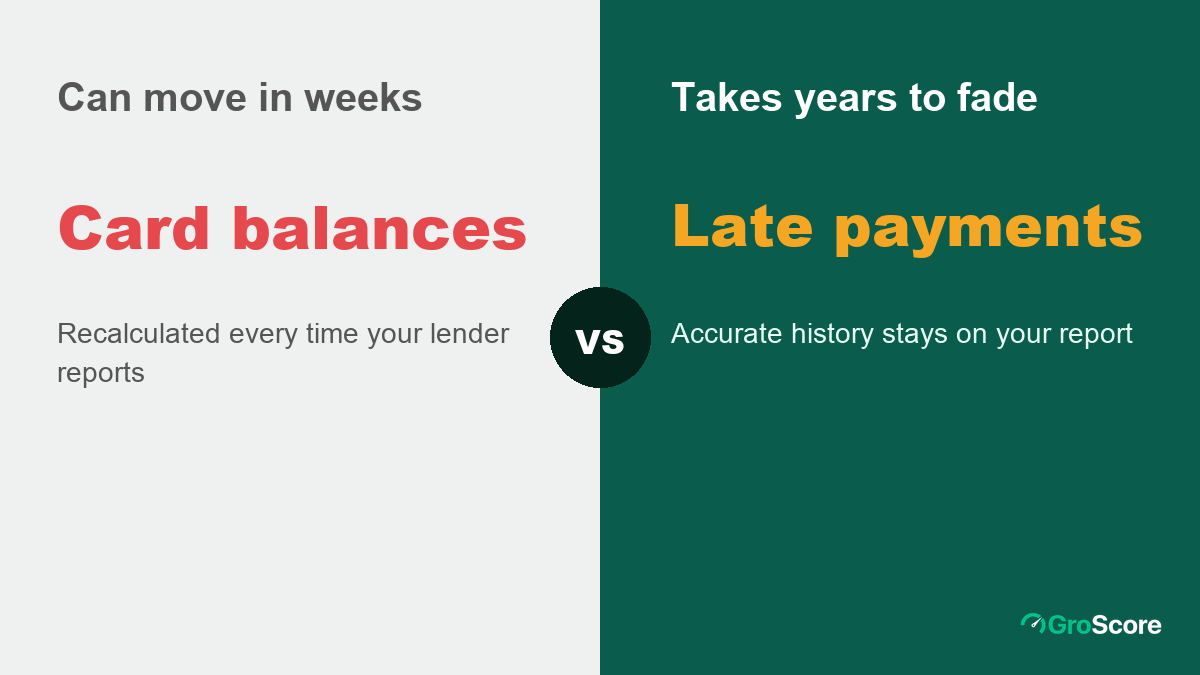
Know which lever is fast before you plan around it.
The 90-Day Plan: How to Improve Credit Score Fast
Put the fast fixes in order, and do them once each, properly.
Days 1 to 7. Read your full credit report. Each bureau gives you one free report a year under RBI rules, and a free app shows you a report anytime with a soft check. List every overdue amount, every card balance, every enquiry and anything that looks wrong.
Days 1 to 30. Pay overdues. Raise disputes for genuine errors. Turn on autopay for every EMI and at least the minimum due on every card. Stop applying for new credit.
Days 30 to 60. Pay card balances down before each statement date. If you can't reach 30% in one go, aim lower every month. Spread spending so no single card is maxed.
Days 60 to 90. Check the report again. Confirm the corrections went through and the new balances were reported. If something didn't update, follow up with the lender first, then the bureau.
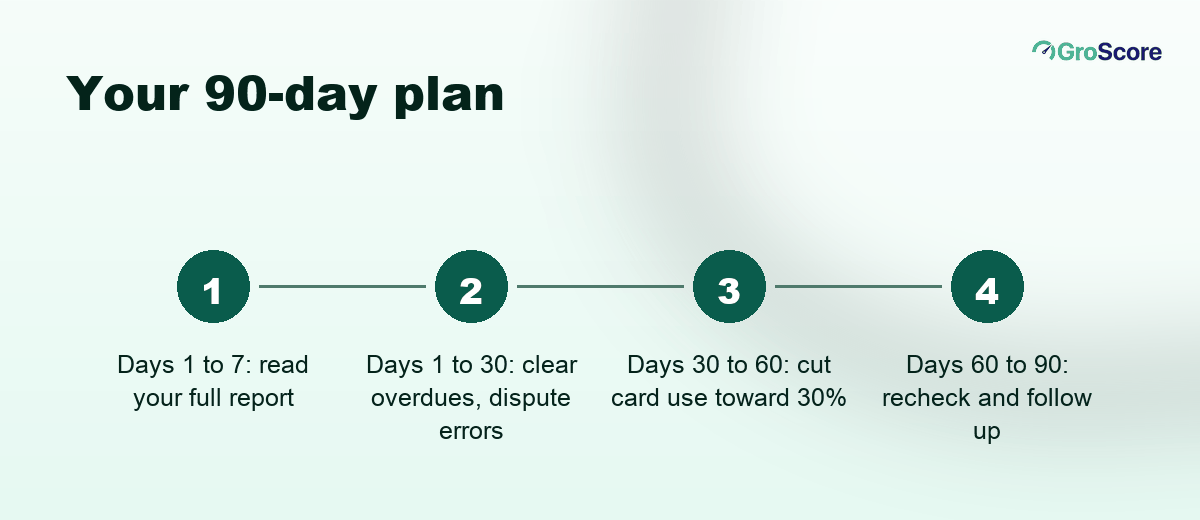
One pass through the fast fixes, in order.
Most of the plan is about card use. GroScore's guidance is to keep it under 30% of your total limit (groscore.in, retrieved 2026-10-05), so it's worth understanding your credit utilisation ratio properly before you start paying down.
What Would a Coach Prioritise in 90 Days?
Here's an illustrative example, not a real customer. Say Rahul, 27, has an Equifax score of 642. Arjun, GroScore's credit coach, reads his report and finds three things.
- A missed minimum due, 20 days late, on his only credit card. He pays it today, before it becomes a 30-day late mark.
- Card use of 85%, which is Rs 68,000 owed on a Rs 80,000 limit. Getting under 30% means a balance of Rs 24,000 or less.
- Three hard enquiries in two months from loan apps he tried. He stops applying.
Rahul can't pay Rs 44,000 at once. So suppose he stops using the card and pays Rs 15,000 more than the minimum each month. The balance works out to Rs 53,000 (66%) after month one, Rs 38,000 (48%) after month two and Rs 23,000 (29%) after month three. Interest on a revolving balance adds to this, so in real life the paydown takes a little more. Because lenders report every week under RBI rules, each lower balance can show within weeks of the statement.
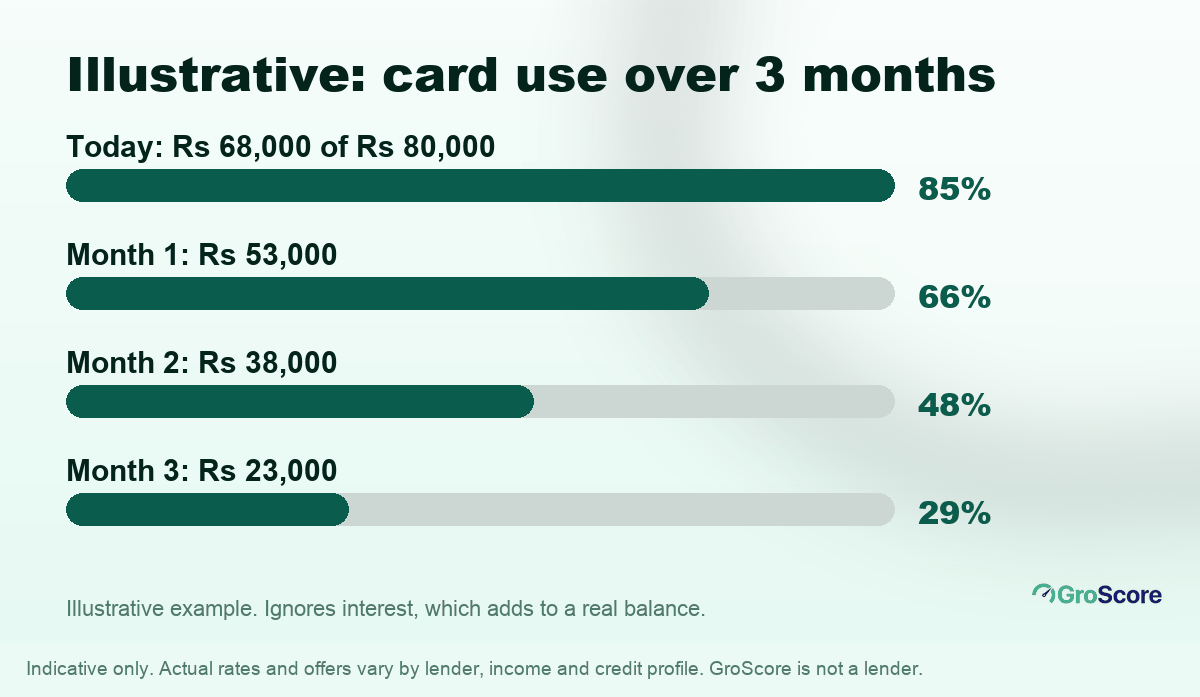
Illustrative example: steady paydowns, one reporting cycle at a time.
What will his score be after 90 days? Nobody can say, and anyone who names a number is guessing. His utilisation will look far healthier and his payment record will have stopped slipping. GroScore ranks fixes like these from patterns across 1 lakh+ analysed credit reports (groscore.in, retrieved 2026-10-05). It can't promise the result, and neither can anyone else. For the longer haul, here's how to increase your CIBIL score from 600 to 750 over six to twelve months.
Is There a Legal Way to Raise Your Score Overnight?
No. In India, your score changes only when lenders report new data and the bureau recalculates. There's no consumer "rapid rescore" you can buy.
Watch for these shortcuts. They either do nothing or make things worse:
- Paid "credit repair" agencies that promise to delete late payments. Accurate entries can't be removed early. Only genuine errors can be corrected, and you can dispute those yourself, free.
- A new card "to raise your limit". The application adds a hard enquiry, and a new account lowers your average credit age.
- Settling a loan to "close it fast". A settled status can hurt for years.
- Many loan applications after a rejection. Each one adds another enquiry.
Can an app speed this up? An app can show and rank the fixes. It can't change bureau data.
One more thing about the word "CIBIL". TransUnion CIBIL is one of four RBI-registered credit bureaus, along with Equifax, Experian and CRIF High Mark. Each calculates its own score from what lenders report, so the same fast fixes help all four.
GroScore is a free credit score app and personal credit coach from Vitrak Technologies (GroMo). It shows your Equifax credit score and full report with a soft check that never affects your score, explains in Hindi or English what is holding the score back, and gives a step-by-step plan to fix it. GroScore is not a lender, and the score it shows is your Equifax score, not a CIBIL score.
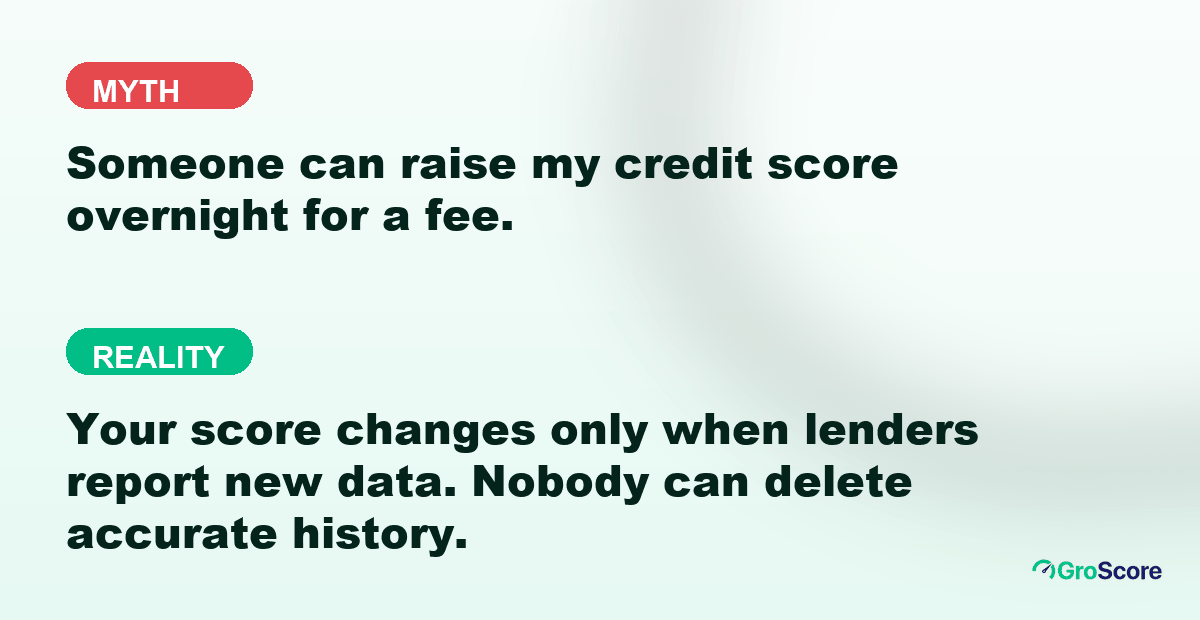
Your score moves when lenders report, and not before.
Frequently Asked Questions
Can I improve my CIBIL score in 30 days?
Sometimes, a little. Clearing overdues, paying card balances down and correcting a genuine error can show after the next weekly report. An old late payment or a settled loan won't fade in 30 days, so the result depends on what's holding your score down.
What is the fastest way to raise my credit score?
Lower your card balances before the statement date. Utilisation is recalculated every time a lender reports, so it's usually the quickest lever. Fixing a genuine error on your report can be just as fast.
How long does it take to go from 600 to 750?
GroScore says it usually takes six to twelve months. A low score caused mostly by high card use can move faster. One caused by defaults or settlements usually takes longer.
Can my score increase instantly after paying dues?
No. The bureau updates your score only after your lender reports the payment. With weekly reporting that's usually a matter of weeks, but it isn't instant.
Is there any legal way to increase my score overnight?
No. Be wary of any person or agency that promises one, especially for an upfront fee. The legal route is the boring one: pay on time, cut card use and dispute genuine errors.
The Bottom Line
You can make a real start in 90 days. Pay what's overdue, get card use down, fix errors and stop applying. Then let the reporting cycle do its work. What you can't do is erase accurate history, so be suspicious of anyone who says otherwise. If you're weighing up a coach app, read our honest answer to can an app raise your score first.

Disclaimer
This GroScore article is for general education and is not financial advice. GroScore provides credit scores and reports sourced from Equifax, an RBI-licensed credit bureau; scores differ between bureaus and change as lenders report new data. Credit score improvement depends on your individual credit behaviour and bureau reporting timelines, and results are not guaranteed. Loan and card decisions are made by lenders on their own criteria. GroScore is not a lender. Figures and rates shown are indicative.
