How to Build Credit Score From Scratch: New to Credit Guide
No credit history isn't a dead end. Here's the safe way to start one.

Wondering how to build credit score from scratch? Open one small credit product from an RBI-regulated bank or NBFC, usually a secured credit card against an FD, use a little of it every month and pay the full bill on time. After a few months of reported history, the bureaus can calculate a score. No history isn't a bad score. It's just a blank page.
Key Takeaways"NH" or "-1" on a credit report means no credit history, not a bad record. Lenders read it as unknown risk.A secured or FD-backed credit card is usually the safest first product, because the FD covers the limit.Keep card use under 30% of the limit and pay in full every month (GroScore guidance, groscore.in).Since 1 July 2026, lenders report to bureaus every week, so new history shows up faster (RBI).
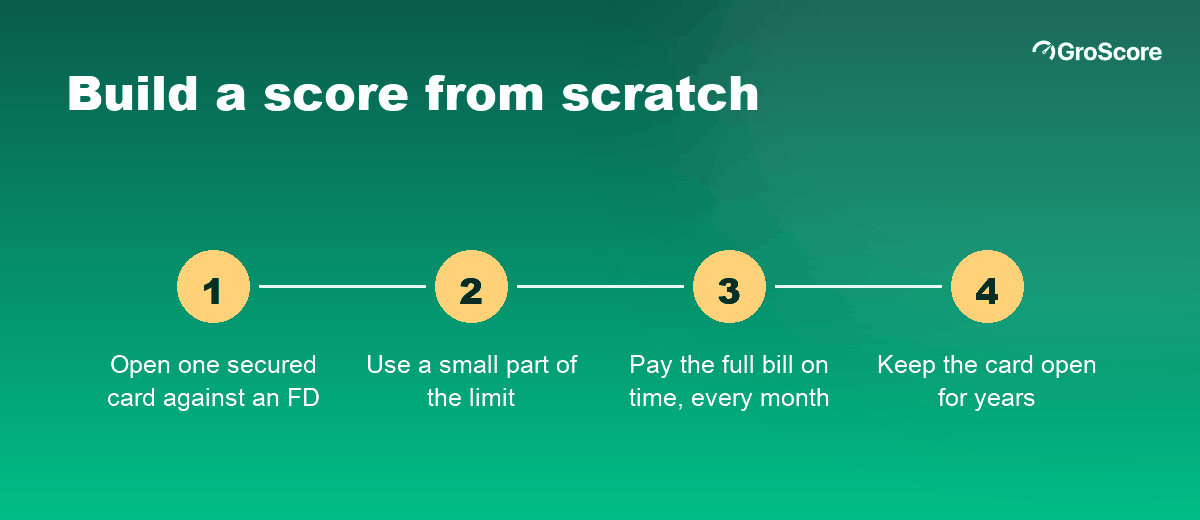
The whole method fits in four steps. The hard part is staying consistent.
What Does NH or -1 on a CIBIL Report Mean?
NH or -1 means the bureau has nothing to score yet. You've never had a loan or credit card, or nothing has been reported in your name. Our explainer on what NH or -1 on CIBIL means goes deeper into each code.
TransUnion CIBIL is one of four credit information companies registered with the RBI, along with Equifax, Experian and CRIF High Mark, per the RBI's list of credit information companies. Each shows a missing score a little differently. You'll commonly see:
| What your report shows | What it usually means |
|---|---|
| NH or -1 | No credit history at all |
| NA or 0 | Some credit, but too little or too recent to score |
| 300 to 900 | Enough history for a full score |
Neither NH nor -1 is a penalty. The catch? Many lenders won't approve an unsecured loan or card without a score, because they can't judge you. That's the loop new-to-credit borrowers get stuck in: no credit without a credit history, no history without credit.
Secured products break the loop. Here's how.
GroScore is a free credit score app and personal credit coach from Vitrak Technologies (GroMo). It shows your Equifax credit score and full report with a soft check that never affects your score, explains in Hindi or English what is holding the score back, and gives a step-by-step plan to fix it. GroScore is not a lender, and the score it shows is your Equifax score, not a CIBIL score. For new-to-credit users it shows credit builder options such as secured cards, FD-backed cards and starter loans from regulated lenders (groscore.in), but the lender always makes the decision.
Can You Have a Credit Score Without a Loan or Credit Card?
Not really. Bureaus build scores from credit accounts that lenders report. Your salary, savings, rent and UPI payments aren't credit, so they don't count.
First-jobbers are often surprised by this. You might have ₹2 lakh in savings and a spotless bank account, and still show NH. If you want the basics on how bureaus work, see our guide on what a credit score is.
So you need at least one credit account. The question is which one carries the least risk.
Safest First Credit Products for New to Credit Borrowers
Start with one. Here are the usual options, safest first:
| Product | How it works | Who it suits | Watch out for |
|---|---|---|---|
| Secured credit card (FD-backed) | Bank gives a card against your FD | Anyone with savings, including students and first-jobbers | Fees vary by bank. The FD stays locked while the card is open |
| Starter consumer loan | Small EMI loan, e.g. for a phone | People who were buying the item anyway | Interest and processing fees. Don't buy just to build credit |
| Education loan | Repayment builds history once EMIs start | Students financing a course | A large commitment, not a credit-building tool |
| Joint loan as co-applicant | You share a loan with a family member | Families taking a home or car loan | Their late payments hurt you too |
All of these should come from an RBI-regulated bank or NBFC, or an app whose lending partner is RBI-registered. Charges here are indicative. Actual offers vary by lender, income and credit profile.
Does a secured credit card build credit?
Yes. A secured card is reported to the bureaus just like any other credit card. The bank holds your FD as security, so it can approve you without a score.
Lenders reading your report later see a credit card with a repayment record. That's what you want.
If your score is already low rather than missing, our guide to a credit card for a low CIBIL score compares secured and FD cards in more detail.
How Do I Build a Credit Score With a Secured Card? A Worked Plan
Here's an illustrative example. Suppose Rahul, 23, has just started his first job and shows NH. He has ₹50,000 in savings. Arjun, GroScore's credit coach, sketches a six-month plan.
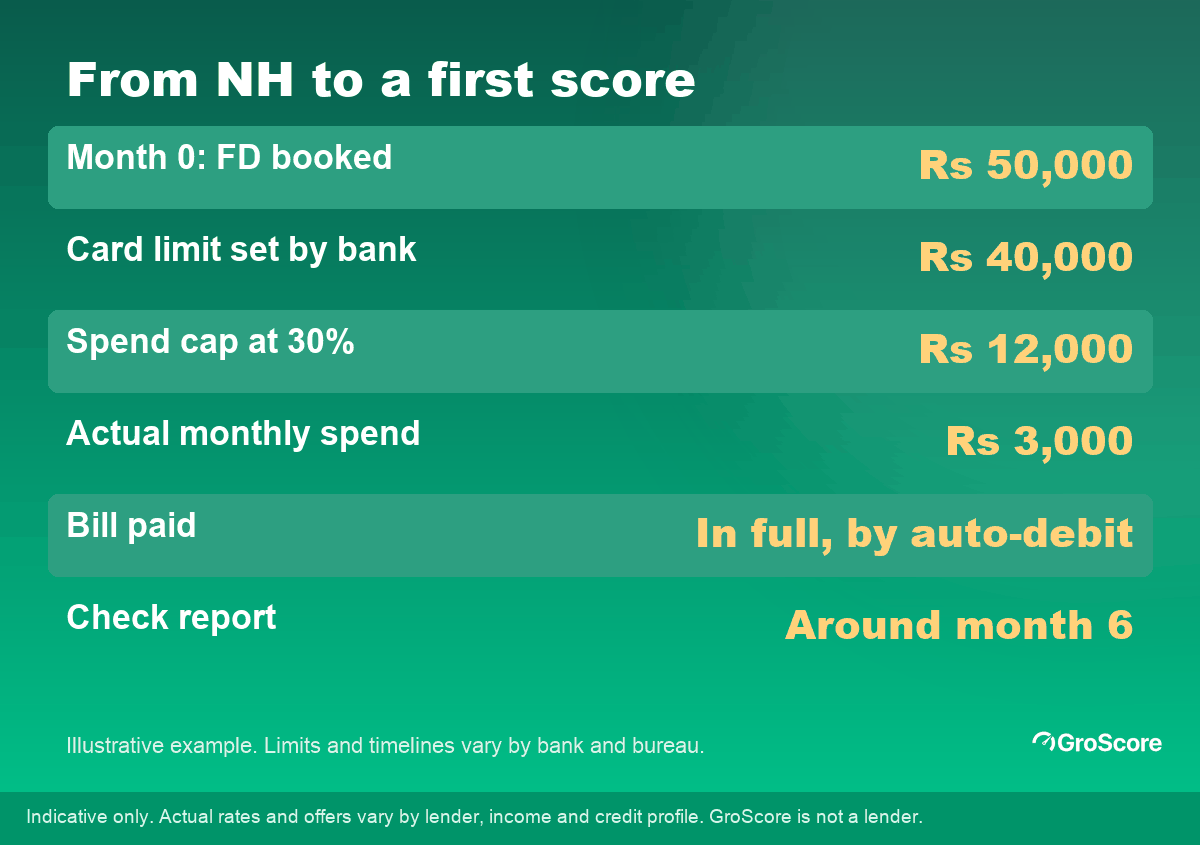
Illustrative example. Limits and timelines vary by bank and bureau.
Month 0. Rahul books an FD of ₹50,000 with his bank and applies for a card against it. Suppose the bank sets a ₹40,000 limit. (Banks set the limit as a share of the FD, and the share varies.)
Spend cap. Under GroScore's guidance to stay below 30% (groscore.in, retrieved 2026-10-05), his target works out to ₹40,000 × 30% = ₹12,000 a month, at most. Arjun suggests less: put only his phone bill and one fuel top-up on the card, about ₹3,000 a month.
Every month. He sets auto-debit for the full statement amount, not the minimum due. No interest, no late fee, and a clean "on time" mark each month.
Months 1 to 6. The bank reports the card to the bureaus. Since the RBI's weekly reporting rule took effect in July 2026, under the RBI's credit information rules (2025), new activity shows up faster.
Around month 6. He checks his report again. A full score often appears once there's roughly six months of history, though each bureau has its own rule and nothing is guaranteed.
What doesn't Rahul do? He doesn't apply for three more cards in month two. He doesn't break the FD. And he doesn't close the card after six months, because its age keeps helping. Nor does he pay for a credit score improver that promises points overnight.
How to Build Credit Score Quickly (And What to Avoid)
There's no shortcut past time. A score needs months of reported behaviour, and nobody can manufacture that. You can avoid slowing yourself down, though.
Do: - pay the full bill, on or before the due date, every month - keep utilisation low, ideally well under 30% - check your report once a few months in, to confirm the card is showing - keep that first card open for years
Don't: - apply to several lenders at once. Each application is a hard enquiry - take a loan you don't need just to "build credit" - pay only the minimum due, since interest then runs on the rest - pay anyone selling a ready-made score or a "guaranteed approval" card, which is a myth with regulated lenders
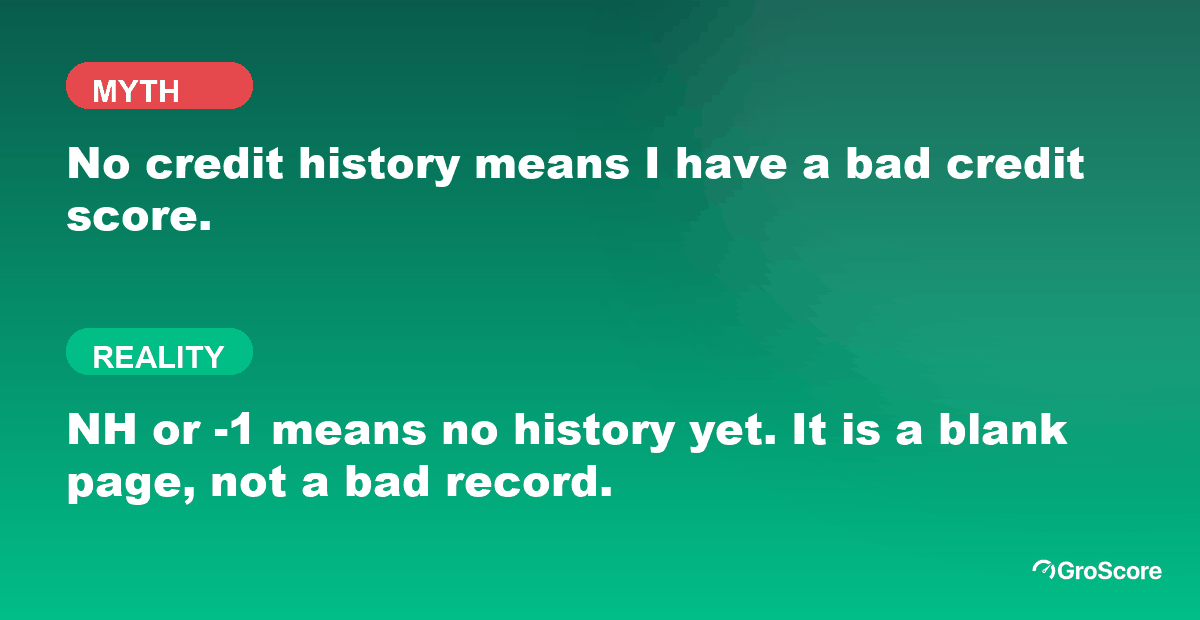
A blank report is a starting point, not a mark against you.
Watch for fake loan apps too, especially ones selling an instant loan without CIBIL checks. Some target exactly this group: young, new to credit, short on cash. Warning signs include an upfront "processing fee" before any money arrives, requests for access to your contacts or photos, and no named RBI-registered lending partner. Report suspicious apps on the RBI's Sachet portal.
How Long Does It Take to Get a Credit Score?
Usually a few months after your first account is reported. Many people see a score after about six months of history. It depends on the bureau, on when the lender reports and on what you opened.
Getting from a first score to a good one takes longer. GroScore treats 750 and above as good (groscore.in). Reaching it depends entirely on your repayment record, and results are not guaranteed. If your first score lands nearer 600, our 600 to 750 plan maps out the climb.
What Would a Credit Coach Flag for a New Borrower?
If you've just opened your first account, here's what GroScore's coach would check on your report, in this order:
- Is the account actually showing? If not after a couple of months, ask the lender.
- Are your personal details right? Name, date of birth, PAN and address. A mismatch can split your history.
- Any accounts you don't recognise? New-to-credit files are a target for identity misuse. An unknown loan is a dispute, not a habit to fix.
- Utilisation on statement day. High balances on a small limit show up fast.
- Enquiries. Only the ones you applied for should be there.
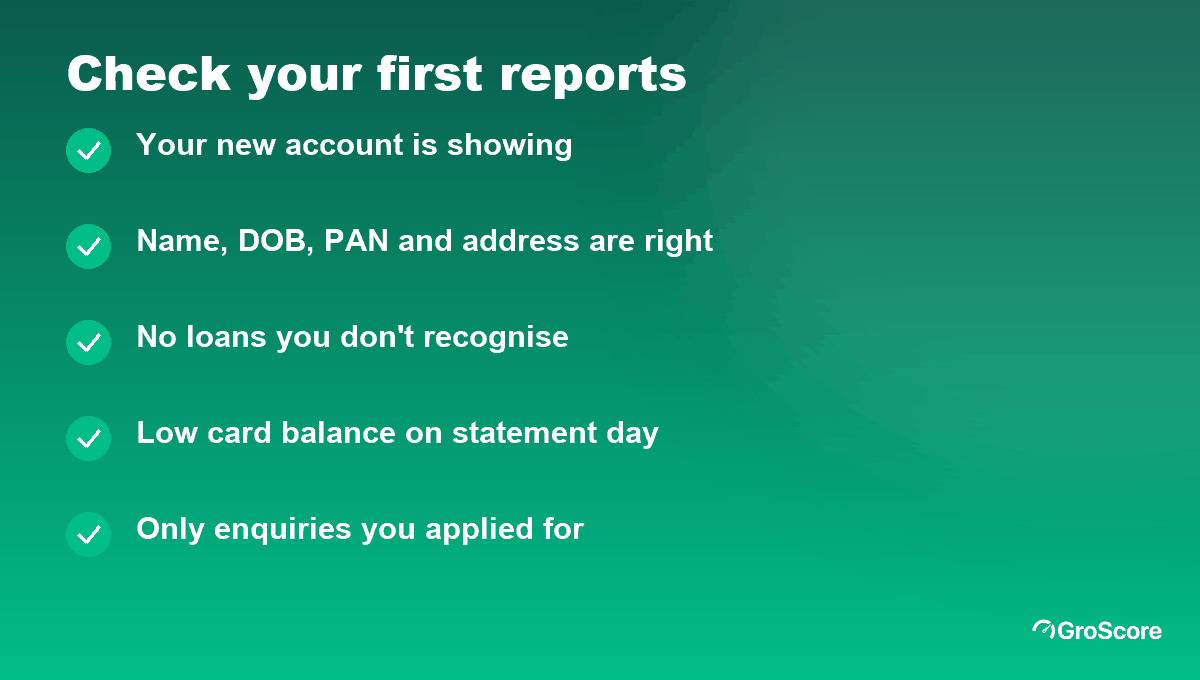
Five checks for your first few reports.
GroScore can show which lenders' criteria your profile clears. It doesn't lend, and it can't promise approval. Once the basics are in place, our guide on how to raise your credit score covers the next steps, from credit mix to handling your first loan.
Frequently Asked Questions
What is the safest first credit product?
For most people, a secured credit card against an FD from an RBI-regulated bank. The FD covers the limit, so the bank can approve you without a score, and the card reports to the bureaus like any other.
Can I have a credit score without a loan or credit card?
No. Bureaus score only credit accounts that lenders report. Savings, salary, rent and UPI payments don't create a score, so you need at least one credit product, even a small one.
What is the fastest way to build credit from zero?
Open one secured card, use a small part of the limit and pay the full bill on time every month. There's no faster legitimate route. Applying for many products at once usually slows you down.
Does a secured credit card build credit?
Yes. It's reported to the bureaus as a credit card, with your monthly repayment record. Paying in full and keeping usage low builds a positive history.
How long does it take to get a credit score?
Commonly around six months after your first account is reported, though each bureau has its own threshold. A good score takes longer and depends on how consistently you repay.
The Bottom Line
No credit history isn't a dead end. Start with one secured card from a regulated bank, use a little of it, pay it in full every month and leave it open. Check your report a few months in to make sure it's showing. Patience does the rest.
Disclaimer
This GroScore article is for general education and is not financial advice. GroScore provides credit scores and reports sourced from Equifax, an RBI-licensed credit bureau; scores differ between bureaus and change as lenders report new data. Credit score improvement depends on your individual credit behaviour and bureau reporting timelines, and results are not guaranteed. Loan and card decisions are made by lenders on their own criteria. GroScore is not a lender. Figures and rates shown are indicative.
