What Is Credit History? How Lenders Read Your Past Borrowing
Your score is the headline. Your credit history is the full story a lender reads before saying yes.

Credit history is the record of every loan and credit card you've had: when you opened it, how much you borrowed and whether you paid each month on time. Credit bureaus keep this record. Lenders read it before they lend, and your credit score is calculated from it. No loans or cards yet? Then you have no credit history, which isn't the same as a bad one.
Key TakeawaysYour credit history lives with four RBI-registered bureaus: TransUnion CIBIL, Equifax, Experian and CRIF High Mark (RBI).Reports typically show a month-by-month payment record for roughly the last 36 months of each account. Older accounts, including closed ones, can still appear.Your score is a summary. Lenders also read the history itself: how recent any late payment was, how old your accounts are, and how often you've applied lately.Since 1 July 2026, lenders report to bureaus every week, so new activity reaches your history faster (RBI).
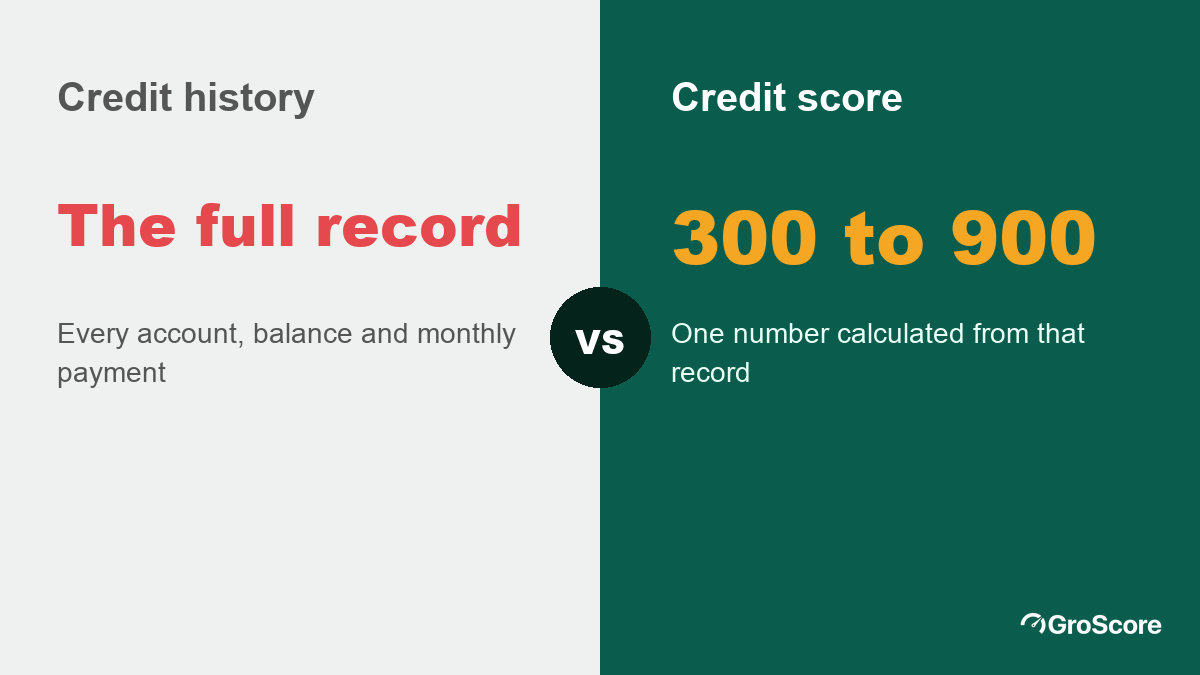
One is the evidence. The other is the verdict.
You can see your own history free on GroScore. It shows your Equifax report with a soft check.
What Does Your Credit History Include?
Think of it as a diary your lenders write for you. Every bank and NBFC you borrow from sends the bureaus an update on each account. Over the years, those updates pile up into a file that looks something like this:
| Part of your history | What it records | Why a lender cares |
|---|---|---|
| Accounts | Every card and loan, open or closed | Shows what kind of credit you've handled |
| Payment record | On time or days past due (DPD), month by month | The best clue to how you'll repay next |
| Balances and limits | What you owe against what you're allowed | Shows whether you're stretched right now |
| Dates | When each account opened and closed | Tells them how long you've been borrowing |
| Enquiries | Each time a lender checked you after you applied | Shows how hungry for credit you are lately |
| Remarks | Settled, written-off, closed | Flags past trouble a score alone can hide |
Your salary isn't there. Neither are your savings, your rent or your UPI payments. A credit history only covers credit.
For a line-by-line walkthrough of the codes, see our guide to reading your credit report. This post is about something different: how a lender reads the story across time.
How Far Back Does Credit History Go?
It goes back further than most people expect. Most bureau reports show a payment grid for each account covering up to the last 36 months, one cell per month. So a card bill you paid 50 days late two years ago is still sitting in that grid today.
Beyond that window, the account itself usually stays on file. Bureaus keep credit information for years, and the RBI's rules for credit information companies have long required individual data to be held for around seven years. A loan you closed in 2021 can still show up, marked closed, with its repayment record intact.
Here's the short version:
- Last 12 months: lenders read these most closely, and fresh late payments and new loans weigh the most.
- Last 36 months: these are visible month by month on most reports.
- Older than that: accounts and remarks are still present, but they usually weigh less.
A late payment doesn't vanish when you pay it off. It fades, slowly, as newer on-time months pile up on top. And closing your oldest card doesn't erase its history, though it can shorten how old your active credit looks.
Credit History vs Credit Score: What's the Difference?
Your credit score is one three-digit number, from 300 to 900 in India. It's the bureau's quick verdict on your file, explained in our credit score guide. Your credit history is the file itself.
| Credit history | Credit score | |
|---|---|---|
| What it is | The full record of your accounts and payments | A single number from 300 to 900 |
| Who builds it | Lenders report it, bureaus store it | Each bureau calculates it from your history |
| What a lender learns | When, how often and how badly anything went wrong | Roughly how risky you look overall |
| How it changes | Grows every month you hold credit | Moves as the history underneath changes |
| Can you fix it directly? | Only by adding good months, or disputing errors | No. It follows the history |
Credit score history is a third thing again. That's how your score has moved over time, which apps like GroScore track month to month. Lenders read the history, not your old scores.
GroScore is a free credit score app and personal credit coach from Vitrak Technologies (GroMo). It shows your Equifax credit score and full report with a soft check that never affects your score, explains in Hindi or English what is holding the score back, and gives a step-by-step plan to fix it. GroScore is not a lender, and the score it shows is your Equifax score, not a CIBIL score.
How Do Lenders Read Your Credit History?
A score gets you through the first filter. After that, many lenders, especially for bigger loans, look at the history line by line. Here's what they usually check:
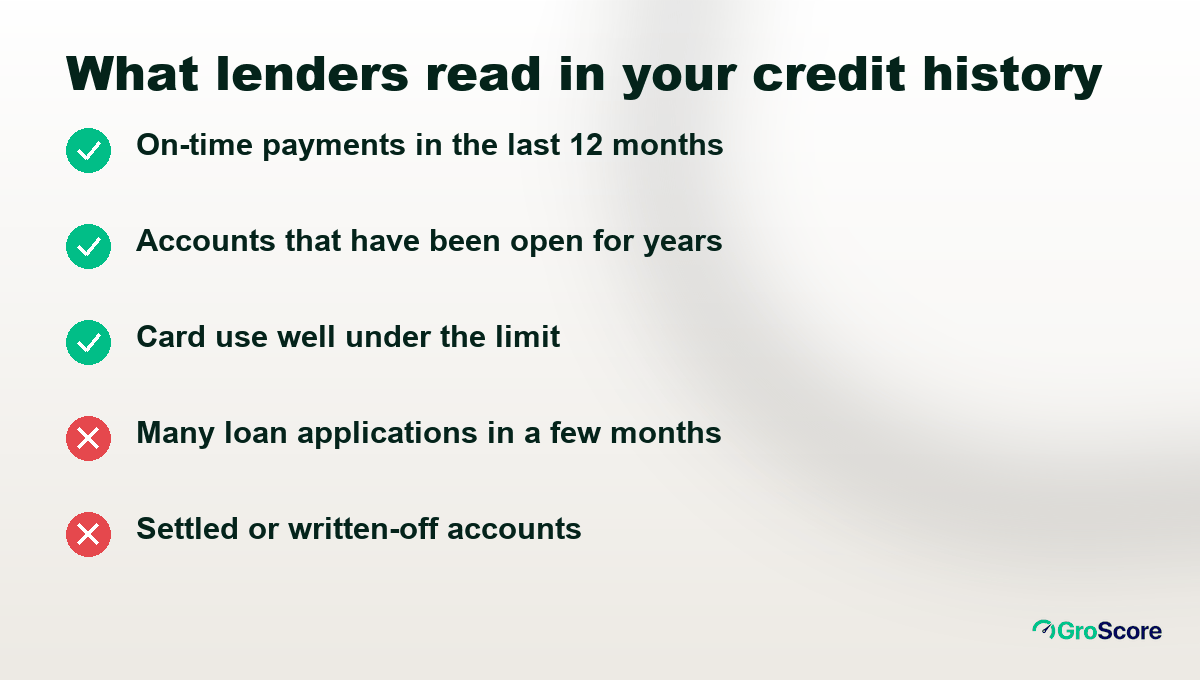
Recency, pattern and age matter as much as the number.
Recency. A 30-day delay last month worries a lender more than one from three years ago. Recent behaviour is the best guide to what you'll do next.
Pattern. One slip in five years reads as an accident. Late payments every few months read as a habit.
Severity. A few days past due is minor. An account marked "settled" or "written-off" means a lender took a loss, and that's a red flag for years.
Age. Long-running accounts show you can manage credit through job changes and bad months. Short histories give lenders less to go on.
Card use. A card running near its limit suggests you're leaning on credit. GroScore's guidance is to keep use under 30% of your limit (groscore.in, retrieved 2026-10-05), and our credit utilisation guide shows the arithmetic.
Recent appetite. Four loan applications in two months, or two new app loans, can suggest money is tight. Each application leaves a hard enquiry.
None of this is a fixed formula. Each lender weighs these things its own way, and your income, existing EMIs and job count too.
Same Score, Different Story: A Worked Example
Here's an illustrative example of why the history matters. Two applicants both show an Equifax score of 742. Arjun, GroScore's credit coach, reads both histories.
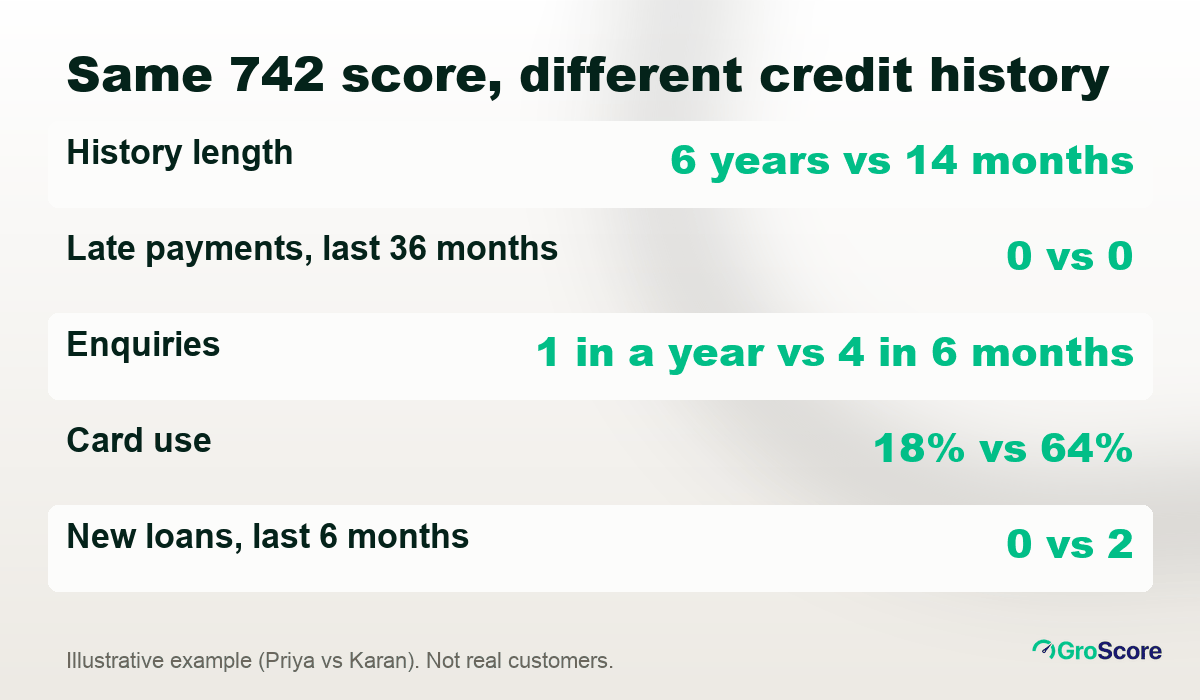
Illustrative example. Same score, very different histories.
Priya, 34. Six years of credit history across three accounts: a credit card, a two-wheeler loan she closed, and a personal loan she's paying now. One DPD of 30 on her card, four years ago. Nothing late in the last 36 months. One enquiry in the past year. Her card use is 18% of the limit.
Karan, 26. Fourteen months of credit history. One card, plus two small app loans taken in the last six months. Four enquiries in six months. No late payments yet, but his card use is 64% of the limit.
On paper, they're equal. In the history, they aren't. Priya's old slip is buried under 36 clean months, and her accounts have aged. Karan has no late payments, but a short file, heavy card use and a burst of new credit. A lender for a large loan may ask Karan for more documents, offer a smaller amount, or price the loan higher. If his habits don't change, our guide to a 650 credit score shows what a slide into the 600s would mean for loans.
Karan's biggest lever is his card. Its use, which is 64% of the limit, is more than double the 30% that GroScore suggests, and since lenders now report weekly under RBI rules, a lower balance reaches his file sooner. What would Arjun flag for Karan, in order?
- High card use. It's the quickest fix, since he can pay it down before the statement date, not after.
- No new applications for a while. Let those four enquiries age.
- Repay the two app loans on schedule. Clean closures add good months to a short file.
None of this is a promise. How Karan's score moves depends on what's on his report and on lender reporting, and results are not guaranteed.
How to Do a Credit History Check for Free
You have two free routes, and neither one lowers your score.
Ask the bureaus. The RBI's credit information rules (2025) requires each bureau to give you one free full credit report, with your score, every calendar year. TransUnion CIBIL is the best known, and our guide to the CIBIL score covers how it compares with the others. Each of these credit reporting agencies runs its own request page, and the credit history report you get is the same file a lender would see.
Use a credit score app. GroScore pulls your Equifax credit report with your consent and tracks it monthly. Here's the flow:
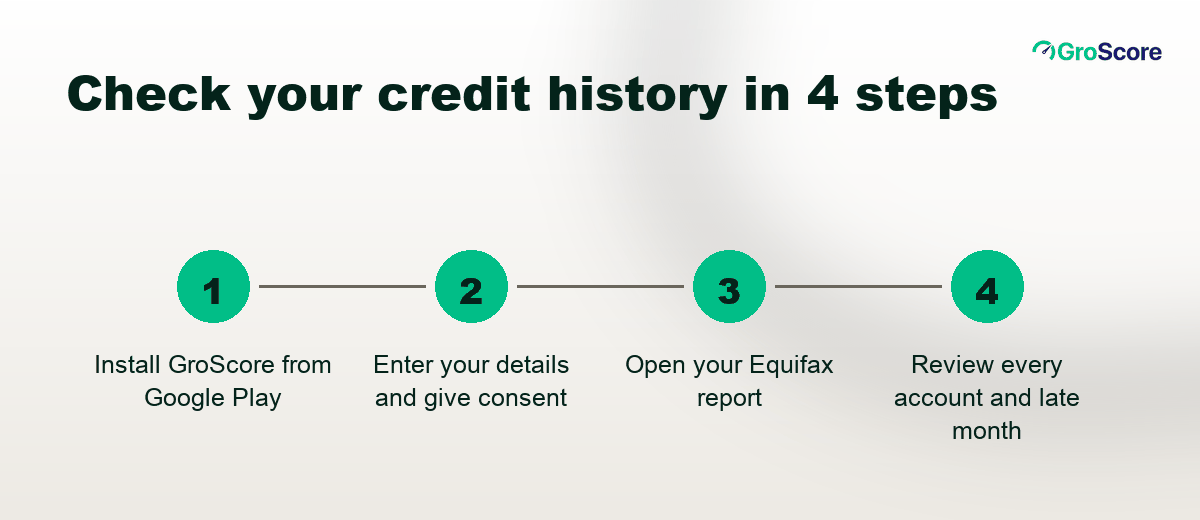
Checking takes a few minutes and costs nothing.
When you check your credit history, look at three things first:
- Every account listed is yours. An unknown loan needs a dispute, not patience.
- Closed accounts show as closed, with a zero balance.
- Any late months are real. Accurate ones can't be removed early, but errors can be corrected.
What If You Have No Credit History?
Then the bureau has nothing to score. Your report may show a code such as "NH" or "-1" instead of a number.
A blank file isn't a black mark. But many lenders won't approve an unsecured loan or card without some history, so you'll need to start small. A secured card against a fixed deposit is the usual first step. Our guide on how to build a credit score from scratch walks through a month-by-month plan.
Frequently Asked Questions
What is credit history in simple words?
Credit history is the record of how you've borrowed and repaid: every loan and card, its balance, and whether each month's payment was on time. Bureaus store it, and lenders read it before deciding to lend.
How can I check my credit history?
Request your free annual report from each of the four bureaus, which the RBI requires them to provide once every calendar year. Or use a free app like GroScore, which shows your Equifax report through a soft check that doesn't affect your score.
How many years of credit history do lenders look at?
Most reports show the last 36 months of payments for each account in detail, and lenders weigh the most recent 12 months most heavily. Older accounts and remarks can stay on file for around seven years.
What is a good credit history?
A good credit history is a long record of on-time payments, low card use, a few well-managed accounts and no settled or written-off remarks. Few recent applications help too. Length matters, so a good history takes time to build.
Can I get a loan with no credit history?
Sometimes you can, usually for smaller amounts or with secured products such as a loan against an FD. Many lenders hesitate on unsecured loans for a blank file, so a secured card is often the easier first step. Lenders decide on their own criteria.
The Bottom Line
Your credit score is the headline. Your credit history is the article lenders actually read. Recent months count most, old mistakes fade under good ones, and the record goes back further than you'd think. Check it once a year from each bureau, keep an eye on it monthly, and fix errors early. GroScore says about 1 in 5 reports, roughly 20%, carries an error (groscore.in, retrieved 2026-10-05). If you're aiming high, here's what a 750+ score means for loans and cards.

Disclaimer
This GroScore article is for general education and is not financial advice. GroScore provides credit scores and reports sourced from Equifax, an RBI-licensed credit bureau; scores differ between bureaus and change as lenders report new data. Credit score improvement depends on your individual credit behaviour and bureau reporting timelines, and results are not guaranteed. Loan and card decisions are made by lenders on their own criteria. GroScore is not a lender. Figures and rates shown are indicative.
