How to Increase CIBIL Score From 600 to 750 (and 750 to 800)
A stage-by-stage plan for the climb from fair to good, and an honest look at whether 800 is worth chasing.

Here's how to increase CIBIL score from 600 to 750: work in three stages. First stop the damage by clearing overdues and disputing errors. Then bring card use under 30% and pause new applications. Then let months of on-time payments build. GroScore says 600 to 750 usually takes six to twelve months, though results aren't guaranteed. Going from 750 to 800 is slower, and it's mostly about time.
Key TakeawaysGroScore says 600 to 750 usually takes six to twelve months. Results aren't guaranteed (groscore.in).A single missed EMI can cost 50 to 100 points, so stage one stops new late payments (groscore.in).Wrong data must be corrected within 30 days, or you're owed Rs 100 a day (RBI).GroScore already treats 750+ as generally good. Above it, gains come slowly.
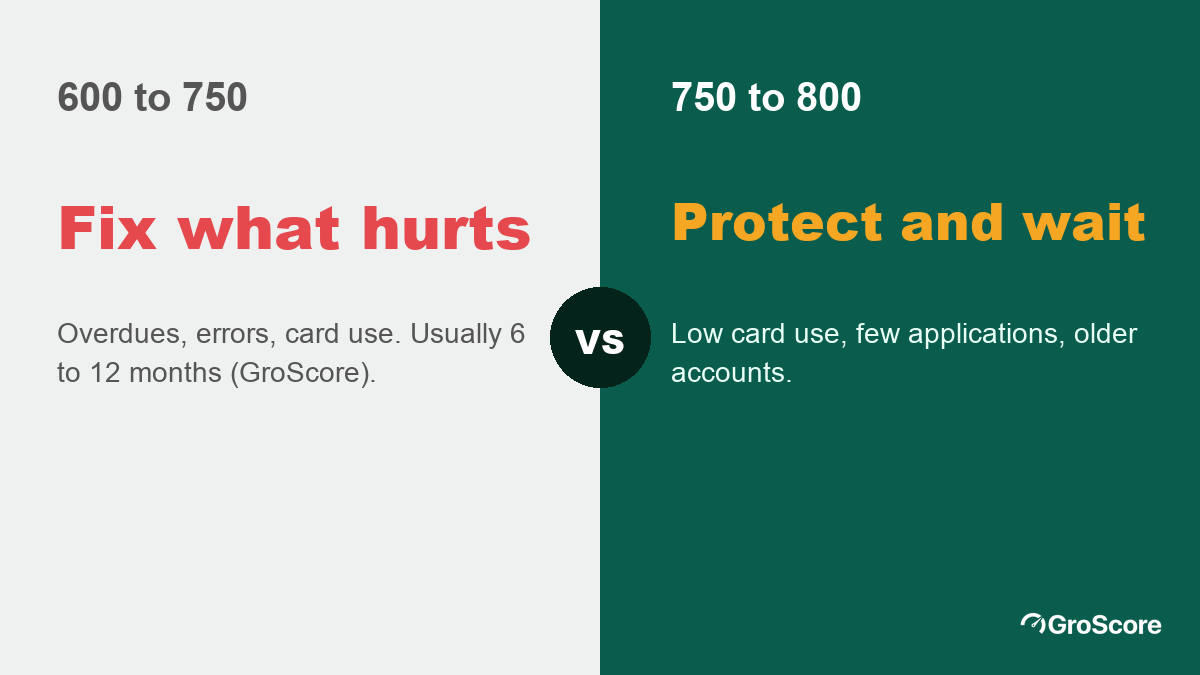
The two climbs need different work.
Why Is Your Score Stuck Near 600?
A score near 600 almost always has a reason you can find on the report. Your credit report lists every loan and card in your name, and the score is calculated from it. Pull it up and look for these five things.
| What you see on the report | What it means | Which stage fixes it |
|---|---|---|
| DPD above 000 in recent months | Days past due: you paid late | Stage 1 stops it, stage 3 fades it |
| An account you don't recognise | A possible error or fraud | Stage 1: dispute it |
| Card balances near the limit | High utilisation | Stage 2 |
| Several enquiries in a few months | Many credit applications | Stage 2 |
| "Settled" or "written-off" status | A loan closed for less than owed | Stage 3, slowly |
Most people near 600 have two or three of these at once, so one fix rarely moves the score far on its own.
A quick note on names. CIBIL is one of four credit bureaus registered with the RBI, along with Equifax, Experian and CRIF High Mark. Each calculates its own score from the data lenders send, so the plan below lifts all four. If your score sits below 600 rather than near it, start with our guide to a low CIBIL score and come back here.
Stage 1: Stop the Damage in the First Two Months
Nothing else counts until the bleeding stops.
Clear anything overdue today. An overdue EMI keeps getting worse on your report. A DPD of 30 becomes 60, then 90. GroScore says a single missed EMI can cost 50 to 100 points (groscore.in), which can wipe out months of progress.
Put every EMI and card bill on autopay, at least for the minimum due. One forgotten bill in month four undoes the work of months one to three.
Dispute genuine errors. GroScore says about 1 in 5 reports, or 20%, carries an error (groscore.in, retrieved 2026-10-05). A loan you never took or a closed card shown as active drags your score for no reason. Each bureau runs a free dispute process, and under the RBI's credit information rules (2025) a complaint must be resolved within 30 days, or you're owed Rs 100 a day.
Errors are the only thing anyone can remove. A late payment that really happened stays, whoever promises otherwise. That includes any credit score improver app that claims it can raise your score for you.

Stage 2: Cut Card Use and Pause Applications
Stage 2 is where most of the visible movement usually happens, because these two factors respond to what you do now.
Card use, or credit utilisation, is your total card balance divided by your total card limit. GroScore's guidance is to keep it under 30% (groscore.in, retrieved 2026-10-05). Pay before the statement date, since that's usually the balance the bank reports. If one card is maxed and another is empty, pay the maxed one down first.
Hard enquiries are the checks lenders run when you apply for credit. Several in a few months tell lenders you're hunting for money. Stop applying until stage 3 is under way. Checking your own score is a soft enquiry and never counts.
Want to see what can shift within the first 90 days? Read our guide on how to increase your CIBIL score quickly. This page is about the longer climb.
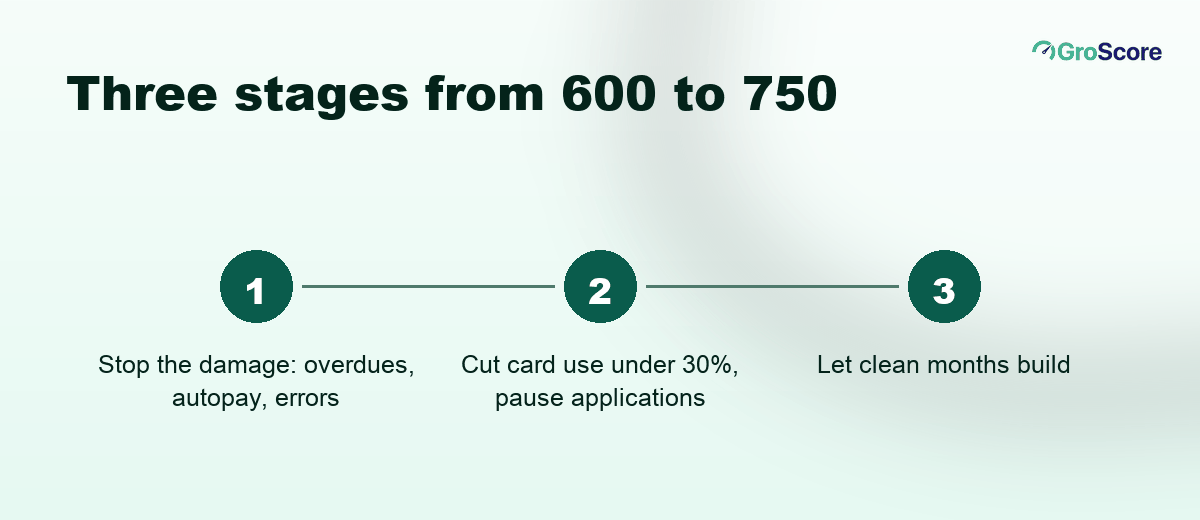
Each stage makes the next one count for more.
Stage by Stage: How to Increase CIBIL Score From 600 to 750
Here's an illustrative example, not a real customer. Rohan, 30, has an Equifax score of 612 and wants a home loan in a year. Arjun, GroScore's credit coach, reads his report and flags four items, in this order.
- An EMI 35 days overdue, Rs 7,400. That's stage 1 work. He pays it this week and sets up autopay.
- Card use of 80%. Rs 70,000 of Rs 80,000 on one card, Rs 42,000 of Rs 60,000 on the other. That adds up to Rs 1,12,000 of Rs 1,40,000, a stage 2 job.
- Five hard enquiries in four months, from shopping for a personal loan. He stops applying.
- A personal loan settled in 2024. It's accurate, so it stays. It fades slowly as clean months build up.
The arithmetic on item 2 decides his timeline. To reach 30%, his total balance must fall to Rs 42,000, which means paying down Rs 70,000. He can spare Rs 10,000 a month.
| Month | Total card balance | Card use |
|---|---|---|
| Today | Rs 1,12,000 | 80% |
| Month 2 | Rs 92,000 | 66% |
| Month 4 | Rs 72,000 | 51% |
| Month 6 | Rs 52,000 | 37% |
| Month 7 | Rs 42,000 | 30% |
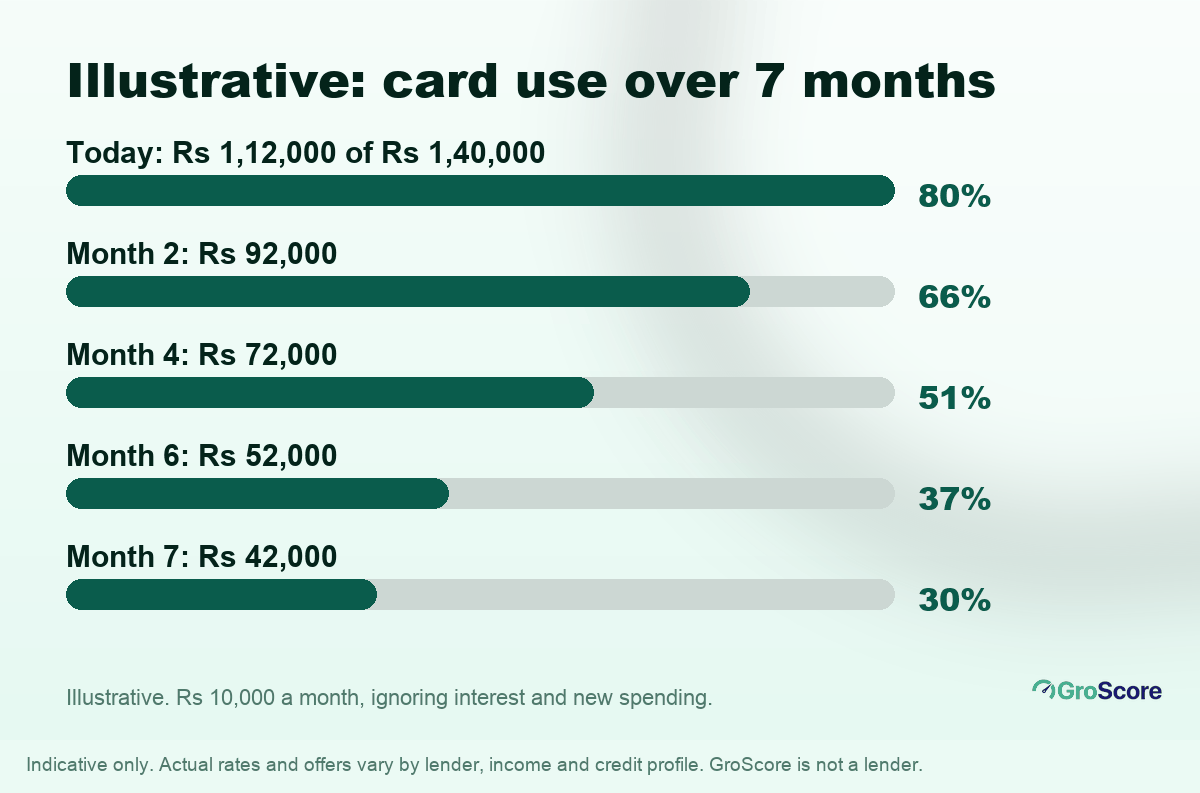
Illustrative example: Rohan pays Rs 10,000 a month, ignoring interest and new spending.
Seven months sits inside GroScore's usual six-to-twelve-month range. Notice that the plan doesn't promise Rohan a score. It promises him a cleaner report. How the bureau scores that depends on everything else in his file, including the settled loan. Since his goal is a home loan, our guide to the CIBIL score for a home loan shows the score lenders look for and how it affects the rate.
Stage 3: How Long Does It Take to Reach 750?
GroScore says moving from 600 to 750 usually takes six to twelve months (groscore.in). Results aren't guaranteed, and where you land inside that range depends on what's on your report.
| If your report shows | The climb usually |
|---|---|
| High card use, no late payments | Moves sooner, once balances fall |
| An error dragging the score | Moves after the dispute is resolved |
| Recent late payments | Takes longer; each clean month helps |
| A settlement or write-off | Takes the longest; the entry stays for years |
| A thin file with one or two accounts | Needs time and a little more history |
The weekly reporting rule helps. Under the RBI's 2025 amendment directions on credit reporting, lenders have reported to bureaus every week since 1 July 2026. A paid-down balance, such as Rohan's drop from 80% to 66% card use, reaches your report sooner than it used to. Old late payments don't fade any faster, though.
Thin file? If you only have one card, a secured card against a fixed deposit adds history without much risk. Our guide on how to build a credit score from scratch explains how.
What Stops a Score From Crossing 750?
A stalled score usually comes down to one of four things.
- Card use creeping back up. For example, you paid down to 30%, then a festival month pushed it to 60%.
- One recent late payment. Even a single 30-day DPD can hold a score back for a long time.
- A burst of applications once the score starts looking good.
- An old settlement or write-off that's still recent enough to weigh on the file.
Stuck just under the line? Check the report rather than the number.

Lenders weigh income and existing EMIs too, not only the score.
From 750 to 800: How to Keep Climbing
The levers get smaller above 750. Fixing problems got you here. Protecting a clean record takes you further, and that's the honest answer to how to increase CIBIL score to 800. To see what the 750 band already gets you, read is 750 a good credit score.
Keep card use well under 30%. Lenders report every week (RBI), so even one high-balance month shows up. Paying the full statement balance keeps it low and saves interest.
Keep your oldest accounts open. A longer credit history helps, and closing an old card also cuts your total limit.
Apply only when you need credit. Each hard enquiry costs a little, for a while.
Don't borrow just to improve your credit mix. A new loan adds debt and an enquiry for an uncertain gain.
Check your report every month so a new error or a stray enquiry doesn't sit there.
Is 800 worth chasing? Often it isn't. GroScore's guidance treats 750 and above as generally good, and lenders also look at your income, existing EMIs and FOIR (the share of your income that goes to EMIs). Once you're past 750, a lower FOIR may help a loan application more than a slightly higher score. Actual offers vary by lender, income and credit profile.
GroScore is a free credit score app and personal credit coach from Vitrak Technologies (GroMo). It shows your Equifax credit score and full report with a soft check that never affects your score, explains in Hindi or English what is holding the score back, and gives a step-by-step plan to fix it. GroScore is not a lender, and the score it shows is your Equifax score, not a CIBIL score. For the fixes in their full order, see how to improve your CIBIL score.
Frequently Asked Questions
How long does it take to increase CIBIL from 600 to 750?
GroScore says it usually takes six to twelve months. A score held down by high card use or an error can move sooner. Recent late payments or a settlement make the climb slower, and no one can promise a date.
What stops a score from crossing 750?
Usually card use creeping back up, one recent late payment, a burst of new applications or an old settlement. Check your full report to see which one applies to you.
How do I go from 750 to 800?
Keep card use well under 30%, pay every bill in full and on time, keep old accounts open and apply for credit only when you need it. Above 750, time and a clean record do most of the work.
Is 800 worth chasing if I already have 760?
Usually not as a goal in itself. GroScore treats 750+ as generally good, and lenders also weigh income, existing EMIs and FOIR. Keep your habits steady and the score tends to look after itself.
The Bottom Line
Going from 600 to 750 is a sequence, not a trick. Stop new damage, fix errors, bring card use down, pause applications, then give the clean months time to count. Past 750, protect what you've built rather than chasing a number. If you need to borrow before you get there, our guide to 300 credit score loans shows what changes at 500 and 600. Whatever your plan, check the report every month so you know which stage you're in.
Disclaimer
This article is for general education and is not financial advice. GroScore provides credit scores and reports sourced from Equifax, an RBI-licensed credit bureau; scores differ between bureaus and change as lenders report new data. Credit score improvement depends on your individual credit behaviour and bureau reporting timelines, and results are not guaranteed. Loan and card decisions are made by lenders on their own criteria. GroScore is not a lender. Figures and rates shown are indicative.
