CIBIL Score for Home Loan: Minimum Score and Rate Impact
A home loan runs for decades, so a few points on your score can be worth lakhs. Here's what lenders look for and what to fix before you apply.

Most lenders treat 700 as a rough floor for a home loan and 750 or above as the score that gets the better rates. Some will consider lower scores with a strong income, a bigger down payment or a co-applicant. There's no single minimum CIBIL score for home loan approval, because each lender sets its own cut-off. Treat every number here as indicative.
Key TakeawaysA home loan is secured by the property, so lenders are more flexible than on personal loans. Indicatively, 700+ opens most doors and 750+ gets the better pricing.On a 25-year loan, a small rate gap becomes a large sum. In our illustrative ₹50 lakh example, 9.5% instead of 7.1% costs about ₹24 lakh more in interest.Lenders read the full report. Recent late payments, settled accounts and a pile of new enquiries can hurt more than the score itself.Under RBI rules, banks and NBFCs can't charge a prepayment fee on floating-rate loans taken by individuals for non-business purposes (RBI).
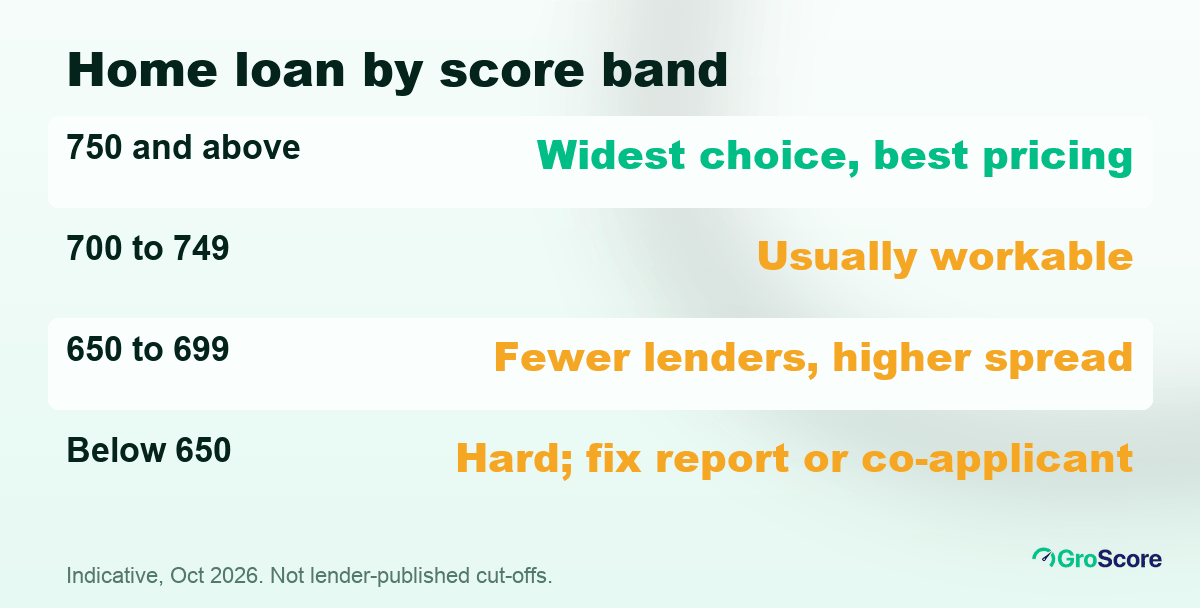
Indicative bands only. Each lender keeps its own cut-off.
A Quick Note on GroScore and the Word "CIBIL"
Because this page talks about loans, here's where we stand. GroScore is a free credit score app and personal credit coach from Vitrak Technologies (GroMo). It shows your Equifax credit score and full report with a soft check that never affects your score, explains in Hindi or English what is holding the score back, and gives a step-by-step plan to fix it. GroScore is not a lender. It doesn't give, approve or disburse home loans.
"CIBIL" is one bureau. TransUnion CIBIL, Equifax, Experian and CRIF High Mark are the four credit information companies registered with the RBI, as the RBI's list of credit information companies shows. A home loan lender may pull one or more of them. Scores across bureaus are usually close but rarely identical. The number GroScore shows is your Equifax score, not a CIBIL score.
What Is the Minimum CIBIL Score for Home Loan Approval?
Short answer: about 700 at many lenders, with 750+ for the best pricing. Long answer: it depends on who's lending and what else you bring. Our guide to the CIBIL score needed for a loan compares cut-offs across every loan type. Here we go deeper on one: the biggest loan most people ever take.
A home loan is secured. Stop paying, and the lender can recover its money from the property. That's why home loan cut-offs are usually lower than for personal loans. Yet the loan runs for 15 to 30 years, so lenders still care a lot about your record.
| Your score | What usually happens | Your best next step |
|---|---|---|
| 750 to 900 | Most lenders are open to you, and you can ask for their best rate | Compare two or three offers on the all-in cost |
| 700 to 749 | Usually workable, sometimes with a slightly higher spread | Pay down card balances before you apply |
| 650 to 699 | Fewer lenders; NBFCs and housing finance companies may consider you at a higher rate | Read your report for fixable items; consider a co-applicant |
| Below 650 | Hard at most banks | Fix the report first or apply jointly with a stronger profile |
Indicative, compiled from GroScore's guidance bands (groscore.in), October 2026. These aren't lender-published cut-offs. Actual offers vary by lender, income and credit profile.
The table can't show two things. Banks are usually stricter than housing finance companies and NBFCs. And a lender may approve a 710 with a low EMI burden while turning down a 790 whose salary already goes to three loans.
How Much Does Your Score Change Your Home Loan Rate?
More than most people expect. Most floating-rate home loans are priced as an external benchmark, often the RBI repo rate, plus a spread the lender sets. Your credit profile mostly moves that spread, and even 0.5% on the spread adds up over 25 years. Lenders call it risk-based pricing: the safer you look, the less they charge.
Here's the arithmetic on an illustrative ₹50 lakh home loan over 25 years.
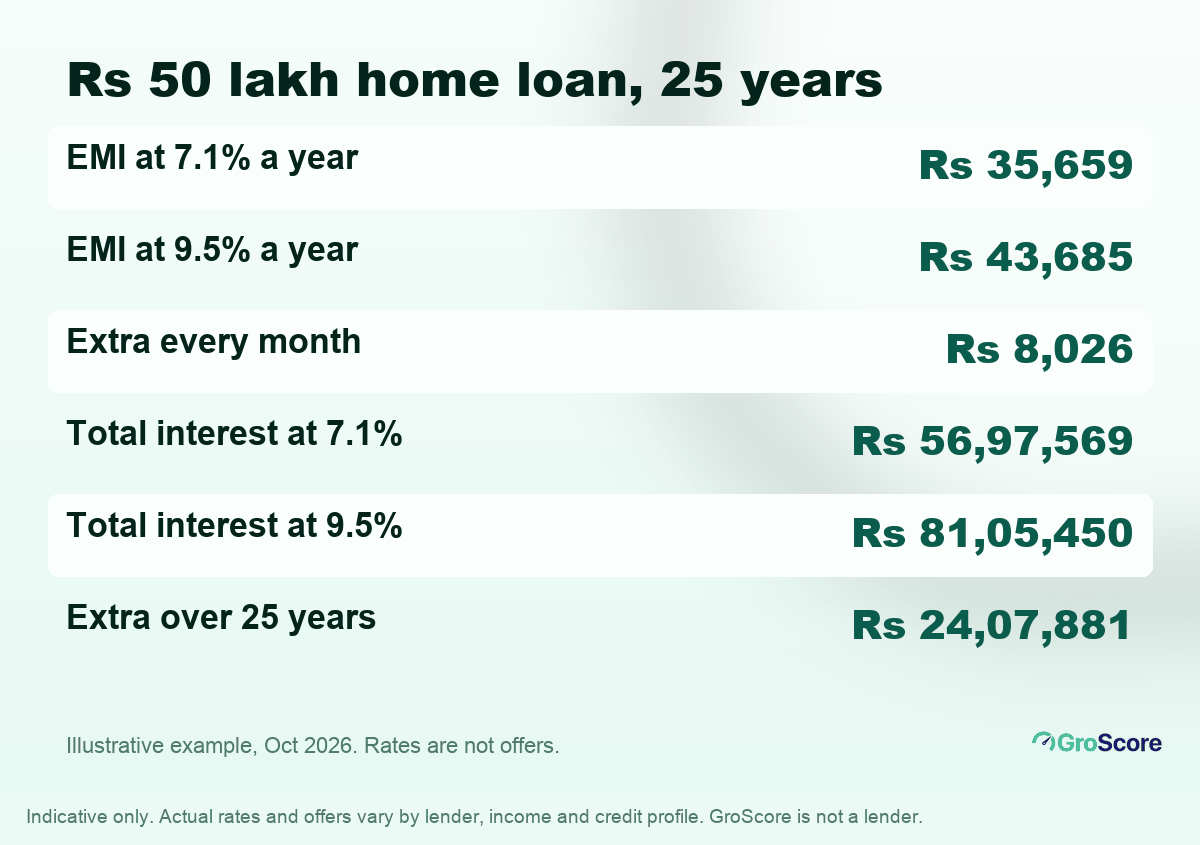
Illustrative example: same house, same tenure, a different rate.
At 7.1% a year, the EMI works out to ₹35,659 and total interest to ₹56,97,569. At 9.5%, the EMI rises to ₹43,685 and interest to ₹81,05,450. That's ₹8,026 extra every month, and ₹24,07,881 more over the full 25 years. These are illustrative figures, worked out with the standard EMI formula as of October 2026. They aren't offers, and no lender is claimed to link these exact rates to particular scores. Actual offers vary by lender, income and credit profile. Before you sign, RBI rules require the lender to give you a Key Fact Statement. Compare its annual percentage rate (APR), processing fee and charges, not the headline rate alone. If you plan to prepay later, it's worth knowing whether closing a loan early affects your credit score.
What Do Home Loan Lenders Check Besides Your Score?
The score gets you through the first screen. Then the underwriter reads everything else.
Income and FOIR. FOIR, or fixed obligation to income ratio, is the share of your monthly income already going to EMIs. Earn ₹1,20,000 and pay ₹30,000 in EMIs, and your FOIR is 25% before the new loan. Add a home loan EMI of ₹40,000 and it jumps to about 58%. Each lender sets its own FOIR ceiling, and this number often decides how much you can borrow.
The property. Lenders check the title, approvals and valuation. They fund a share of the property's value and expect you to bring the rest as a down payment.
Job stability and documents. Salaried borrowers show salary slips and Form 16. Self-employed borrowers show ITRs and business vintage.
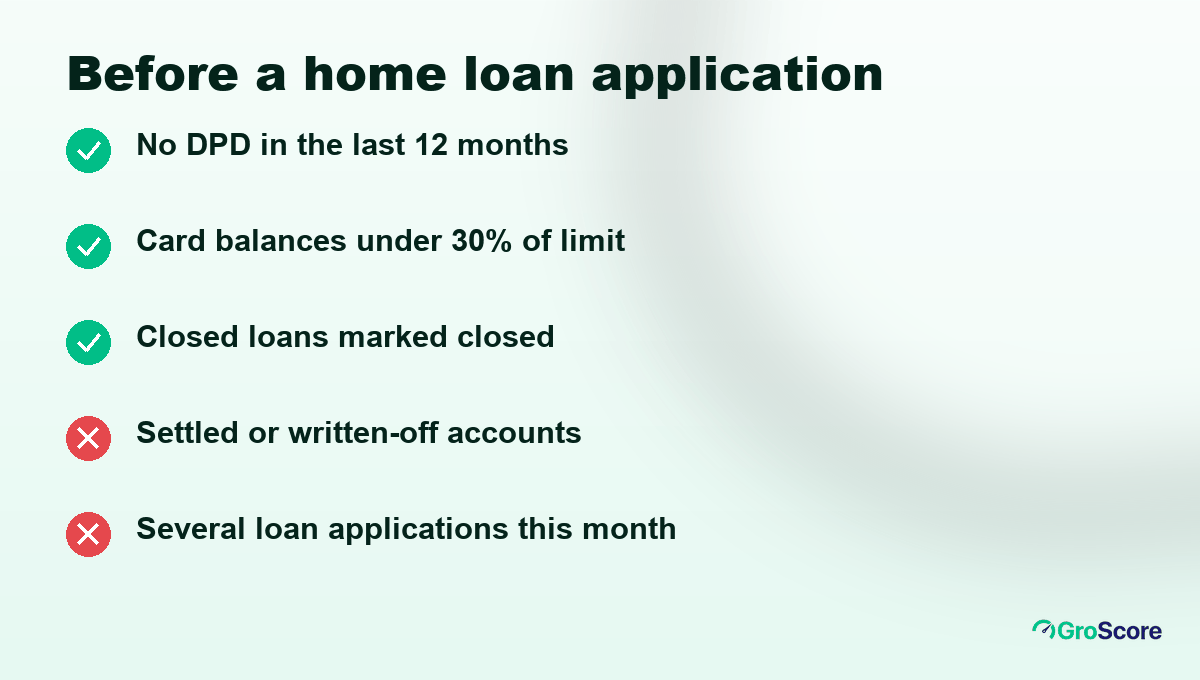
The detail inside your report. A "settled" or "written-off" status, even an old one, can sink an application the score alone would pass. So can a DPD (days past due) entry from the last few months. Our guide to reading your credit report explains each of those codes.
Does Adding a Co-Applicant Help With a Low Score?
Often, yes, but not the way people assume. A joint home loan lets the lender add a co-applicant's income, which can raise the amount you qualify for. The lender reads both credit reports, though. A strong co-applicant doesn't hide a weak one, and some lenders weigh the weaker profile heavily.
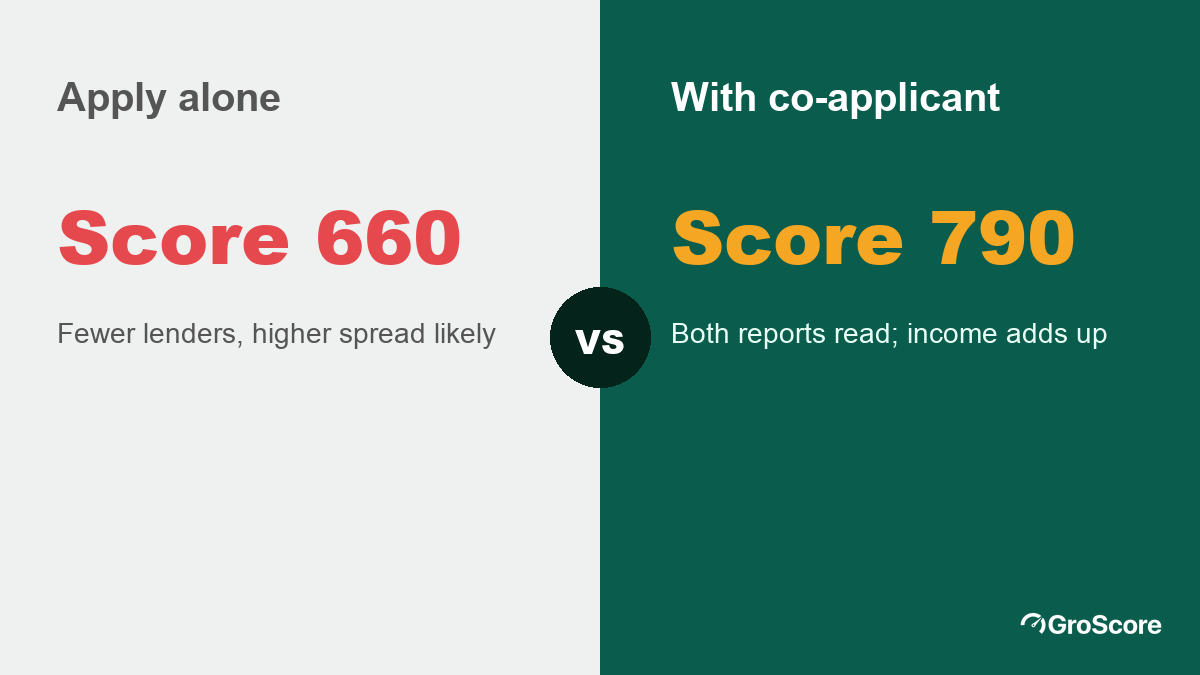
Illustrative example: a joint application changes what the lender sees.
Take an illustrative case. You're at 660, and your spouse is at 790 with a steady salary. Applying together may open lenders that would turn you down alone, and it can improve the rate. Both of you become liable for every EMI. Miss one, and it shows on both reports.
Who suits a joint loan? A spouse or parent who'll co-own the property and can genuinely share the repayment. Who should avoid it? Anyone signing only to help, with no stake in the house.
What Would a Credit Coach Flag Before You Apply?
Here's an illustrative example, built on the kind of report GroScore reads every day. Say Karan, 33, wants a home loan in four months. His Equifax score is 684. Arjun, GroScore's credit coach, reads his report with him and flags four things, in this order:
- Two credit cards at 82% of their combined limit (an indicative figure for this example). Paying them below 30% before the statement date is the quickest item he controls. GroScore's guidance is to keep card use under 30% of the limit (groscore.in, retrieved 2026-10-05).
- A personal loan still showing "active" that he closed last year. GroScore says about 1 in 5 reports carries an error, roughly 20% (groscore.in, retrieved 2026-10-05). If the closure is real, he gets the NOC from the lender and raises a dispute with the bureau, as our CIBIL dispute guide explains.
- A 30-day DPD on a phone EMI, eight months old. It's accurate, so nobody can remove it early. It fades as on-time payments pile up.
- Four enquiries in five weeks from home loan "eligibility checks" he clicked through. The advice is to stop until he picks one or two lenders.
Read your report the way an underwriter will.
Why the cards first? A card balance updates with each statement, and lenders have reported to bureaus every week since 1 July 2026 (RBI). A paid-down balance can show up within weeks. The old DPD can't be rushed. For a structured plan through that middle ground, see how to increase your CIBIL score from 600 to 750.
No coach can promise Karan a loan or a rate, and results depend on what's on his report. GroScore ranks the fixes and shows which lenders' criteria his profile clears across 100+ loans and cards from 60+ banks and NBFCs (groscore.in). The lender decides.
Can You Get a Home Loan With a Low or No CIBIL Score?
With no history at all, possibly. A score of "NH" or "-1" means no history, not bad history. Some lenders will consider a first-time borrower on income, documents and the property, often for a smaller amount or a joint application.
A home loan for a low CIBIL score is harder. Below 650, most banks decline. Your options, in rough order:
- Fix what's fixable first, such as high card balances and genuine errors.
- Add a co-applicant with a clean report and income.
- Bring a larger down payment so the lender funds less.
- Approach an RBI-regulated housing finance company or NBFC, and expect a higher rate.
Check any lender before you share PAN or Aadhaar. Banks are easy to verify. For an NBFC, search the RBI's list of registered NBFCs. Anyone promising a home loan "without CIBIL check" or with guaranteed approval is making a promise no regulated lender makes. If a regulated lender doesn't resolve your complaint, escalate to the RBI's Complaint Management System (cms.rbi.org.in).
Frequently Asked Questions
What is the minimum CIBIL score for a home loan?
There's no single minimum. Many lenders treat about 700 as a starting point and offer their better rates from 750 up. Some housing finance companies and NBFCs consider lower scores at higher rates. Every lender sets its own cut-off, so treat these as indicative.
Can I get a home loan with a 650 score?
Possibly, with fewer lenders and a higher rate. A co-applicant with a strong report, a bigger down payment or a smaller loan amount improves your chances. Find out why you're at 650 first. One maxed-out card is a fix you can make this month; a recent 60-day late payment is not.
Does adding a co-applicant help with a low score?
Usually it helps with the amount and sometimes the rate, because the lender can count both incomes. But it reads both credit reports, so the co-applicant doesn't erase your history. Both of you are responsible for every EMI.
How much can a better score save on a home loan?
For example, on an illustrative ₹50 lakh, 25-year loan, 7.1% instead of 9.5% means an EMI ₹8,026 lower and ₹24,07,881 less interest over the term. A better score doesn't guarantee a rate, but it usually puts you in a cheaper pricing bracket.
Can I prepay my home loan without a penalty?
On a floating-rate home loan taken as an individual for a non-business purpose, RBI rules bar prepayment charges. The RBI's 2025 prepayment directions apply this to all such loans sanctioned or renewed from 1 January 2026. Fixed-rate loans can carry a charge, so check your agreement.
The Bottom Line
The CIBIL score for home loan approval is usually less demanding than for a personal loan, but the price of a weak score is far bigger, because you pay it every month for decades. Aim for 750+ if you can wait. If you can't, clean up the report, consider a co-applicant you trust, and compare APRs, not headline rates. Unsecured loans are stricter still, as our guide to the CIBIL score for a personal loan shows.

Disclaimer
This GroScore article is for general education and is not financial advice. GroScore provides credit scores and reports sourced from Equifax, an RBI-licensed credit bureau; scores differ between bureaus and change as lenders report new data. Credit score improvement depends on your individual credit behaviour and bureau reporting timelines, and results are not guaranteed. Loan and card decisions are made by lenders on their own criteria. GroScore is not a lender. Figures and rates shown are indicative.
