Does Closing a Loan Affect Credit Score? Prepaying Explained
Paying off a loan is good news for your wallet. Here's what it does to your score, and the paperwork that decides whether your report agrees.

Does closing a loan affect credit score badly? Not if you pay it in full. The account stays on your report as "closed", with its whole on-time record. Some people see a small, temporary dip afterwards, because an active account stops adding fresh payments and your credit mix narrows. The one closure that really hurts is a "settled" loan, where you paid less than you owed.
Key TakeawaysA loan repaid in full stays on your credit report as a closed account with its payment history. Closing it doesn't erase the good record.A small dip after closure is common and usually fades. A "settled" or "written-off" status is the closure that does real damage.Under RBI rules, banks and NBFCs can't charge a prepayment fee on floating-rate loans to individuals for non-business purposes (RBI).With the loan gone, card balances count for more. GroScore's guidance is to keep card use under 30% of the limit (groscore.in).After closure, collect your NOC and check that your report shows "Closed" with a zero balance. Lenders have reported to bureaus weekly since 1 July 2026 (RBI).
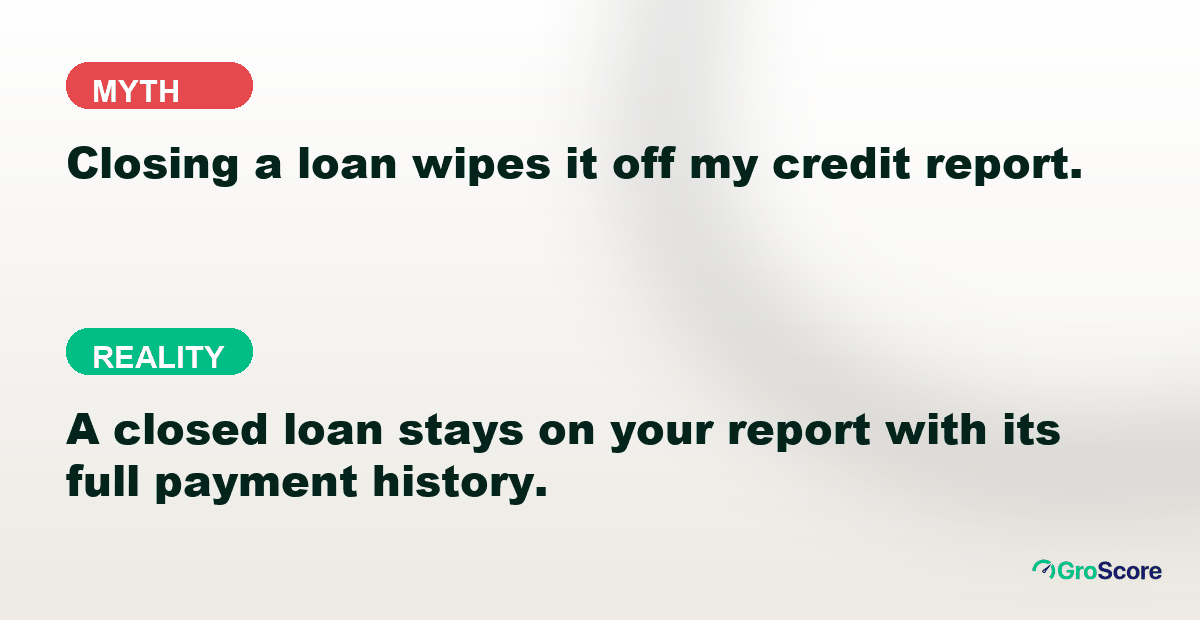
Your repaid loan keeps working for your record after it closes.
First, What GroScore Is and Isn't
Because this page is about loans, here's a plain note. GroScore is a free credit score app and personal credit coach from Vitrak Technologies (GroMo). It shows your Equifax credit score and full report with a soft check that never affects your score, explains in Hindi or English what is holding the score back, and gives a step-by-step plan to fix it. GroScore is not a lender. It doesn't give, approve or close loans, and it can't change what a lender reports.
People often say "CIBIL" for any credit score. TransUnion CIBIL is one of four RBI-registered credit bureaus, alongside Equifax, Experian and CRIF High Mark. Your lender may report to all of them, and each one shows your closed loan. The number GroScore shows is your Equifax score, not a CIBIL score. Planning a new loan after this one? Our guide to the CIBIL score needed for a loan shows what lenders look for.
Why Did My Score Drop After I Closed a Loan?
You did the responsible thing, and the score fell a few points. Three things usually explain it.
An active account stopped reporting new payments. Every on-time EMI added a fresh positive entry. Once the loan closes, the history stays, but nothing new is added.
Your credit mix narrowed. Scoring models like seeing that you can handle both secured loans (home, car) and unsecured credit (cards, personal loans). Close your only instalment loan, and you're left with just cards.
Your remaining debt looks different. With the loan gone, any card balances become a bigger share of what's left on your report. If your cards run above the 30% of the limit that GroScore suggests (groscore.in, retrieved 2026-10-05), they now stand out.
Most of these dips are small and fade as your other accounts keep reporting on time. Your score can recover, but how fast depends on what else is on your report. If the drop is large, something else is probably going on: a missed payment elsewhere, a new enquiry, or a closure reported wrongly. Our guide on why your credit score dropped walks through the other causes.
Closed or Settled: Does Closing a Loan Affect Credit Score Differently?
How a loan ends matters far more than when it ends. Lenders reading your report treat these statuses very differently.
| Status on your report | What it means | Effect on future loans |
|---|---|---|
| Closed | You repaid everything you owed | Positive record; lenders see a loan handled well |
| Settled | The lender accepted less than the full dues | A serious red flag for years, even though the account is shut |
| Written off | The lender gave up recovering the dues | One of the worst entries a report can carry |
| Still "active" after you paid | A reporting error by the lender | Fixable: ask the lender, then dispute with your NOC |
Status names vary slightly by bureau. General guidance, October 2026.
If you're offered a "settlement" because you're struggling, understand the trade. It ends the calls, but the report will say you didn't pay in full. Accurate settled entries can't be removed early by anyone, including agencies that charge to "repair" your score.
Is It Better to Prepay a Loan or Keep Paying EMIs?
For your score, it barely matters. For your wallet, prepaying usually wins, because every rupee of principal you clear stops attracting interest.
For example, say your personal loan is ₹5 lakh at 14% a year for five years. The figures below are illustrative.
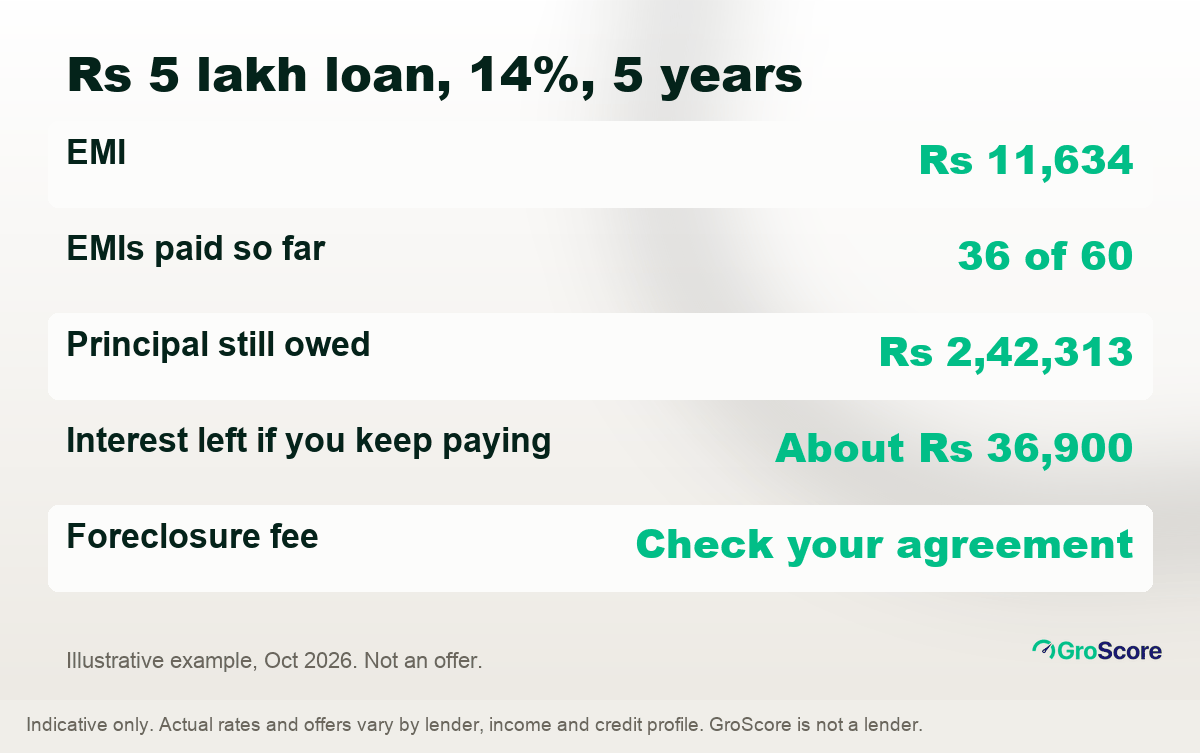
Illustrative example: what's left to pay after three years.
The EMI works out to ₹11,634. After 36 of the 60 EMIs, about ₹2,42,313 of principal is still outstanding. Keep paying, and the remaining 24 EMIs total ₹2,79,216, so about ₹36,900 of that is interest. Close the loan now, and you save most of that interest, minus any foreclosure charge. These figures are illustrative, worked out with the standard EMI formula as of October 2026. They aren't offers. Actual terms vary by lender, income and credit profile. Any foreclosure charge appears in the Key Fact Statement that RBI rules require lenders to give you.
What about charges? Under the RBI's Pre-payment Charges on Loans Directions, 2025, banks and NBFCs can't levy prepayment charges on floating-rate loans to individuals for non-business purposes, with or without a co-borrower. They apply to loans sanctioned or renewed from 1 January 2026, whatever money you use to prepay, and with no minimum lock-in, so even a ₹50,000 part-prepayment on such a loan can't attract a charge. Many personal loans are fixed-rate, though, and those can carry a foreclosure fee. Your loan agreement and Key Fact Statement show it.
Hold off if prepaying would empty your emergency fund, or if you carry costlier debt like a card balance. Clear that first. Closing a loan to free up room for a home loan? Our guide to the CIBIL score for a home loan shows the score lenders look for and how it moves the rate.
How to Close a Loan the Right Way
The money part is easy. The paperwork is where closures go wrong.
- Ask for a foreclosure statement. It gives the exact amount due on a date, including interest up to that day and any charge. Pay that figure, not an estimate.
- Collect your NOC. A no objection certificate (NOC) is the lender's written confirmation that nothing is owed. Keep it safely. It's your proof if the bureau record is ever wrong.
- Get your documents back and the charge removed. For a home or vehicle loan, the lender holds documents or a registered charge (such as hypothecation on your car's registration). Under an RBI circular in force since 1 December 2023, lenders must release original property documents and remove registered charges within 30 days of full repayment. If they're late for reasons of their own, they owe you ₹5,000 for each day of delay, as the RBI's circular on release of property documents sets out.
- Check your credit report. Give it a few weeks, then confirm the account shows as closed.
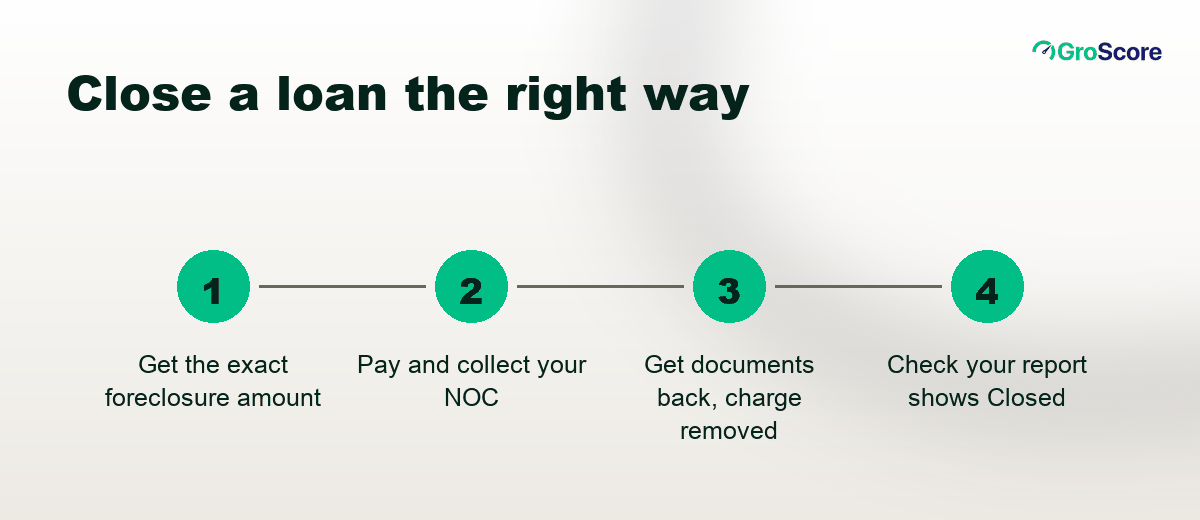
Four steps, and the last one is the one people skip.
How Do You Check Your Report Shows the Loan as Closed?
Pull your report and find the account. A clean closure has a few tell-tale fields.
Look for Account status: Closed, a zero current balance, nothing overdue, and a date closed that matches your NOC. No "settled" or "written-off" remark should appear.
Lenders have reported to bureaus every week since 1 July 2026 (RBI), so a closure should reach your report faster than it used to. Still showing "active" after a month or two? First ask the lender to correct what it reported. If that doesn't work, raise a dispute with the bureau and attach your NOC. Our CIBIL dispute guide covers each step, and the RBI's Complaint Management System (cms.rbi.org.in) is the escalation route if a regulated lender doesn't fix it.
What Would a Credit Coach Flag After a Closure?
Here's an illustrative example. Say Priya, 36, prepaid her car loan in March. In June her Equifax score is 12 points lower than in February, and she wants to know why. Arjun, GroScore's credit coach, reads the report with her and flags three things, in this order:
- The car loan still shows "active" with a small balance. The lender never reported the closure. With her NOC, she asks the lender to correct it and raises a dispute if needed.
- Her only credit card is at 64% of its limit (an indicative figure for this example). With the loan gone, the card is now the main live account on her report. GroScore's guidance is to keep card use under 30% of the limit (groscore.in).
- Nothing else is wrong. Her payment history is clean, so the dip from the closure itself should fade.
Reporting errors aren't rare: GroScore says about 1 in 5 reports carries one, roughly 20% (groscore.in, retrieved 2026-10-05).
Notice the order. A reporting error comes first because it's a quick, factual fix. The card comes next because it's the item she controls. The closure itself needs nothing. GroScore can't edit what a lender reports, and it can't promise points. Instead, it flags the problem: its in-app alerts cover new enquiries, report errors and overdue payments, and it tracks the report monthly (groscore.in).
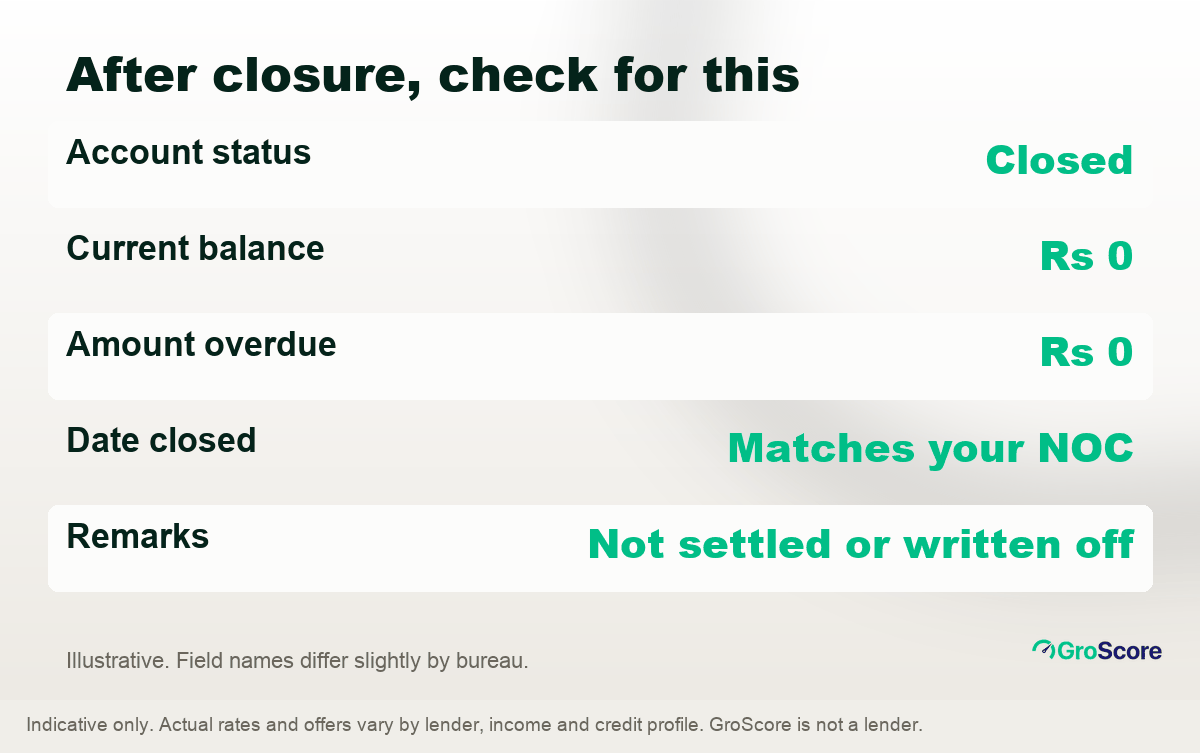
Illustrative fields. Each bureau labels them slightly differently.
Does Paying Off All Your Debt Raise Your Credit Score?
Paying off cards usually helps, because utilisation falls. Paying off loans is mostly neutral for the score and good for your finances. Owing nothing at all doesn't give you a perfect score, though. Bureaus score how you handle credit, so an empty report has less to judge.
If you want to keep a healthy profile after closing your loans:
- Keep your oldest credit card open and use it lightly, well under 30% of the limit. Our guide to the credit utilisation ratio explains why.
- Pay every bill in full and on time.
- Apply for new credit only when you need it.
Frequently Asked Questions
Does closing a loan improve my CIBIL score?
Not directly. A loan repaid in full stays on your report as a closed account with a good record, which helps future lenders trust you. The score itself may stay flat or dip slightly for a while. Bigger gains usually come from keeping card balances low and paying everything on time.
Why did my score drop after I closed a loan?
Usually because an active account stopped adding new on-time payments, your credit mix narrowed, or your card balances now stand out more. A large drop deserves a closer look. Check that the loan shows as closed with a zero balance, and look for a missed payment or new enquiry elsewhere.
Is it better to prepay a loan or keep paying EMIs?
For your score, it makes little difference. For your finances, prepaying usually saves interest. For example, in our illustrative ₹5 lakh, 14% loan, about ₹36,900 of interest is still due after three years. Check for a foreclosure charge first, and keep an emergency fund.
Does paying off all my debt raise my credit score?
Clearing card balances usually helps because utilisation drops. Closing every loan and card doesn't create a perfect score, since bureaus need active accounts to judge. Keep an old card open and use it lightly.
The Bottom Line
Closing a loan the right way is good for your finances and, over time, good for your record. A small dip is normal. The things that cause real damage are a settlement, a missed payment on the way out, or a closure the lender never reports. Collect your NOC, get your documents back, and check your report a few weeks later. If any entry puzzles you, our guide to reading your credit report decodes it.
Disclaimer
This GroScore article is for general education and is not financial advice. GroScore provides credit scores and reports sourced from Equifax, an RBI-licensed credit bureau; scores differ between bureaus and change as lenders report new data. Credit score improvement depends on your individual credit behaviour and bureau reporting timelines, and results are not guaranteed. Loan and card decisions are made by lenders on their own criteria. GroScore is not a lender. Figures and rates shown are indicative.
