Why Did My Credit Score Drop? 9 Reasons and What to Do
A sudden fall almost always has a cause you can find on your report. Here's where to look, and in what order.

Why did my credit score drop? Usually because something new reached your credit report: a late payment, a higher card balance, a fresh loan application, a closed account or an error. Compare the full report with last month's. The changed entry is almost always the cause, and most drops can recover once you fix it.
Key TakeawaysA single missed EMI can cost 50 to 100 points, by GroScore's guidance. It's the most damaging cause on this list (groscore.in).A high card balance can pull your score down even when you pay the bill in full. GroScore suggests keeping use under 30% of your limit (groscore.in).Lenders have reported to the bureaus every week since 1 July 2026, so changes show up faster than before (RBI).About 1 in 5 credit reports carries an error, GroScore says. Rule that out before you assume the worst (groscore.in).
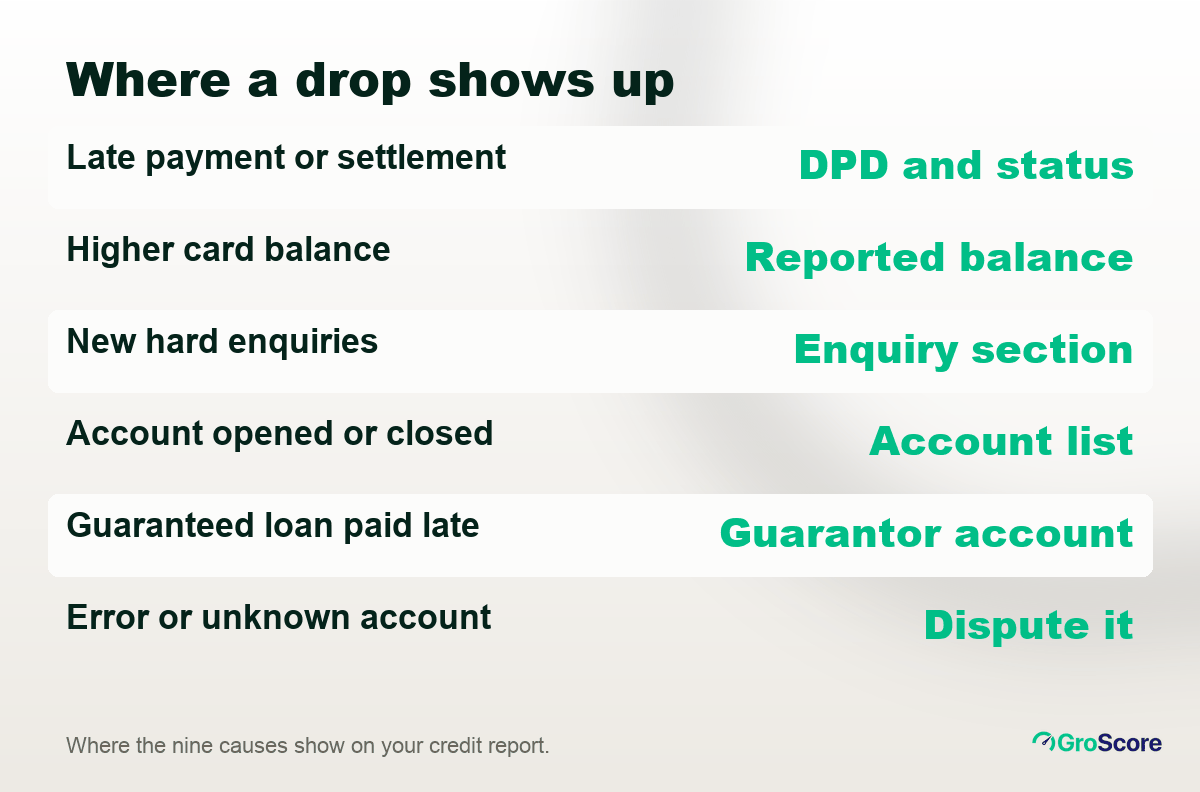
Every drop leaves a trace somewhere on the report.
The 9 Most Common Reasons a Credit Score Drops
Here they are, roughly from most to least damaging. You'll usually find one or two, rarely all nine.
- A late or missed payment. Your report marks each late month as DPD, days past due. One EMI paid 30 days late is enough to show.
- A higher card balance. The balance on your statement date is what the lender reports. A big purchase can push your utilisation (balance divided by limit) well above 30%.
- New hard enquiries. Each loan or card application adds one. Several in a few weeks look like you're short of money.
- A new loan or card. It adds fresh debt and lowers the average age of your accounts.
- Closing a credit card. Your total limit shrinks, so the same spending becomes a higher share of it.
- Paying off a loan. Surprising, but a small dip can follow when you close your only instalment loan. It passes.
- A settlement or write-off. "Settled" means you paid less than you owed, with the lender's agreement. It weighs heavily.
- A loan you co-signed. If the borrower pays late, it can hit your report too.
- An error, or an account that isn't yours. A wrong DPD, a closed loan shown open, or a loan someone took in your name.
A score that's been low for years is a different problem, covered in why your credit score is low. Here, the job is tracing a sudden fall back to one entry.
Credit Score Dropped Suddenly? Check These Three First
Start with the causes that move a score most in a single month. A big fall rarely comes from one enquiry.
- The payment history section. Scan every account for a DPD in the latest month. Under RBI rules, your lender must also send you an SMS or email when it reports a default or DPD to a bureau (RBI). Check your inbox for one.
- The account list. Is there one you don't recognise, or a closed loan still showing "Active"?
- The card balances. Compare each reported balance with its limit.
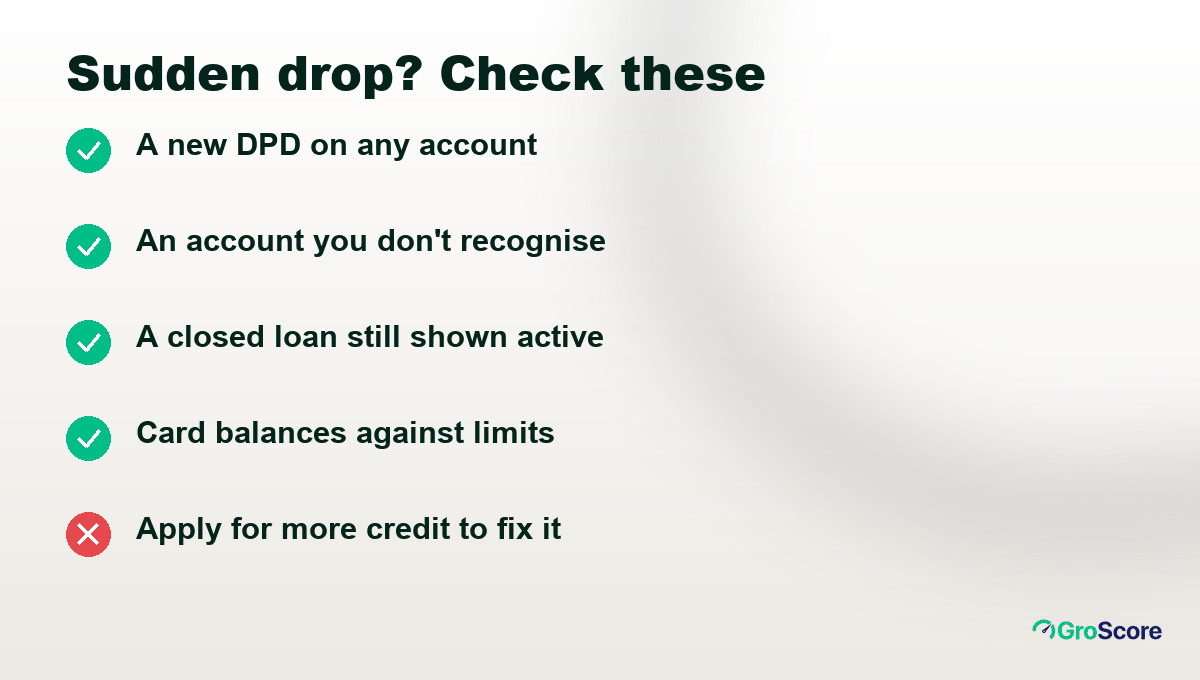
Three checks find the cause of most sudden drops.
If the DPD is real, our guide on missed EMI and your CIBIL score shows how to stop the damage before the next month is reported. None of the three? Then look at enquiries and recent account changes, which usually cause smaller dips.
Why Did My Score Drop After I Paid My Credit Card?
You paid in full, on time, and the score still fell. Three things usually explain it.
The first is timing. Card issuers usually report the balance from your statement, not the balance after you pay. Say your limit is Rs 50,000 and your statement shows Rs 40,000. The bureau sees 80% utilisation, even if you clear it all three days later.
The second is a closed card. People often pay a card off and close it in the same week. That's the step that hurts, because it removes the limit from your total.
The third is coincidence. Something else changed that month, and the payment just arrived at the same time.
The fix for the first one is simple. Pay down a large balance before the statement date, not after.
Score Drop Without a Missed Payment: The Quieter Causes
You have no late payments and no big balances. So what's left?
Enquiries. If you checked loan offers on several apps, some may have run a hard check. Each one lowers your score a little for a while. Checking your own score is a soft enquiry and never affects it. Our explainer on hard vs soft enquiry shows how to tell them apart. Bureaus must alert you by SMS or email when a lender pulls your report (RBI), so an alert you don't remember deserves a closer look.
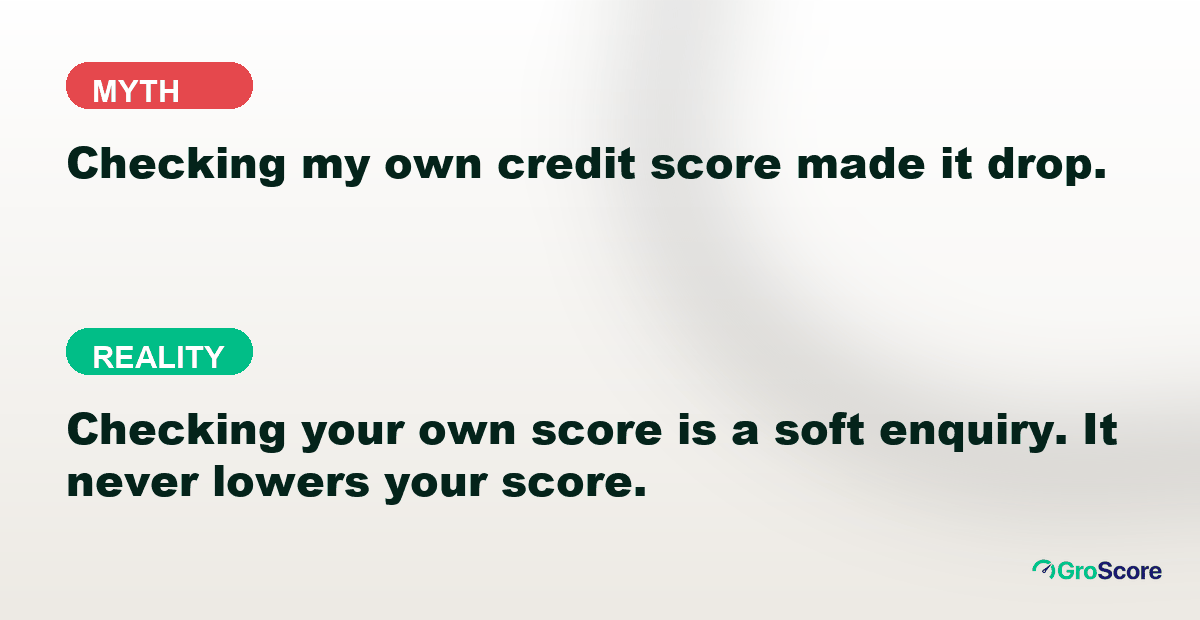
Checking your own score is never the reason it fell.
A co-signed loan. Your report lists loans where you're a borrower, a co-borrower or a guarantor (RBI). If a relative pays late on one, it can show on yours.
A new account. A new card or consumer-durable loan adds debt and lowers the average age of your accounts. A small, short dip is normal.
Reporting lag. Sometimes last month's change simply got reported this month. Lenders report weekly from 1 July 2026 under the RBI's 2025 amendment directions on credit reporting, so that lag is shorter than it was. A loan you paid off a month or two ago can surface this way too, so it helps to know how closing a loan affects your credit score.
What Would a Credit Coach Flag on a Dropped Score?
Here's an illustrative example. Karan, 29, sees his Equifax score fall from 742 to 711 in one month. He's never missed a payment. Arjun, GroScore's credit coach, goes through the report and finds three changes:
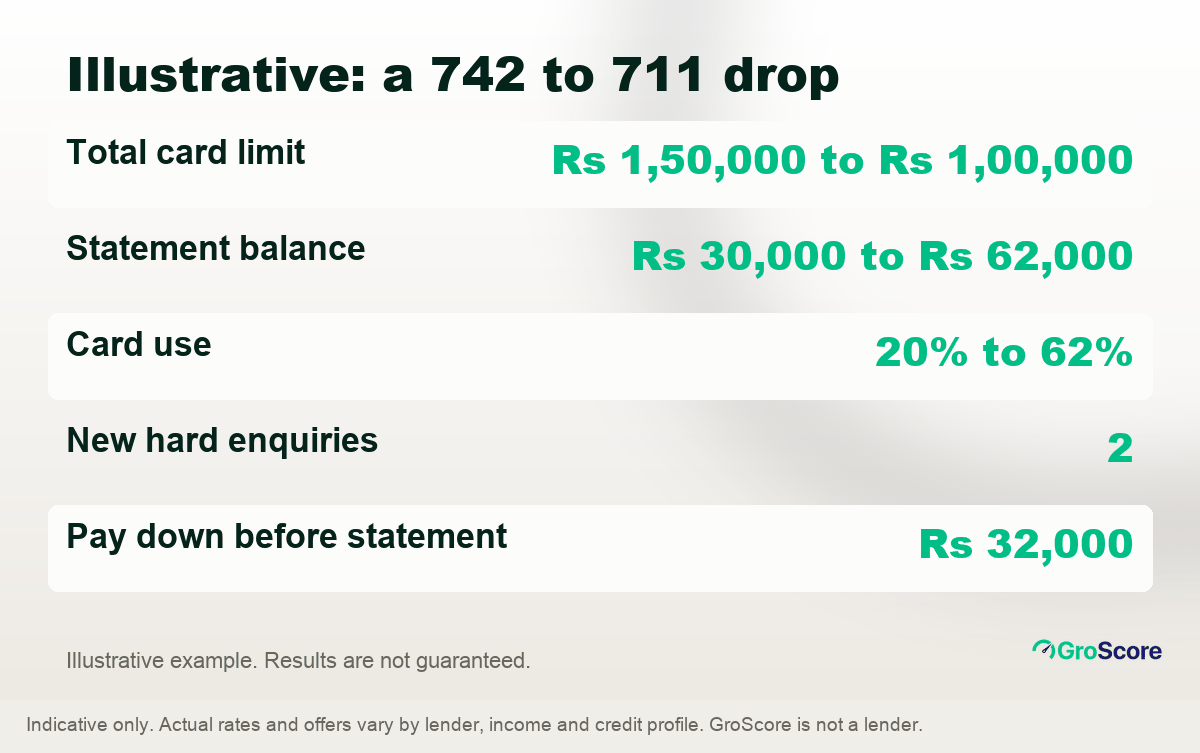
Illustrative example. Three ordinary decisions, one 31-point fall.
- A closed card. Karan had two cards with limits of Rs 1,00,000 and Rs 50,000, so Rs 1,50,000 in total. He closed the smaller one.
- A bigger balance on the card he kept. He put a Rs 32,000 phone on it, so his statement balance went from Rs 30,000 to Rs 62,000. Before, that works out to Rs 30,000 ÷ Rs 1,50,000 = 20%. After, it's Rs 62,000 ÷ Rs 1,00,000 = 62%.
- Two hard enquiries from comparing personal loan offers in the same fortnight.
There's no DPD, no unknown account and no error, so the fix order is short. Pay the card down to Rs 30,000 or less (the 30% target on Rs 1,00,000) before the next statement date, which means paying Rs 32,000. Our guide to keeping credit card use under 30% shows the same arithmetic for other limits. Next, stop comparing loan offers that run hard checks. The enquiries simply age. How far his score recovers depends on the whole report, and results are not guaranteed.
GroScore is a free credit score app and personal credit coach from Vitrak Technologies (GroMo). It shows your Equifax credit score and full report with a soft check that never affects your score. It alerts you to a new enquiry, an overdue payment, a report error or possible fraud, and tracks your report monthly. GroScore is not a lender, and the score it shows is your Equifax score, not a CIBIL score.
Should You Dispute a Sudden Drop?
Dispute it only if the cause is an error. You can't dispute a score. You dispute an entry on the report, and only when it's false.
| What you found | Is it an error? | What to do |
|---|---|---|
| DPD on a month you paid on time | Yes | Dispute it, with your bank statement as proof |
| Loan or card you never opened | Yes, possibly fraud | Dispute it and contact the lender at once |
| Closed loan still shown "Active" | Yes | Dispute it, with the closure letter |
| High card balance you really spent | No | Pay it down before the statement date |
| Enquiry from a loan you applied for | No | Nothing to fix. It fades with time |
| Late payment that really happened | No | Pay on time from now; it stays on the report |
Disputes are free, and you file them with the bureau that shows the error. Under RBI rules the complaint must be resolved within 30 days, or you're owed Rs 100 for each day of delay. Our step-by-step guide covers how to fix errors in your credit report with each bureau. Be wary of anyone who offers to "remove" a true late payment for a fee. Nobody can delete an accurate entry early.
How to Answer "Why Did My Credit Score Drop?" in 15 Minutes
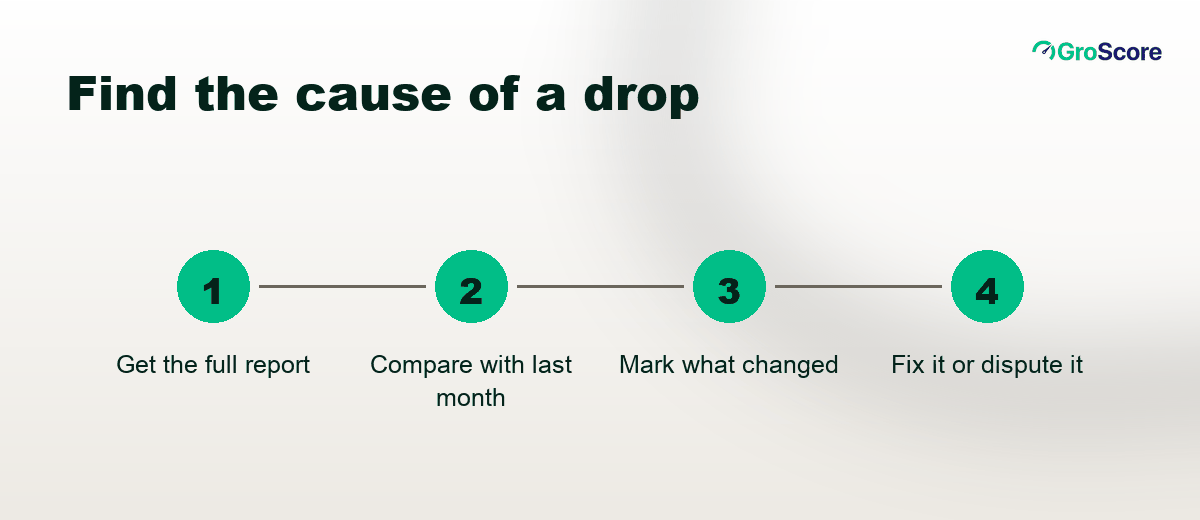
Work through this in order. It finds the cause on most reports.
Compare, don't guess.
- Get the full report, not just the number. Each bureau must give you one free full credit report a year, under the RBI's credit information rules (2025). GroScore shows your Equifax report free, any time.
- Compare it with last month's. Look for new accounts, new enquiries, a changed status or a new DPD.
- Check whether you're comparing like with like. A CIBIL score and an Equifax score are calculated separately by two different bureaus. CIBIL is one of four RBI-registered credit bureaus, along with Equifax, Experian and CRIF High Mark. A "drop" between two apps may just be two bureaus.
- Fix what you control, dispute what's wrong. Pay down balances, clear any overdue amount today, and file a dispute for anything false.
Then wait for the next update. Timing depends on when your lender reports, as our guide on when your credit score updates explains.
Frequently Asked Questions
Why did my credit score drop for no reason?
There's almost always a reason, even if it isn't obvious. The usual quiet causes are a higher statement balance, a hard enquiry from a loan offer you checked, a new account or a co-signed loan. Errors are possible too. Compare this month's report with last month's.
Why did my score drop after I paid my credit card?
Card issuers usually report the balance on your statement date, before your payment. So a large statement balance can lower your score even if you paid it in full. Closing the card after paying it off can also cause a dip, because your total limit shrinks.
Can a lender's reporting error cause a drop?
Yes. A payment marked late by mistake, a closed loan reported as active or someone else's account on your report can all lower your score. GroScore says about 1 in 5 reports carries an error. Dispute it with the bureau that shows it, and keep your proof ready.
Can a new enquiry lower my score by 20 points?
A single hard enquiry usually lowers a score only a little, and the effect fades over time. Bureaus don't publish an exact number of points. A 20-point fall is more often a mix of things in the same month, such as two or three enquiries plus a higher card balance.
Should I dispute a sudden drop?
Only if you find an error. You can't dispute the score itself, only a wrong entry such as a false late payment or an account that isn't yours. Accurate entries stay on the report, so for those the answer is to pay on time and keep card balances low.
The Bottom Line
A sudden drop is a signal to read your report, not to panic or apply for more credit. Find the entry that changed. Deal with a real late payment or a large balance this month, and dispute an error for free. If a settled account is behind the fall, follow our plan to improve your CIBIL score after settlement.

Disclaimer
This GroScore article is for general education and is not financial advice. GroScore provides credit scores and reports sourced from Equifax, an RBI-licensed credit bureau; scores differ between bureaus and change as lenders report new data. Credit score improvement depends on your individual credit behaviour and bureau reporting timelines, and results are not guaranteed. Loan and card decisions are made by lenders on their own criteria. GroScore is not a lender. Figures and rates shown are indicative.
