Missed EMI? How to Improve Credit Score After Late Payments
One missed EMI is a problem. Ninety days of them is a default. Here's what changes at each stage and how to climb back.

Missed an EMI? Pay the overdue amount as soon as you can, because the damage grows with every day it stays unpaid. Here's how to improve credit score after late payments: clear the dues, set up auto-debit so it can't happen again, and let months of on-time payments outweigh the late mark. An accurate late payment can't be removed, but its weight fades.
Key TakeawaysUnder RBI rules, a loan overdue up to 30 days is SMA-0, 31 to 60 days SMA-1, 61 to 90 days SMA-2, and more than 90 days becomes a non-performing asset (RBI).Lenders must send you an SMS or email alert when they report a default or days past due to a bureau (RBI).GroScore's guidance is that a single missed EMI can cost 50 to 100 points (groscore.in).Paying late is still far better than not paying. Every extra month adds a new late mark.
You can check whether your missed EMI has reached your report, free, on GroScore. It shows your Equifax score and full report with a soft check.
What Happens When You Miss an EMI?
Three things start at once. Your lender charges a late fee and, if the auto-debit bounced, a bounce charge. Interest keeps running on the overdue amount. And the clock starts on days past due (DPD), the count of days a payment has been late.
Missed EMI penalty and bounce charges vary by lender and are listed in your loan agreement or key fact statement. Check yours rather than trusting a figure from the internet.
Then comes reporting. Lenders send account data to the four RBI-registered credit bureaus: TransUnion CIBIL, Equifax, Experian and CRIF High Mark. Since 1 July 2026, RBI rules require them to report weekly, so a payment that's still overdue can reach your report quickly. If your score has already fallen, here's why your credit score dropped and how to trace the cause. Under the RBI's credit information rules (2025), the lender must also alert you by SMS or email when it reports DPD or a default, if it has your contact details.
GroScore is a free credit score app and personal credit coach from Vitrak Technologies (GroMo). It shows your Equifax credit score and full report with a soft check that never affects your score, explains in Hindi or English what is holding the score back, and gives a step-by-step plan to fix it. GroScore is not a lender, and the score it shows is your Equifax score, not a CIBIL score.
What Changes at 1, 30, 60 and 90 Days Past Due?
Lenders also tag your loan internally as it ages. RBI's asset-classification rules set the buckets for every loan, retail ones included (RBI):
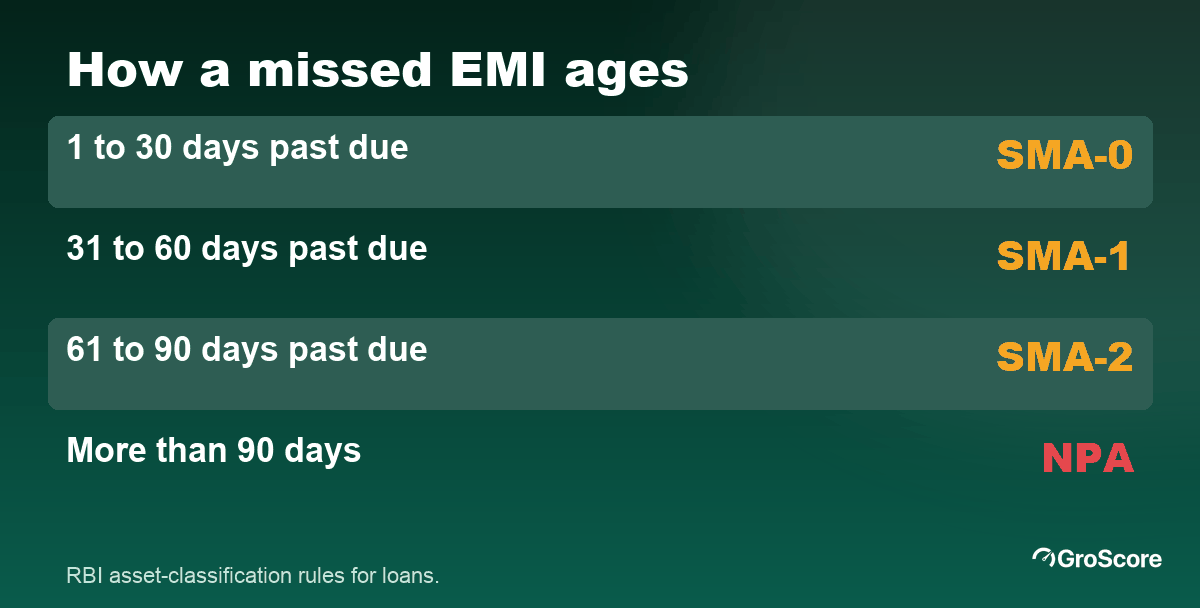
Each bucket tells the lender more about the risk. Your report shows the DPD behind it.
| Days past due | Lender's classification | What it usually means for you |
|---|---|---|
| 1 to 30 | SMA-0 | Late fee and calls. A short DPD can show on your report |
| 31 to 60 | SMA-1 | More collection contact. A 30-plus DPD is a serious mark |
| 61 to 90 | SMA-2 | Last stage before default. Talk to your lender now |
| More than 90 | NPA (non-performing asset) | A default. Recovery action and a lasting negative on your report |
SMA stands for special mention account, an early-warning flag. Once a loan becomes an NPA, RBI rules allow it to go back to "standard" only after the entire arrears of interest and principal are paid (RBI). Partial payments won't do it.
So what does that mean in practice? Paying on day 10 and paying on day 95 are completely different events. Our guide to DPD and STD codes in your CIBIL report shows how each one appears.

What to Do in the First 48 Hours After a Missed EMI
Move fast, and in this order.
- Pay the overdue EMI, plus any charges, through the lender's app, website or branch. Keep the receipt.
- Call or email the lender to confirm the payment has been received and applied to the right loan.
- Find out why it was missed. A low balance on the debit date? A cancelled mandate? A changed salary date? Fix that cause today.
- Ask about moving your EMI date if your salary now arrives after it. Some lenders allow this.
- Don't borrow from a quick-loan app to cover the EMI. That swaps one problem for a costlier one.
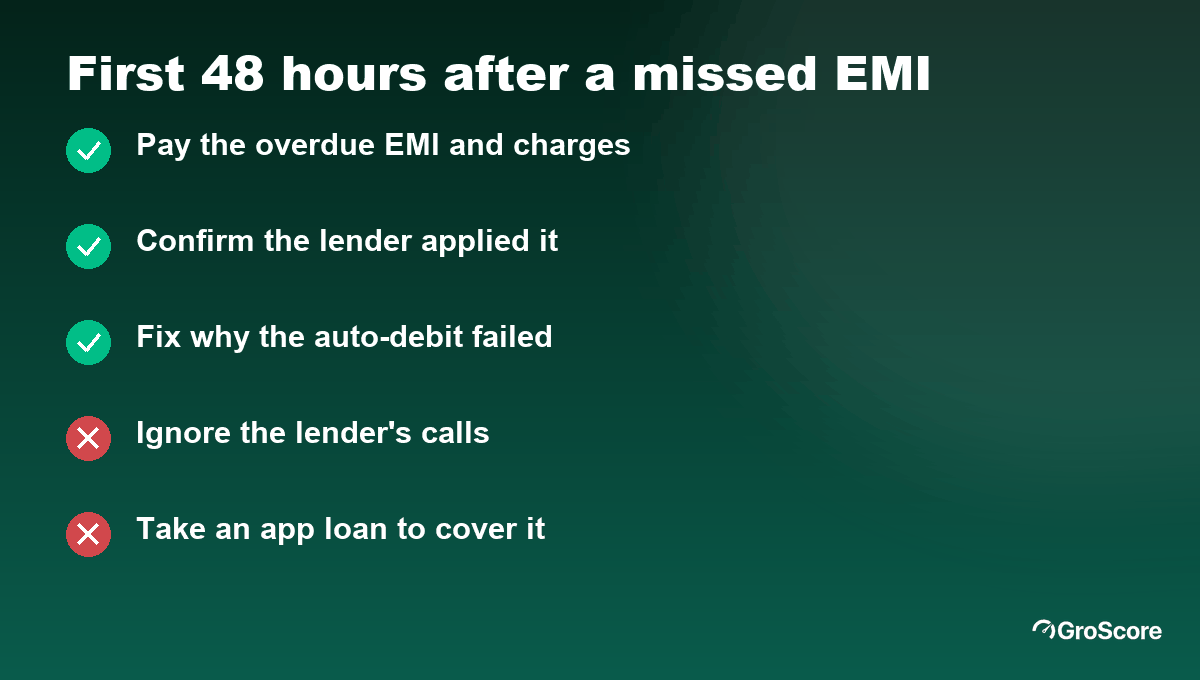
Speed matters more than anything else here.
Can't pay at all this month? Tell the lender before the next due date, not after. Ask whether they offer restructuring, a longer tenure or a short repayment plan. Those are the lender's decisions, not your right, but asking early keeps options open that disappear after 90 days.
How Much Does a Missed EMI Hurt Your Credit Score?
The damage depends on your whole report. A clean file with one 15-day late payment takes a smaller hit than a thin file with several. GroScore's guidance is that a single missed EMI can cost 50 to 100 points (groscore.in), and the drop is usually bigger the longer it stays unpaid. Our main guide to a low CIBIL score covers the other things that pull a score down.
For example (illustrative), say Kavya's EMI of ₹15,000 is due on the 5th. Her salary is delayed, and the auto-debit bounces.
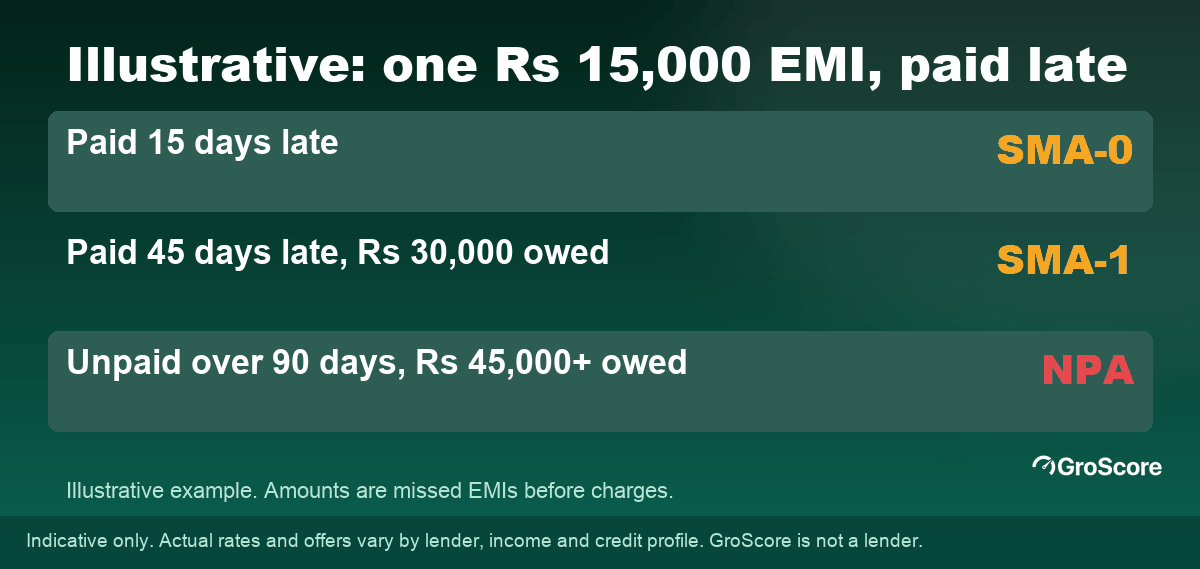
Illustrative example. Same EMI, three very different outcomes.
- She pays on the 20th. That works out to 15 days past due. The loan is in SMA-0, and a short DPD may appear on her report.
- She pays 45 days late. That's SMA-1, with two EMIs now owed (₹30,000) before charges.
- She pays nothing for over 90 days. The loan becomes an NPA, with ₹45,000 or more in missed EMIs before charges, and a default on her report.
Arjun, GroScore's credit coach, would tell Kavya the same thing in each case: pay the oldest EMI first, then stop new ones being missed. All figures here are illustrative, and results are not guaranteed. If you're already past 90 days and weighing a settlement, read about loan settlement and CIBIL before you sign anything.
Does a missed credit card payment count the same?
Mostly, yes. If you don't pay at least the minimum due on a card by the due date, it's reported as late, like an EMI. The difference is cost. Card interest and late fees pile up fast, so a missed credit card payment gets expensive quicker than a missed EMI. Paying only the minimum avoids a late mark but leaves interest running on the rest.
Can You Remove a Late Payment From Your Credit Report?
Only if it's wrong. People search how to remove late payments from credit score all the time, and the honest answer is that an accurate late mark stays.
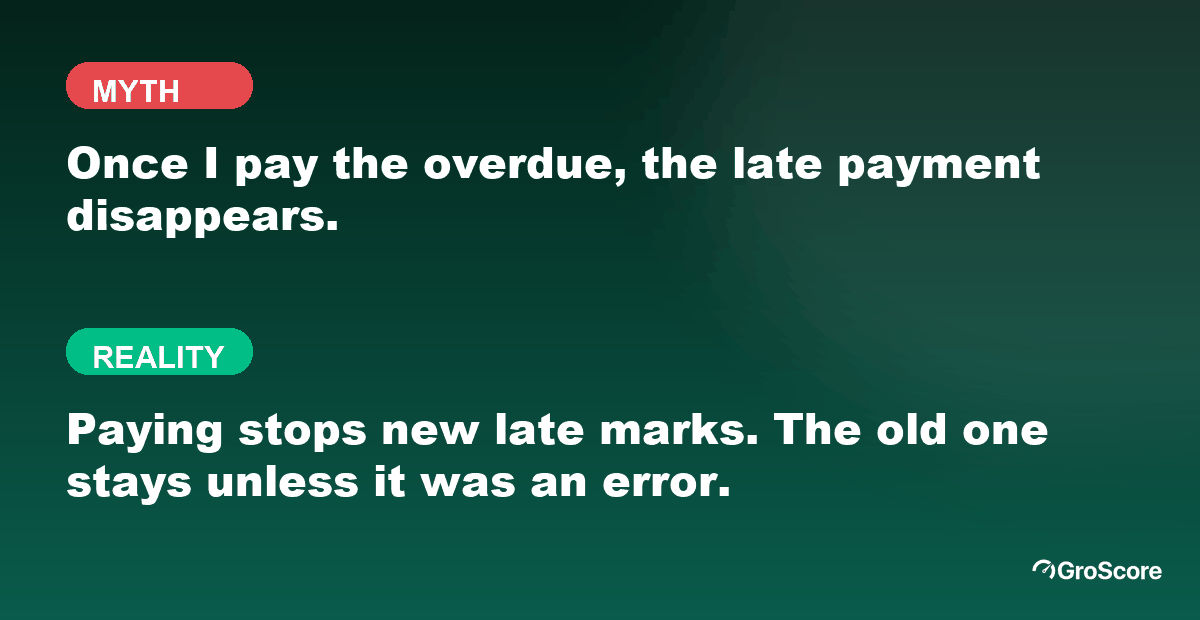
Paying fixes the future, not the past.
Errors are different. If you paid on time and the lender recorded it late, or your bank failed to process a valid mandate, you can raise a dispute with proof. Our CIBIL dispute guide walks through the steps. Under RBI rules, if the complaint isn't resolved within 30 days, you're owed ₹100 for every calendar day of delay (RBI).
Anyone offering to delete a genuine late payment for a fee is selling something the law doesn't allow.
How to Improve Credit Score After Late Payments: The Recovery Plan
Your recovery plan here is about rhythm, not tricks. Late payments are fixed by a long run of on-time ones.
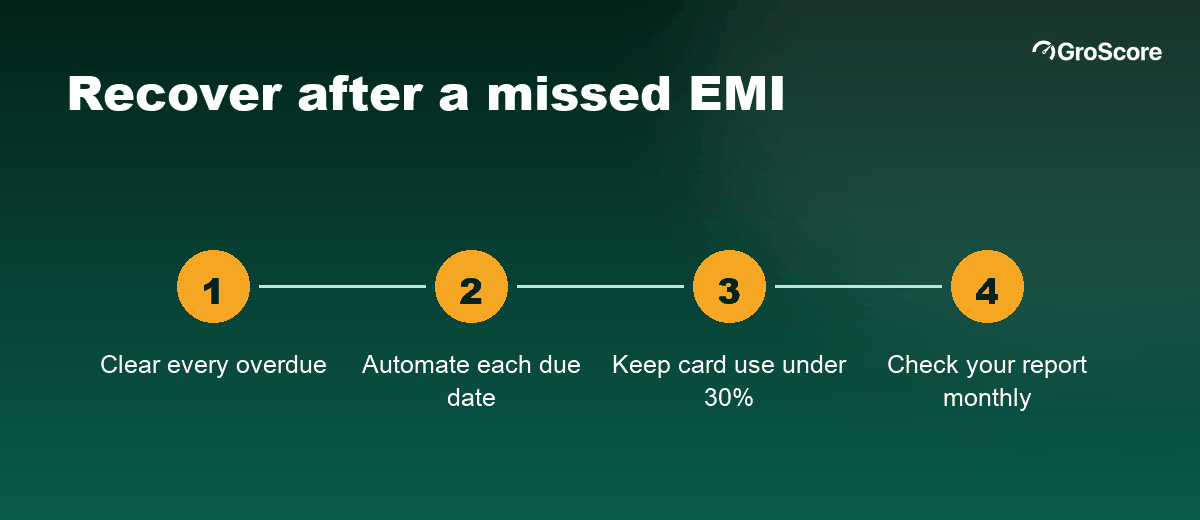
Same four habits, month after month.
Clear everything overdue. Any account still past due adds a new late mark each month.
Automate every due date. Auto-debit for each EMI, and at least the minimum due on each card, from an account that's funded a few days early.
Keep card use under 30% of the limit (GroScore guidance, groscore.in, retrieved 2026-10-05). Low utilisation helps your score while the late mark ages.
Don't apply for new credit for a while. A fresh rejection adds a hard enquiry and helps nothing.
Check your report every month. Confirm the overdue now shows as paid. Our guide to payment history explains why this factor carries so much weight.
How long to improve credit score after late payments? Nobody can promise a timeline. It depends on how late you were, what else is on your report and how consistently you pay from here.
If recovery agents are contacting you, they must follow RBI's conduct rules. Complain to the lender first, and then through the RBI's complaint portal at cms.rbi.org.in if you're harassed.
Frequently Asked Questions
How much does one missed EMI reduce my CIBIL score?
There's no fixed number, because it depends on your whole report. GroScore's guidance is that a single missed EMI can cost 50 to 100 points. The longer it stays unpaid, the bigger the damage.
Can a late payment be removed from my credit report?
Only if it's an error, such as a payment you made on time that was recorded late. You can dispute errors with the bureau. An accurate late payment stays, but its effect fades as on-time payments build up.
What should I do right after missing an EMI?
Pay the overdue amount and charges as soon as you can, confirm with the lender that it has been applied, and fix whatever caused it, such as a low balance on the debit date. If you can't pay, contact the lender before the next due date.
How long does it take to recover from a missed payment?
Nobody can promise a timeline. A single short delay on an otherwise clean report usually matters less over time, while 90-plus days past due takes much longer to outgrow. Consistent on-time payments are what move it.
Does a missed credit card payment hurt more than a missed EMI?
Both are reported as late payments. The bigger difference is cost: card interest and late fees build quickly. Paying at least the minimum due on time avoids a late mark.
The Bottom Line
A missed EMI is fixable if you move fast. Pay it, find out why it happened and fix that, and talk to your lender before day 90 if you're struggling. Then let automated, on-time payments do the slow work of rebuilding. If an account has already gone past 90 days, follow our plan to improve your CIBIL score after a default.

Disclaimer
This GroScore article is for general education and is not financial advice. GroScore provides credit scores and reports sourced from Equifax, an RBI-licensed credit bureau; scores differ between bureaus and change as lenders report new data. Credit score improvement depends on your individual credit behaviour and bureau reporting timelines, and results are not guaranteed. Loan and card decisions are made by lenders on their own criteria. GroScore is not a lender. Figures and rates shown are indicative.
