How to Improve CIBIL Score After Default: A Rebuild Plan
A default isn't permanent damage, but it isn't erased either. Here's the order to rebuild in, from the first call to your lender to your next real loan.

If you're asking how to improve CIBIL score after default, start by getting the account out of default: clear the overdue or close the loan. Then add new on-time history with small, secured credit and give it time. An accurate default stays on your report, so no one can delete it early. Its weight fades as clean months stack up.
Key TakeawaysA loan becomes a non-performing asset (NPA) once dues stay unpaid for more than 90 days, under RBI's asset-classification rules (RBI).An NPA account can be upgraded to standard only after the entire arrears of interest and principal are paid (RBI).A secured card against an FD is the usual first step back. Keep its use under 30% of the limit (GroScore guidance, groscore.in).Accurate defaults can't be removed for a fee. Only errors can be disputed.
You can see how your defaulted account is reported right now, free, on GroScore. It shows your Equifax score and full report with a soft check.
What Does "Default" Mean on Your CIBIL Report?
"Default" isn't one entry. It's a family of them, and which one you have decides what you do next. Banks and NBFCs report each account to the four RBI-registered credit bureaus: TransUnion CIBIL, Equifax, Experian and CRIF High Mark. A default usually shows up in one of these ways:
| What you see | What it usually means |
|---|---|
| DPD of 90 or more | Payments unpaid for over three months |
| SUB, DBT or LSS | Asset-classification codes: substandard, doubtful, loss |
| Written-off | The lender has booked the dues as a loss, but you may still owe them |
| Settled | You paid less than you owed, by agreement |
| Suit filed | The lender has taken legal action to recover |
Our guide to what STD means in CIBIL decodes each code in full. Before you plan anything, check every account line. Two people who both "defaulted" can have very different reports.
GroScore is a free credit score app and personal credit coach from Vitrak Technologies (GroMo). It shows your Equifax credit score and full report with a soft check that never affects your score, explains in Hindi or English what is holding the score back, and gives a step-by-step plan to fix it. GroScore is not a lender, and the score it shows is your Equifax score, not a CIBIL score.
Can You Improve Your CIBIL Score After a Default?
Yes. Most people can, though it's slow. Here's what actually moves and what doesn't.
The part that stays: the history. Every late month and the default status are accurate records, and accurate records aren't deleted on request. That's also the honest answer if you're wondering how to fix a default on your credit file: you can't erase it, you can only outgrow it.
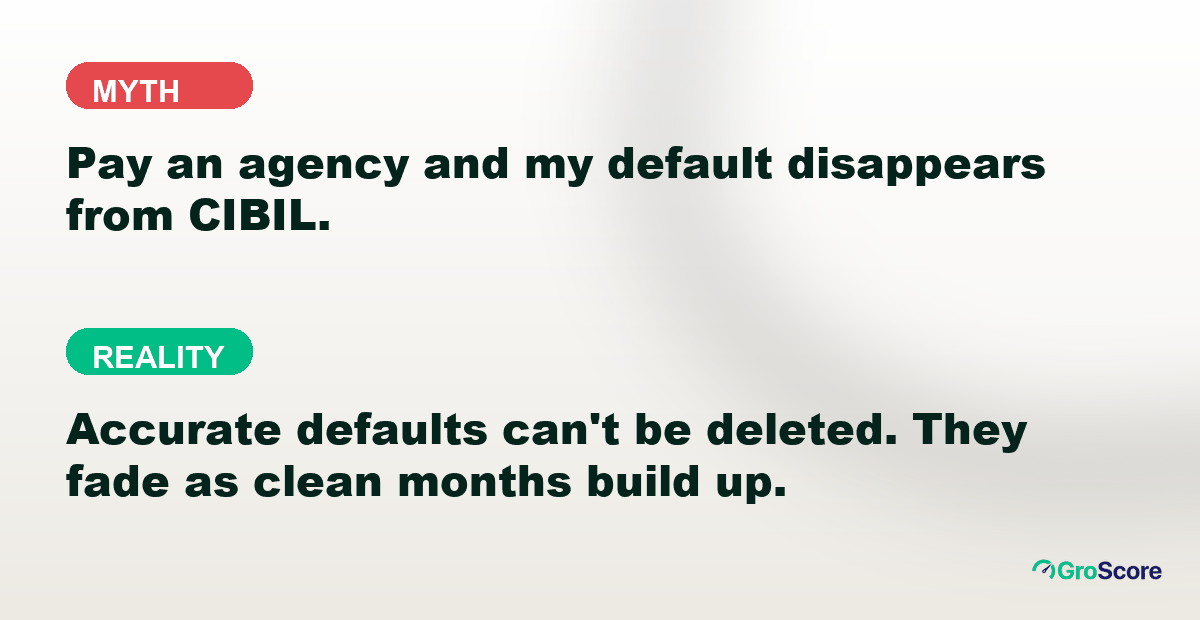
A default fades with time. It isn't deleted for a fee.
The part that changes: almost everything else. The account can stop being overdue. Your newer accounts can show months of perfect payments. Lenders look hardest at your recent behaviour, so a default with two clean years after it reads very differently from one that's still open.
GroScore's guidance is that a single missed EMI can cost 50 to 100 points (groscore.in). A default usually means several missed EMIs in a row, so the drop is bigger and the climb is longer. Nobody can give you a date. For the wider picture of why your credit score is low, start with our main guide.
Step 1: Get the Account Out of Default
Rebuilding on top of an open default barely works. Each month it stays unpaid adds a fresh late mark. So the first job is to stop that.
Call or write to the lender's collections or grievance team, and ask what your options are. You'll usually be offered one of three:
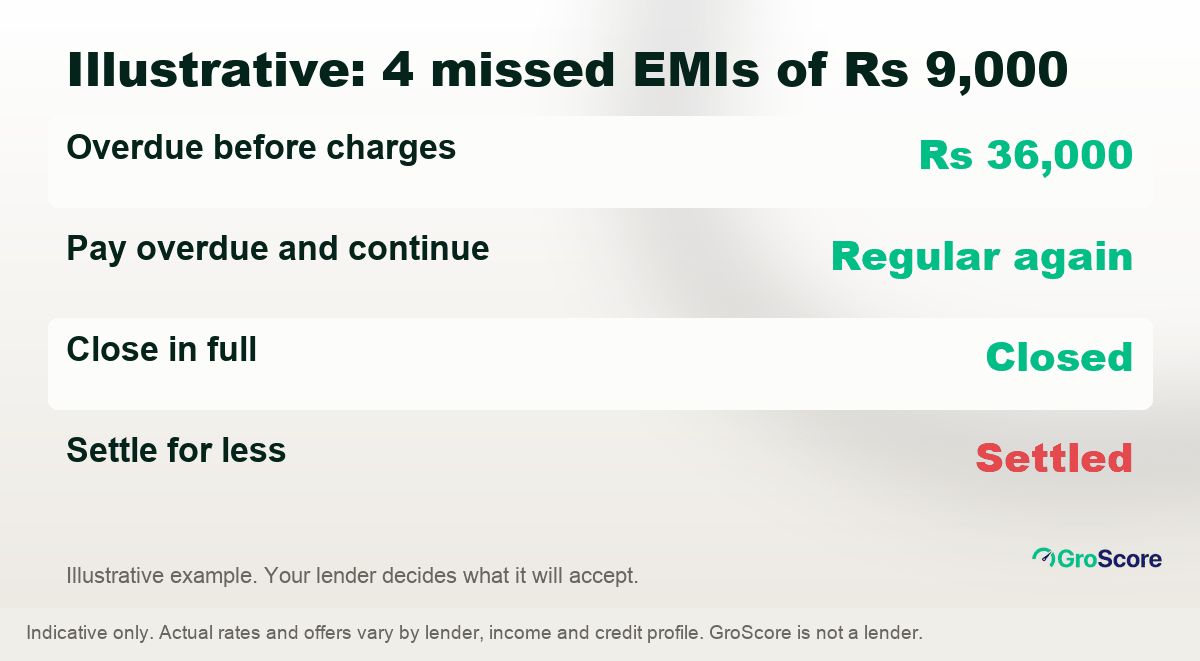
Illustrative example. Your lender decides what it will accept.
| Option | What you pay | How it reports |
|---|---|---|
| Pay the overdue and continue | Missed EMIs plus charges | Account becomes regular again |
| Close the loan in full | Everything outstanding | Closed |
| Settle | Less than you owe | Settled, a lasting negative |
Here's an illustrative example. Suresh, 36, missed four EMIs of ₹9,000 on a personal loan after a job change. His overdue works out to ₹36,000, plus late charges. Arjun, GroScore's credit coach, would walk him through it in this order:
- Paying the ₹36,000 and continuing is usually the cleanest route if he can afford it. RBI's rules let an NPA account be upgraded to standard only once all arrears of interest and principal are cleared (RBI).
- Closing in full works if he has a bonus or savings to cover the whole balance.
- Settling stops the calls but leaves a "settled" tag. That's the last resort, not the first. If you've already settled, our guide on how to improve your CIBIL score after settlement covers that case.
All figures here are illustrative. Results depend on the full report and are not guaranteed.
A Rebuild Plan: How to Improve CIBIL Score After Default
Once nothing is overdue, rebuilding starts. Here's a plan built around one idea: small, boring, on-time credit, added slowly.
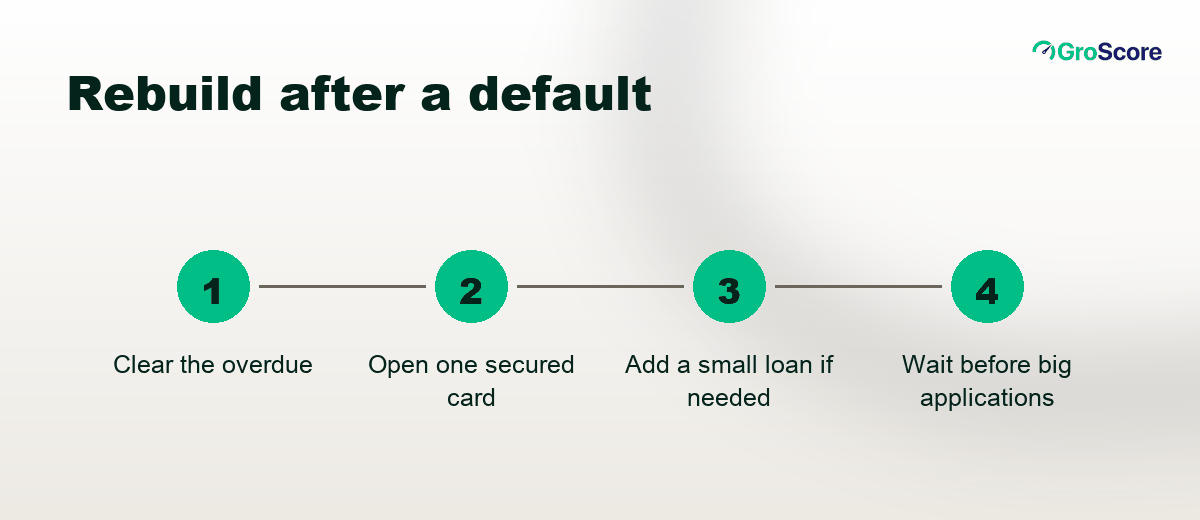
Stop the damage, then add proof you can repay.
Stage 1, the first month: check every bureau. Pull your free report from each one. You're entitled to one free full credit report a year from every bureau under the RBI's credit information rules (2025). Confirm the account now shows as paid or regular. If it doesn't after a few reporting cycles, raise a dispute. Lenders report to bureaus weekly since 1 July 2026, so updates show sooner than before.
Stage 2: one secured card. A card backed by a fixed deposit is the most common way back in after a default, because the bank holds your FD as security.
Stage 3: use it lightly and pay in full. Small, regular spends. Auto-pay for the full bill. Nothing more.
Stage 4: one small instalment loan, only if you need it. A loan against your FD or a gold loan from a bank or RBI-registered NBFC adds an instalment track record. Don't borrow just to build credit if the cost isn't worth it.
Stage 5: wait before big applications. A home or car loan application soon after a default often ends in a rejection and one more hard enquiry. Give your new accounts time to build a record.
Lenders that see a default followed by a long run of on-time payments read it as a past problem. That's the whole goal.
Can You Get a Credit Card After a Default?
An unsecured card soon after a default is unlikely. A secured one is a different story.
Take an illustrative case. Say you open an FD of ₹25,000 and the bank gives you a card with a ₹20,000 limit against it. Banks set their own limit as a share of the FD, so yours may differ. Keeping use under 30% means a balance of ₹6,000 or less at statement time (₹20,000 × 30%, per GroScore guidance, groscore.in, retrieved 2026-10-05).
A few rules make the card work for you:
- Pay the full bill, not the minimum.
- Don't break the FD while the card is open.
- Keep the card open once it's working. Its age helps later.
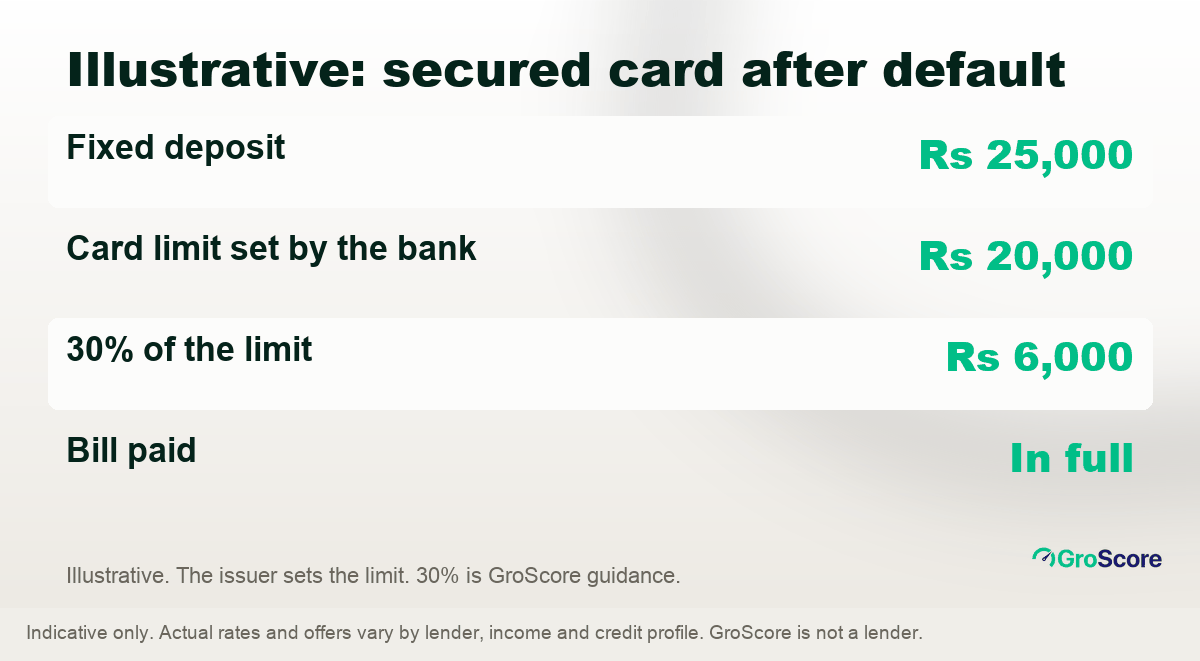
Illustrative example. The issuer sets the limit.
Our guide to a credit card for a low CIBIL score compares secured and FD-backed cards in more depth.
What If You've Been Labelled a Wilful Defaulter?
A wilful defaulter is different from an ordinary one. The label applies when a lender finds that a borrower could repay but chose not to, or diverted the money, under a separate RBI framework. It carries heavier restrictions on fresh credit than a normal default does.
Most people who search how to improve CIBIL score if defaulter aren't in this group. They lost a job, fell ill or over-borrowed. If you have been classified as a wilful defaulter, or your case went through insolvency proceedings, get advice from a lawyer on what the order allows before you apply anywhere. The rebuild habits above still apply once you can borrow again.
When Can You Borrow Again After a Default?
There's no fixed date, and anyone who gives you one is guessing. Each lender sets its own policy, and some decline applicants with any recent default.
If a lender turns you down, ask why. Our guide on loan rejected due to low CIBIL explains how to read a rejection and what to fix before the next try. Avoid apps that promise a loan "for CIBIL defaulters" and ask for a fee before disbursal. Every RBI-regulated lender checks a bureau.
GroScore can show which lenders' criteria your profile clears. It doesn't lend, and it can't promise an approval.
Frequently Asked Questions
Can I improve my CIBIL score after a default?
Yes. Clear the overdue or close the account first, then add new on-time history with small secured credit such as an FD-backed card. The default stays on record, but its weight fades as clean months build up.
How long does a default stay on my CIBIL report?
The account's history stays on your report for years, and no one can promise a date when it drops off. Lenders weigh recent behaviour more heavily, so an old default with a long clean record after it matters far less than a fresh one.
Can I get a credit card after a default?
An unsecured card is unlikely for a while. A secured card against a fixed deposit is usually possible, because the deposit covers the bank's risk. Paying it in full every month is one of the best ways to rebuild.
Does clearing the default immediately raise my score?
Not immediately. Clearing it stops new late marks and changes the status, which helps, but the past missed payments remain. The score usually recovers gradually as the lender reports the update and new on-time months are added.
The Bottom Line
A default is a hard chapter, not the whole book. Get the account out of default, check that every bureau shows the update, open one secured card and pay it in full, and wait before any big application. Skip anyone who offers to erase it for money.
Disclaimer
This GroScore article is for general education and is not financial advice. GroScore provides credit scores and reports sourced from Equifax, an RBI-licensed credit bureau; scores differ between bureaus and change as lenders report new data. Credit score improvement depends on your individual credit behaviour and bureau reporting timelines, and results are not guaranteed. Loan and card decisions are made by lenders on their own criteria. GroScore is not a lender. Figures and rates shown are indicative.
