How to Improve CIBIL Score After Settlement: A Step-by-Step Plan
Settled a loan or card? Here's what that word does to your report, the one option worth asking your lender about, and a plan for the year after.

Wondering how to improve CIBIL score after settlement? Confirm the report shows the right amounts, ask your lender whether paying the shortfall would change "settled" to "closed", then add fresh on-time history, usually through a secured card. A settled status is accurate, so nobody can delete it early. Its weight fades as clean months pile up on top of it.
Key Takeaways"Settled" means you paid less than you owed, with the lender's agreement. Lenders read it as a loss they took on you.Some lenders will report an account as "closed" if you pay the waived amount. That's their call, not a right, so ask in writing.Under RBI's June 2023 framework for compromise settlements, the lender you settled with must wait at least 12 months before lending to you again (RBI).No agency can legally remove an accurate settled status. Only errors can be disputed.
You can see exactly how your settled account is reported, free, on GroScore. It shows your Equifax score and full report with a soft check.
What Does "Settled" Mean on Your CIBIL Report?
A one-time settlement (OTS) is a deal where the lender accepts less than the full outstanding and stops chasing the rest. Maybe you agreed to one after a job loss or a medical bill. It ends the calls. It doesn't end the record.
Your lender then reports the account to the bureaus as "Settled", usually with the settlement amount beside it.
CIBIL is one of four credit bureaus registered with the RBI. Equifax, Experian and CRIF High Mark hold their own reports, and a settled loan normally shows on every bureau that lender reports to. Not sure which line to look at? Our guide to what STD means in CIBIL decodes each status and DPD code.
GroScore is a free credit score app and personal credit coach from Vitrak Technologies (GroMo). It shows your Equifax credit score and full report with a soft check that never affects your score, explains in Hindi or English what is holding the score back, and gives a step-by-step plan to fix it. GroScore is not a lender, and the score it shows is your Equifax score, not a CIBIL score.
Settled vs Closed: Why the Word Matters
Both words mean the account is finished. Lenders read them very differently.
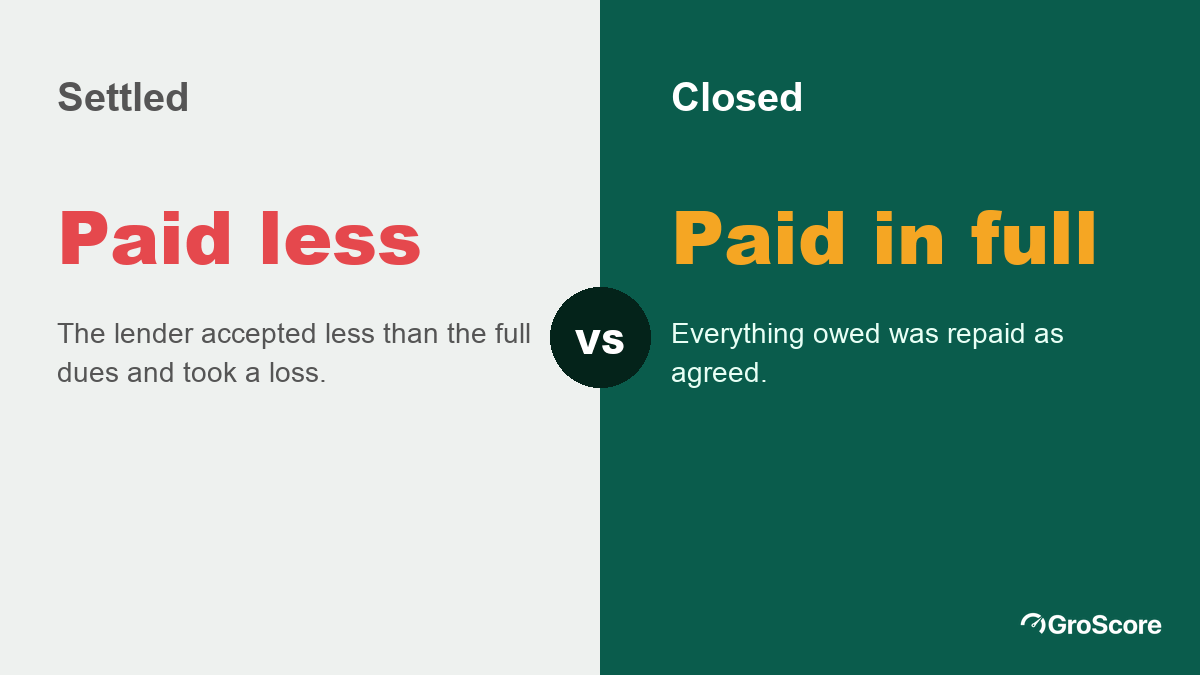
Same account, same end date. Two very different signals.
| Settled | Closed | |
|---|---|---|
| What you paid | Less than the full dues | Everything owed |
| What a lender reads | The last lender lost money | Repaid as agreed |
| Effect on new applications | Many lenders decline or ask more questions | Neutral to positive |
| Can it change later? | Only if the lender agrees to re-report it | Stays closed |
So does loan settlement affect your CIBIL score? Yes. The missed payments before the deal usually did most of the damage, and the settled tag keeps telling that story. GroScore's guidance is that a single missed EMI can cost 50 to 100 points (groscore.in). Most settlements follow several. For everything else that drags a score down, see why your credit score is low.
Can You Convert "Settled" to "Closed"?
Sometimes. It depends entirely on your lender.
Some banks and NBFCs will update the status to "Closed" if you pay the amount they waived. Others refuse. No RBI rule requires them to agree, so treat this as a request, not an outcome to expect. To try:
- Write to the lender's grievance or collections team. Ask what amount would let them report the account as closed, and whether that includes interest and charges they waived.
- Get the figure and the promise in writing before you pay. You want a letter or email that says they'll report "Closed" to the bureaus.
- Pay, then collect a No Dues Certificate (NOC). Keep it with the settlement letter.
- Check your report after the next few reporting cycles. Lenders now report to bureaus every week, under RBI rules in force since 1 July 2026.
- Raise a dispute with each bureau if the status hasn't changed, attaching the NOC and the lender's letter.
Worth it? That depends on the amount and on what you need credit for next.
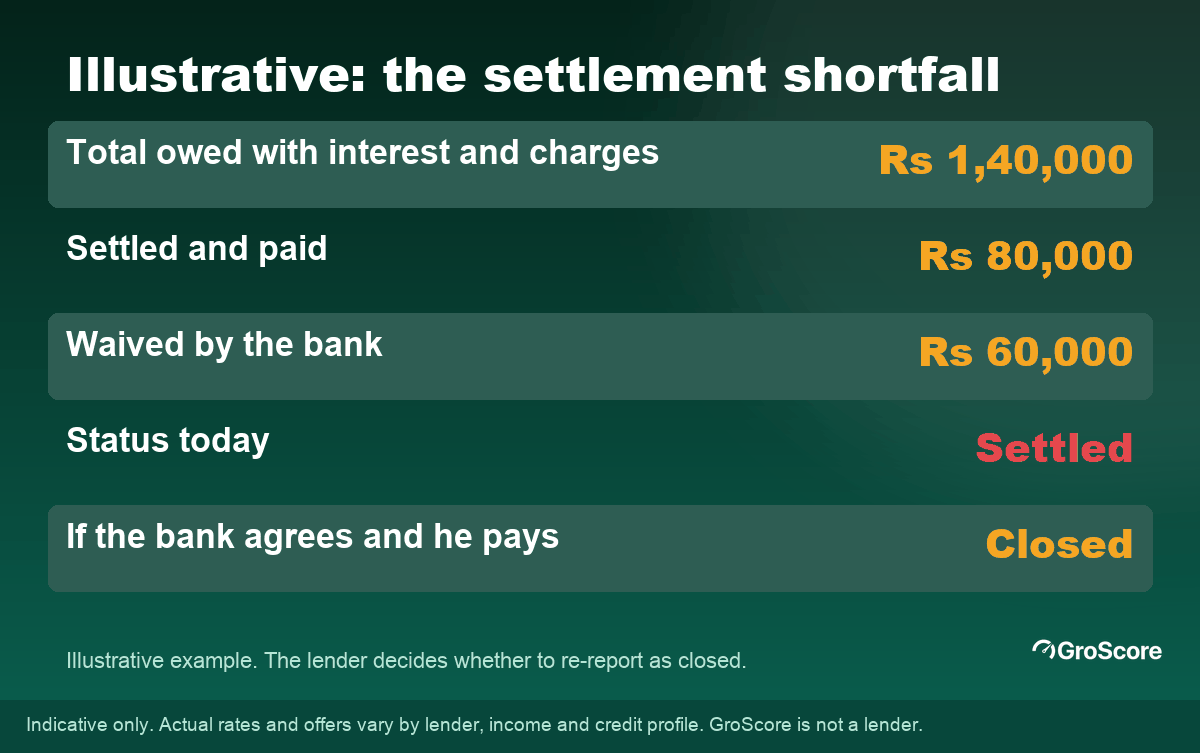
Illustrative example. Your lender's quote may be lower, higher or simply no.
For example (illustrative): Ravi, 31, settled a credit card in 2024. He owed ₹1,40,000 with interest and charges, and the bank accepted ₹80,000. The waived amount works out to ₹60,000 (₹1,40,000 − ₹80,000). He's planning a home loan in two years, so he asks for a written quote to convert the account to closed.
Arjun, GroScore's credit coach, would put it plainly for Ravi in this illustrative case. If, for example, the bank quotes the full ₹60,000 and he can pay without borrowing, it may be worth it before a big loan. If paying means a new high-interest loan, it isn't. Fresh debt to clean old debt usually backfires. Results are not guaranteed.
Will Your CIBIL Score Improve After Settlement?
Yes, slowly, as long as nothing new goes wrong. A settled account stops getting worse the day it's settled. From then on, every on-time payment on other accounts outweighs it a little more.
Don't expect it to vanish, though. An accurate settled status stays part of the account's history for years, and no one can promise a date when it drops off. That's also why "how to clear CIBIL score" offers from repair agencies are a red flag. Nobody can lawfully delete a genuine settlement for a fee.
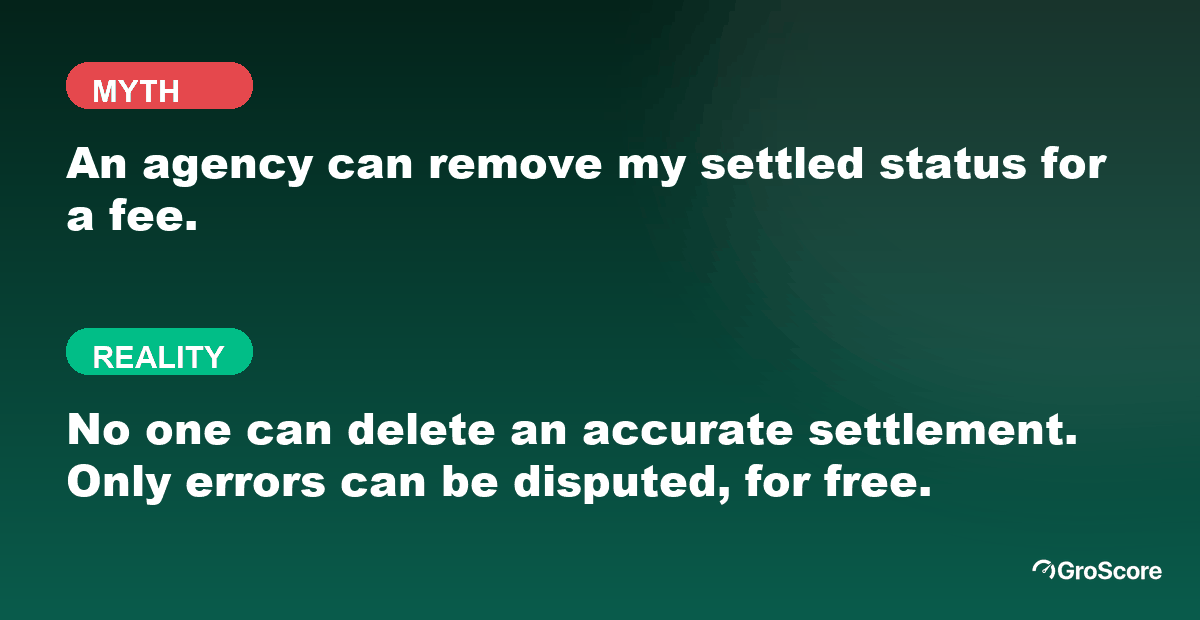
Only errors come off a report. A real settlement doesn't.
Errors are another matter. Our guide to the CIBIL report shows where each figure sits. A wrong amount, a settlement on a loan you closed in full, an account that isn't yours: all of these can be disputed. Under RBI rules, if a complaint isn't resolved within 30 days you're owed compensation of ₹100 per calendar day (RBI).
A 12-Month Plan: How to Improve CIBIL Score After Settlement
A settlement-only plan assumes nothing else is overdue. Still behind on other EMIs? Clear those first.
Month 1: audit every bureau. Pull your free report from each bureau. Check the settled amount, the date and that no other account carries a late mark it shouldn't. You're entitled to one free full credit report a year from every bureau, under the RBI's credit information rules (2025). If the score has fallen since the settlement, work out why your credit score dropped before you plan anything else.
Month 1 to 2: decide on the shortfall. Ask the lender for a written quote, as above. Pay nothing until you have it.
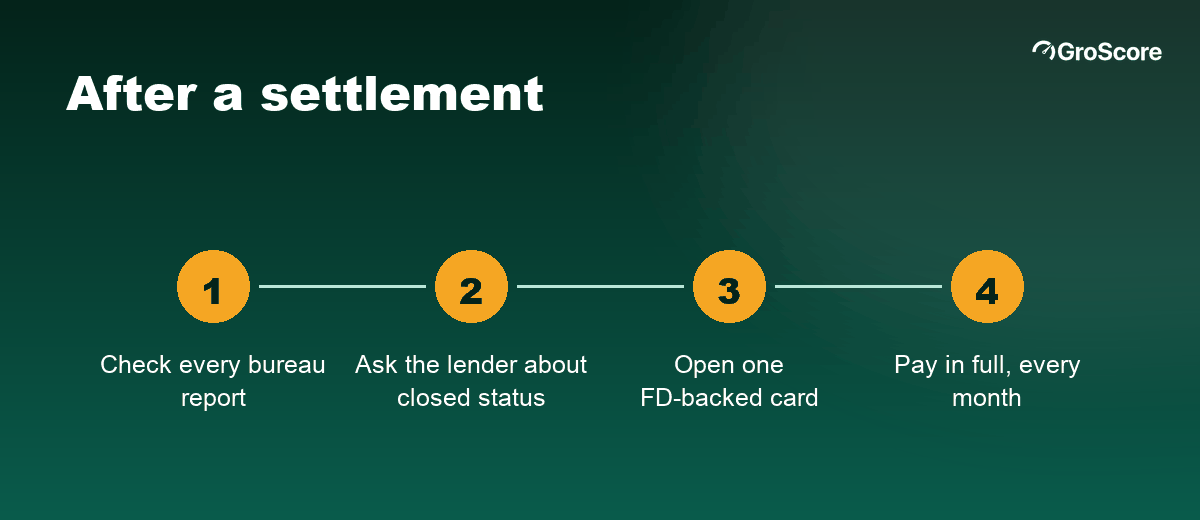
Order matters. Check first, then rebuild.
Month 2: open one secured card. A card against a fixed deposit is the usual first step back. The bank holds your FD, so it can approve you despite the settlement.
Months 2 to 12: use it lightly, pay in full. Keep spending under 30% of the limit (GroScore guidance, groscore.in, retrieved 2026-10-05) and set up auto-pay for the full bill.
Months 6 to 12: don't apply for anything else. Every application adds a hard enquiry, and a fresh rejection teaches you nothing.
Month 12 onwards: reassess. RBI's framework for compromise settlements (June 2023) sets a cooling period of at least 12 months before the lender you settled with can lend to you again, and lenders may set longer ones (RBI). Other lenders apply their own policies. Treat a year of clean history as the minimum before a bigger application.
What If You Settled a Credit Card?
People ask how to improve CIBIL score after credit card settlement as if it were a different problem. Mostly it isn't. The status reads the same way to a new lender.
Two differences matter. Card dues grow fast with interest and late fees, so the waived amount is often a large share of the total. Ask the bank to break it down. A settled card is also closed for good, so you lose that limit. Your next card carries all your utilisation alone, which makes staying under 30% (GroScore guidance, groscore.in, retrieved 2026-10-05) even more important. Our guide to a credit card for a low CIBIL score explains how FD-backed cards work.
Can You Get a Loan After a Settlement?
Possibly, but expect fewer options for a while. Many lenders treat a recent settlement as a decline reason, whatever your score says. Others ask for security, a co-applicant or a higher rate. No regulated lender guarantees approval.
Secured options are usually the realistic ones. Avoid apps that promise a loan "even with settled CIBIL" and ask for a fee upfront.
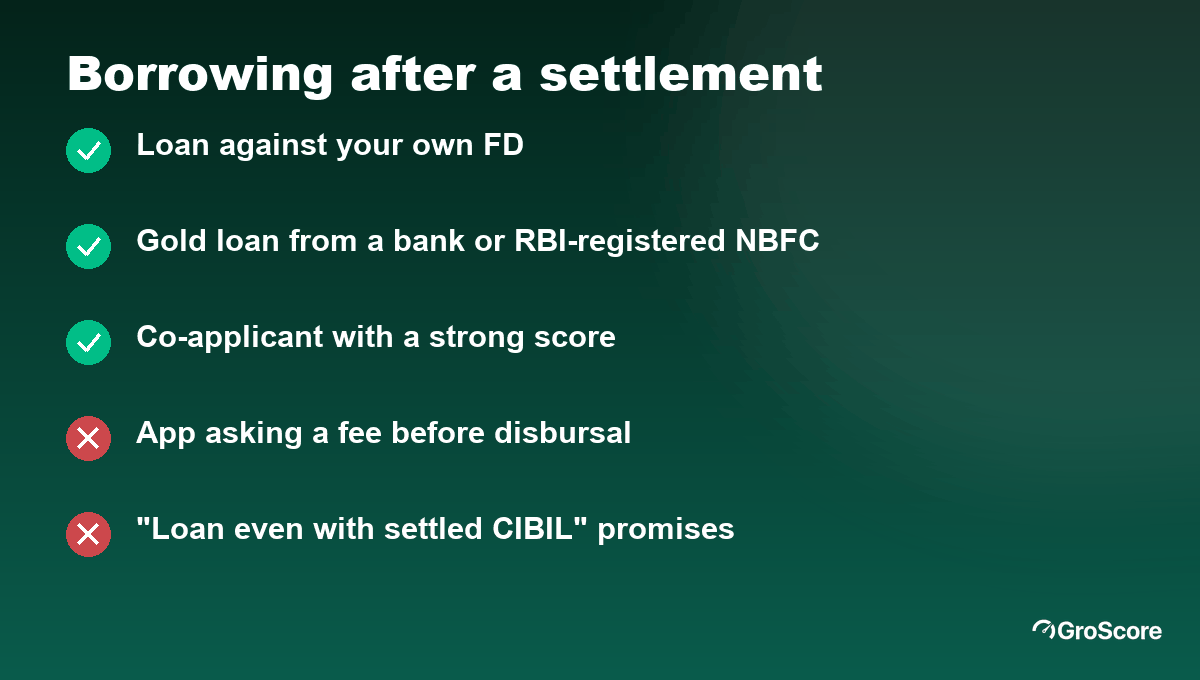
Secured and regulated first. Fee-first apps never.
If other accounts are still overdue, a settlement isn't your main problem yet. Our plan to rebuild credit after default covers that case.
GroScore can show which lenders' criteria your profile clears. It doesn't lend, and it can't promise approval.
Frequently Asked Questions
Does loan settlement affect my CIBIL score?
Yes. The settled status tells new lenders that a previous lender accepted less than it was owed, and the missed payments before the settlement usually lower the score too. The effect fades as you add on-time history, especially if you keep card use under 30% (GroScore guidance, groscore.in, retrieved 2026-10-05).
How can I remove 'settled' status from my CIBIL report?
You can't have an accurate settled status deleted. You can ask the lender whether paying the waived amount would let them report the account as closed. If they agree, get it in writing, pay, collect the NOC, and dispute with the bureau if the status isn't updated.
What is the difference between settled and closed?
Closed means you repaid everything you owed. Settled means you paid less, by agreement, and the lender took a loss. Both end the account, but settled is read as a serious negative.
How long does a settlement stay on my credit report?
A settlement stays part of that account's history for years, and nobody can promise a date when it drops off. Its weight changes, though: an older settlement with several clean years after it counts for far less than a recent one.
Can I get a loan after a settlement?
A new loan is possible, though often only as a secured one at first, and after a stretch of clean repayments elsewhere. The lender you settled with must wait at least 12 months under RBI's 2023 framework, and may set a longer period.
The Bottom Line
A settlement isn't the end of your credit life. It's a mark you build over. Check the report on every bureau, ask your lender in writing about converting it to closed if you can afford the shortfall, then let a secured card and on-time payments do the slow work. Be wary of anyone who promises to clear it faster.
Disclaimer
This GroScore article is for general education and is not financial advice. GroScore provides credit scores and reports sourced from Equifax, an RBI-licensed credit bureau; scores differ between bureaus and change as lenders report new data. Credit score improvement depends on your individual credit behaviour and bureau reporting timelines, and results are not guaranteed. Loan and card decisions are made by lenders on their own criteria. GroScore is not a lender. Figures and rates shown are indicative.
