Credit Card Score: How Credit Cards Affect Your CIBIL Score
Your card doesn't get its own score. Here's how every bill you pay, or don't, shows up in the one score lenders read.

There's no separate credit card score in India. Your card feeds the same credit score (300 to 900) that every bureau calculates, including your CIBIL score. Pay the full bill on time and keep your balance low, and the card helps. Miss payments or run it close to the limit, and it drags the score down.
Key TakeawaysCard issuers can report you as "past due" to the credit bureaus only once a payment is more than three days late (RBI Master Direction on credit cards, 2022).Keep card use under 30% of your limit. GroScore's guidance says a single missed EMI or bill can cost 50 to 100 points (groscore.in).Paying only the minimum due keeps your record clean but leaves your balance, and your utilisation, high.Closing a card cuts your total limit. Your utilisation can jump even if you spend nothing extra.
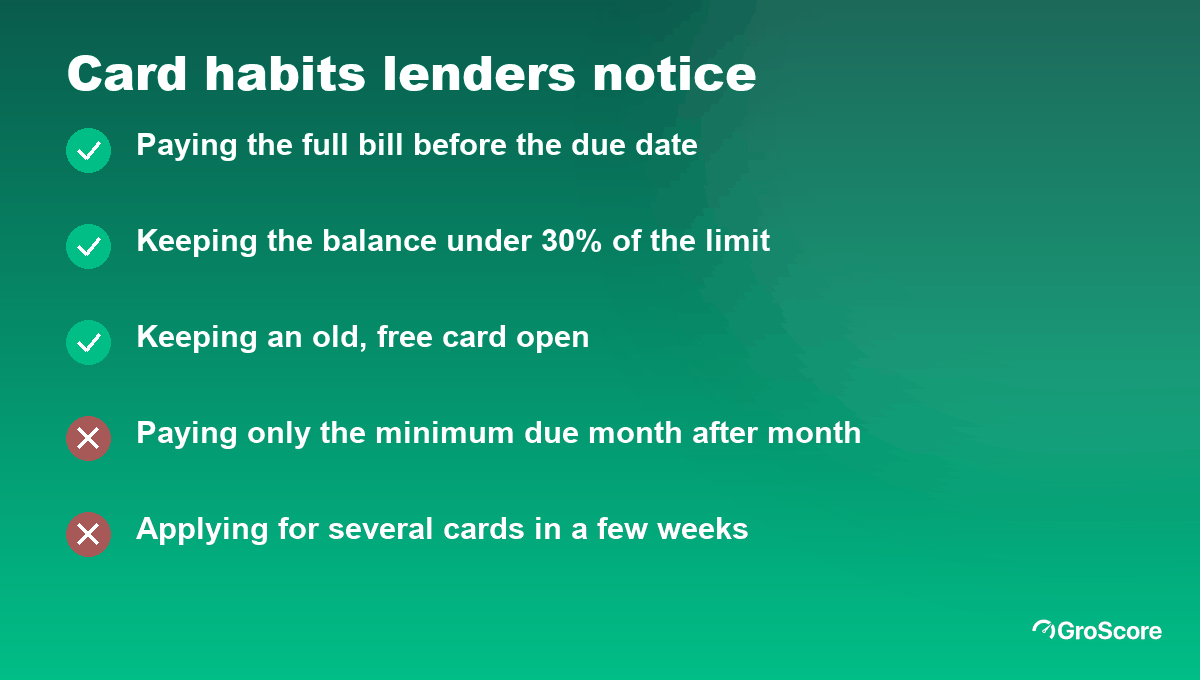
Five card habits that decide whether your card helps or hurts.
Is There a Separate Credit Card Score in India?
No. People search for a "credit card score" because the card feels like its own thing. For the bureaus, though, a credit card is one more account on your credit report, the record of every loan and card in your name.
Four credit bureaus are registered with the RBI: TransUnion CIBIL, Equifax, Experian and CRIF High Mark. Each one builds its own score from what lenders report. A CIBIL score is simply the score from TransUnion CIBIL. Your card shows up at all four if your bank reports to them, and most banks do.
So when a bank checks your credit score for a credit card application, it's reading your whole history. Your home loan counts. So does the phone you bought on EMI two years ago.
What does the card add? Two things, mostly: a monthly payment record and a utilisation figure. Those are the two biggest credit score factors in any bureau's model.
GroScore is a free credit score app and personal credit coach from Vitrak Technologies (GroMo). It shows your Equifax credit score and full report with a soft check that never affects your score, explains what is holding the score back, and gives a step-by-step plan to fix it. GroScore is not a lender and not a credit bureau, and the score it shows is your Equifax score, not a CIBIL score. It doesn't issue cards. It can show which cards your profile may suit, but the bank decides.
Lenders now report every week, under an RBI rule in force since 1 July 2026. A bill paid late, or a balance paid down, reaches your report faster than it used to.
How Payment History on Your Card Moves Your Score
Payment history matters most. Every month your issuer tells the bureaus whether you paid by the due date.
Pay late and the report shows DPD, or days past due. A "30" in that column means the bill was about a month overdue. Lenders read it as a warning, and it stays on your record for years.
The RBI gives you a small cushion. Under its Master Direction on credit and debit cards, issuers may report a card as past due, or charge late fees, only when the payment is more than three days past the due date. Here's the official text: RBI's Master Direction on credit and debit cards.
Don't plan around those three days. Treat the due date as the deadline.
The easiest fix is boring. Set an auto-debit for at least the minimum due from your salary account. You'll still want to pay the full bill by hand, but a forgotten date won't turn into a DPD.
Credit Utilisation: The Number You Control Every Month
Credit utilisation is how much of your card limit you're using. Divide the balance by the limit. For example, a Rs 25,000 balance on a Rs 1 lakh limit is 25%.
Lenders read high utilisation as stretched finances, even when you pay in full. GroScore's guidance is to keep utilisation under 30% (groscore.in, retrieved 2026-10-05).
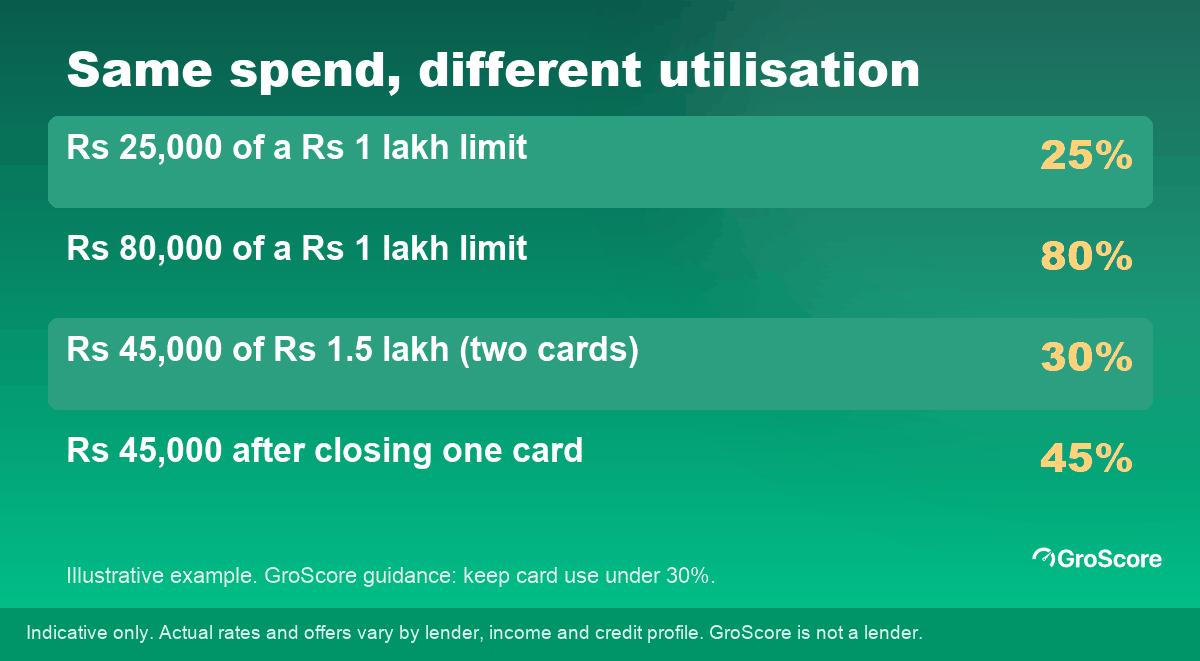
Illustrative example: the same spending can look very different to a lender.
Here's the arithmetic behind that card, worked out for this article:
| Situation | Balance | Total limit | Utilisation |
|---|---|---|---|
| One card, light month | Rs 25,000 | Rs 1,00,000 | 25% |
| One card, heavy month | Rs 80,000 | Rs 1,00,000 | 80% |
| Two cards, Rs 1,50,000 limit in total | Rs 45,000 | Rs 1,50,000 | 30% |
| Same spend after closing the Rs 50,000 card | Rs 45,000 | Rs 1,00,000 | 45% |
Two tips change the number fast. First, pay part of the bill before the statement date. The balance your bank reports is usually close to your statement balance, so a mid-cycle payment lowers what lenders see. Second, spread spending across cards. For instance, overall use of 40% looks fine on paper, but one card sitting at 80% can still stand out.
Why Is Paying Only the Minimum Due a Trap?
Because it protects your payment record and nothing else.
The minimum amount due is the smallest payment that stops your account from going past due. Pay it, and no DPD gets reported. For example, on a Rs 50,000 bill the minimum might be Rs 2,500. RBI rules say the minimum due must be set so the balance doesn't grow on its own, which is called negative amortisation.
But the rest of the bill rolls over, and interest starts. Say your card charges 3.5% a month. That's an indicative figure; check your own card's key fact statement for the real rate.
Pay Rs 50,000 in full and you pay no interest. Pay Rs 2,500 and about Rs 47,500 carries over. At 3.5% a month, that works out to roughly Rs 1,660 in interest for one month, and your card's terms may charge more. Your utilisation also stays near 48% on a Rs 1 lakh limit.
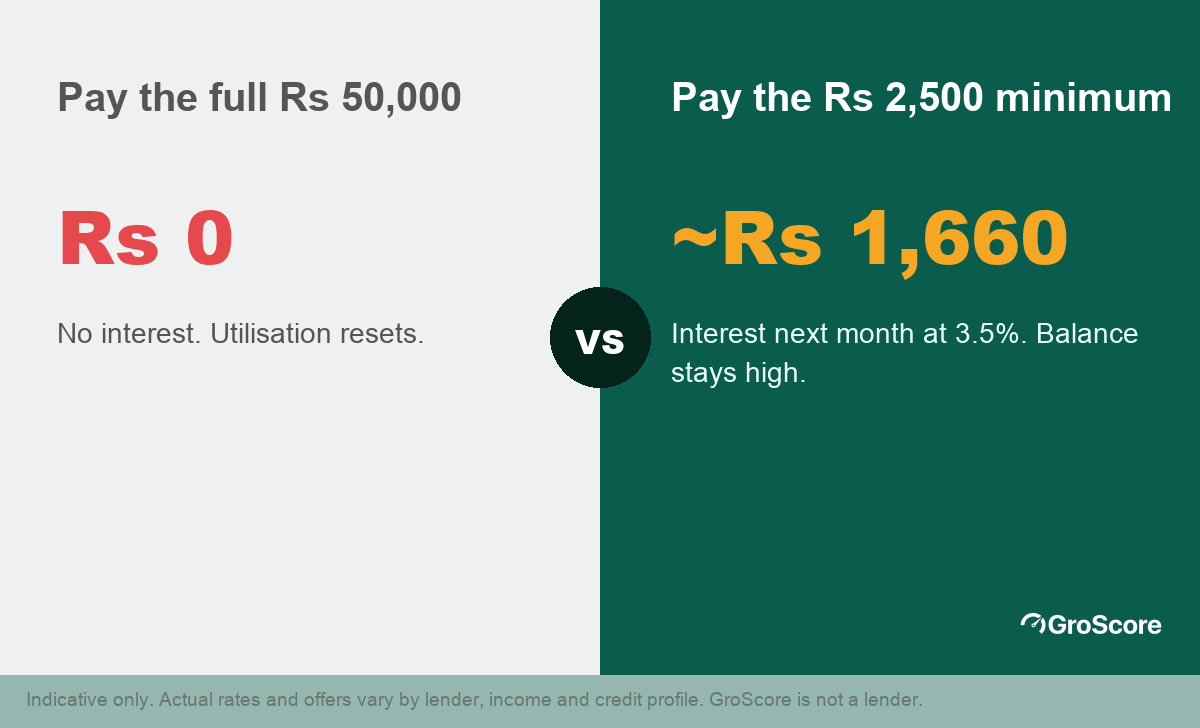
Illustrative example at 3.5% a month. Actual card rates vary by issuer.
Do that for six months and the score feels it twice. Utilisation stays high, and the growing interest makes a real missed payment more likely later.
If you can't pay in full this month, pay as much as you can above the minimum. Then stop using the card until the balance is cleared.
Should You Close an Old Credit Card?
Usually not, if it's free to keep. Closing a card does three things to your profile:
- Your total limit drops, so utilisation rises (see the 30% to 45% row above).
- Your history on that card stops growing.
- Nothing changes on what you already owe. Dues must be cleared before the bank closes it.
A closed card doesn't vanish from your report straight away. Its payment history stays on record, good or bad.
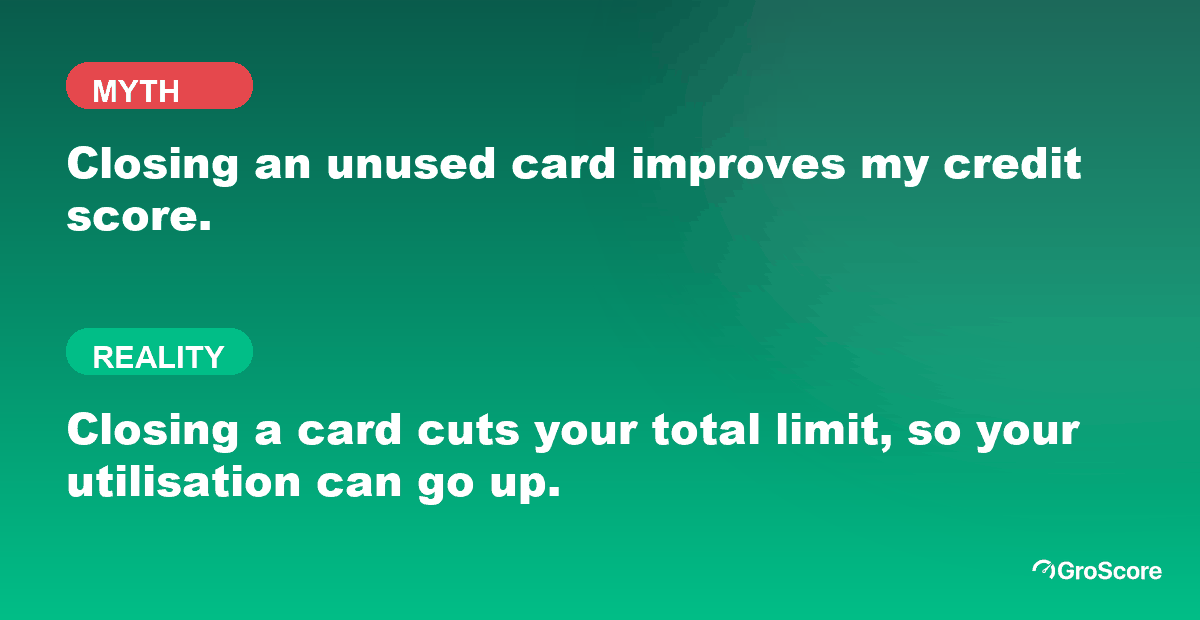
An unused card still works for you through its limit.
Close a card when the annual fee isn't worth it, when it tempts you to overspend, or when you simply have too many to track. The RBI says a bank must close your card within seven working days of your request, once dues are paid. If it's late, it owes you Rs 500 for every day of delay (RBI Master Direction, 2022).
One more rule. If you don't use a card for over a year, the bank can start closing it after telling you. If you don't reply within 30 days, it may close the account. Use an old card for a small bill every few months and pay it off, if you want to keep it.
Applications, Upgrades, Add-On and Expired Cards
A few events trip people up.
Applying for a new card. The bank pulls your report, which is a hard enquiry. One is normal. Five card applications in a month look like credit hunger. Checking your own score on an app is a soft enquiry, so you can do a credit card score check before you apply without affecting your credit score. Compare the result with the minimum CIBIL score for a credit card before you pick one.
Upgrades. The RBI bars banks from upgrading your card or raising your limit without your explicit consent. A higher limit you asked for can lower your utilisation: a Rs 30,000 balance is 30% of a Rs 1 lakh limit but 20% of Rs 1.5 lakh. Whether an upgrade means a fresh enquiry or a new account depends on the bank, so ask before you accept.
Add-on cards. The main cardholder is liable for what add-on users spend (RBI). So their spending counts against the main card's limit and payment record. If your parent spends Rs 20,000 on an add-on against your Rs 1 lakh limit, that's 20% of your utilisation gone.
Expired cards. An expiry date is for the plastic, not the account. When the bank sends a renewed card, the same account carries on with its history.
How to Use a Credit Card to Build Credit
Used well, a card is one of the simplest ways of building credit. Here's the routine for building a credit score with a credit card:
- Put one or two fixed bills on it, like your phone or a streaming plan.
- Pay the full statement balance every month, before the due date.
- Keep the balance under 30% of the limit at statement time.
- Apply for new cards rarely, and only after checking your own report.
- Keep your oldest card open if it's free.
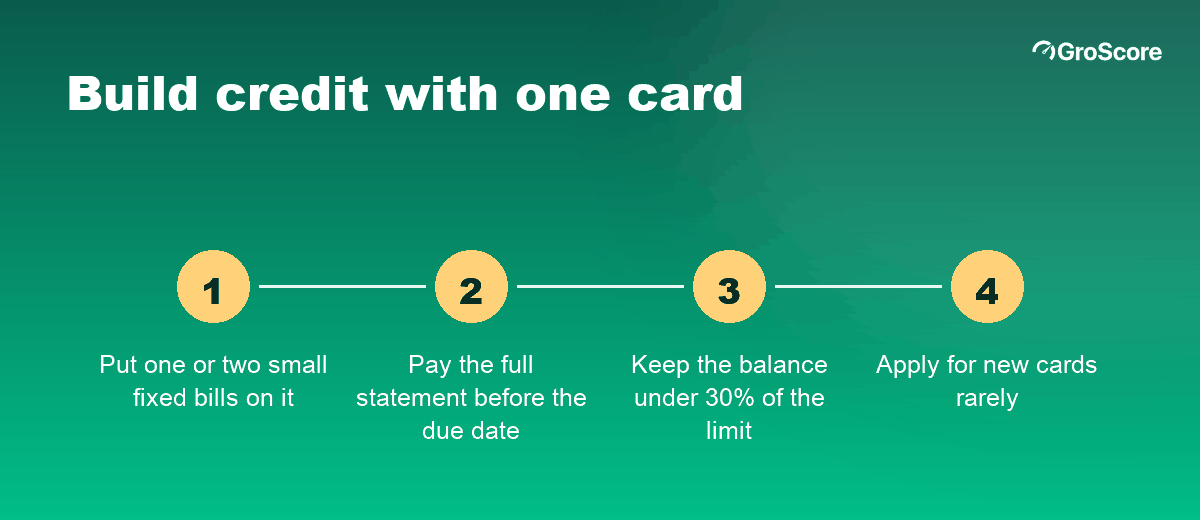
A dull routine, repeated every month, is what builds credit.
Starting from zero? With no credit history, a regular card can be hard to get. Secured credit cards, issued by banks against a fixed deposit, are the usual first step. They report to the bureaus like any other card. Treat any approval talk with care: a bank decides on its own criteria, and nothing here is a promise.
What would a credit coach flag on your card?
Here's an illustrative example. Meera, 31, has a 702 score and two cards. Arjun, GroScore's credit coach, reads her report and flags three things in this order:
- Card A at 78% utilisation: a Rs 47,000 balance on a Rs 60,000 limit. Paying Rs 30,000 before the statement date works out to about 28%, a fix she can make this month.
- A plan to close Card B, her oldest card, with no annual fee. Arjun's advice: keep it, and use it for one small bill a month.
- Two card applications in six weeks. No more until the enquiries age.
Notice what's missing. Nothing on her report can be deleted. Her one late payment from 2024 is accurate, so it stays. It fades as on-time months pile up.
Frequently Asked Questions
Does using a credit card improve my credit score?
A credit card can help, if you pay in full and on time and keep the balance low. A card used that way builds a monthly record of reliable repayment. A card you max out or pay late does the opposite.
How should I use my credit card to build credit?
Put a few small, regular bills on it and pay the full statement every month. Keep the balance under 30% of the limit when the statement is generated. Avoid applying for several cards at once.
Does a credit card upgrade affect my score?
The upgrade itself often doesn't, but it depends on whether the bank runs a fresh enquiry or opens a new account. A higher limit can lower your utilisation. Under RBI rules, a bank can't upgrade you without your explicit consent.
Does an expired card affect my credit score?
No. Expiry only replaces the plastic. Your account and its history continue when the renewed card arrives. A card left unused for over a year can be closed by the bank after notice, which can raise your utilisation.
Do add-on cards affect the primary cardholder's score?
Yes. The primary cardholder is liable for add-on spending, so it counts toward their balance and their payment record. Agree a spending limit with add-on users and watch the shared bill.
The Bottom Line
Your card has no score of its own. It feeds the one credit score lenders read, through two levers: paying on time and keeping the balance low. Pay the full bill, not the minimum. Keep old free cards open. Apply rarely. Then check your report every month so a slip shows up before a lender sees it. For the basics of how the number itself works, start with our guide to your credit score.

Disclaimer
This GroScore article is for general education and is not financial advice. GroScore provides credit scores and reports sourced from Equifax, an RBI-licensed credit bureau; scores differ between bureaus and change as lenders report new data. Credit score improvement depends on your individual credit behaviour and bureau reporting timelines, and results are not guaranteed. Loan and card decisions are made by lenders on their own criteria. GroScore is not a lender. Figures and rates shown are indicative.
