Does Increasing Credit Limit Affect Score? What Really Happens
A bigger card limit can help your score, do nothing, or quietly hurt it. Here's how to tell which one you're about to get.

Does increasing credit limit affect score? It usually helps, or changes nothing. A higher limit with the same spending lowers your credit utilisation, one of the biggest factors in your score. The catch is the route. If you ask for the increase and the issuer pulls your credit report, that hard enquiry can cost a few points for a while. If your spending rises to fill the new limit, the benefit disappears.
Key TakeawaysA higher limit lowers your utilisation only if your balance stays the same. GroScore's guidance is to keep card use under 30% (groscore.in).Card issuers can't raise your limit or upgrade your card without your explicit consent (RBI Master Direction on credit cards, 2022).A limit increase you request may involve a hard enquiry. A bank-offered one often doesn't. Ask your issuer before you accept.Lenders now report to the bureaus every week, so a new limit usually shows on your report within weeks (RBI).
Check your current utilisation first with your free Equifax score and report on GroScore. A soft check never lowers your score.
A Limit Increase Has Three Possible Outcomes
Which one you get depends on how the increase came about and how you use the card afterwards.
| What happens | Effect on your score | Why |
|---|---|---|
| Bank offers it, spending stays the same | Usually helps | Utilisation falls, no new enquiry |
| You request it, issuer pulls your report | Small dip, then usually helps | A hard enquiry first, lower utilisation after |
| Spending rises to fill the new limit | No help, can hurt | Utilisation stays high, and so does your debt |
| Limit raised without your consent | Not allowed | RBI rules require your explicit consent |
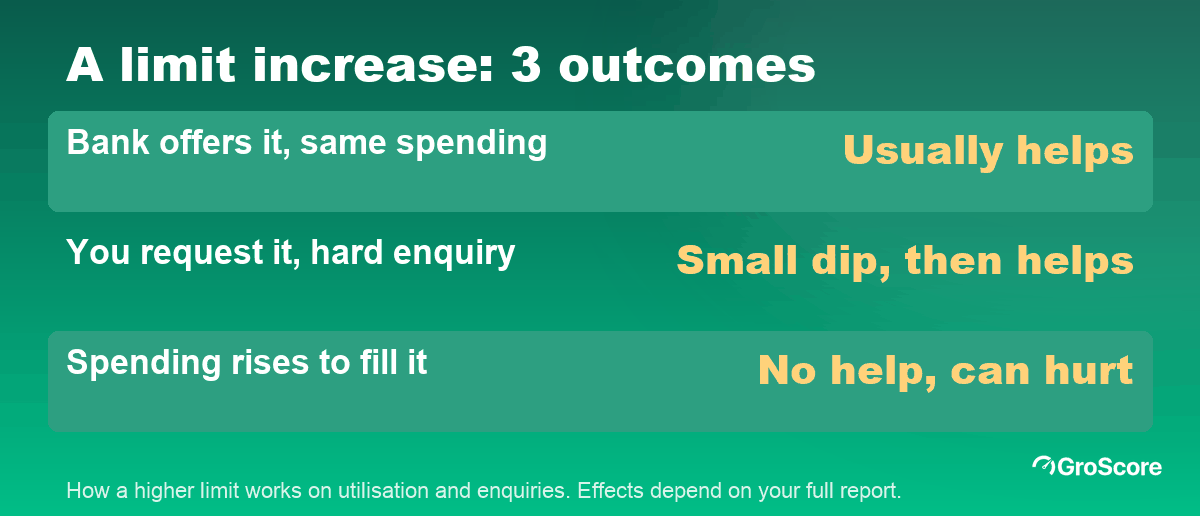
The same limit increase can lead to three different results.
So can increasing credit limit hurt score, or does a higher credit limit help credit score? Usually it helps. Harm rarely comes from the limit itself. The damage comes from the enquiry around it, or from the spending that follows.
GroScore is a free credit score app and personal credit coach from Vitrak Technologies (GroMo). It shows your Equifax credit score and full report with a soft check that never affects your score, explains in Hindi or English what is holding the score back, and gives a step-by-step plan to fix it. GroScore is not a lender and doesn't issue cards or raise limits. The score it shows is your Equifax score, not a CIBIL score.
How Does Increasing Credit Limit Affect Score Through Utilisation?
Does increasing credit card limit affect credit score directly? Only through this ratio. Credit utilisation is your card balance divided by your card limit, and bureaus read it as a sign of how stretched you are. It's one of five factors every bureau weighs, alongside payment history, credit age, credit mix and enquiries, as our guide to how your credit score is calculated explains.
Here's an illustrative example. Say Sneha has one card with a ₹60,000 limit and a statement balance of ₹24,000 most months. Her utilisation works out to ₹24,000 ÷ ₹60,000 = 40%. After a limit increase to ₹1,00,000, the same balance works out to ₹24,000 ÷ ₹1,00,000 = 24%.
Sneha spends exactly the same. Her reported ratio drops from above GroScore's 30% line to below it (groscore.in, retrieved 2026-10-05).
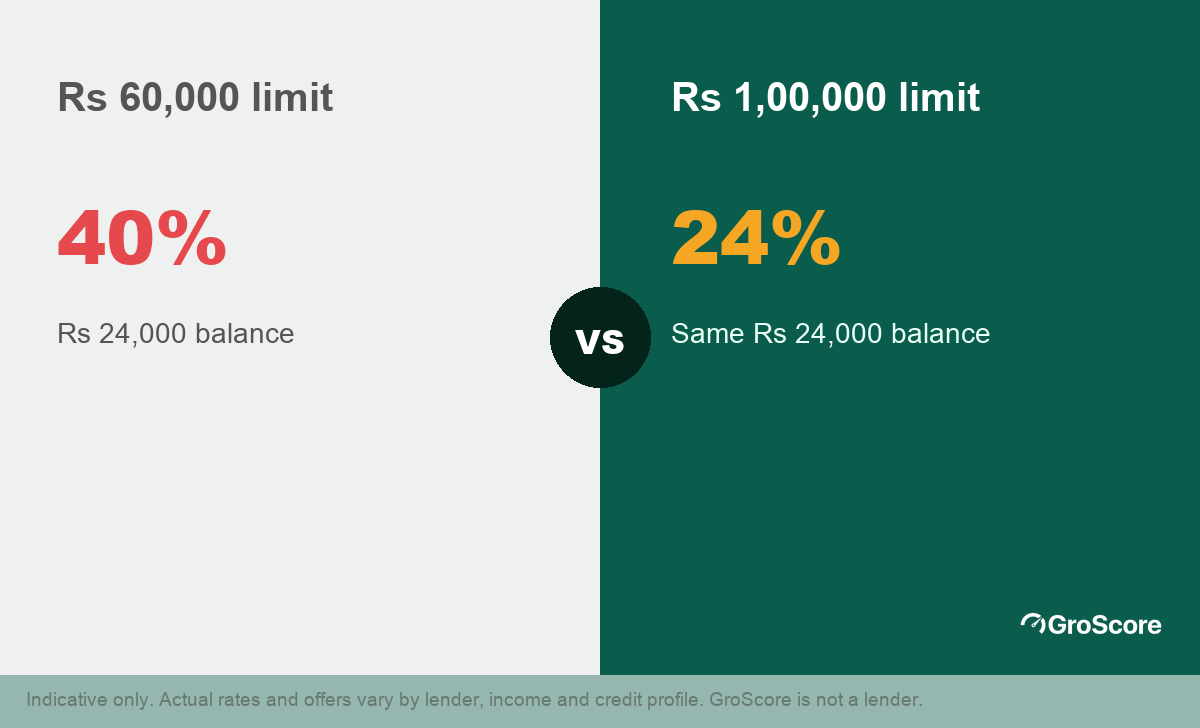
In this illustrative example, only the limit changes and the Rs 24,000 balance stays the same.
Now the version that goes wrong. Suppose Sneha treats the extra room as spare money and her balance climbs to ₹40,000. That works out to 40% again. She's back where she started, with ₹16,000 more debt.
Two details matter. Bureaus usually see your statement balance, not what you owe after paying. Also, your report lists every card separately, so a lender sees each card's ratio as well as the total. The card-by-card method is in our guide on how to keep utilisation under 30%.
How many points will a lower ratio add? Nobody can say in advance. Results are not guaranteed.
Is a Credit Limit Increase Request a Hard Enquiry?
Whether a credit line increase affects your credit score this way depends on who starts the process and on the issuer's policy.
Bank-initiated increases. Issuers often offer a higher limit based on how you've used and repaid the card, using their own account data. There's usually no fresh application, so no new enquiry.
Increases you request. The issuer may want updated income proof, and it may pull your credit report. That pull is a hard enquiry, a lender's check made because you asked for credit. Other lenders can see it, and it can lower your score a little for a while. One is normal. Several in a few weeks look like credit hunger. Our guide to the CIBIL enquiry explains which checks count.
So does a credit limit increase request affect credit score? Only if it triggers a hard enquiry, and then usually by a small amount that fades. Ask the issuer first: "Will this request involve a credit check?"
One rule protects you either way. Under the RBI's Master Direction on credit and debit cards, issuers can't unilaterally upgrade your card or raise your limit. They need your explicit consent. If a limit went up without you agreeing, you can complain to the issuer first and escalate to the RBI Ombudsman if it isn't resolved.
Why Did My Score Drop After a Limit Increase?
A score drop after a limit increase is a common worry, and the limit is rarely the culprit. When Arjun, GroScore's credit coach, reads a report like that, he usually finds one of five things:
- A hard enquiry. You requested the increase, and the issuer pulled your report.
- Spending caught up. A bigger statement balance arrived with the new limit.
- Another account moved. A late payment, a new loan or a closed card landed the same month.
- Reporting timing. The balance was reported before the new limit, so the bureau briefly saw the old ratio.
- A different bureau. You compared an Equifax score with a CIBIL score. CIBIL is one of four RBI-registered bureaus, with Equifax, Experian and CRIF High Mark, and each calculates its own number.
Small dips usually settle as the next updates reach your report. If the drop is large, check the report line by line. A late payment you didn't make is an error you can dispute with the bureau. Accurate entries can't be removed early. Of the five, a late payment usually does the most damage, so it's worth knowing how late payments affect your credit score.
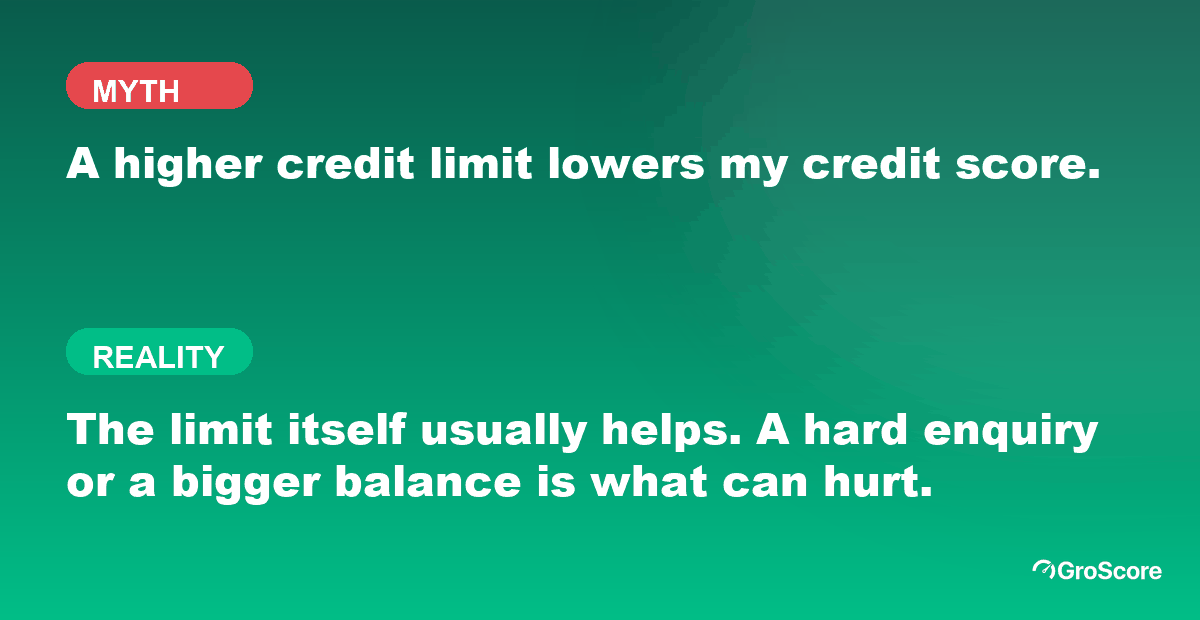
If your score fell, look at the enquiry and the balance, not the limit.
Should You Accept a Pre-Approved Limit Increase?
You often should, but not always. A higher limit is more room to spend, and that's the risk.
Say yes if:
- You pay the full bill every month, not just the minimum due.
- Your utilisation regularly crosses 30% because of normal spending, not because you're short of money.
- The issuer confirms there's no hard enquiry, or you're not applying for any other credit soon.
- You trust yourself to keep spending where it is.
Think twice if:
- You carry a balance from month to month. A bigger limit means a bigger possible debt at card interest rates.
- You're about to apply for a home or car loan, and the increase would mean a new enquiry.
One angle few people know: under RBI rules, a card issuer must consider the limits you already hold elsewhere when it sets a limit on a new card. Collecting limits you don't need can shape what the next issuer offers.
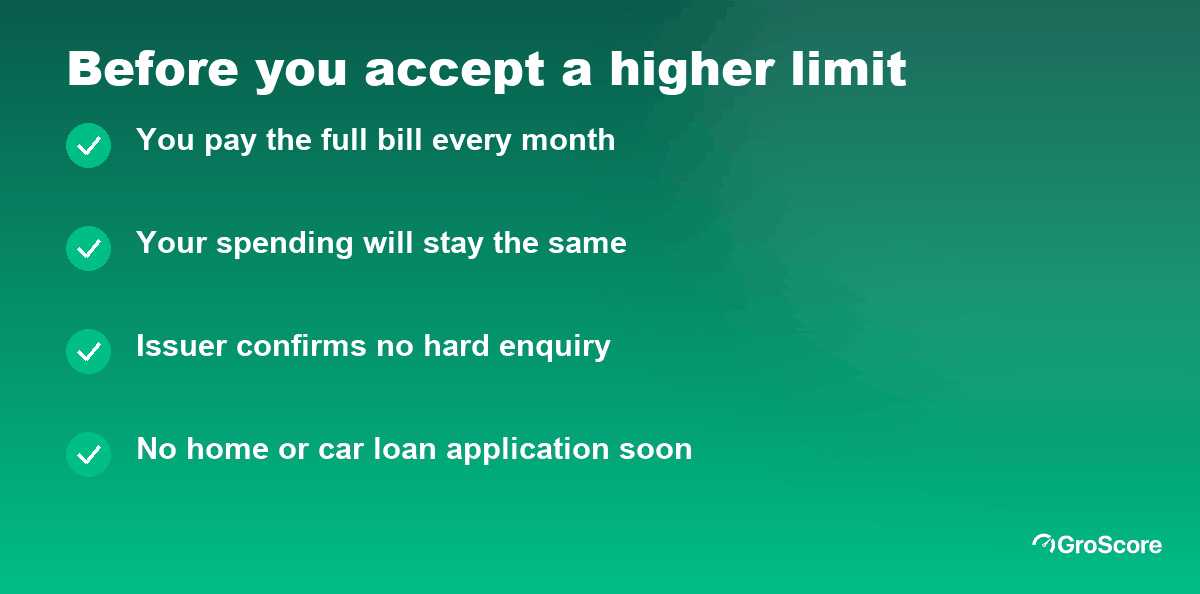
Four questions to answer before you say yes.
What Would a Credit Coach Flag Before You Ask?
Here's an illustrative example. Say Vikram, 34, wants a higher limit because his card keeps running high, for example at two-thirds of its limit. Arjun, GroScore's credit coach, reads his report first and flags three things, in this order:
- The high ratio is a timing problem. Vikram pays in full, but after the statement date. Paying part of the bill before that date lowers the reported balance, with no request at all.
- Two loan enquiries in eight weeks. A third, through a limit request, would stack up. Wait until those age.
- A free second card, used once a year. Keeping it open adds to his total limit at no cost.
Free fix first, possible enquiry last. All figures here are illustrative.
How to Ask for a Credit Limit Increase the Right Way
A little preparation helps.
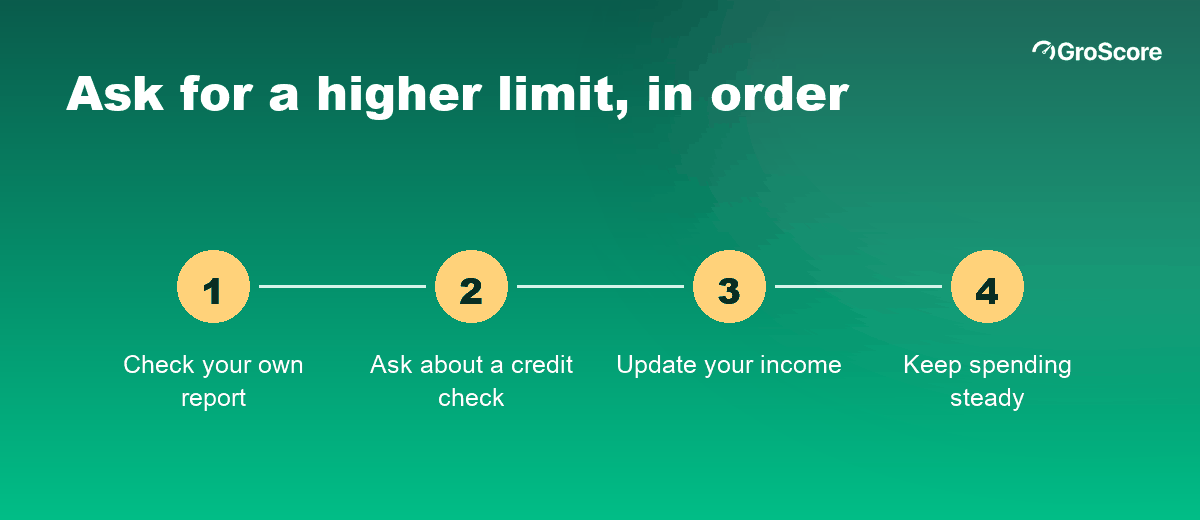
Make one request and follow these steps in order.
- Check your own report first. A self-check is a soft enquiry. Fix any errors before an issuer looks.
- Ask whether the request involves a credit check. If it does, time it away from any loan application.
- Update your income details. Issuers set limits partly on income.
- Keep your spending steady afterwards. The benefit lasts only while your balance stays put.
Make one request, to one issuer. Since 1 July 2026, lenders have had to report to the bureaus every week, so a new limit of, say, ₹1,00,000 usually shows on your report within a few weeks (RBI). For the bigger picture on cards, see credit cards and your CIBIL score.
Frequently Asked Questions
Does a credit limit increase improve my CIBIL score?
A credit limit increase can help your CIBIL score, and your scores at the other three bureaus, if your spending stays the same, because utilisation falls. It won't help if the balance rises to fill the new limit. GroScore shows your Equifax score, which responds to the same factors.
Is a credit limit increase request a hard enquiry?
A request can be a hard enquiry, if the issuer pulls your credit report. Bank-offered increases based on your account history often don't involve one. Ask the issuer before you apply.
Why did my score drop after a limit increase?
Usually because of a hard enquiry, a higher statement balance or something else on your report that changed the same month. A short timing gap between the balance and the new limit being reported can also cause a brief dip.
Should I accept a pre-approved limit increase?
Accept it if you pay in full, your spending is steady and you're not applying for a loan soon. Skip it if you carry a balance or might spend more just because the room is there. Under RBI rules, it's your choice: no issuer can raise your limit without your consent.
The Bottom Line
A higher credit limit is good for your score in one situation: when the limit grows and your balance doesn't. Ask your issuer whether a request means a hard enquiry, accept bank-offered increases if you pay in full, and keep your spending where it was. If your score dipped after a limit increase, check the enquiry and the balance before you blame the limit.
Disclaimer
This GroScore article is for general education and is not financial advice. GroScore provides credit scores and reports sourced from Equifax, an RBI-licensed credit bureau; scores differ between bureaus and change as lenders report new data. Credit score improvement depends on your individual credit behaviour and bureau reporting timelines, and results are not guaranteed. Loan and card decisions are made by lenders on their own criteria. GroScore is not a lender. Figures and rates shown are indicative.
