Instant Loan Approval: Can You Get a Loan in 5 Minutes?
The decision can take minutes. The rest of the loan usually can't. Here's what instant approval really covers, and what slows it down.

You can sometimes get the decision in five minutes, but rarely the whole loan. Instant loan approval means a lender's software can say yes or no within minutes, using your credit report, KYC and income data. Video KYC, an auto-debit mandate and the bank transfer can still take hours or a working day, and no regulated lender can promise approval before it checks.
Key TakeawaysThe fast part is the credit decision. KYC, the loan agreement and disbursal are separate steps that can slow things down.Pre-approved offers from your own bank are usually the quickest, because most checks were done before you asked.Every RBI-regulated lender checks a credit report. "Guaranteed approval" is a scam warning, not a feature (RBI).Applying to many apps at once adds hard enquiries and can make the next approval harder.GroScore says about 1 in 5 credit reports carries an error, roughly 20%, so check yours before you apply (groscore.in, retrieved 2026-10-05).
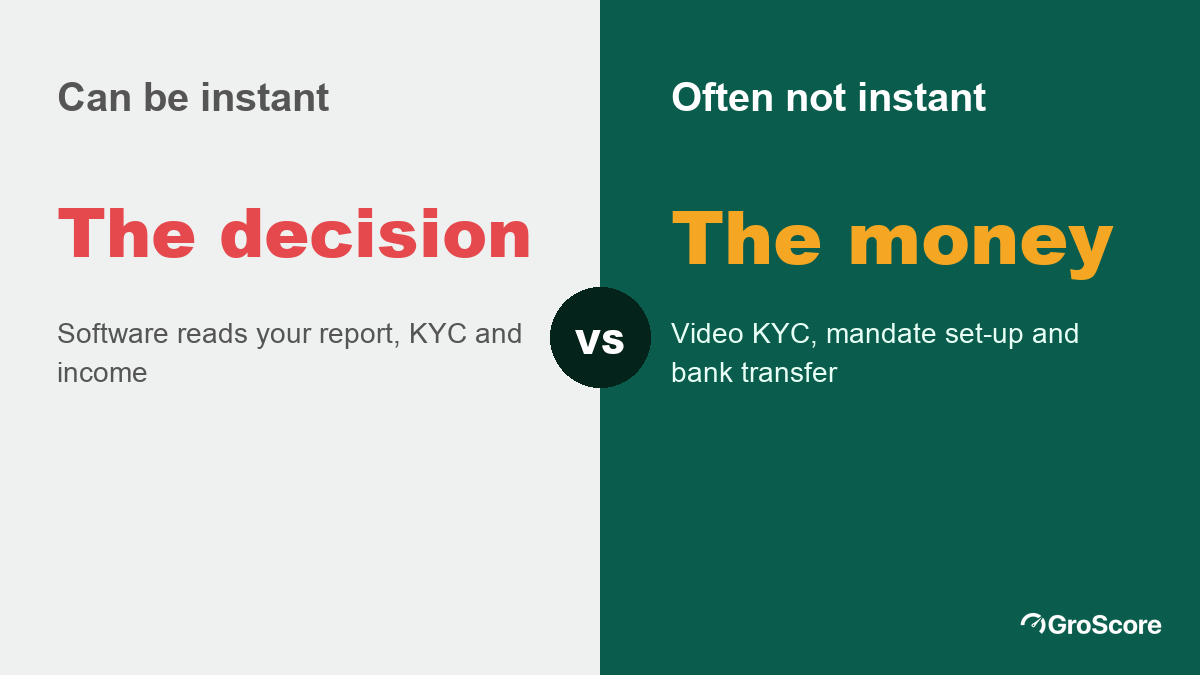
Only one part of the loan is truly instant.
Can You Really Get a Loan in 5 Minutes?
You can get a decision in five minutes. That's different from having the money.
Ads for an instant loan in 5 minutes are describing the best case: your KYC is already verified, your credit report is clean, your income data matches, and the lender's rules say yes on the first pass. Plenty of applications don't fit that picture. One mismatch, such as a name spelt differently on PAN and Aadhaar, sends the file to a human. If you want the bigger picture first, read our guide on how instant loans work.
A note on who's writing this. GroScore is a free credit score app and personal credit coach from Vitrak Technologies (GroMo). It shows your Equifax credit score and full report with a soft check that never affects your score, explains in Hindi or English what is holding the score back, and gives a step-by-step plan to fix it. GroScore is not a lender. It doesn't give, approve or disburse loans, and its number is your Equifax score, not a CIBIL score.
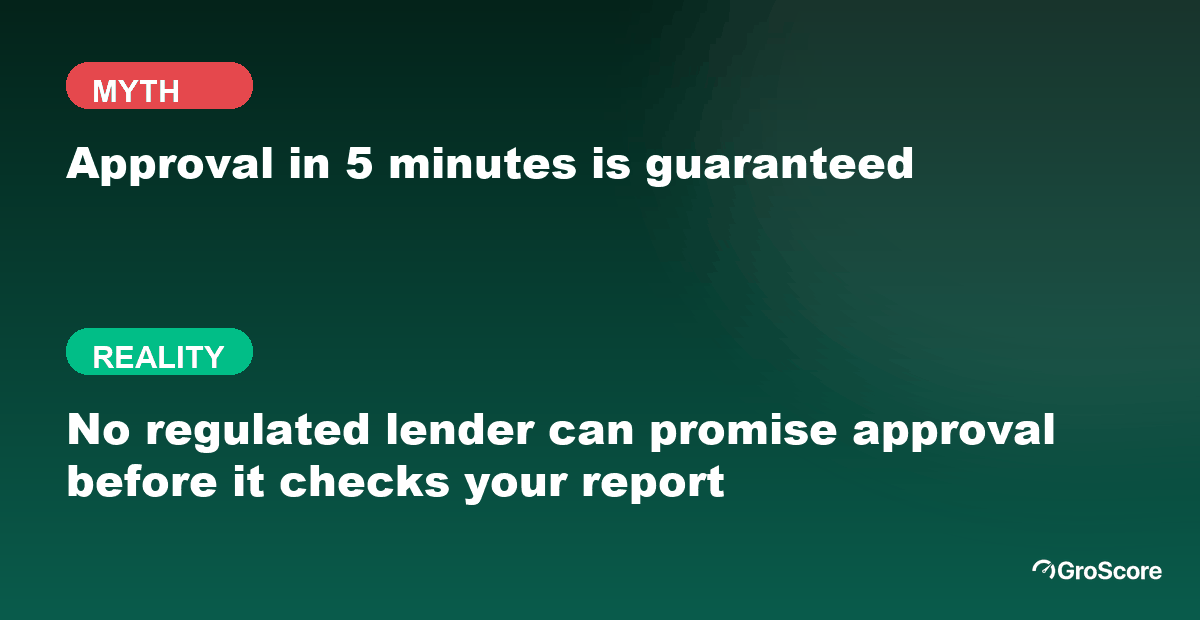
A lender can't know your answer before it checks.
What Happens During Instant Loan Approval, Step by Step?
Behind the "approved" screen sits a short pipeline. Some steps are automatic; others wait on you, a third party or banking hours.
| Step | What happens | Can it be instant? | What slows it |
|---|---|---|---|
| Application | You enter PAN, mobile, income and the amount | Yes | Typos, a mismatched name or date of birth |
| KYC | Aadhaar-based check or video KYC | Often | Video KYC queues, a blurry document |
| Credit check | The lender pulls your report from a bureau | Yes | A thin or missing credit history |
| Underwriting | Rules check score, income, existing EMIs | Usually | Self-employed income, a borderline profile |
| Offer and KFS | You see the amount, APR and fees, then sign | Yes | Time you take to read it (take it) |
| Mandate and disbursal | Auto-debit set-up, money to your account | Sometimes | Bank holidays, mandate failures |
The credit check is where the bureau comes in. Lenders can pull from any of the four RBI-registered credit bureaus: TransUnion CIBIL, Equifax, Experian and CRIF High Mark. Our guide on how to read your credit report shows what they see. Lenders must report your accounts to them every week since 1 July 2026 (RBI), so a recently cleared card balance can show up sooner than it used to.
Read the Key Fact Statement (KFS) before you tap "accept". It must show the APR, the all-in yearly cost including fees (RBI). For example, a 2% or 3% processing fee can push the APR well above the headline rate. A five-minute approval doesn't mean a five-minute read.
Pre-Approved Offers vs Fresh Applications
A pre-approved offer isn't a different product. It's a lender telling you, in advance, that your profile already passes its first filter.
Pre-approved offers come from a bank or NBFC that already sees your salary credits, balances or repayment record. That's why they're often the fastest route to a fast loan approval. The offer still isn't final: most lenders run a fresh check before disbursal, and an offer can change if your report has changed.
Fresh applications start from zero. The lender has to verify who you are, pull your report and assess your income. Banks tend to be stricter; NBFCs and app-based lenders may accept more varied profiles at a higher price. Our comparison of instant bank loans, NBFCs and loan apps covers the trade-offs.
Got an "approved" message from a company you've never dealt with? Treat it as marketing, or worse, until you've confirmed the lender on the RBI's list of registered NBFCs or the RBI's directory of digital lending apps.
What Do Lenders Check Before Approving an Instant Loan?
Lenders mostly check four things. Software reads them in seconds, which is the whole trick.
Your credit report. Payment history matters most. A recent DPD (days past due) entry or a written-off account can stop an application on its own. GroScore's guidance treats below 600 as the zone where approvals get hard (groscore.in).
Recent enquiries. Each lender's check is a hard enquiry. Several in a few weeks can read as credit hunger. Our hard vs soft enquiry guide explains which checks count.
Income and FOIR. FOIR, the fixed obligations to income ratio, is the share of your monthly income already committed to EMIs. Lenders set their own limits, and a high FOIR can sink an application with a good score.
Identity match. Your name, date of birth and PAN have to agree across documents. Small mismatches are a common reason a fast application slows down.
Here's how FOIR plays out, as an illustrative example. Suppose Priya earns ₹35,000 a month and already pays a ₹9,000 EMI. Her FOIR is about 26%. She wants ₹30,000 at 24% a year.
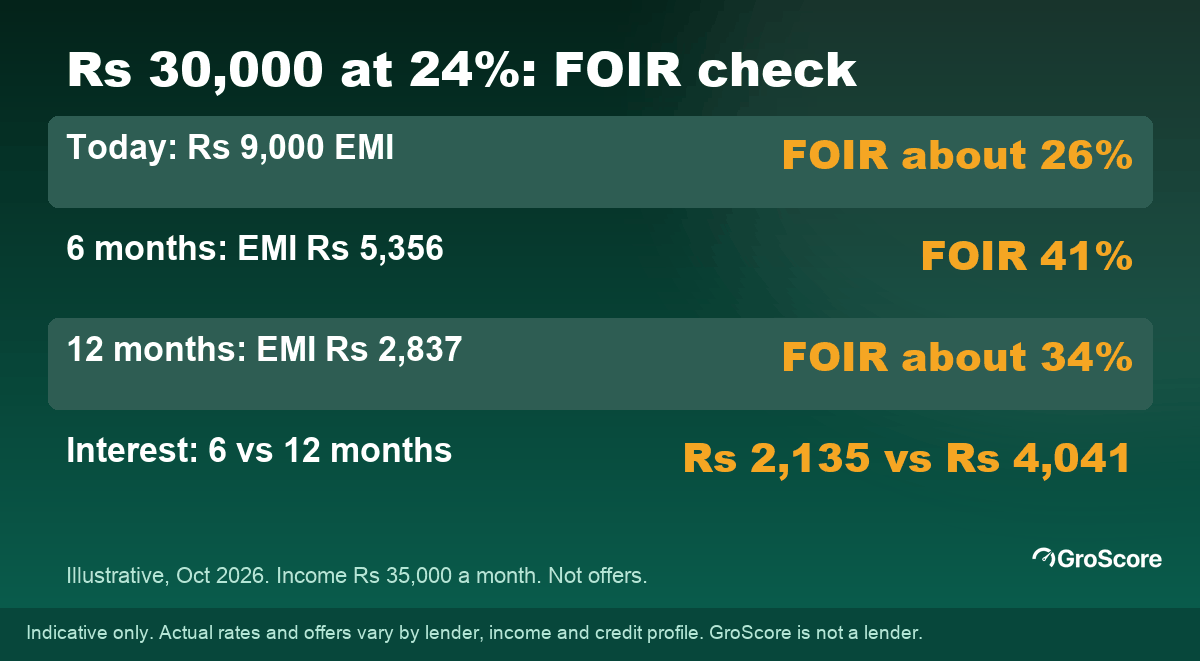
Illustrative example: a longer tenure lowers FOIR but adds interest.
Over six months, the EMI works out to ₹5,356, and her FOIR jumps to 41%. Over 12 months, the EMI is ₹2,837 and FOIR is about 34%, but total interest rises from ₹2,135 to ₹4,041. Tenure is only one lever on cost, so to find an instant loan with low interest, compare the APR, not the headline rate. If a lender's internal limit sat at 40% (an assumption for this example, not a published rule), the shorter loan could be declined and the longer one approved. These figures are indicative, worked out with the standard EMI formula as of October 2026. Actual offers vary by lender, income and credit profile.
Why Was My Instant Loan Rejected?
Rejections usually come with little explanation. These are the common causes, roughly in the order a coach would check them:
- Your report shows a late payment or default, especially in the last 12 months.
- You've made too many recent applications, each leaving an enquiry.
- Your FOIR goes above the lender's limit once the new EMI is added.
- The lender couldn't verify your income, or your employer isn't on its approved list.
- Your report has an error, like a closed loan still shown as open.
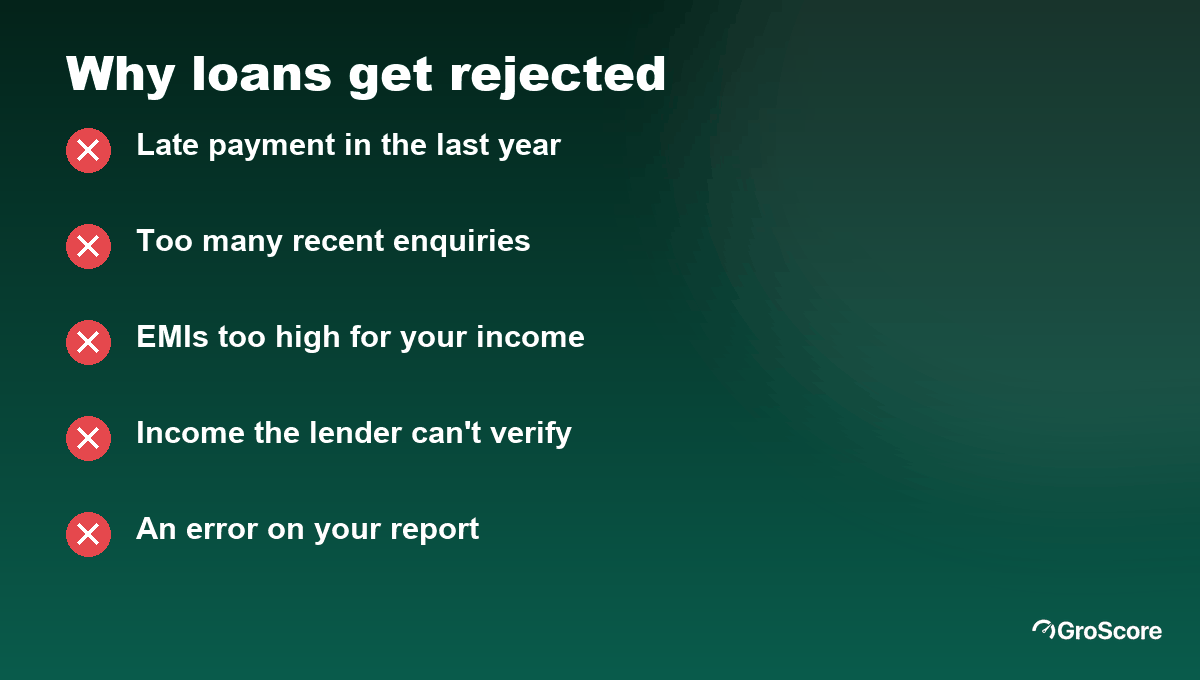
Find the reason before you apply again.
Don't fire off five more applications to "see which one says yes". Each one adds a hard enquiry and changes nothing about the reason you were declined. Pull your report, find the cause, then apply once. Our guide on what to do after a loan rejection walks through the next steps.
How Can You Improve Your Approval Odds Safely?
Here's an illustrative example: suppose Ravi, 27, was declined by two loan apps in a week. His Equifax score is 688. Arjun, GroScore's credit coach, reads the report with him and flags three things, in this order:
- Six enquiries in 30 days. Advice: stop applying for at least a few weeks.
- A credit card at 82% of its limit (an indicative figure for this example). GroScore's guidance is to keep card use under 30% (groscore.in, retrieved 2026-10-05).
- An old phone EMI marked overdue that he says he paid. If his bank records prove it, he can raise a dispute with the bureau.
Arjun can't promise Ravi an approval. The lender decides. GroScore can show which lenders' criteria a profile clears, across 100+ loans and credit cards from 60+ banks and NBFCs (groscore.in).
Watch out for shortcuts. Apps that promise easy loan approval for everyone, ask for an "approval fee" upfront or want access to your contacts aren't faster; they're unsafe. RBI rules require the loan to be paid from the lender straight into your bank account. Learn how to check if a loan app is RBI-registered before you share any documents. If an app harasses or cheats you, report it on the RBI's Sachet portal and call the cybercrime helpline on 1930.
Frequently Asked Questions
Can I really get a loan in 5 minutes?
You can get a credit decision in minutes if your KYC is verified and your profile clearly fits the lender's rules. The money can take longer, depending on the mandate set-up, the lender's process and banking hours. No regulated lender can promise approval in advance.
What do lenders check before approving an instant loan?
Lenders check your credit report, recent enquiries, income, existing EMIs (FOIR) and whether your identity details match. Software does it quickly, but the standards are the same as for a slower loan.
Why was my instant loan rejected?
Common reasons are recent late payments, too many enquiries, a high FOIR, income the lender couldn't verify, or an error on your report. Check your full report before applying again, so you fix the real cause.
Does applying to many instant loan apps hurt my score?
Yes, it can. Each application usually triggers a hard enquiry, and several in a short time can lower your score a little and make lenders cautious. Checking your own score is a soft enquiry and doesn't affect it.
The Bottom Line
Instant loan approval is real, but it's narrow: a fast decision for a clean, verifiable profile. Fast loan approval comes from a tidy report, a sensible FOIR and documents that match, not from an app's promises. Check your report first, fix what you can, and apply once to a lender you've verified. If your income is hard to document, see what's possible with an instant personal loan without income proof.
Disclaimer
This GroScore article is for general education and is not financial advice. GroScore provides credit scores and reports sourced from Equifax, an RBI-licensed credit bureau; scores differ between bureaus and change as lenders report new data. Credit score improvement depends on your individual credit behaviour and bureau reporting timelines, and results are not guaranteed. Loan and card decisions are made by lenders on their own criteria. GroScore is not a lender. Figures and rates shown are indicative.
