Instant Student Loan: Options for Students in India
Most students can't get a big loan in minutes, and that's not bad news. Here's what you can borrow, what it costs, and the safer routes most students miss.

An instant student loan is hard to get if you have no income. Lenders need proof you can repay, so most offers go to students over 18 with a part-time income or a parent as co-applicant. For fees, an education loan is usually cheaper. Small app loans exist, but their fees push the real yearly cost very high.
Key TakeawaysYou must be 18 or older to sign a loan contract in India. Without income, most lenders will ask for a co-applicant.Students admitted to one of the top 860 institutions by NIRF ranking can apply for collateral-free, guarantor-free education loans through the PM-Vidyalaxmi portal (Ministry of Education, PIB).On a ₹10,000, three-month app loan, a ₹500 fee can push the APR to about 68% in our illustrative example.Your first loan starts your credit history. A missed EMI at 20 can still show up when you apply for a home loan at 30.
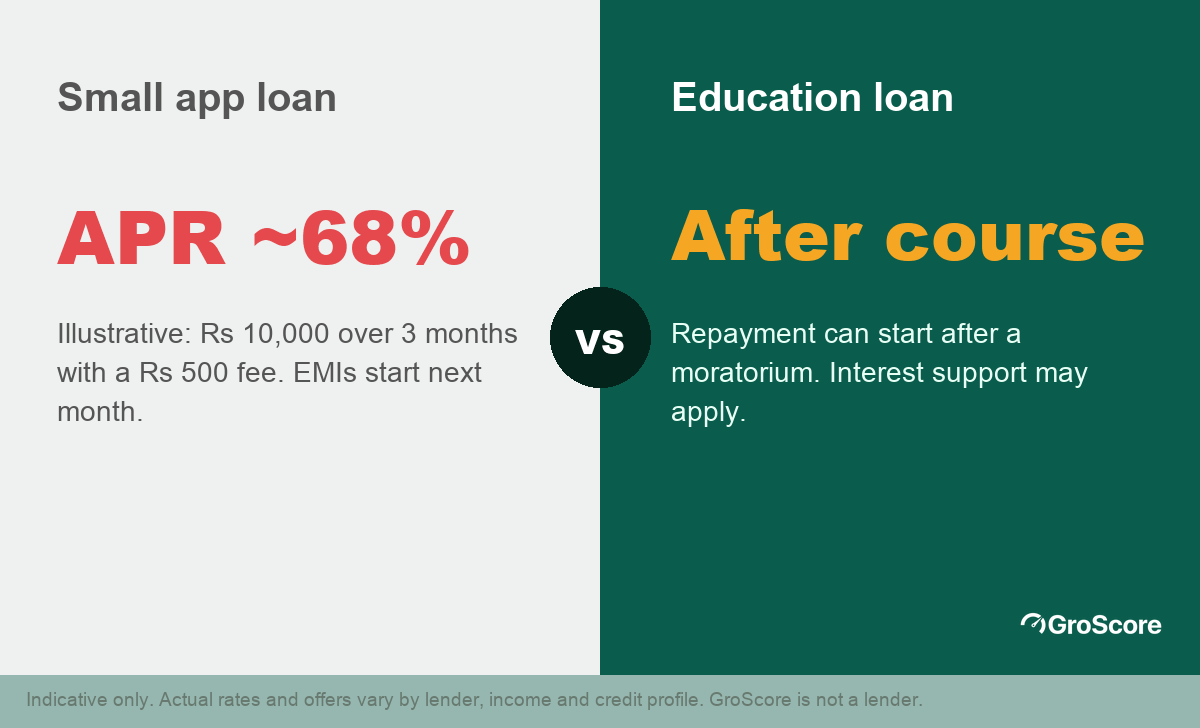
Illustrative comparison: speed isn't the only thing that differs.
Can You Get an Instant Student Loan Without Income?
Rarely, and you should be wary of anyone who says it's easy.
Every RBI-regulated bank and NBFC has to judge whether you can repay. A student with no salary, no ITR and no credit history gives a lender almost nothing to go on. Your credit report will usually show "NH" (no history) or a score of -1. That isn't a bad score, it's just empty. Our guide to having no credit score explains what those codes mean.
So what do lenders do with a student? One of three things:
- Ask for a co-applicant, usually a parent with a steady income and a decent credit record. The loan then shows on both reports.
- Look at your own income, if you have a stipend, part-time job or freelance work that lands in your bank account each month.
- Offer a very small amount, often a few thousand rupees over a short tenure, priced high to cover the risk.
Age matters too. Under the Indian Contract Act, 1872, a minor can't enter a binding contract, so you need to be at least 18 to sign a loan agreement in your own name.
GroScore is a free credit score app and personal credit coach from Vitrak Technologies (GroMo). It shows your Equifax credit score and full report with a soft check that never affects your score, explains in Hindi or English what is holding the score back, and gives a step-by-step plan to fix it. GroScore is not a lender. It doesn't give, approve or disburse loans, and the number it shows is your Equifax score, not a CIBIL score.
Education Loan vs Personal Loan: Which Fits a Student?
The answer depends on what the money is for. College fees, hostel and course costs belong in an education loan. A laptop that broke the week before exams is a different problem, closer to the personal loans in our guide on how instant loans work.
| Education loan | Instant personal loan | |
|---|---|---|
| What it's for | Tuition, hostel, books, course costs | Any personal need |
| Usual borrower | The student, often with a parent as co-applicant | The person with the income |
| Speed | Days to weeks; documents from the college needed | Minutes to a day, if you qualify |
| Repayment | Often starts after the course, with a moratorium | Starts next month |
| Cost | Usually lower; interest support may apply | Usually higher, plus fees |
Indicative, as of October 2026. Actual offers vary by lender, income and credit profile.
Two government schemes change the maths for education loans. Under PM-Vidyalaxmi, approved by the Union Cabinet on 6 November 2024, students admitted on merit to one of the top 860 higher education institutions by NIRF ranking can get collateral-free, guarantor-free education loans. The government backs loans up to ₹7.5 lakh with a 75% credit guarantee (PIB, Ministry of Education, retrieved 2026-10-06).
Students with a family income up to ₹8 lakh a year can also get 3% interest subvention on loans up to ₹10 lakh. By 21 July 2026, 1,12,817 loans worth ₹15,634 crore had been sanctioned under the scheme (PIB, Ministry of Education, retrieved 2026-10-06). You apply on the PM-Vidyalaxmi portal, which lists the participating banks.
Then there's the older Central Sector Interest Subsidy scheme. It covers the full interest during the moratorium for students from families earning up to ₹4.5 lakh a year, on loans up to ₹10 lakh for approved technical and professional courses (Ministry of Education, education.gov.in).
Banks also have a reason to lend for education. RBI's priority sector rules count education loans of up to ₹25 lakh per student, including vocational courses (RBI, Priority Sector Lending Directions, 2025).
Is there an instant education loan? Not really in the fees-paid-in-minutes sense. The college has to confirm your admission and costs first. Start the application as soon as you have the admission letter, and you'll rarely need a quick education loan at the last minute.
What Does an Instant 10000 Loan for Students Really Cost?
Small loans look cheap because the rupee amounts are small. Look at the yearly cost instead.
Take, for example, an illustrative ₹10,000 app loan repaid over three months at 30% a year, with a ₹500 processing fee plus 18% GST:
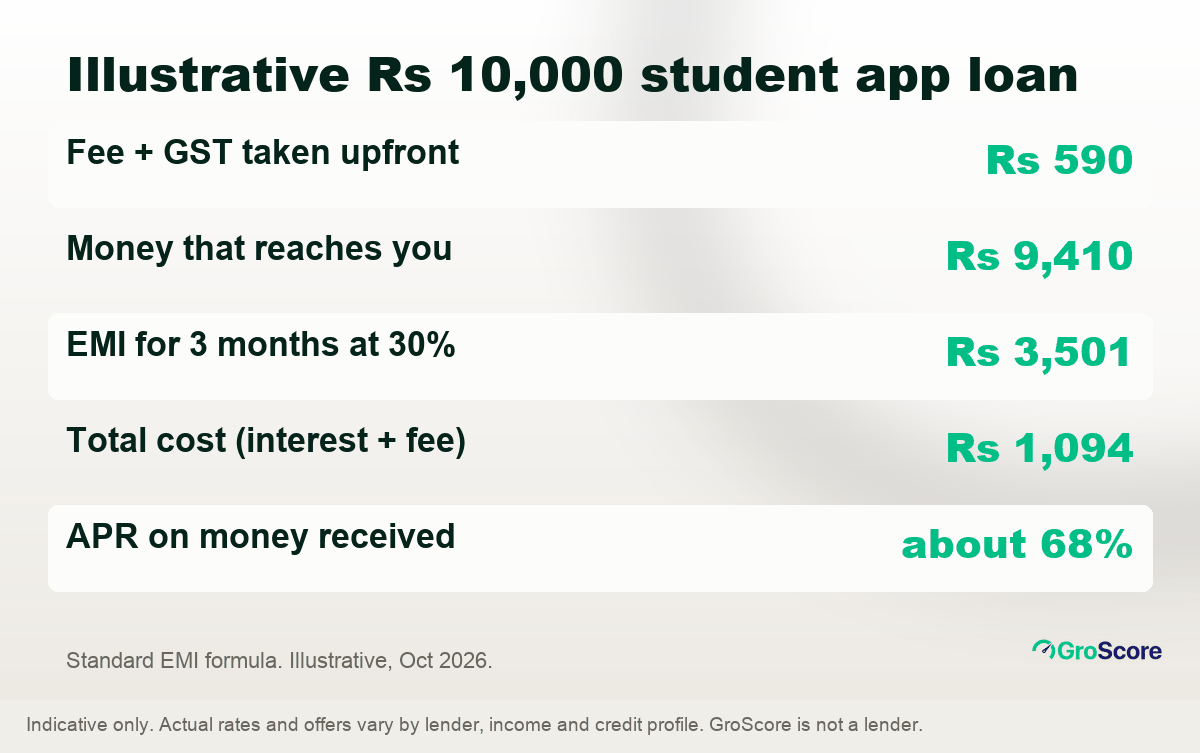
Illustrative example: on a short loan, the fee does most of the damage.
- The fee plus GST, ₹590, comes off upfront, so ₹9,410 reaches your account.
- The EMI works out to ₹3,501 a month, and interest to ₹504.
- Your total cost is ₹1,094 for three months.
- Measured on the money you actually received, the APR works out to about 68% a year.
We worked these out with the standard EMI formula, as of October 2026. They're indicative, not an offer. Actual offers vary by lender, income and credit profile. The same logic applies to an instant 5000 loan for students: a flat fee on a smaller amount makes the APR even worse.
Now the harder question. Where does ₹3,501 a month come from if you don't earn? If the answer is "another loan", stop there. That's how a ₹10,000 problem becomes a ₹30,000 one. For more on small-ticket costs, see our guide to an instant loan of ₹5,000 to ₹20,000.
How to Judge a Loan App for Students Without Getting Burned
People search for the "best loan app for students" every month. We won't name one, because the right answer depends on who is lending and on what terms. Here's how to judge any instant loan app for students yourself.
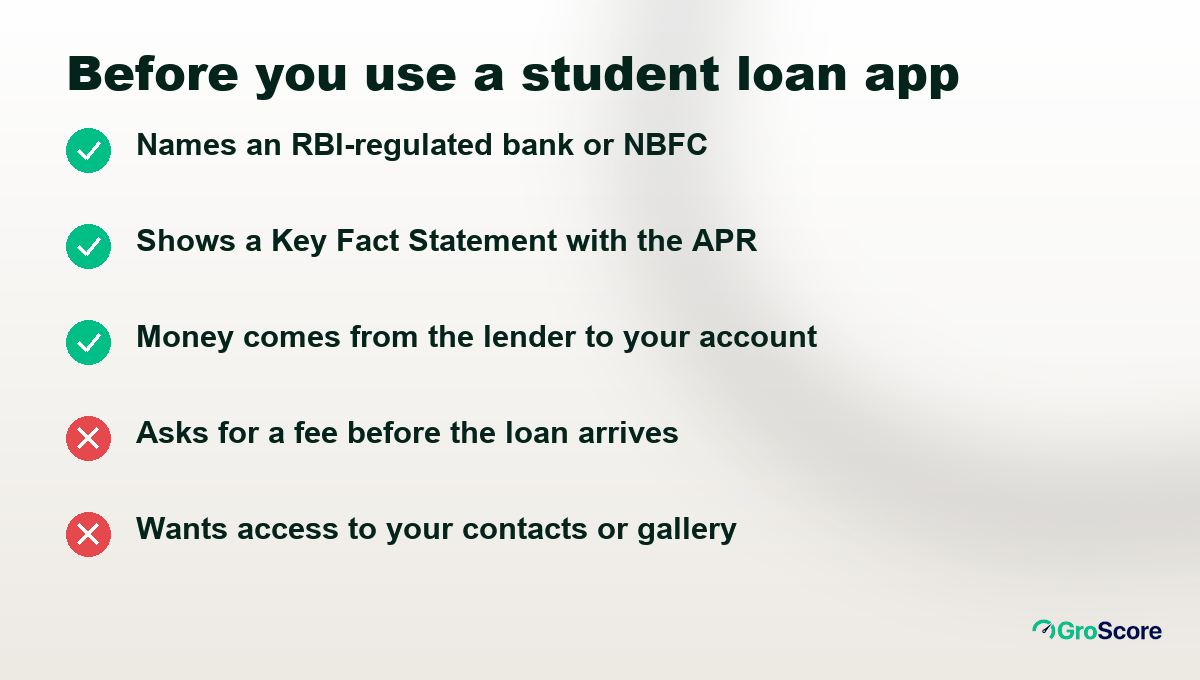
If an app fails one of these, close it.
1. Find the actual lender. A loan app is often just the shopfront for a bank or NBFC. The app, the loan agreement and the Key Fact Statement must name it. Check that name on the RBI's list of registered NBFCs, and look for the app in the RBI's directory of digital lending apps.
2. Read the Key Fact Statement. Under the RBI's Digital Lending Directions, 2025, every loan offer must show the APR, and you get a cooling-off period of at least one day to exit by repaying the principal and the proportionate APR (RBI, May 2025).
3. Check where the money comes from. RBI rules say a digital loan must go from the lender straight into your own bank account. Money from a stranger's UPI ID is a red flag.
4. Refuse upfront fees and phone access. No genuine lender asks you to pay before disbursal, and lending apps aren't allowed to take your contacts or photo gallery.
Students are a favourite target for illegal apps, because they're short of cash and embarrassed to tell their parents. If an app harasses you or threatens to message your contacts, don't pay. Save screenshots, call the cybercrime helpline on 1930 and report the app on the RBI's Sachet portal. Our guide to fake loan apps walks through each step.
Safer Ways to Cover a Short-Term Cash Gap
Emergency student loans aren't the only option. Before you borrow from an app, try these, roughly in this order:
- Ask your college about fee instalments or a late-fee waiver. Many institutions have a hardship process. It costs nothing to ask.
- Check scholarships and the PM-Vidyalaxmi portal if the gap is about fees.
- Borrow with a parent as co-applicant from a bank or NBFC. The rate is usually far lower than a no-income app loan.
- Use a family member's card as an add-on, and repay them, if the need is a one-off purchase.
None of these is as fast as tapping "apply" in an app. All of them are cheaper. If a parent or working sibling ends up borrowing for you, they'll want to read instant loan for salaried and self-employed applicants first.
What Would a Credit Coach Tell a Student?
Here's an illustrative example. Kabir, 20, is in his second year and wants ₹10,000 for an exam-prep course. He checks his Equifax report on GroScore, and it shows no score yet. Arjun, GroScore's credit coach, walks him through three things, in this order:
- No history isn't a problem to fix with a loan. Taking an expensive app loan just to "create a score" is a bad trade.
- The course fee can wait two weeks. The institute offers a two-part payment, so the immediate gap is ₹5,000, which a part-time tutoring job covers.
- Start building credit safely. An FD-backed credit card on a small fixed deposit, used for one small bill a month and paid in full, starts a record without real debt.
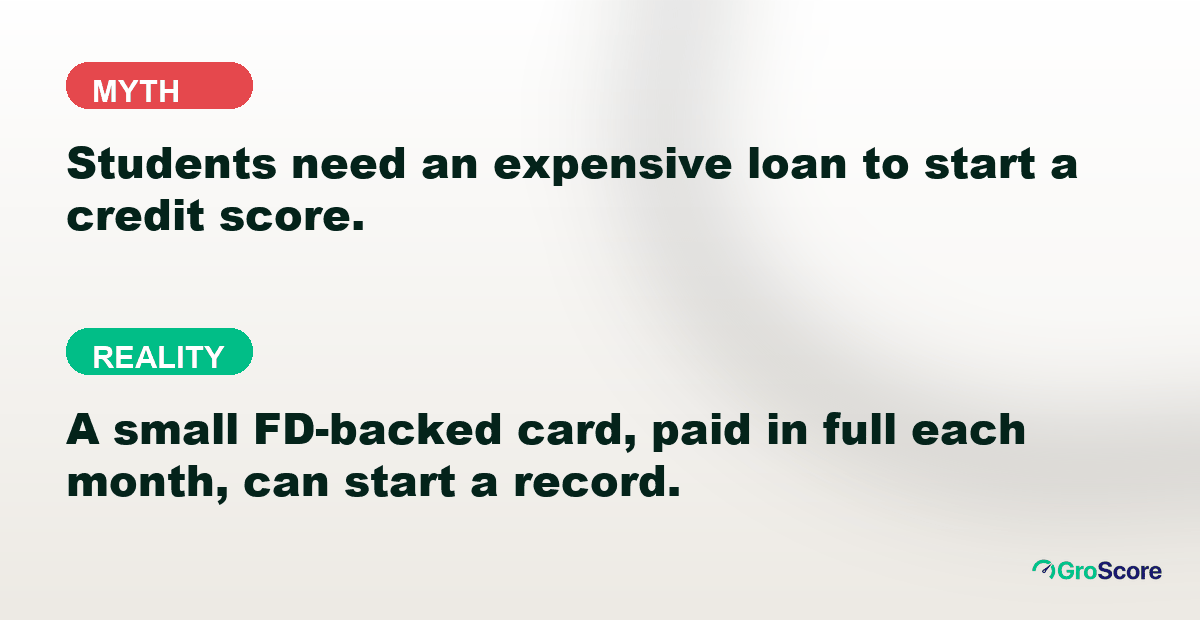
A first credit record can start small and cheap.
GroScore's credit builder fits that last step: it points new-to-credit users to secured cards, FD-backed cards and starter loans (groscore.in). Our guide on how to build a credit score from scratch has the full six-month plan.
Arjun doesn't promise Kabir a score or an approval. Bureaus calculate the score, and lenders decide on loans.
Frequently Asked Questions
Can a student get an instant loan without income?
Usually not easily. Lenders need to see how you'll repay, so most ask for a co-applicant, usually a parent, or for proof of part-time income. Small amounts may be offered without income, but usually at a high cost. Any app promising a big loan with no income and no checks is a warning sign.
Is an education loan better than a personal loan for students?
For fees and course costs, usually yes. Education loans tend to cost less, often let repayment start after the course, and may qualify for interest support under PM-Vidyalaxmi or the Central Sector Interest Subsidy scheme. A personal loan is faster but starts EMIs at once.
Do student loans affect my future CIBIL score?
Yes. Every loan from a regulated lender is reported to the credit bureaus, including TransUnion CIBIL and Equifax. Paying on time builds your history; a missed EMI stays on your report for years. If a parent is a co-applicant, the loan shows on their report too.
Can students get a credit card?
Without income, an unsecured card is unlikely. Students over 18 can often get an FD-backed card against a small fixed deposit, or an add-on card on a parent's account. Our guide to a credit card for a low CIBIL score covers secured cards.
The Bottom Line
A student usually doesn't need an instant loan as much as a cheaper route to the same money. For fees, start the education loan early and check PM-Vidyalaxmi. For a small gap, ask the college, a parent or a part-time job first. If you do borrow from an app, verify the lender, read the APR, and only borrow what you can repay from money you already have. Start your credit history on purpose, not by accident.
Disclaimer
This GroScore article is for general education and is not financial advice. GroScore provides credit scores and reports sourced from Equifax, an RBI-licensed credit bureau; scores differ between bureaus and change as lenders report new data. Credit score improvement depends on your individual credit behaviour and bureau reporting timelines, and results are not guaranteed. Loan and card decisions are made by lenders on their own criteria. GroScore is not a lender. Figures and rates shown are indicative.
