Fake Loan Apps: How to Check If a Loan App Is RBI-Registered
There's no official list of fake loan apps, and lists online go stale fast. Here's how to check any app yourself in five minutes, and what to do if one is already harassing you.

Fake loan apps are apps that lend, or pretend to lend, without an RBI-regulated bank or NBFC behind them. To check any app, find the lender it names, then confirm that the app appears in the RBI's directory of digital lending apps and that the lender is RBI-regulated. If an app names no lender, asks for a fee before paying out, or wants your contacts, don't use it.
Key TakeawaysThe RBI doesn't publish a list of fake loan apps. It publishes the opposite: a directory of apps that regulated lenders have reported, live since July 2025 (RBI).A loan app is never the lender itself. A genuine one names the RBI-regulated bank or NBFC that lends.Under RBI rules, lending apps can't access your contact list or call logs (RBI).Harassed or cheated? Call 1930 or file at cybercrime.gov.in, and report the app on RBI's Sachet portal.
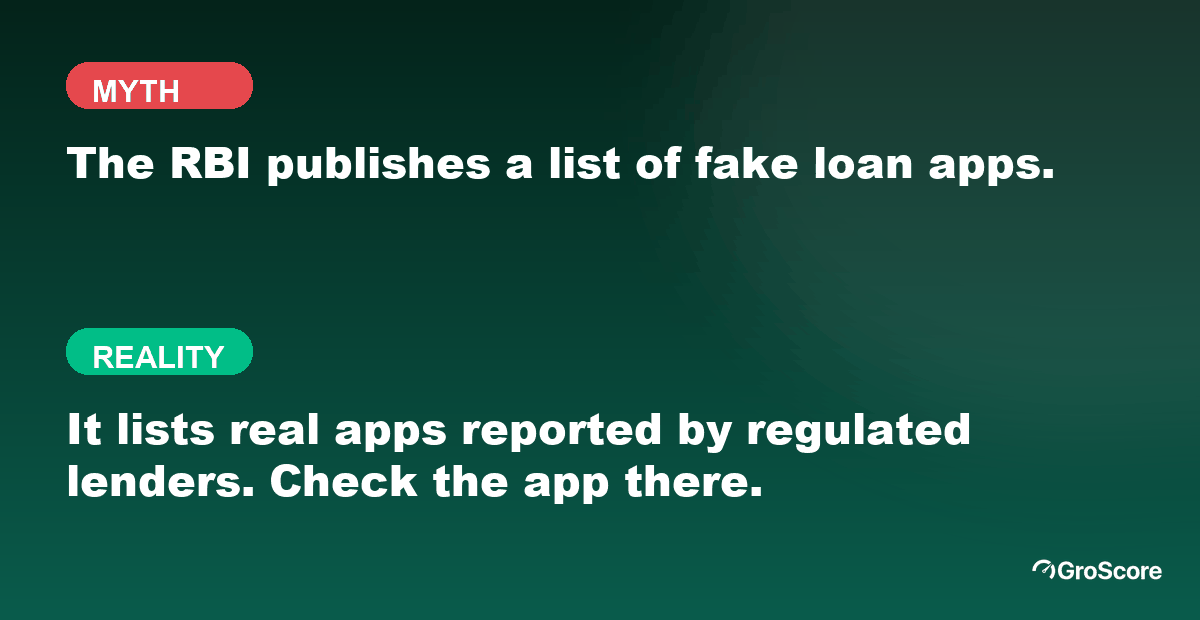
Check the app against the official list of real apps, not a forwarded list of fake ones.
Is There an Official Fake Loan App List?
No. Many people search for a "fake loan app list" or an "all fake loan app list", and plenty of websites and WhatsApp forwards offer one. The RBI doesn't publish such a list, and the ones that circulate go out of date quickly. Illegal apps change their names, icons and developer accounts often, so an app that isn't on someone's fake list may still be fake.
The RBI went the other way. Since July 2025, its website has carried a directory of digital lending apps (DLAs) that RBI-regulated lenders have reported as their own or their partners' apps (RBI). Instead of asking "is this app on a fake list?", ask "is this app on the real list, and who is the lender?"
A word on who's writing this. GroScore is a free credit score app and personal credit coach from Vitrak Technologies (GroMo). It shows your Equifax credit score and full report with a soft check. GroScore is not a lender and not a credit bureau. It doesn't give, approve or disburse loans, and the score it shows is your Equifax score, not a CIBIL score. For how genuine instant loans work, read our guide to the instant personal loan.
How to Check If a Loan App Is RBI-Registered
Strictly speaking, the RBI registers lenders, not apps. A loan app is legitimate when an RBI-regulated bank or NBFC stands behind it and has reported the app to the RBI. Here's how to check that in about five minutes:
- Find the lender's name. A genuine app names its lending partners on the app and its website. The lender's name also appears in the loan agreement and the Key Fact Statement (KFS).
- Search the RBI's app directory. On rbi.org.in, open Citizen's Corner, then "DLAs deployed by Regulated Entities". Search for the app and note which bank or NBFC reported it.
- Confirm the lender. For an NBFC, search its exact name on the RBI's list of registered NBFCs. Banks are licensed by the RBI already.
- Match the names. The lender in the directory, on the app and on your KFS should be the same company.
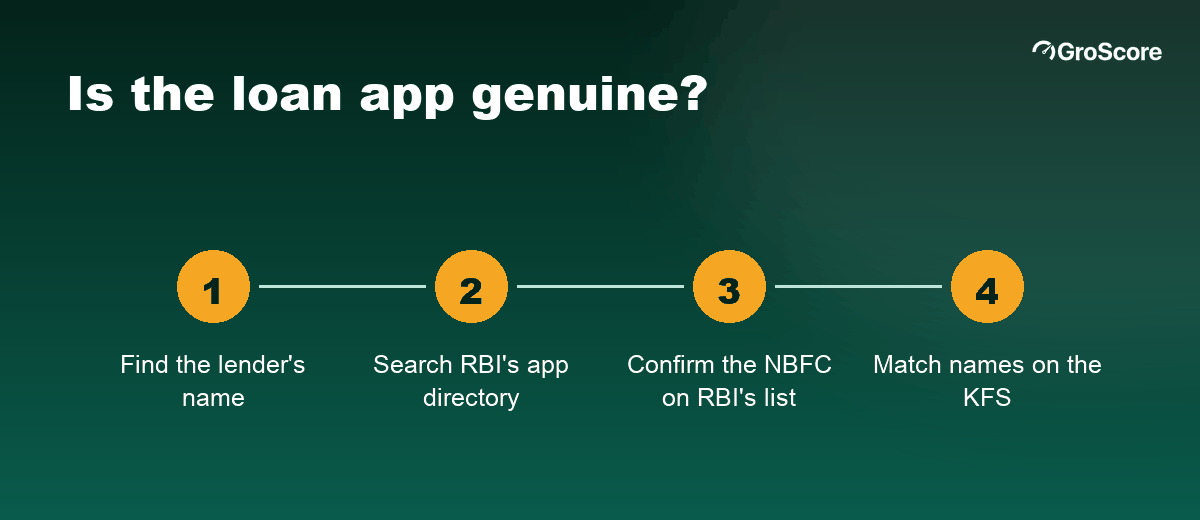
If any step fails, stop and don't share documents.
Know what the directory can and can't tell you. The RBI says the list is built from data lenders submit, on an as-is basis, without further validation by the RBI, and exists to help you verify an app's claim that it's linked to a regulated lender (RBI press release, 8 May 2025). It isn't an endorsement of the app's prices or service.
Is the app missing from the directory? Treat that as a serious red flag. Also check the developer name on the app store page: it should match the lender or a company the lender names as its partner.
What Are the Signs of Fake Loan Apps?
Most fake loan apps give themselves away before you borrow. Watch for these:
- A fee before the loan. The app asks you to pay "processing", "GST", "insurance" or "verification" charges upfront, often to a personal UPI ID. Regulated lenders show fees in the KFS and usually deduct them from the amount paid out. A promise of money with no documents at all is another lure, so know what's realistic for an instant personal loan without income proof.
- No named lender. The app doesn't name a bank or NBFC, or names one you can't find on the RBI's lists.
- Permissions it shouldn't need. The app wants access to your contacts, call logs or photo gallery.
- No Key Fact Statement. You're asked to accept without seeing the APR and fees.
- A loan you didn't fully agree to. Money lands in your account, followed by demands for much more than you received.
- Pressure and secrecy. You're told the "offer is valid for 10 minutes" or asked to keep the loan private.
- Threats. The app threatens to message your contacts or share morphed photos.
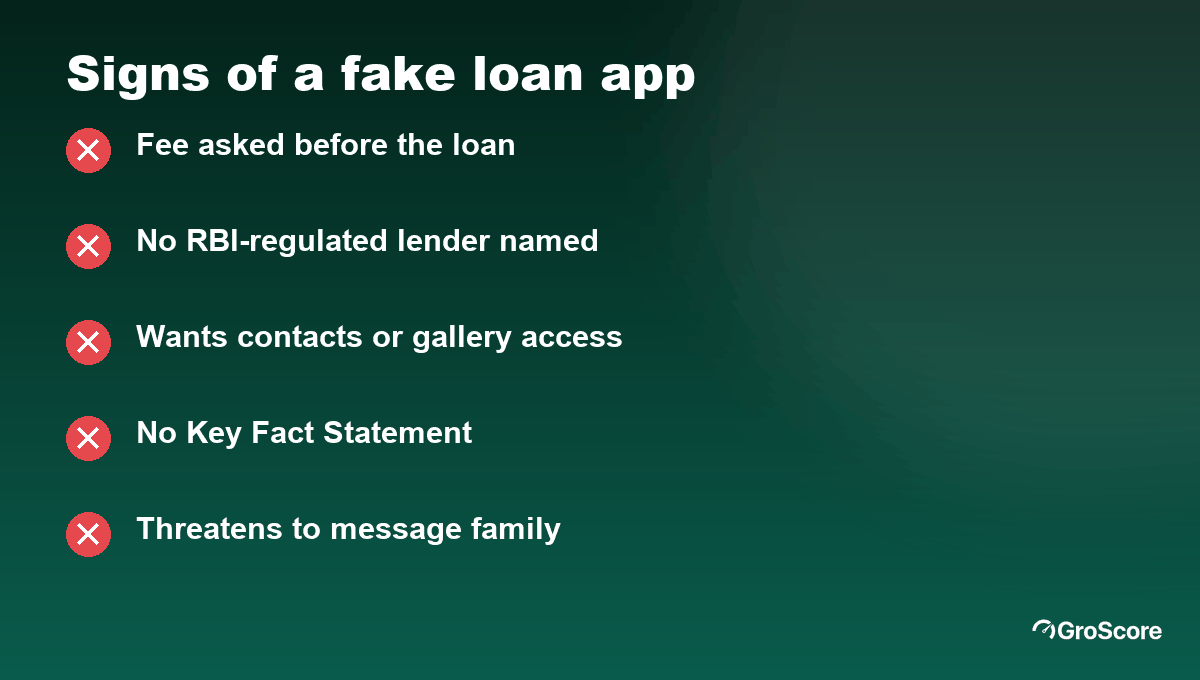
One of these is enough to walk away.
If you're borrowing because your score is low, these apps target exactly that moment. Our guide to safe loan apps for low scores shows the regulated routes that remain open to you.
What Must a Genuine Loan App Do Under RBI Rules?
RBI's digital lending rules spell out what you should see from any app tied to a regulated lender. Use them as a checklist.
| RBI rule | What you should see |
|---|---|
| Key Fact Statement | The APR, every fee, the repayment schedule and the lender's name before you sign |
| Direct payment | Money paid into your bank account by the lender; EMIs paid to the lender's account, not to the app or an agent |
| Data limits | No access to contacts, call logs or telephony functions; camera, microphone or location only once, for onboarding or KYC, with your consent |
| Cooling-off period | At least one day to exit by repaying the principal and proportionate APR, without a penalty |
| Recovery agents | The agent's details sent to you by SMS or email before they contact you |
| Grievance officer | A named grievance redressal officer, with escalation to the RBI if not resolved in 30 days |
| Credit reporting | Loans reported to credit bureaus |
Based on the RBI's Digital Lending Directions, May 2025, as of October 2026 (RBI).
An app that breaks these rules isn't automatically fake, but it is breaking the rules, and you can complain about it. An app that ignores all of them almost certainly has no regulated lender behind it. A loan from a genuine app, on the other hand, appears in your credit report like any other loan.
What Should You Do If a Loan App Is Harassing You?
Loan app harassment usually starts with abusive calls and escalates to messages to your contacts. You aren't powerless. Act in this order:
- Don't pay under threat. Paying an illegal app rarely ends the demands. It often brings bigger ones.
- Save the evidence. Screenshot messages, call logs, UPI receipts, the app's name and its store page before you uninstall anything.
- Report it as cybercrime. Call the national cybercrime helpline, 1930, or file a complaint at cybercrime.gov.in. You can also go to your local police station.
- Report the app on Sachet. The RBI's Sachet portal (sachet.rbi.org.in) takes complaints about entities that aren't authorised by the RBI.
- Tell your contacts. A short message that any threats about you are part of a scam takes away most of the app's power.
- Lock down your phone. Revoke the app's permissions, uninstall it, and change passwords and UPI PINs if you shared them.
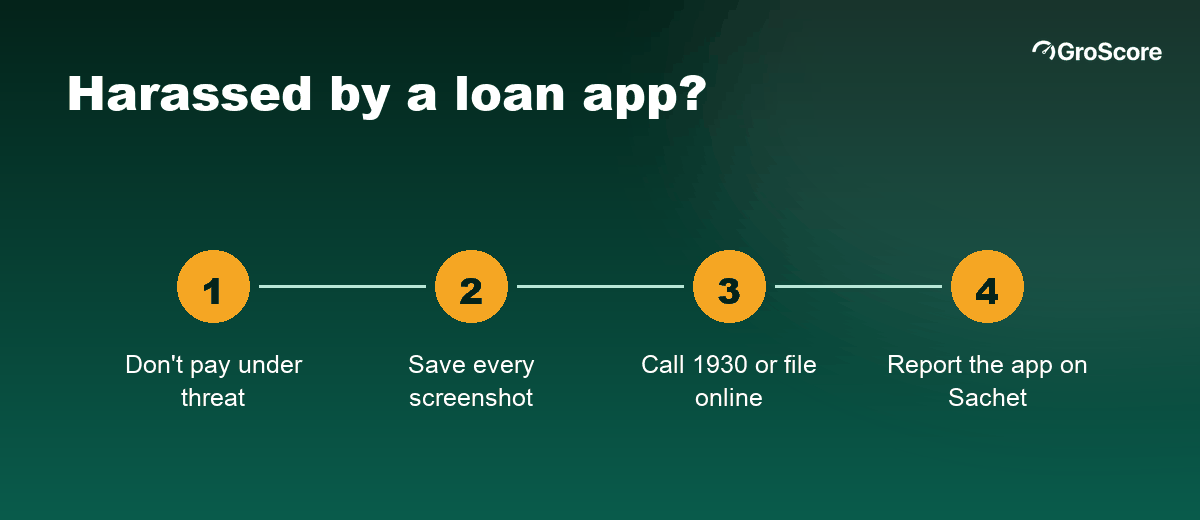
Evidence first, then report. Paying rarely stops it.
What if the app is linked to a regulated lender and still harasses you? Complain to the lender's grievance redressal officer in writing. If you don't get a resolution within 30 days, or you're unhappy with the reply, escalate to the RBI Ombudsman through the RBI's Complaint Management System at cms.rbi.org.in (RBI).
Can a Fake Loan App Affect Your Credit Score?
Usually not directly. Credit bureaus take data from their member credit institutions, which are regulated lenders. An illegal app with no regulated lender behind it generally can't report a loan to a bureau, so its threats to "ruin your CIBIL score" are mostly empty. Apps that promise an instant loan without CIBIL checks deserve the same suspicion. CIBIL, by the way, is one of four RBI-registered bureaus, alongside Equifax, Experian and CRIF High Mark.
There are two exceptions to watch for:
- The app was linked to a real lender. Then the loan is a real credit account, and RBI rules require the lender to report it to the bureaus. Missed EMIs will show.
- Someone used your documents. Fake apps collect PAN, Aadhaar and selfies. Those can be misused to take loans in your name elsewhere.
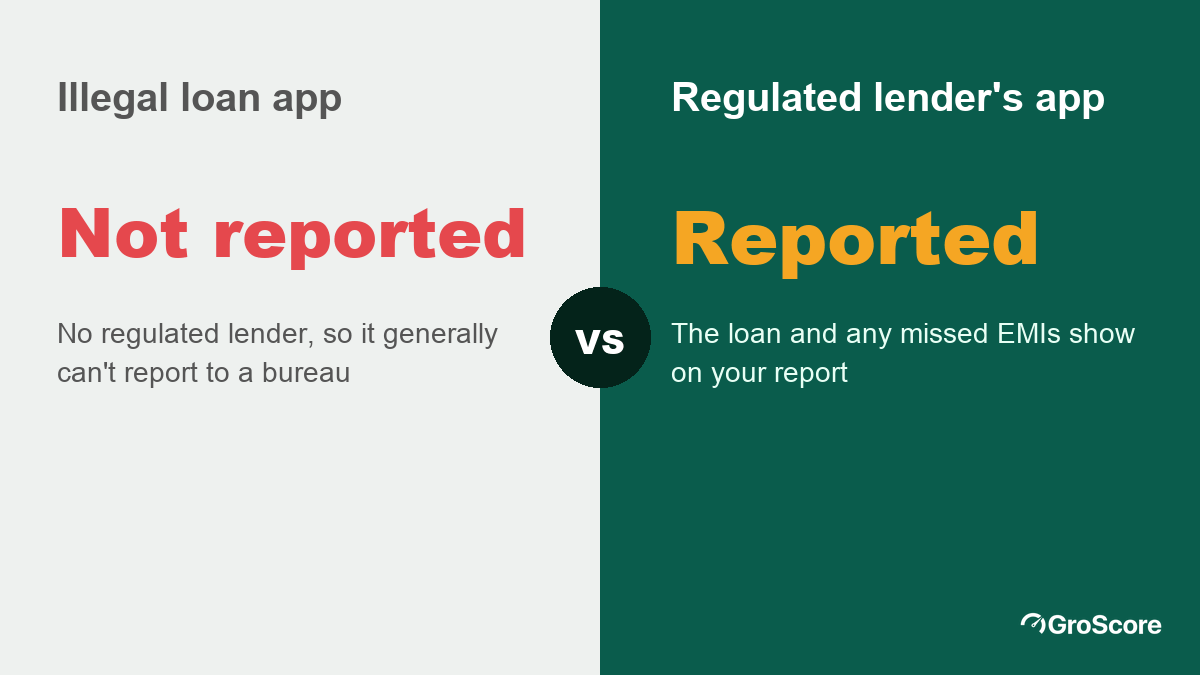
Who's behind the app decides whether a loan reaches your report.
The fix for both is the same: read your credit report. Look for accounts or enquiries you don't recognise. Our guide to check your active loans shows how to spot one. If an entry is wrong, raise a dispute with the bureau, and an error can be corrected. Accurate entries can't be removed early. Errors aren't rare: GroScore says about 1 in 5 reports carries one (groscore.in, retrieved 2026-10-05).
Illustrative example. Say you uninstalled a fake app three months ago. Arjun, GroScore's credit coach, would check your Equifax report for three things: a personal loan you never took, a hard enquiry from a lender you never applied to, and a mismatch in your PAN or address details. Any one of them goes straight to a dispute.
Where to Complain About an Illegal Loan App
Pick the route that matches your problem. You can use more than one. For a wrong entry on your report, our guide to raising a credit report dispute walks through each bureau's process.
| Problem | Where to go |
|---|---|
| Threats, extortion, morphed photos, money taken | 1930 or cybercrime.gov.in, and local police |
| An app or entity lending without RBI authorisation | RBI's Sachet portal, sachet.rbi.org.in |
| A regulated lender or its app breaking the rules | Lender's grievance officer, then RBI Ombudsman via cms.rbi.org.in after 30 days |
| A loan on your credit report you never took | Dispute with the credit bureau, and report identity theft to the police |
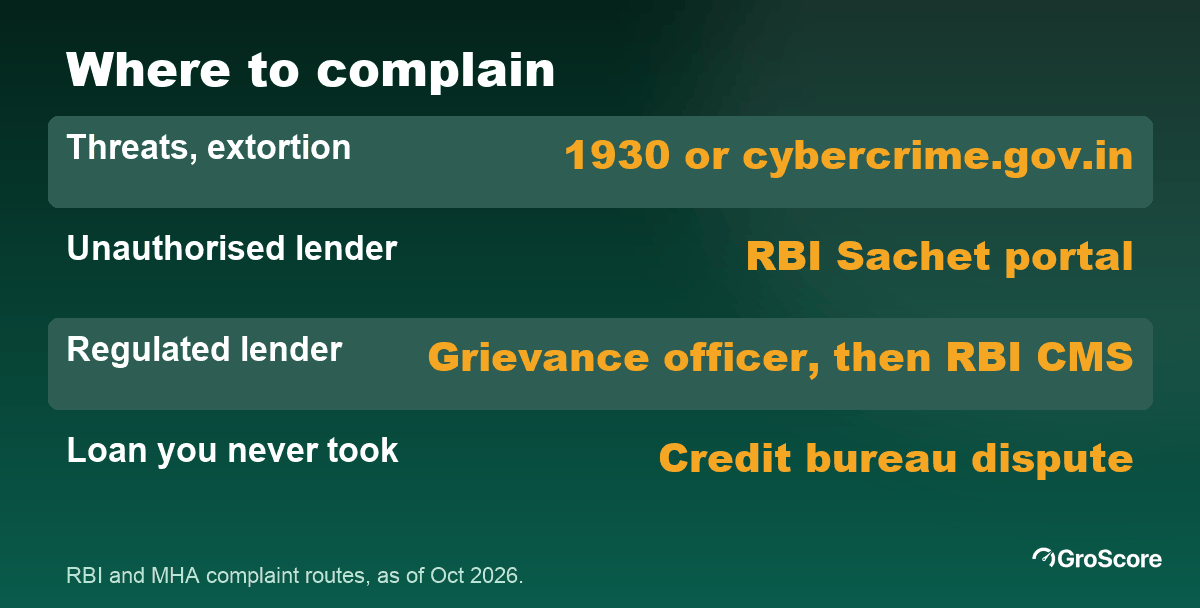
Save this table. The right route gets action faster.
Frequently Asked Questions
How can I check if a loan app is RBI-approved?
Find the bank or NBFC the app names as its lender, then search the app in the RBI's directory of digital lending apps (Citizen's Corner on rbi.org.in). Confirm an NBFC on the RBI's list of registered NBFCs. If the names don't match, or the app names no lender, don't borrow.
What are the signs of a fake loan app?
The main signs are an upfront fee before payout, no named RBI-regulated lender, requests for access to your contacts or gallery, no Key Fact Statement, and pressure to decide in minutes. Threats to message your family are a sure sign.
What should I do if a loan app is harassing me?
Don't pay under threat. Save screenshots, then call 1930 or file at cybercrime.gov.in, and report the app on the RBI's Sachet portal. If the lender is regulated, complain to its grievance officer and escalate to the RBI Ombudsman after 30 days.
Can a fake loan app affect my CIBIL score?
An illegal app with no regulated lender generally can't report to the credit bureaus. A loan from an app linked to a real lender is reported, and stolen documents can be used for loans in your name. Check your credit report for accounts you don't recognise.
Where do I complain about an illegal loan app?
Report fraud or harassment on 1930 or cybercrime.gov.in. Report unauthorised lenders on the RBI's Sachet portal. For a regulated lender, go to its grievance officer first, then the RBI Ombudsman through cms.rbi.org.in.
The Bottom Line
There's no reliable fake loan app list, so stop looking for one. Check the app against the real one instead: a named, RBI-regulated lender, a listing in the RBI's directory, and a Key Fact Statement before you sign. Never pay to unlock a loan. If an app is already threatening you, save the evidence and report it on 1930. Then check your credit report for anything you didn't take. When you do need credit, see how fast loan approval really is with a regulated lender.
Disclaimer
This GroScore article is for general education and is not financial advice. GroScore provides credit scores and reports sourced from Equifax, an RBI-licensed credit bureau; scores differ between bureaus and change as lenders report new data. Credit score improvement depends on your individual credit behaviour and bureau reporting timelines, and results are not guaranteed. Loan and card decisions are made by lenders on their own criteria. GroScore is not a lender. Figures and rates shown are indicative.
