Instant Short Term Loans in India: Costs, Risks, Alternatives
A 30-day loan looks cheap in rupees and expensive as a yearly rate. Here's how to judge one, and what to try first.

Instant short term loans are small loans, usually for a few days to a few months, that apps and NBFCs approve online and pay into your bank account. They're legal when an RBI-regulated lender is behind them. They're also expensive: a fee that looks small in rupees becomes a very high annual rate over 30 days. Use one only for a one-off gap you can repay on time, never to repay another loan.
Key TakeawaysA 30-day loan costing 6% works out to about 73% a year as a simple annual rate. Always compare the APR in the Key Fact Statement (RBI).Since 1 October 2024, lenders can't charge any fee that isn't in the Key Fact Statement without your explicit consent (RBI).Short loans are reported to credit bureaus like any other, and lenders report weekly since 1 July 2026 (RBI).An RBI working group found about 600 illegal loan apps among roughly 1,100 it studied in early 2021 (RBI).
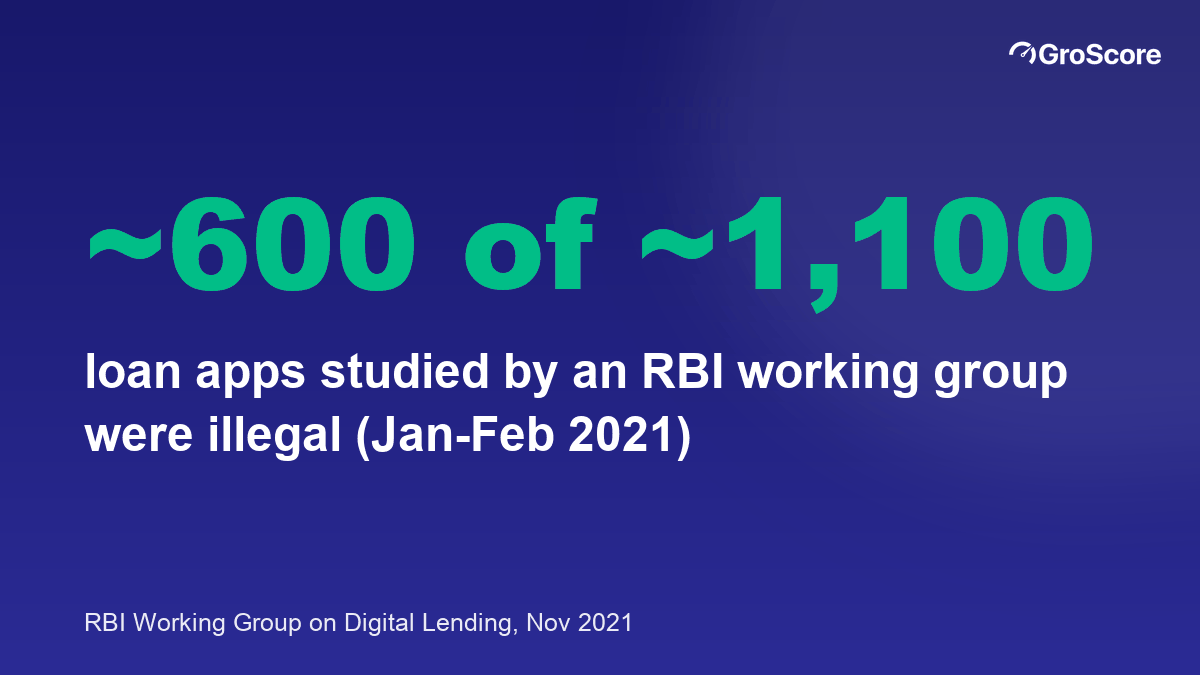
Fast, short loans are where illegal apps cluster, so verify the lender first.
What Are Instant Short Term Loans?
Think of them as personal loans with the timeline squeezed. You borrow a few thousand rupees, or sometimes a lakh or two, and repay in one go or in a handful of instalments. The whole cycle, from application to the money arriving, happens on your phone.
You'll see them sold under different names: quick short term loans, one day loans, cash loan instant, or instant short term loan online. Some lenders, especially informal ones, also offer "day to day loans" repaid in small daily amounts. The name doesn't matter. Who lends and what it costs does.
GroScore is a free credit score app and personal credit coach from Vitrak Technologies (GroMo). It shows your Equifax credit score and full report with a soft check that never affects your score, explains in Hindi or English what is holding the score back, and gives a step-by-step plan to fix it. GroScore is not a lender. It doesn't give, approve or disburse loans, and its number is your Equifax score, not a CIBIL score.
For the basics of eligibility and approval speed, read how instant loans work. This guide is about the short end: what a few weeks of borrowing really costs, and when to say no.
Is an Instant Pay Day Loan Legal in India?
India has no separate "payday loan" product in its rules. When people search for an instant pay day loan or a pay day loan online, they usually land on short-tenure digital loans: a small amount, due on or around your next salary date.
Short-tenure loans are legal if an RBI-regulated bank or NBFC lends the money and follows RBI's rules. The RBI doesn't set a maximum interest rate for NBFC loans. Its Fair Practices Code does require each NBFC's board to adopt an interest rate model, disclose the rate as an annualised figure, and avoid rates that are excessive (RBI).
The risk in many payday-style offers isn't the label. It's who's behind them. Between January and February 2021, an RBI working group found about 1,100 loan apps available to Indian Android users, and roughly 600 of them, about 55%, were illegal (RBI Working Group on Digital Lending, retrieved 2026-10-06). Search terms like "instant loan" and "quick loan" surfaced many of them.
So we don't recommend payday-style borrowing. If you're considering one anyway, confirm the lender first: find its name in the app or loan agreement, then search for it on the RBI's list of registered NBFCs. Our guide explains how to check if a loan app is RBI-registered against the RBI's app directory too.
What Does a 30-Day Loan Really Cost?
Short loans hide their cost in plain sight. A fee of a few hundred rupees feels small. Over a month, it isn't.
Take, for example, an illustrative Rs 15,000 loan for 30 days with Rs 900 in total charges (interest plus fees). That's 6% for one month. Scale it to a year with simple interest (6% × 365 ÷ 30), the kind of annualised figure RBI's Fair Practices Code asks lenders to disclose, and you get about 73%. These figures are indicative, as of October 2026. Actual offers vary by lender, income and credit profile.
Lenders must show you the APR (annual percentage rate) in a Key Fact Statement before you sign. Since 1 October 2024 that applies to every retail loan, and any fee not listed in the KFS can't be charged later without your explicit consent (RBI). Read the APR line, not the "per day" or "flat fee" figure on the ad.
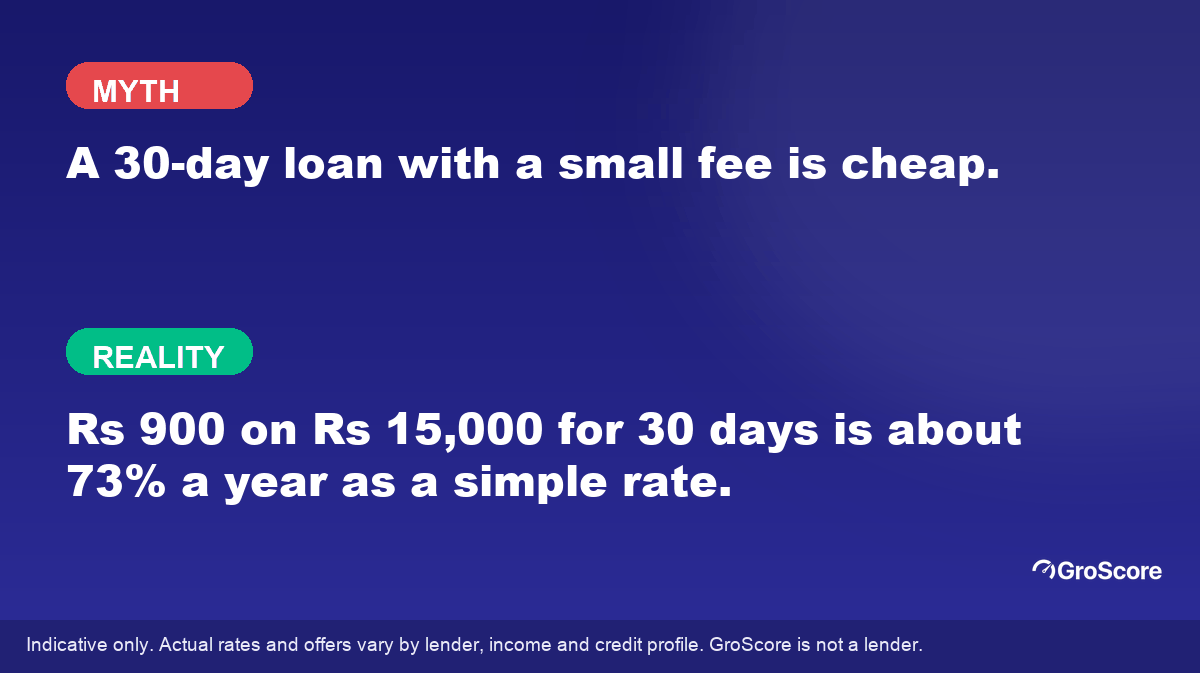
Illustrative example (October 2026): rupees feel small; the annual rate tells the truth.
For a full walk-through of flat rates, fees and APR, see our guide to the real cost of an instant loan.
Why Is Rolling Over a Short Loan So Expensive?
Here's where most people get hurt. A 30-day loan is easy to take. Repaying it in full on day 30 often isn't, so borrowers take a new short loan to clear the old one. Then again the next month.
Let's stay with the illustrative Rs 15,000, as of October 2026. Say you need the money for six months, not one, and keep re-borrowing every 30 days at Rs 900 a time. You'll pay Rs 900 × 6 = Rs 5,400 in charges.
Now compare a six-month instalment loan for the same Rs 15,000 at an illustrative 24% a year. The EMI works out to about Rs 2,678, and total interest to about Rs 1,067. That's Rs 4,333 less for the same money over the same six months (illustrative, as of October 2026).
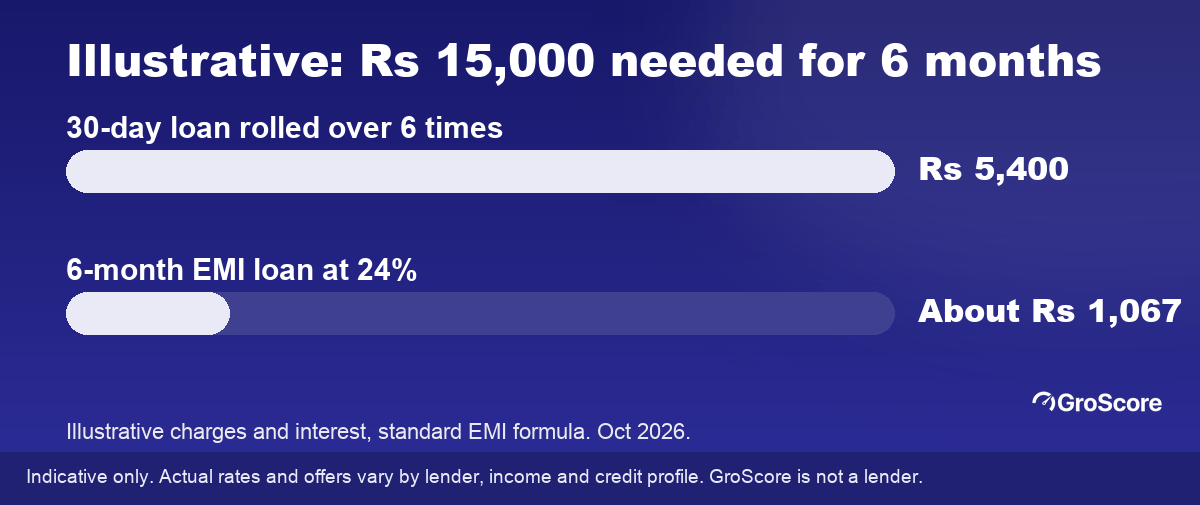
Illustrative example (October 2026): the same need, two very different bills.
Both figures are illustrative, worked out with the standard EMI formula as of October 2026, and ignore any processing fee on the EMI loan. They aren't offers. The lesson holds, though: if your gap will last months, a short loan is the wrong tool.
Do Short-Term Loans Affect Your Credit Score?
Yes, in both directions. A regulated lender pulls your credit report when you apply, which is a hard enquiry. Then it reports the loan to the bureaus.
Repay on time and the loan adds a small positive record. Miss the due date and the late payment shows up as DPD (days past due), which can hurt more than the loan ever helped. Since 1 July 2026, lenders report to credit bureaus weekly, so a missed payment can reach your report within days, according to RBI's amendment directions. Our guide to how late payments affect your credit score explains the damage.
Two more points:
- Late fees can't snowball. Since 1 January 2024, RBI rules allow a penal charge for late payment but not interest on that charge (RBI).
- Five short loans in two months look like credit hunger. Each application adds an enquiry, even when you're approved.
A genuine short loan from a regulated lender shows on your report like any other loan. An illegal app usually can't report to a bureau at all, which is one more reason a loan that never appears on your report deserves suspicion.
What Would a Credit Coach Check First?
Here's an illustrative example. Say Pooja, 30, takes home Rs 32,000 a month and has borrowed Rs 10,000 three months in a row from short-term apps. Arjun, GroScore's credit coach, reads her Equifax report with her and flags three things, in this order:
- Three short loans in 90 days, each repaid with the next. That's the rollover pattern. Stopping it matters more than any score tweak.
- A credit card at 70% of its limit (an indicative figure for this example, as of October 2026). GroScore's guidance is to keep card use under 30% (groscore.in). High use plus repeated short loans tells lenders she's stretched.
- One loan marked 15 days past due. It's accurate, so it can't be removed early. On-time payments from here will slowly outweigh it.
Arjun's suggestion: replace the cycle with one cheaper instalment loan or one of the alternatives below, and build a small buffer before the next due date. If her score becomes the obstacle, a gold loan with a low CIBIL score is often the cheapest asset-backed route. He can't promise Pooja a loan; the lender decides. GroScore can show which lenders' criteria a profile clears, across 100+ loans and credit cards from 60+ banks and NBFCs (groscore.in).
What Are Cheaper Alternatives to Payday Loans?
Before you take a fast short term loan, check these. Costs vary, so compare the APR on each.
| Option | How it works | Watch for |
|---|---|---|
| Salary advance from your employer | Part of next month's pay, early | Terms depend on your employer's policy |
| Loan or overdraft against an FD | You borrow against your own deposit | The FD stays locked until you repay |
| Gold loan | Your gold secures the loan, so score and income count for less | The lender can auction the gold if you default |
| Credit card EMI or interest-free period | Converts a purchase into instalments, or gives you time to pay | Interest is steep if you only pay the minimum |
| Small instalment personal loan | Several months to repay instead of one | Each application adds a hard enquiry |
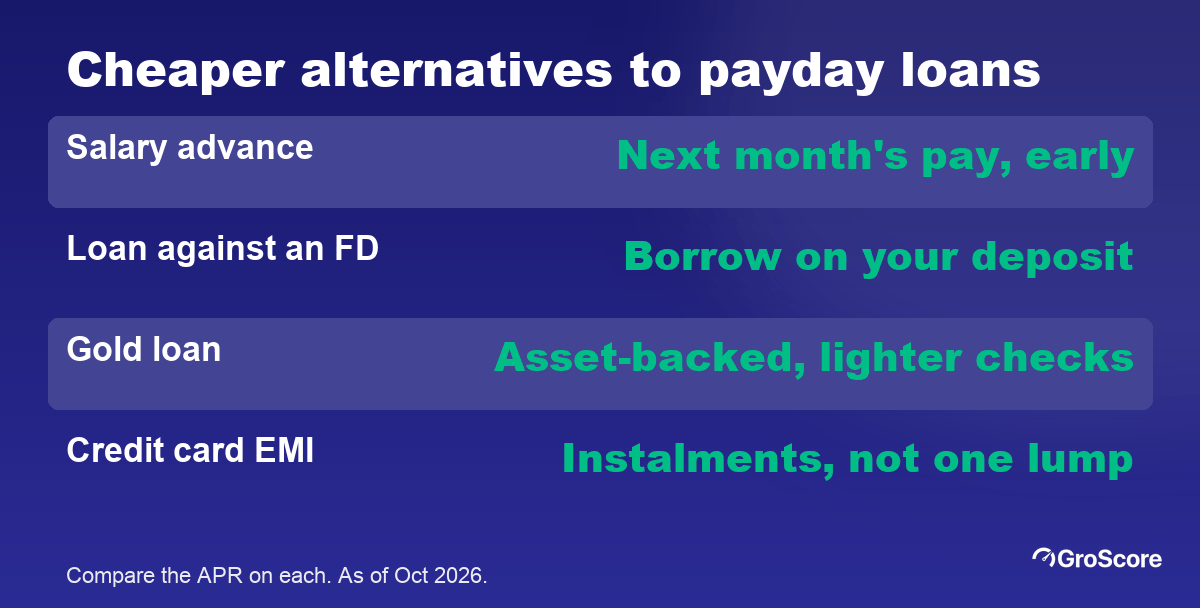
An asset or a longer tenure usually beats a 30-day app loan.
Need a few thousand rupees rather than a few lakh? Our guide to small instant loans compares options for amounts up to Rs 20,000.
Frequently Asked Questions
Are payday loans legal in India?
There's no separate payday loan category in India. Short-tenure loans are legal when an RBI-regulated bank or NBFC lends and gives you a Key Fact Statement. An RBI working group found about 600 illegal apps among roughly 1,100 studied in 2021, about 55%, so verify the lender first.
What is the real interest rate on a 30-day loan?
Work it out from the total charges. For example, in an illustrative case (October 2026), Rs 900 on Rs 15,000 for 30 days is 6% a month, or about 73% a year as a simple annual rate. Under RBI rules, the Key Fact Statement must show the APR, which includes fees.
Do short-term loans affect my credit score?
Yes. Applying adds a hard enquiry, and the lender reports the loan to the bureaus. On-time repayment helps a little; a missed due date shows as DPD and can hurt for years. Lenders now report weekly, so changes appear faster.
What are cheaper alternatives to payday loans?
A salary advance from your employer, a loan against an FD, a gold loan, a credit card EMI or a small personal loan over several months usually costs less. Compare the APR on each and pick the one you can repay without borrowing again.
Can I take a new short-term loan to repay an old one?
You can, but it's the costliest habit in short-term borrowing. For example, in our illustrative case (October 2026), rolling over Rs 15,000 for six months cost Rs 5,400, against about Rs 1,067 of interest on a six-month EMI loan at 24%.
The Bottom Line
Instant short term loans solve a one-time gap of a few weeks, if a regulated lender is behind them and you can repay on the due date. They're the wrong tool for a gap that lasts months, and the rollover habit is where the real cost hides. Check your report, read the APR in the Key Fact Statement, and try an asset-backed or longer-tenure option first.

Disclaimer
This GroScore article is for general education and is not financial advice. GroScore provides credit scores and reports sourced from Equifax, an RBI-licensed credit bureau; scores differ between bureaus and change as lenders report new data. Credit score improvement depends on your individual credit behaviour and bureau reporting timelines, and results are not guaranteed. Loan and card decisions are made by lenders on their own criteria. GroScore is not a lender. Figures and rates shown are indicative.
