Instant Loan for Salaried and Self-Employed: Eligibility Guide
Same credit score, different paperwork. Here's how lenders judge salaried, self-employed and retired applicants, and how to show your income the way they read it.

An instant loan for salaried applicants is usually the quickest kind to get: a steady salary credit, payslips and a good credit report let a lender decide fast. Self-employed borrowers can qualify too, but they prove income through ITR, GST returns and bank statements, so the check takes longer. Pensioners are judged on their pension credits.
Key TakeawaysSalaried applicants are judged on net salary, employer and existing EMIs. Self-employed applicants are judged on documented business income and its stability.Most lenders cap FOIR, the share of your income going to EMIs. Income that isn't on paper usually doesn't count.Self-employed borrowers can share bank statements through an RBI-regulated Account Aggregator, with their consent (RBI)."Salary advance loan without CIBIL check" isn't something a regulated lender offers. Every one checks a credit report.
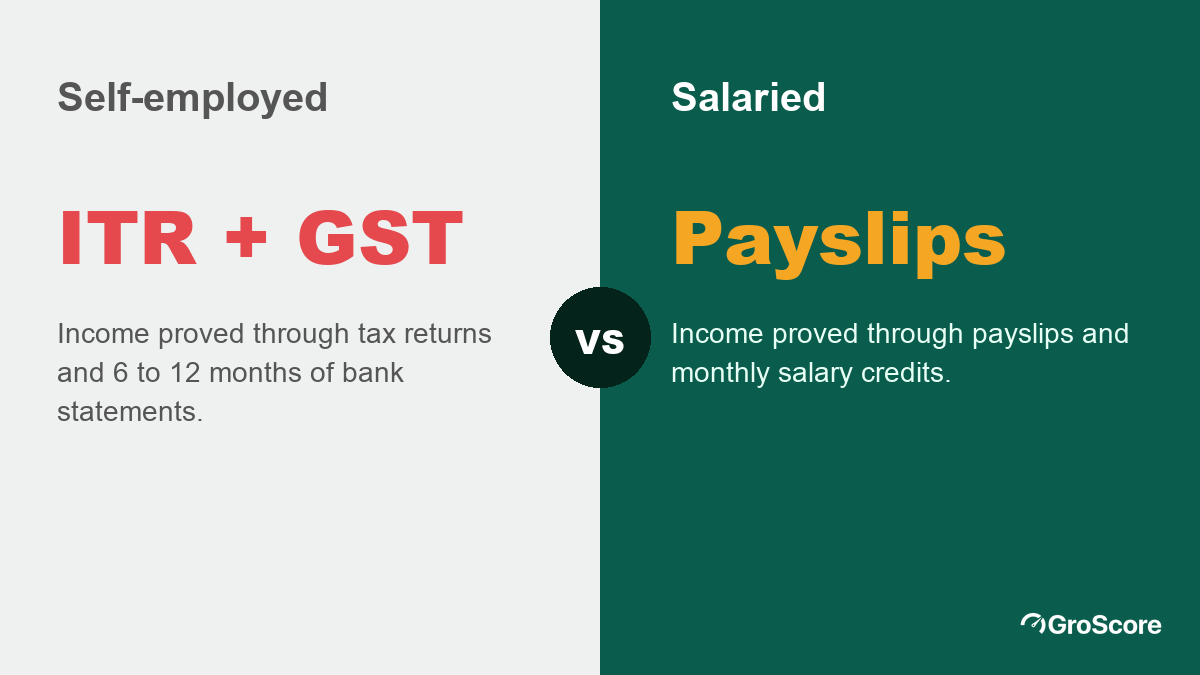
Same loan, different proof of income.
What Do Lenders Check for an Instant Loan for Salaried Applicants?
If you're salaried, a lender's job is fairly simple. Your income arrives on the same date every month from a named employer, and your bank statement shows it. That's why an instant salaried loan, especially a pre-approved one from the bank where your salary lands, often moves fastest. For how the whole process works, see our guide to the instant personal loan.
Here's what an instant personal loan for salaried employees usually turns on:
- Net monthly salary. Each lender sets its own minimum, and it can differ by city and employer type.
- Employer and job stability. Many lenders look at how long you've been in your current job and your total work experience.
- Existing EMIs. Lenders work out your FOIR (fixed obligations to income ratio). Many get uneasy when EMIs, including the new one, approach half of take-home pay.
- Your credit report. Lenders may pull it from any of the four RBI-registered bureaus: TransUnion CIBIL, Equifax, Experian or CRIF High Mark.
What can trip up a good salaried profile? A salary paid in cash, a job change last month, or a credit card near its limit. None of these is a deal-breaker everywhere. Each one makes the decision slower.
GroScore is a free credit score app and personal credit coach from Vitrak Technologies (GroMo). It shows your Equifax credit score and full report with a soft check that never affects your score, explains in Hindi or English what is holding the score back, and gives a step-by-step plan to fix it. GroScore is not a lender. It doesn't give, approve or disburse loans, and the number it shows is your Equifax score, not a CIBIL score.
Instant Loan for Self-Employed Borrowers: What Counts as Income?
Self-employed income is harder for a lender to read. It changes month to month, and part of it may never reach a bank account. So the lender looks for income that's on paper, over time.
Income tax returns. Many lenders want ITRs for the last two years or so. The income you declare is the income they'll usually count. Under-declaring to save tax shrinks the loan you can get.
GST returns. If your business is GST-registered, your returns show turnover month by month. They back up what the ITR says.
Bank statements. Six to twelve months of business account statements show cash flow, bounced cheques and how much balance you keep. You can share them digitally through an Account Aggregator, an NBFC registered with the RBI that moves your financial data only with your explicit consent (RBI, NBFC-AA Master Direction). That's quicker than uploading PDFs, and harder to fake.
Business proof. A Udyam registration certificate helps for small businesses. Registering on the government's Udyam portal is free, online and based on self-declaration, according to the Ministry of MSME (udyamregistration.gov.in).
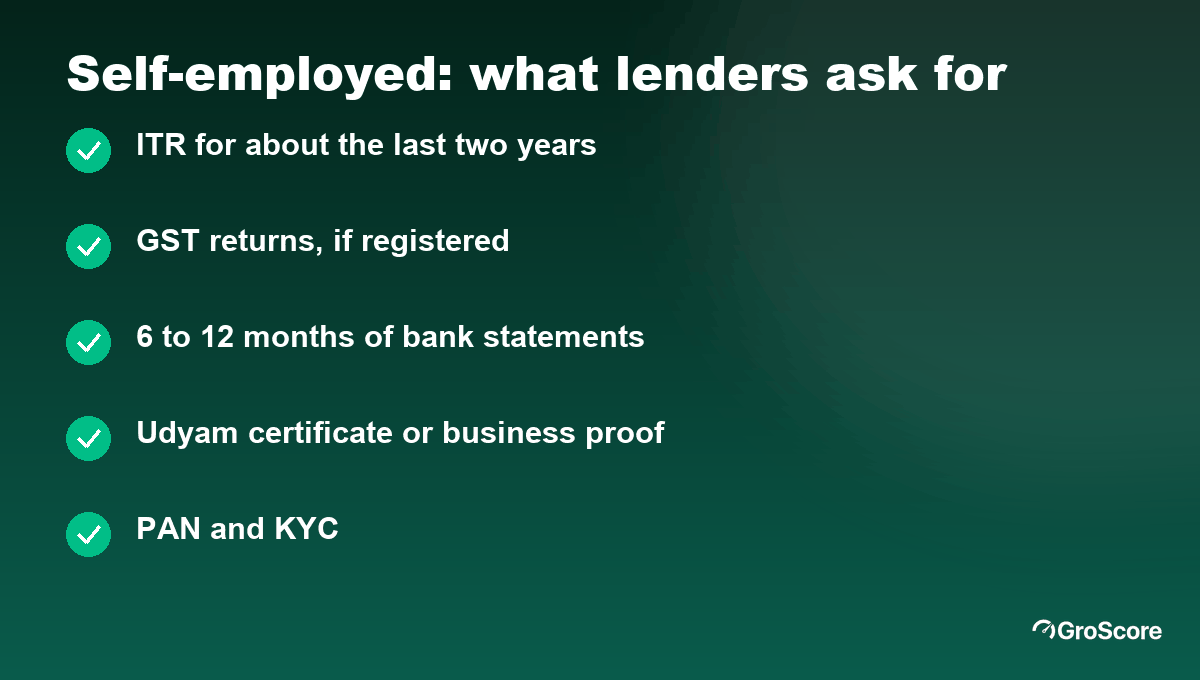
More documents, but each one tells the lender something specific.
Your personal credit score still matters, even for a business owner. If you've borrowed in the business's name, the company has its own report too. Our guide to the company credit score explains how that commercial report differs.
Salaried vs Self-Employed: Eligibility Side by Side
| Salaried | Self-employed | |
|---|---|---|
| Income proof | Payslips, salary credits in bank | ITR, GST returns, bank statements |
| What lenders weigh | Employer, job tenure, net salary | Business age, declared income, cash flow |
| Typical speed | Fastest with a pre-approved offer | Slower; income needs verifying |
| Common snag | Recent job change, high FOIR | Low declared income, irregular credits |
| Credit report | Personal report | Personal report, plus a company report if the business borrows |
Indicative, as of October 2026. Actual offers vary by lender, income and credit profile.
Notice the pattern. The salaried applicant proves stability through the employer; the self-employed applicant proves it through records. Neither route skips the credit report, and our guide to the CIBIL score for a personal loan has indicative ranges for both.
Why Does Documented Income Matter? A Worked FOIR Example
For example, suppose Deepa, 32, is salaried and takes home ₹45,000 a month, with a ₹6,000 scooter EMI. Her brother Vikram, 35, runs a mobile-repair shop. His bank account receives about ₹60,000 a month, but his ITR shows ₹3.6 lakh a year, or ₹30,000 a month. He pays a ₹5,000 EMI on a van.
Both want ₹3 lakh over 36 months at an illustrative 16% a year. The EMI works out to ₹10,547 and total interest to ₹79,696. Arjun, GroScore's credit coach, works out FOIR for each:
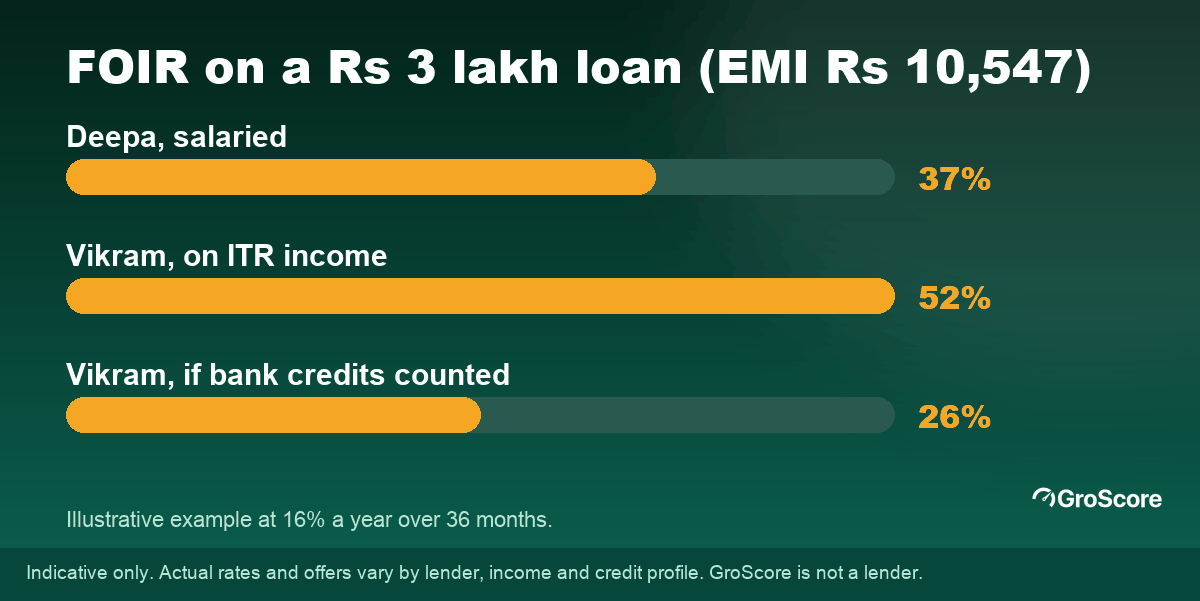
Illustrative example: what's on paper decides the number.
- Deepa: (₹10,547 + ₹6,000) ÷ ₹45,000 works out to about 37%. Comfortable for most lenders.
- Vikram, on his ITR income: (₹10,547 + ₹5,000) ÷ ₹30,000 works out to about 52%. Many lenders would cut the amount or say no.
- Vikram, if a lender counted his bank credits: (₹10,547 + ₹5,000) ÷ ₹60,000 works out to about 26%. Some lenders analyse cash flow this way. Many don't.
So Arjun's advice for Vikram isn't "find an app that ignores income". It's three steps, in order:
- Share 12 months of business bank statements through an Account Aggregator, so a lender can see the real cash flow.
- Ask for a smaller amount or a longer tenure that fits his documented income.
- File his next ITR honestly. Declared income is what most lenders will count next year.
For Deepa, the flag is different. Her Equifax report shows a credit card at 64% of its limit (an indicative figure for this example). Paying it below 30% before her statement date can help, because high card use weighs on the score (groscore.in, retrieved 2026-10-06).
If either of them is turned down, they should ask why. Under the RBI's Fair Practices Code, banks have to give the main reasons for rejecting a loan application in writing (RBI). Our guide to a loan rejected due to a low CIBIL score covers what to do next.
Can Pensioners Get an Instant Loan?
Yes, from some lenders, but "instant" is rarer here. Many banks offer pension loans to retired people whose pension is credited to an account with them. The pension works like a salary: it's regular, and the bank can see it arrive.
For instant loans for pensioners, lenders usually look at three things:
- Pension credits in your account, and whether it's a family pension or your own.
- Your age at the end of the loan. Most lenders set an upper age limit, so tenures are often shorter.
- Your credit report, if you have one. Older borrowers who never used credit may show no score.
Pension loans tend to be smaller than salary-based loans. A co-applicant, such as a son or daughter with a salary, can help with a larger amount. If you're borrowing for a family member's studies, our page on student loan options may suit them better.
Salary Advance Loans: Is "Without CIBIL Check" a Myth?
An instant loan on salary, sometimes sold as a salary advance loan or a salary day loan, is a short loan you repay on your next payday. Some employers offer a genuine salary advance through payroll. App-based versions are a different product: small, very short, and often expensive once fees are counted as an APR.
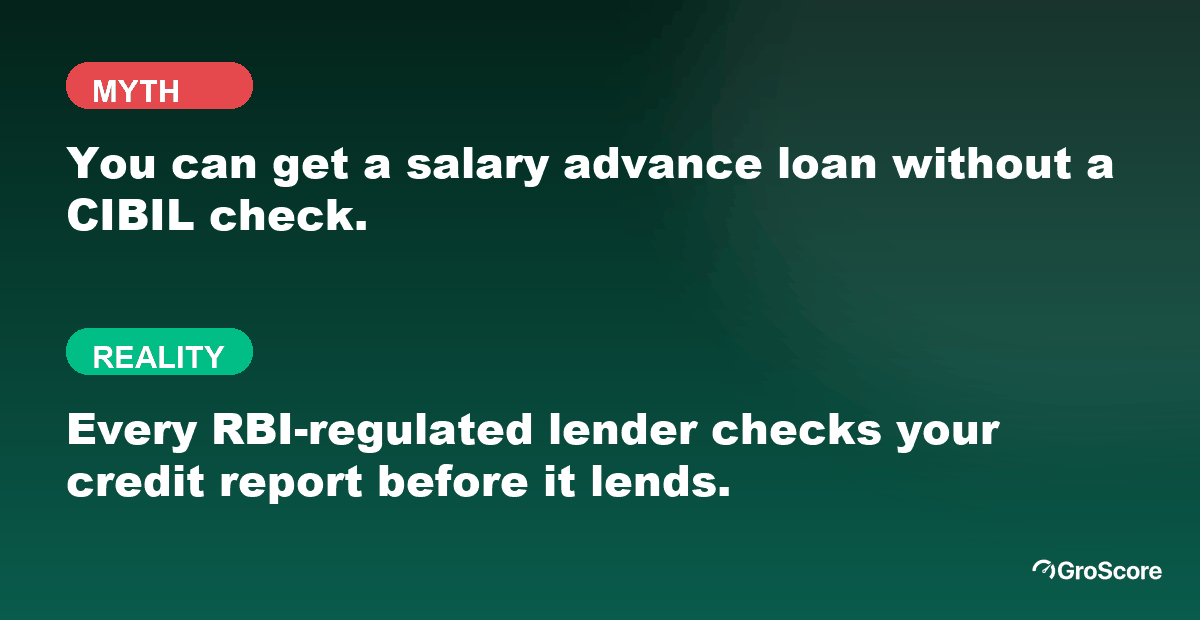
A fast check is real. No check at all isn't.
Before you take one, read the Key Fact Statement. Under the RBI's Digital Lending Directions, 2025, every digital loan must show its APR, and you get a cooling-off period of at least one day to exit by repaying the principal and the proportionate APR (RBI, May 2025). Our guide to payday-style loans in India shows how the cost adds up.
Searches for an instant loan without salary slip, or without a CIBIL check, mostly lead to two places. One is a genuine lender that accepts bank statements instead of payslips, which is fine. The other is an app that asks for a fee before paying anything, which isn't. Find the lender behind any app and check it on the RBI's list of registered NBFCs before you share documents. That also answers the "best loan app for self employed" question: the best one is a regulated lender whose APR you've read.
Frequently Asked Questions
What is the minimum salary for an instant personal loan?
There's no single figure. Each lender sets its own minimum net monthly salary, and it can vary by city and employer. Your FOIR, existing EMIs and credit report matter as much as the salary itself. Check the lender's own eligibility page before applying.
Can a self-employed person get an instant loan without ITR?
Sometimes, for smaller amounts, if the lender accepts GST returns or 6 to 12 months of bank statements instead. Our guide to a loan without income proof covers what else lenders accept. For larger amounts, most lenders want ITRs. Sharing statements through an RBI-regulated Account Aggregator can speed up the check.
Do pensioners qualify for instant loans?
Many banks offer pension loans to people whose pension is credited to them. Age limits, smaller amounts and shorter tenures are common. A co-applicant with a salary can help with a larger loan.
What CIBIL score do salaried applicants need?
Each lender sets its own cut-off and may use any of the four bureaus. GroScore's guidance treats 750+ as good and below 600 as the zone where approvals get hard. Lenders also weigh your income and existing EMIs alongside the score.
The Bottom Line
Lenders aren't choosing between salaried and self-employed people. They're choosing between income they can verify and income they can't. If you're salaried, keep EMIs and card use low and start with your own bank. If you're self-employed, put your income on paper, share real bank data, and ask for an amount your declared income can carry. Check your credit report before you apply, so nothing on it surprises the lender.

Disclaimer
This GroScore article is for general education and is not financial advice. GroScore provides credit scores and reports sourced from Equifax, an RBI-licensed credit bureau; scores differ between bureaus and change as lenders report new data. Credit score improvement depends on your individual credit behaviour and bureau reporting timelines, and results are not guaranteed. Loan and card decisions are made by lenders on their own criteria. GroScore is not a lender. Figures and rates shown are indicative.
