Instant Loan: How Instant Personal Loans Work in India
Fast decisions are real. Guaranteed approval isn't. Here's how instant personal loans work, what they really cost, and how to check who's lending.

An instant loan is a small, unsecured personal loan that a bank, NBFC or lending app approves online, often within minutes, and pays straight into your bank account. The decision is fast because software reads your credit report, income and KYC. Approval still isn't guaranteed, and the real cost is the APR, not the headline rate.
Key Takeaways"Instant" usually describes the decision. KYC checks and disbursal can still take hours or a working day.Every RBI-regulated lender checks a credit report. Offers of approval for everyone, with no check, are a scam warning (RBI).Compare the annual percentage rate (APR) in the Key Fact Statement. It includes the processing fee; the headline rate doesn't.Before you apply, confirm the lender on the RBI's NBFC list or its directory of digital lending apps.
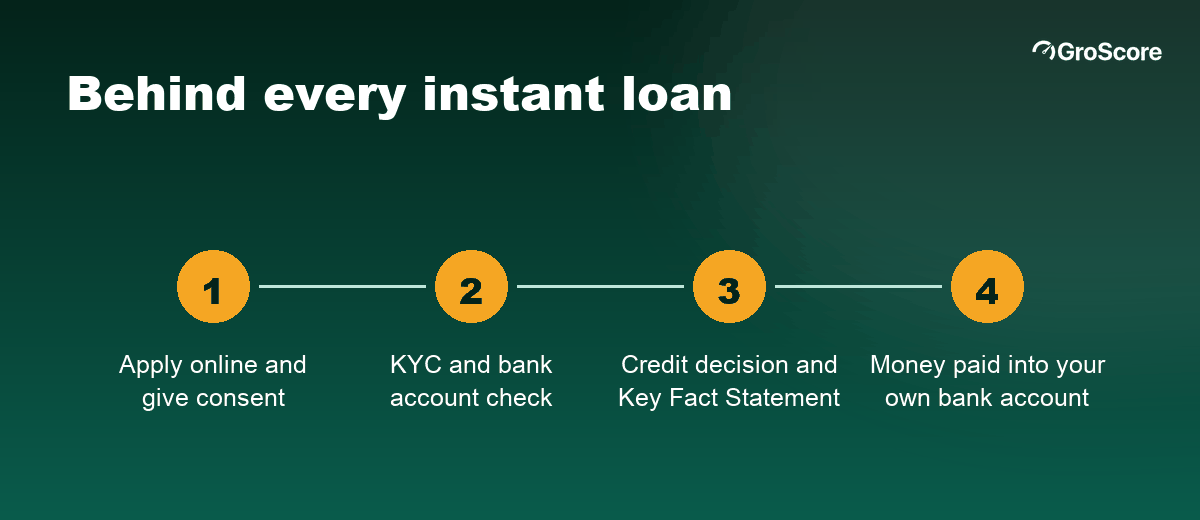
Four steps sit behind every "instant" loan, and only one of them is truly instant.
What Is an Instant Loan and How Does It Work?
Picture an ordinary personal loan with the paperwork moved onto your phone. You fill in a form, verify your KYC, and consent to the lender pulling your credit report and, often, your bank statements. A rules engine then decides in minutes instead of days.
Most instant personal loans are small and short: thousands or a few lakhs, repaid over months rather than decades. They're unsecured, so no gold, property or deposit backs them. Your credit report carries most of the weight as a result. New to scores? Start with what a credit score is and how lenders read it.
You'll meet four kinds of fast loans online:
| Type | Who lends | Usually | Watch for |
|---|---|---|---|
| Pre-approved offer | Your own bank or NBFC | Quickest, fewest documents | Offers can be withdrawn after a fresh check |
| Fresh application | A bank or NBFC, on its own app or site | Full KYC and credit check | Each application adds a hard enquiry |
| Digital lending app | An RBI-regulated bank or NBFC behind the app | Fast, small-ticket loans | Apps that don't name the real lender |
| Loan against gold or an FD | A bank or NBFC, against your asset | Lighter on your score, often cheaper | Losing the pledged asset if you default |
The third kind is where most of the confusion, and most of the fraud, lives. More on that below.
GroScore is a free credit score app and personal credit coach from Vitrak Technologies (GroMo). It shows your Equifax credit score and full report with a soft check that never affects your score, explains in Hindi or English what is holding the score back, and gives a step-by-step plan to fix it. GroScore is not a lender. It doesn't give, approve or disburse loans, and the number it shows is your Equifax score, not a CIBIL score.
So read this as a coach's guide, not a sales page. We don't name or rank lenders here.
How Fast Is an Instant Personal Loan, Really?
An instant loan is faster than a branch loan. It's also slower than the ads suggest.
Here's what usually happens. The credit decision can come back within minutes if your KYC is already on file and your report is clean. Video KYC, a bank-account check or an auto-debit mandate can add time. Disbursal then depends on the lender's process and banking hours. A pre-approved offer from your own bank tends to be the quickest, because most checks happened before you asked.
No regulated lender can promise you money in five minutes. It can't know your result before it checks. For what "instant" covers and what it doesn't, read our guide to instant loan approval.
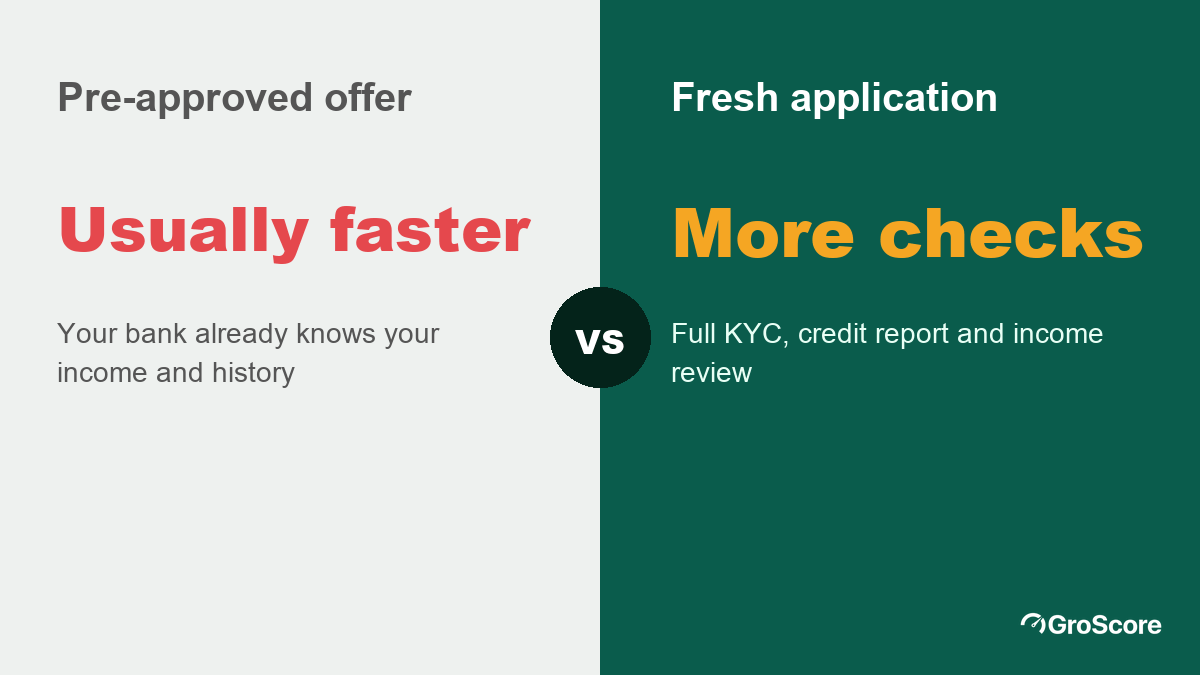
Speed depends on how much the lender already knows about you.
Instant Loan Eligibility: What Lenders Check
Lenders don't publish a single formula. Four things decide most applications.
Your credit report. Lenders pull it from one or more of the four RBI-registered bureaus: TransUnion CIBIL, Equifax, Experian and CRIF High Mark. Banks usually want a stronger score than NBFCs. GroScore's guidance treats 750+ as good and below 600 as the zone where approvals get hard (groscore.in).
Your income. Salary credits, ITR or bank statements show you can carry an EMI. Self-employed and gig workers face more questions here.
Existing EMIs. Lenders look at FOIR (fixed obligations to income ratio), the share of your monthly income already going to EMIs. A high FOIR can sink an application even with a good score.
KYC. PAN, Aadhaar-based verification or a video call, plus a bank account in your name.
Documents for an instant money loan are usually light: PAN, Aadhaar, recent bank statements and, for salaried applicants, payslips. Can't show regular income? That's a separate problem with different answers, covered in our guide to a loan without income proof.
What Does an Instant Loan Actually Cost?
Two loans with similar EMIs can cost very different amounts. The processing fee is the usual culprit.
Under RBI rules, lenders must give you a Key Fact Statement (KFS) before you sign. It shows the APR, the all-in yearly cost including fees, plus every charge you might pay. In the example below, a 3% fee turns a 24% rate into an APR of about 31% (RBI KFS rules, illustrative figures).
Take, for example, an illustrative ₹50,000 instant personal loan over 12 months, with 18% GST on the processing fee:
- Offer A: 16% a year, 1% fee. The EMI works out to ₹4,537 and interest to ₹4,439. The fee plus GST, ₹590, comes off upfront, so ₹49,410 reaches you. The total cost is ₹5,029, an APR of about 18%.
- Offer B: 24% a year, 3% fee. The EMI works out to ₹4,728 and interest to ₹6,736. Fee plus GST is ₹1,770, so ₹48,230 reaches you. The total cost is ₹8,506, an APR of about 31%.
Offer B costs ₹3,477 more for the same ₹50,000. We worked these out with the standard EMI formula, treating APR as the yearly rate on the money you actually receive, as of October 2026. They're indicative, not offers. Actual offers vary by lender, income and credit profile.
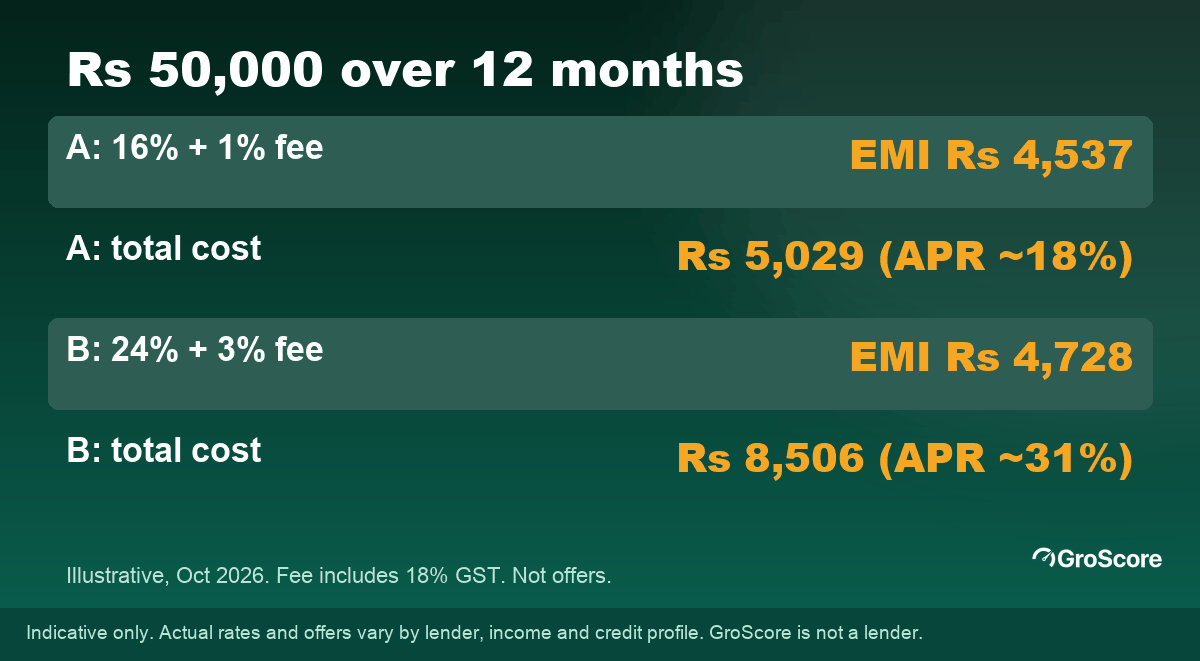
Illustrative example: the fee pushes the APR well above the headline rate.
Late-payment charges and bundled insurance can add more. For a fuller walk-through, see the real cost of an instant loan.
Digital loans also come with a cooling-off period, stated in the KFS. During it you can exit by repaying the principal and the proportionate APR, with no prepayment penalty (RBI).
Is the Loan App Genuine? How to Verify the Lender
A loan app isn't always the lender. Often it's a front end that sources loans for a bank or NBFC, and it must tell you which one. That lender is who you owe, and who answers to the RBI.
Run two checks before you share a single document:
- Find the lender's name in the app, the loan agreement or the KFS. Then search for it on the RBI's list of registered NBFCs. Banks are licensed separately, and the RBI website lists them too.
- Check the app itself in the RBI's directory of digital lending apps, live on the RBI website since July 2025 under Citizen's Corner. Lenders submit these details themselves, so match the app name, the lender and the developer.
Then watch for the red flags:
- The app asks for an upfront fee for "file charges" or "insurance" before any loan arrives, often to a personal UPI ID.
- No lender is named, or the name doesn't appear on the RBI's lists.
- The app wants your contacts, photos or call logs, which RBI rules bar lending apps from collecting.
- The ad claims guaranteed approval or "no credit check", which no regulated lender can honestly promise.
- The money arrives from someone else's account instead of the lender's.
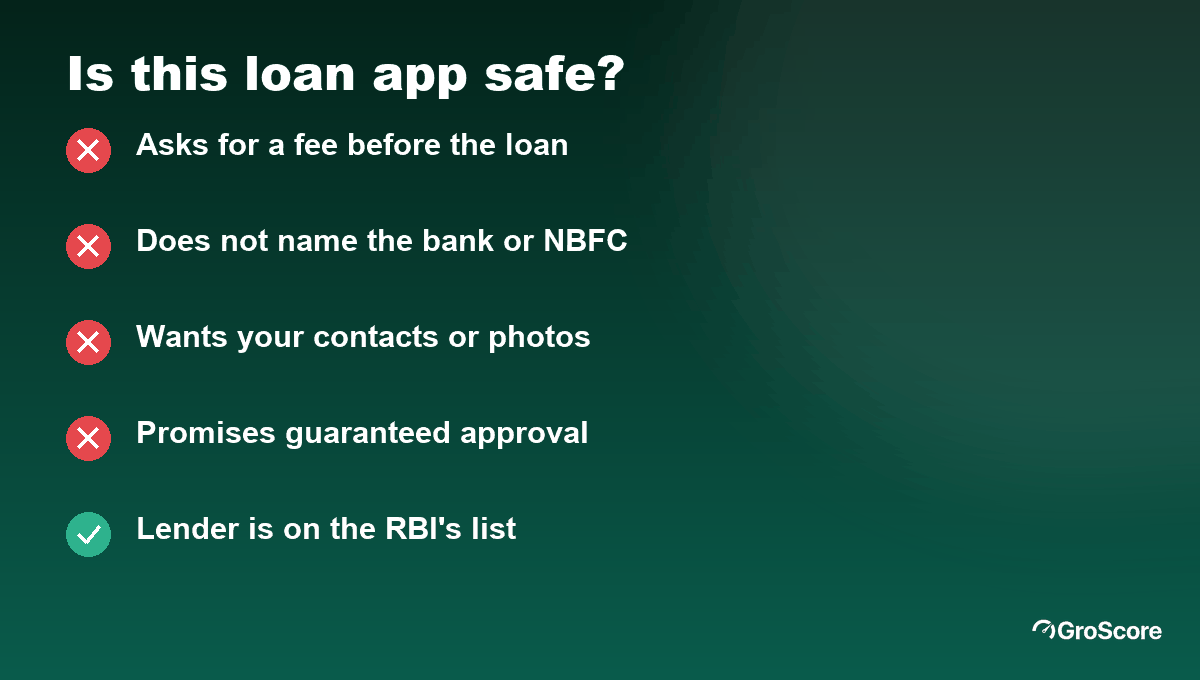
One red flag is enough to stop.
Under RBI's digital lending rules, the loan must go from the lender straight into your bank account. Already paid a "fee" and got nothing? Stop paying. Keep the screenshots. Report the app on the RBI's Sachet portal, call the national cybercrime helpline on 1930, and file at cybercrime.gov.in. If a regulated lender doesn't resolve your complaint, escalate to the RBI's Complaint Management System. Our guide on how to check if a loan app is RBI-registered covers each step.
What Would a Credit Coach Check Before You Apply?
Here's an illustrative example: suppose Imran, 31, needs ₹60,000 for a family wedding in three weeks. His Equifax score is 702. Arjun, GroScore's credit coach, reads the report with him and flags three things, in this order:
- Four loan-app enquiries in the past month. Each was a hard enquiry, and another round would signal credit hunger. Advice: stop applying, and pick one regulated lender.
- A credit card at 68% of its limit (an indicative figure for this example). GroScore's guidance is to keep card use under 30% (groscore.in, retrieved 2026-10-05). Paying it down before the statement date is in his control.
- A small consumer loan shown as open that he closed last year. If the lender didn't report the closure, that's an error he can dispute.
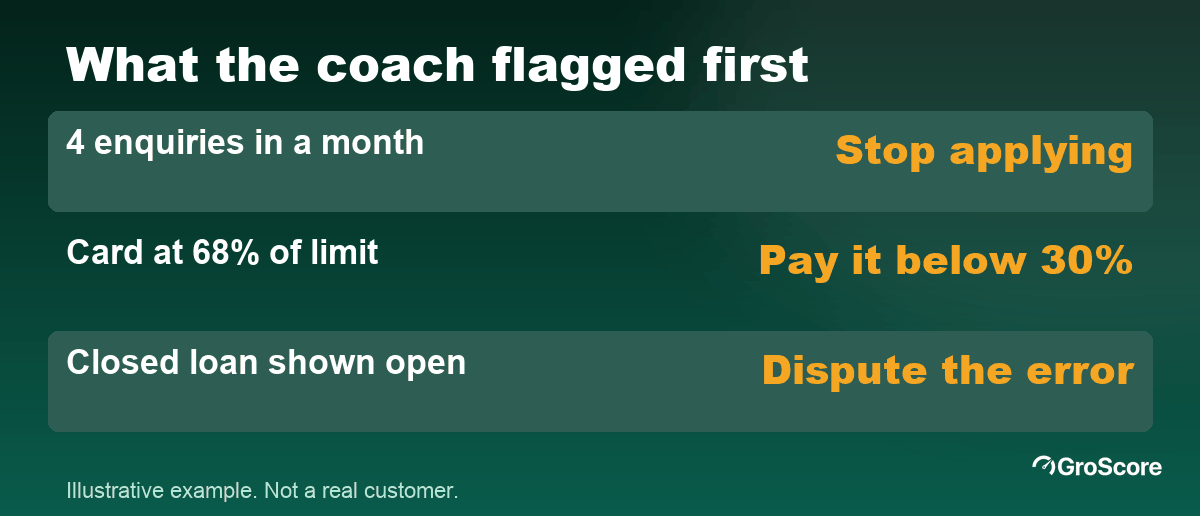
Illustrative example: fix the report before the next application.
Arjun doesn't promise Imran a loan, because the lender decides. Checking your own score is a soft enquiry and never lowers it; a lender's check is a hard one. Our hard vs soft enquiry guide explains the difference.
GroScore can show which lenders' criteria a profile clears, across 100+ loans and credit cards from 60+ banks and NBFCs (groscore.in). Lenders still run their own checks.
Frequently Asked Questions
How fast can I get an instant personal loan?
The credit decision can take minutes when your KYC and report are in order. Money usually follows within hours to a working day, depending on the lender, your bank and any extra checks. Pre-approved offers from your own bank tend to be fastest.
What CIBIL score do I need for an instant loan?
There's no single cut-off; each lender sets its own and may check any of the four bureaus. Banks usually expect higher scores than NBFCs. GroScore's guidance treats 750+ as good, and below 600 is where approvals get hard. Our page on the CIBIL score for a personal loan has indicative ranges.
What documents are required for an instant loan?
You'll usually need PAN, Aadhaar-based KYC, a bank account in your name and recent bank statements. Salaried applicants may be asked for payslips; self-employed applicants for ITR or GST returns. A lender may ask for more if something doesn't match.
What is the interest rate on instant loans?
Rates vary widely by lender, amount and credit profile, so compare the APR in the Key Fact Statement, not the headline rate. For example, in our illustrative ₹50,000 case, a 3% fee turned a 24% rate into an APR of about 31%.
How do I know an instant loan app is genuine?
Find the bank or NBFC behind it, check that name on the RBI's NBFC list, and look for the app in the RBI's directory of digital lending apps. Walk away from upfront fees, contact access requests and approval guarantees.
Does GroScore give instant loans?
No. GroScore is not a lender and doesn't give, approve or disburse loans. It shows your free Equifax score and report, explains what's holding it back, and shows which lenders' criteria your profile clears. The lender makes the decision.
The Bottom Line
An instant loan can be a useful bridge for a real, short-term need. Speed is the selling point, though, and speed is exactly what scammers fake. Check your own report first, apply once to a lender you've verified, and compare APRs, not headline rates. If you can wait a few weeks, fixing an error or a maxed-out card may get you a cheaper offer. Still choosing where to borrow? Our comparison of a bank vs NBFC vs loan app walks through the trade-offs.
Disclaimer
This GroScore article is for general education and is not financial advice. GroScore provides credit scores and reports sourced from Equifax, an RBI-licensed credit bureau; scores differ between bureaus and change as lenders report new data. Credit score improvement depends on your individual credit behaviour and bureau reporting timelines, and results are not guaranteed. Loan and card decisions are made by lenders on their own criteria. GroScore is not a lender. Figures and rates shown are indicative.
