Instant Bank Loan vs NBFC vs Loan App: Which Is Safer?
Banks, NBFCs and loan apps can all be safe. The difference is who actually lends you the money, and you can check that in five minutes.

An instant bank loan is usually the safest and cheapest option, because banks are licensed and closely supervised by the RBI. An NBFC loan is just as legal if the NBFC is registered with the RBI. A loan app is not a lender at all. It's safe only when it names an RBI-regulated bank or NBFC as the lender, and you can confirm that on the RBI website before you share a single document.
Key TakeawaysBanks hold an RBI licence and NBFCs hold an RBI certificate of registration. Both are regulated lenders (RBI).A loan app is a front end. The real lender must be a bank or NBFC, and RBI rules require the app to tell you which one.Since July 2025, the RBI website lists the digital lending apps that regulated lenders have reported to it (RBI).Compare offers on the APR in the Key Fact Statement, not the headline rate.
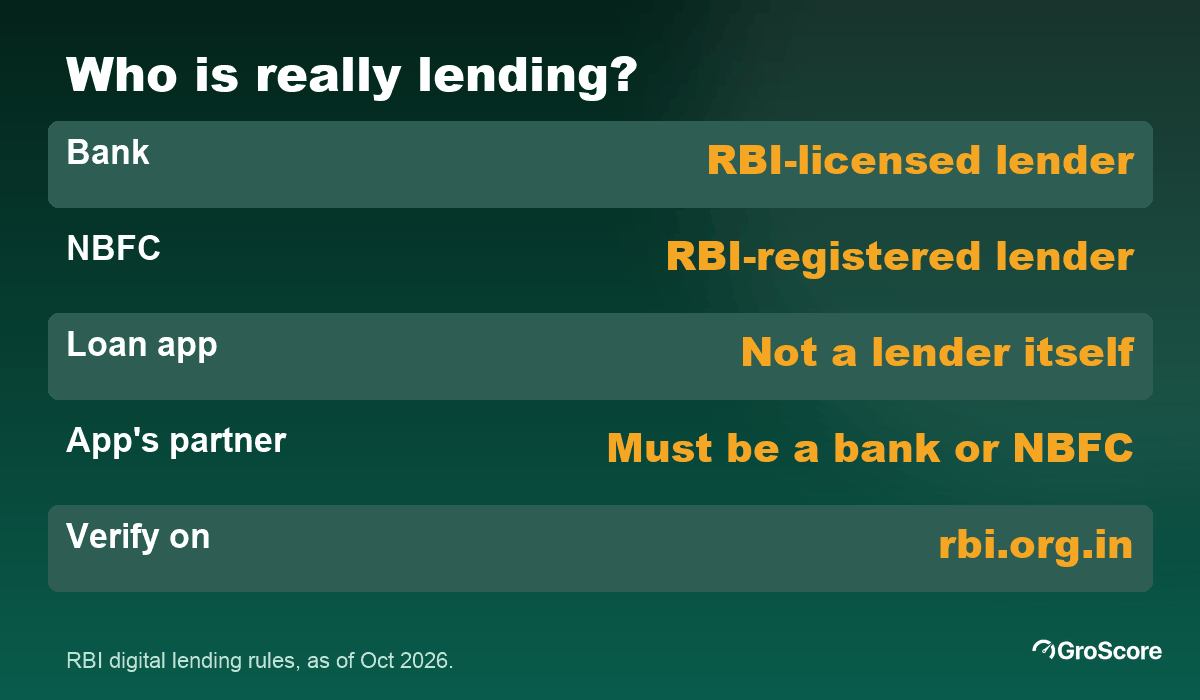
Three routes to the same money. Only the first two are lenders.
How Do Banks, NBFCs and Loan Apps Differ?
Banks, NBFCs and apps differ in one thing that matters more than speed: who carries the legal responsibility for your loan. Speed gets the headlines, and if that's your main worry, here's how instant loan approval actually works.
A quick word on who's writing this. GroScore is a free credit score app and personal credit coach from Vitrak Technologies (GroMo). It shows your Equifax credit score and full report with a soft check, and explains what is holding the score back. GroScore is not a lender and not a credit bureau. It doesn't give, approve or disburse loans, and the score it shows is your Equifax score, not a CIBIL score.
A bank is licensed by the RBI under the Banking Regulation Act, 1949. It takes deposits, lends, and faces the tightest supervision in the system.
An NBFC (non-banking financial company) lends but usually can't offer you a savings account. It must hold a certificate of registration from the RBI. Many NBFCs specialise in personal loans, gold loans or small-ticket credit, and they often approve profiles a bank would turn down.
A loan app is software. In RBI language it's a digital lending app, run either by the lender itself or by a lending service provider (LSP), a company the lender hires to find and onboard borrowers. The LSP isn't the lender. The bank or NBFC behind it is, and that regulated entity stays responsible for how the app treats you.
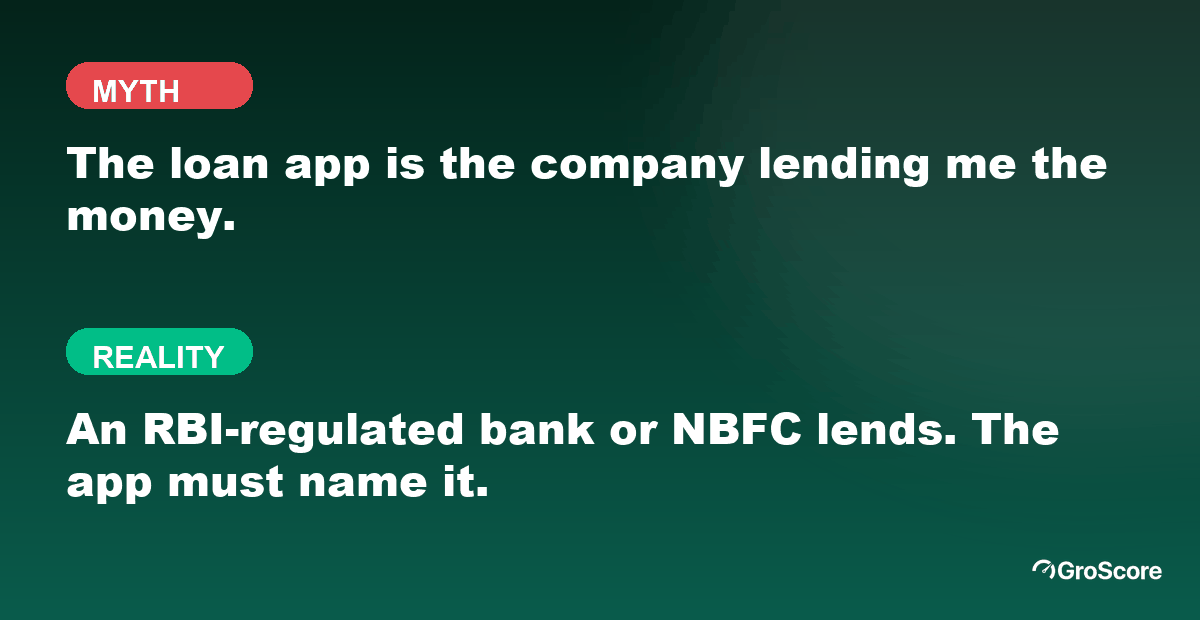
The logo on your phone is rarely the name on your loan agreement.
| Bank | NBFC | Loan app | |
|---|---|---|---|
| Who lends | The bank | The NBFC | A bank or NBFC behind the app |
| RBI status | Licensed bank | Registered NBFC | Not a lender; its partner must be RBI-regulated |
| How to verify | Bank's own site and app | RBI's NBFC list | App names its lender; check RBI's app directory |
| Usually suits | Existing customers, good scores | Fair scores, faster decisions | Convenience, small amounts |
| Watch for | Slower for new customers | Higher rates and fees | Apps that name no lender at all |
Indicative comparison as of October 2026. Actual offers vary by lender, income and credit profile.
So "bank vs NBFC vs app" is the wrong question. Ask which regulated lender is on the other side, and whether you can prove it. If you're new to how these loans work end to end, start with our guide to the instant personal loan.
Instant Loan From Bank: Do Banks Give Instant Personal Loans?
Yes, mostly to people they already know. Your bank sees your salary credits and balances, so it can offer a pre-approved instant personal loan through net banking or its app, sometimes paid the same day.
New customers wait longer. Without your account history, the bank needs documents and a full credit report review, so "instant" can stretch to days. An instant loan from bank sources is usually cheaper, but speed depends on your relationship with that bank.
Two things to check before you tap "accept" on a pre-approved offer:
- The Key Fact Statement (KFS), which shows the APR and every fee. The RBI has required a KFS for all new retail and MSME term loans sanctioned on or after 1 October 2024 (RBI circular, 15 April 2024).
- Whether you actually need the full amount. A pre-approved limit is an invitation, not a recommendation.
Your score still counts. Pre-approved offers are built from your credit report, and a weak or thin file narrows them. Our guide to the CIBIL score for a personal loan shows how lenders read each score band.
NBFC Instant Loan: Is an NBFC Loan Safe?
An NBFC loan is safe when the NBFC is registered with the RBI. Registered NBFCs follow RBI rules on fair practices, recovery conduct, grievance handling and credit reporting. They aren't a grey market.
Where NBFCs differ is price and appetite. They'll often consider a fair score or a short credit history, and they decide fast. In return, an instant personal loan NBFC offer usually carries a higher rate and a bigger processing fee than a bank would charge the same borrower. If you're self-employed and short on paperwork, an NBFC is often where you'll end up, so check what's realistic for an instant personal loan without income proof before you apply.
Checking an NBFC takes about two minutes. Search its exact registered name on the RBI's list of registered NBFCs. The name in your loan agreement should match a name on that list. A brand name on a billboard may not.
What if the NBFC isn't listed? Don't borrow. An unregistered lender sits outside the RBI's complaint system altogether.
Who Is the Actual Lender When You Borrow Through an App?
Most borrowers skip this question, yet it decides whether you're protected.
Under RBI's digital lending rules, an app working for a lender has to disclose the names of the banks or NBFCs it lends for. If it shows offers from several lenders, it has to show each lender's name with the loan amount, tenure and APR. Your money must be paid straight into your bank account by the regulated lender, and your EMIs must go straight to the lender's account, not to a pool account held by the app.
Here's how to find the real lender in five minutes:
- Read the app's "lending partners" page. A genuine app names its bank or NBFC partners on the app and its website.
- Check the RBI's directory of digital lending apps. On rbi.org.in, go to Citizen's Corner and open "DLAs deployed by Regulated Entities". Search for the app and see which bank or NBFC reported it.
- Confirm the lender itself. For an NBFC, use the RBI's NBFC list. For a bank, it's licensed already.
- Read the KFS. The lender's name, the APR and the cooling-off period should all be on it before you sign.
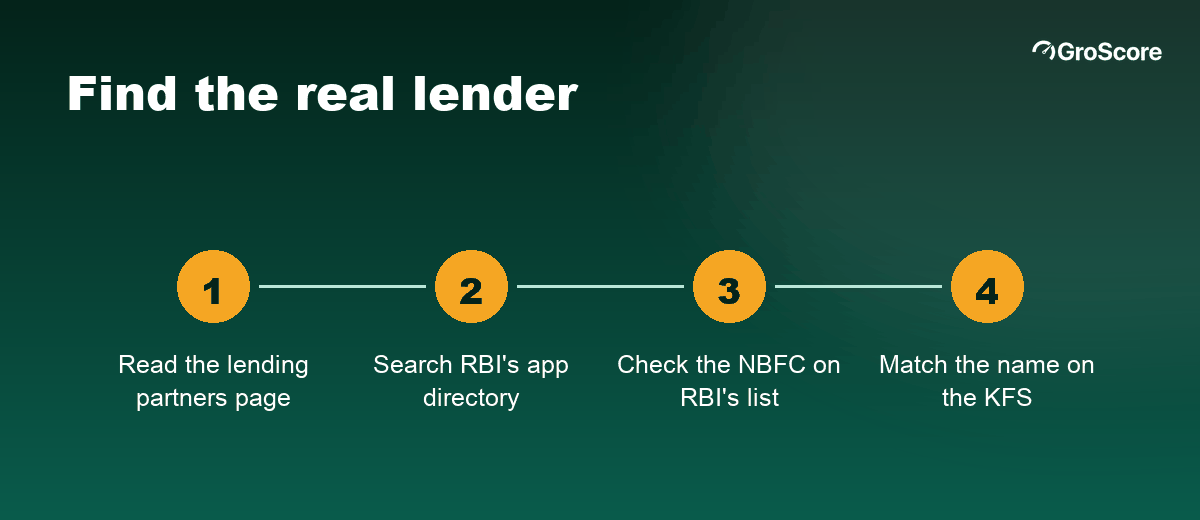
If any step fails, stop there.
One limit matters. The RBI says its app directory is built from what lenders report, on an as-is basis, without further checks by the RBI (RBI press release, 8 May 2025). So the directory tells you an app is linked to a regulated lender. It doesn't vouch for the price. If the app isn't in the directory at all, treat that as a red flag and read our guide to check if a loan app is RBI-registered.
Which Is Cheaper, a Bank or an NBFC?
Usually the bank, for the same borrower. But the headline rate hides part of the cost. Processing fees, 18% GST on those fees (the rate as of 2026) and bundled insurance all land on top. The APR in the KFS, the all-in yearly cost that RBI rules require lenders to show, is the only fair way to compare.
For example, take two illustrative offers on a Rs 2 lakh loan, repaid over 24 months, with the arithmetic shown:
| Offer A (bank) | Offer B (NBFC) | |
|---|---|---|
| Interest rate (reducing) | 12% a year | 18% a year |
| Processing fee | 1% + 18% GST = Rs 2,360 | 3% + 18% GST = Rs 7,080 |
| EMI | Rs 9,415 | Rs 9,985 |
| Total interest over 24 months | Rs 25,953 | Rs 39,636 |
| Interest + fee | Rs 28,313 | Rs 46,716 |
| Approximate APR | about 13.2% | about 21.8% |
Illustrative figures as of October 2026, worked out with the standard EMI formula. APR here is the yearly rate that matches the cash you actually receive (loan minus fee) to the EMIs you pay. These aren't offers. Actual offers vary by lender, income and credit profile.
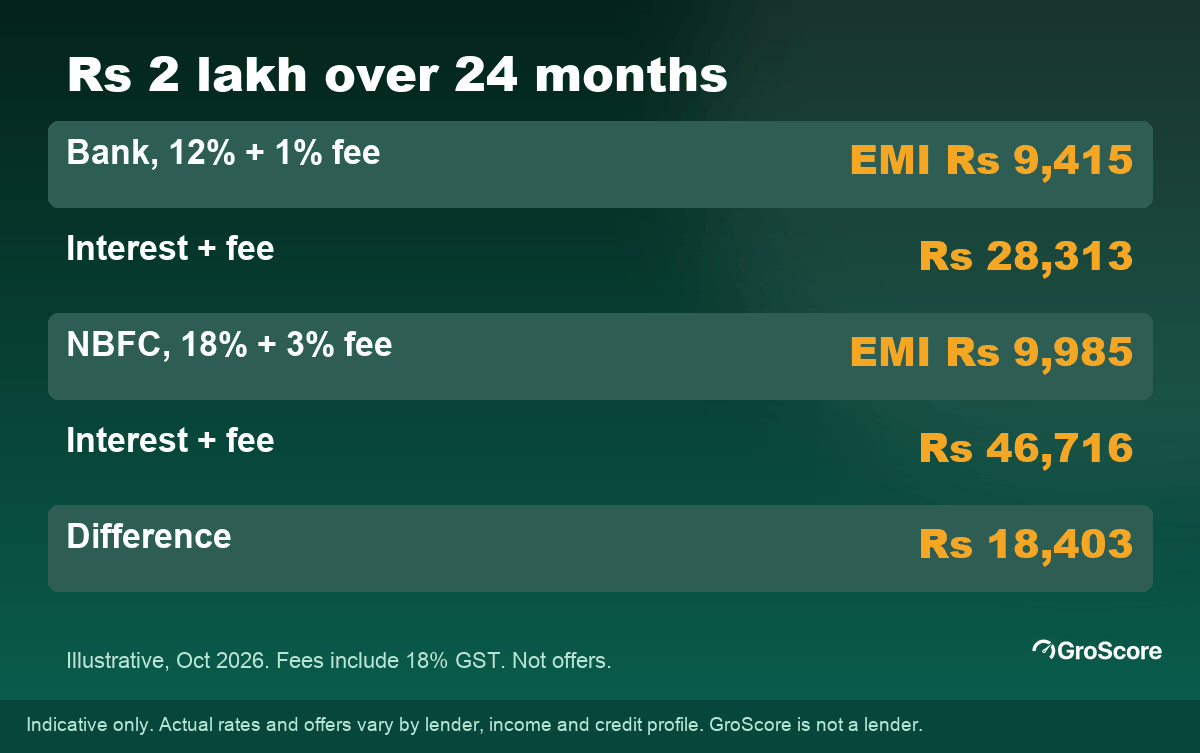
Same Rs 2 lakh. Rs 18,403 apart once fees are counted (illustrative, as of October 2026).
The NBFC loan costs Rs 18,403 more, yet its EMI is only Rs 570 higher. EMI alone is a poor guide. Notice the fee too: a 3% fee pushes the APR well above the 18% headline rate, and the KFS that RBI rules require shows you that APR before you sign.
Is the NBFC still the right call sometimes? Yes. If the bank won't lend to you, or you need the money before a bank can decide, a regulated NBFC at a fair APR beats an unregulated app at any price.
What Would GroScore's Credit Coach Check Before You Choose?
Illustrative example. Say you're 29, salaried, with an Equifax score of 712 and a pre-approved bank offer you haven't opened. You also have two NBFC offers in a loan app. Arjun, GroScore's credit coach, would look at your report in this order:
- Recent hard enquiries. Three loan applications in the past month already tell lenders you're hunting for credit. Each new application adds a hard enquiry, so apply to one or two lenders, not five.
- Card utilisation. A card at 70% of its limit drags the score. GroScore's guidance is to keep card use under 30% (groscore.in, retrieved 2026-10-05).
- Any DPD (days past due) entry. A single 30-day late payment in the last year can be why a bank offer is smaller than you hoped.
- Accounts you don't recognise. A loan you never took is either an error or fraud, and both need a dispute before you borrow.
Then shop in order. Open the bank's pre-approved offer first. Compare its KFS against the best NBFC KFS, and pick on APR and total cost, not speed.
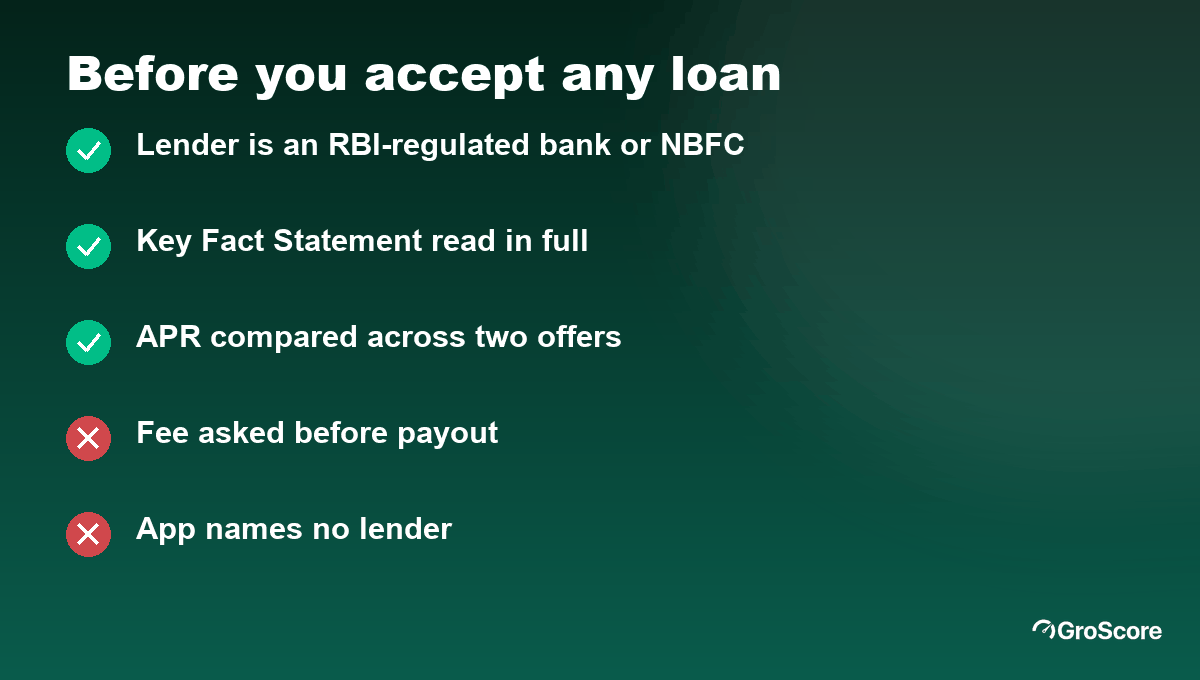
You want three ticks and no crosses before you sign anything.
How to Choose Between an Instant Bank Loan, NBFC and App
Match the route to your situation:
- You bank with a lender that's offering you credit. Start there. An instant bank loan from your own bank is usually the cheapest and quickest.
- Your score is fair, around 650 to 749. Compare one bank and one or two registered NBFCs on APR.
- You found the offer in an app. That's fine if the app names its lender and appears in RBI's directory.
- You need a small amount for a few days. Ask whether a credit card or a loan against an FD costs less. Fees on a short loan can push the APR far higher.
- Your score is low. Read our guide to a low CIBIL score personal loan before you apply anywhere.
Frequently Asked Questions
Is an NBFC loan safe?
Yes, if the NBFC holds an RBI certificate of registration. Check its exact name on the RBI's list of registered NBFCs and make sure that name appears on your loan agreement and Key Fact Statement. If the NBFC isn't on the list, don't borrow.
Who is the actual lender when I borrow through an app?
A bank or NBFC regulated by the RBI. The app must disclose its lending partners, and the lender's name appears in the Key Fact Statement. You can also search the app in the RBI's directory of digital lending apps under Citizen's Corner on rbi.org.in.
Do banks give instant personal loans?
Yes, mostly as pre-approved offers to existing customers, through net banking or the bank's app. New customers usually need fuller checks, so the process takes longer. Approval is never guaranteed, even on a pre-approved offer.
Which is cheaper, a bank or an NBFC?
For the same borrower, a bank is usually cheaper. For example, in our illustrative Rs 2 lakh, two-year case, a 12% bank loan cost Rs 28,313 in interest and fees and an 18% NBFC loan cost Rs 46,716. Compare the APR in each KFS, which RBI rules require, since fees can change the answer.
The Bottom Line
Banks, NBFCs and loan apps can all be safe. A loan is safe when it comes from a regulated lender you can name and verify, a Key Fact Statement you've read, and an APR you've compared. Start with your own bank, check any NBFC on the RBI list, and check any app in RBI's directory before you share documents. Before you apply anywhere, look at your full credit report so you know what a lender will see; our guide to reading your credit report shows you where to look.
Disclaimer
This GroScore article is for general education and is not financial advice. GroScore provides credit scores and reports sourced from Equifax, an RBI-licensed credit bureau; scores differ between bureaus and change as lenders report new data. Credit score improvement depends on your individual credit behaviour and bureau reporting timelines, and results are not guaranteed. Loan and card decisions are made by lenders on their own criteria. GroScore is not a lender. Figures and rates shown are indicative.
