Instant Loan Low Interest: How to Find the Real Cost (APR)
The lowest headline rate is often not the cheapest loan. Here's how to work out what an instant loan really costs, with the arithmetic shown.

When you search for an instant loan low interest deal, compare offers on their APR (annual percentage rate), not the headline rate. APR folds the interest and the upfront fees into one yearly figure, and RBI rules require lenders to show it in a Key Fact Statement before you sign. A "flat 12%" loan can cost more than an "18%" one once you do the arithmetic.
Key TakeawaysThe RBI has required a Key Fact Statement (KFS), with the APR, for all new retail and MSME term loans since 1 October 2024 (RBI).A flat rate is charged on the full loan for the whole tenure, so its real yearly cost is close to double the quoted figure.Processing fees, GST on fees and bundled insurance can add several percentage points to the APR.Your credit score is one of the biggest levers on the rate you're offered, but no score guarantees a rate.
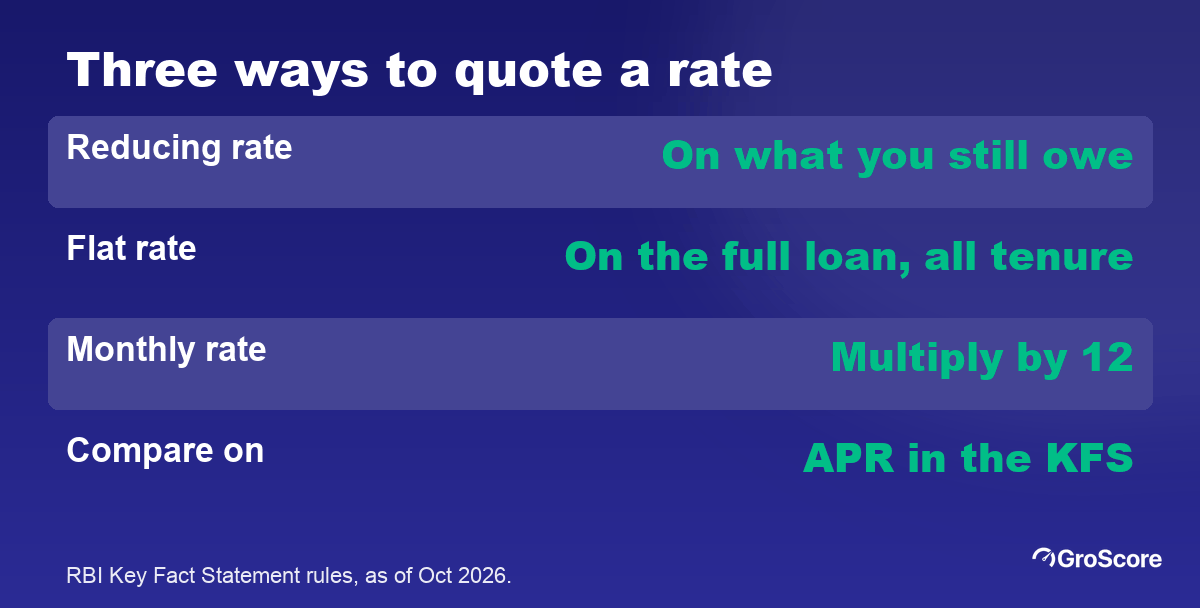
Three ways to quote a rate. Only one number lets you compare them.
What Does "Low Interest" Really Mean on an Instant Loan?
A low-interest loan is one with a low total cost, and that's rarely the number in the ad. Lenders and apps quote rates in different ways, and some ways make a loan look cheaper than it is.
Before the arithmetic, a word on who's writing this. GroScore is a free credit score app and personal credit coach from Vitrak Technologies (GroMo). It shows your Equifax credit score and full report with a soft check, and explains what is holding the score back. GroScore is not a lender. It doesn't give, approve or disburse loans, and the score it shows is your Equifax score, not a CIBIL score.
Here's the problem with headline rates. One offer says "1.5% a month". Another says "flat 12% a year". A third says "16% a year" with a 3% processing fee. All three could be honest. None of them can be compared with the others until you convert each into an APR. If you want the basics of how these loans are approved and paid out first, read our guide to the instant personal loan.
Flat Rate vs Reducing Rate vs Monthly Rate: What's the Difference?
There are three common ways to quote a quick loan interest rate. You'll meet all three.
| How it's quoted | What it means | What to watch for |
|---|---|---|
| Reducing-balance rate, e.g. 16% a year | Interest is charged only on what you still owe. As you repay, the interest part of each EMI shrinks. | The standard for bank and NBFC personal loans. Still check the fees. |
| Flat rate, e.g. 12% a year | Interest is charged on the full loan amount for the whole tenure, even after you've repaid most of it. | Looks low. The real yearly cost is close to double. |
| Monthly rate, e.g. 1.5% a month | A reducing or flat rate quoted per month. | Multiply by 12 for the yearly figure. 1.5% a month is 18% a year before fees. |
Indicative explanations as of October 2026. Actual offers vary by lender, income and credit profile.
A flat rate is the one that catches people. Take an illustrative Rs 1 lakh, 12-month loan at a flat 12%. You pay Rs 12,000 in interest, the same as if you'd held the full Rs 1 lakh all year. But you didn't. By month six you'd repaid half of it. For example, that's why the same flat 12% works out to about 21.5% a year on a reducing basis, before any fee.
What Is APR and Why Does It Matter?
APR is the yearly cost of the loan with the interest and the lender's charges rolled together. Under the RBI's Key Fact Statement rules, it includes charges like the processing fee, verification and documentation charges, but not contingent charges such as penal charges for late payment, which the KFS lists separately (RBI).
APR is therefore the one number you can line up across a bank, an NBFC and an app. If you're still choosing between those three, here's how an instant bank loan compares with an NBFC or an app on safety. Since 1 October 2024, lenders have had to give you a KFS before you sign any new retail or MSME term loan (RBI circular, 15 April 2024). The KFS also carries a repayment schedule and the lender's grievance contact.
For loans taken through an app, RBI's digital lending rules add a cooling-off period of at least one day. Inside it, you can exit by repaying the principal and the proportionate APR, without a prepayment penalty (RBI press release on the Digital Lending Directions, 8 May 2025). If an app won't show you a KFS before you accept, don't accept.
Instant Loan Low Interest Offers Compared: A Worked Example
For example, here are three illustrative offers on the same Rs 1 lakh loan, repaid in 12 monthly EMIs, worked out as of October 2026. The processing fee is deducted from the amount paid out, and 18% GST is charged on the fee.
| Offer A | Offer B | Offer C | |
|---|---|---|---|
| How it's quoted | Flat 12% a year | 1.5% a month, reducing | 16% a year, reducing |
| Processing fee | 2% + GST = Rs 2,360 | 2% + GST = Rs 2,360 | 3% + GST = Rs 3,540 |
| Cash you receive | Rs 97,640 | Rs 97,640 | Rs 96,460 |
| EMI | Rs 9,333 | Rs 9,168 | Rs 9,073 |
| Total interest | Rs 12,000 | Rs 10,016 | Rs 8,877 |
| Interest + fee | Rs 14,360 | Rs 12,376 | Rs 12,417 |
| Approximate APR | about 26.1% | about 22.6% | about 23.0% |
Illustrative figures as of October 2026. EMIs use the standard reducing-balance formula; Offer A's EMI is (Rs 1,00,000 + Rs 12,000) ÷ 12. APR here is the yearly rate that matches the cash you receive to the EMIs you pay. These aren't offers. Actual offers vary by lender, income and credit profile.
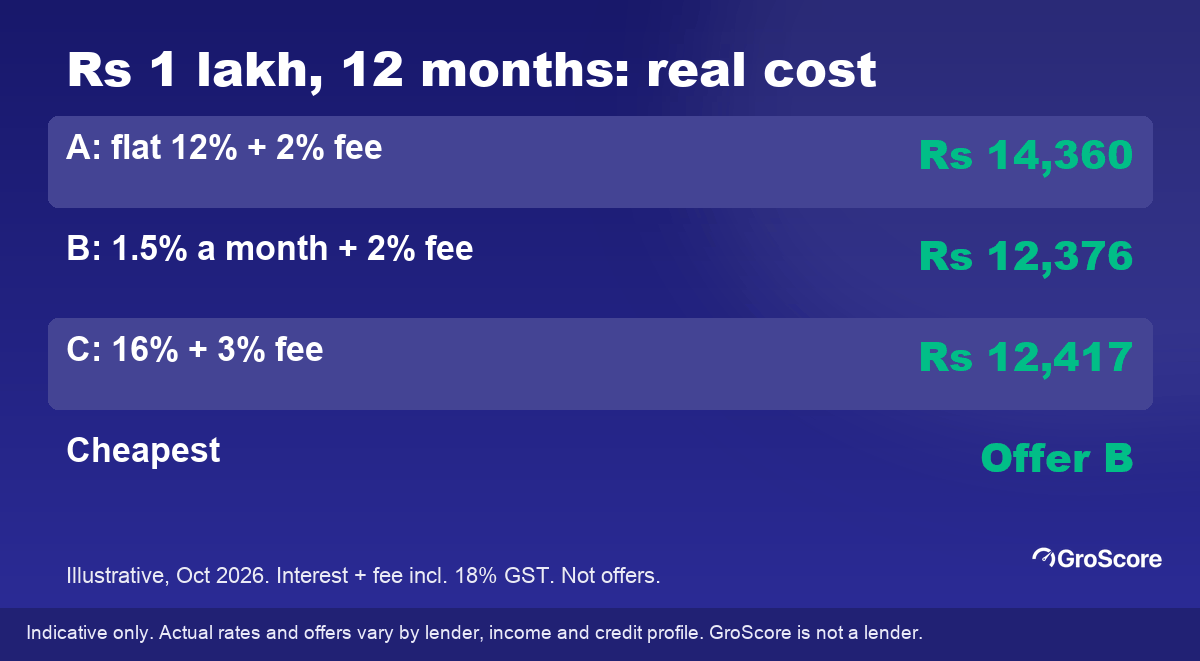
The lowest headline rate turns out to be the most expensive loan.
Look at what happened. Offer A had the lowest headline number and turned out to be the most expensive, by almost Rs 2,000, with an APR of about 26.1% against about 22.6% for Offer B. The KFS that RBI rules require would have shown you that before signing. Offers B and C sit about Rs 40 apart, even though C's rate looks two points lower. C's bigger fee eats almost all of that gap.
So the order of cheapest to costliest is B, then C, then A. Only the APR and the total cost show that. A fast yes doesn't change the maths either, so don't let the promise of instant loan approval rush you past the KFS.
Which Fees Push Up the Real Cost?
Interest is only part of the bill. Check each of these lines in the KFS:
- Processing fee. Often a percentage of the loan, plus 18% GST on the fee (the GST rate as of October 2026). It's usually deducted before the money reaches you, so you pay interest on cash you never got.
- Insurance. Some loans bundle credit insurance. It may be optional. Ask, and get it in writing.
- Foreclosure or prepayment charge. This matters if you plan to repay early.
- Penal charges. Under RBI rules, a late payment attracts a penal charge rather than extra interest added to your rate. Check how much.
- Other fees. Look for documentation, stamp duty, mandate or bounce charges.
Short-tenure app loans deserve extra care. In an illustrative case (October 2026), say an app lends Rs 10,000 for 30 days and deducts Rs 1,000 in fees upfront. You get Rs 9,000 and repay Rs 10,000. That's about 11.1% for one month, which works out to roughly 135% a year as a simple annual rate. A small rupee fee on a short loan can mean a very high APR, and the KFS that RBI rules require must show it.
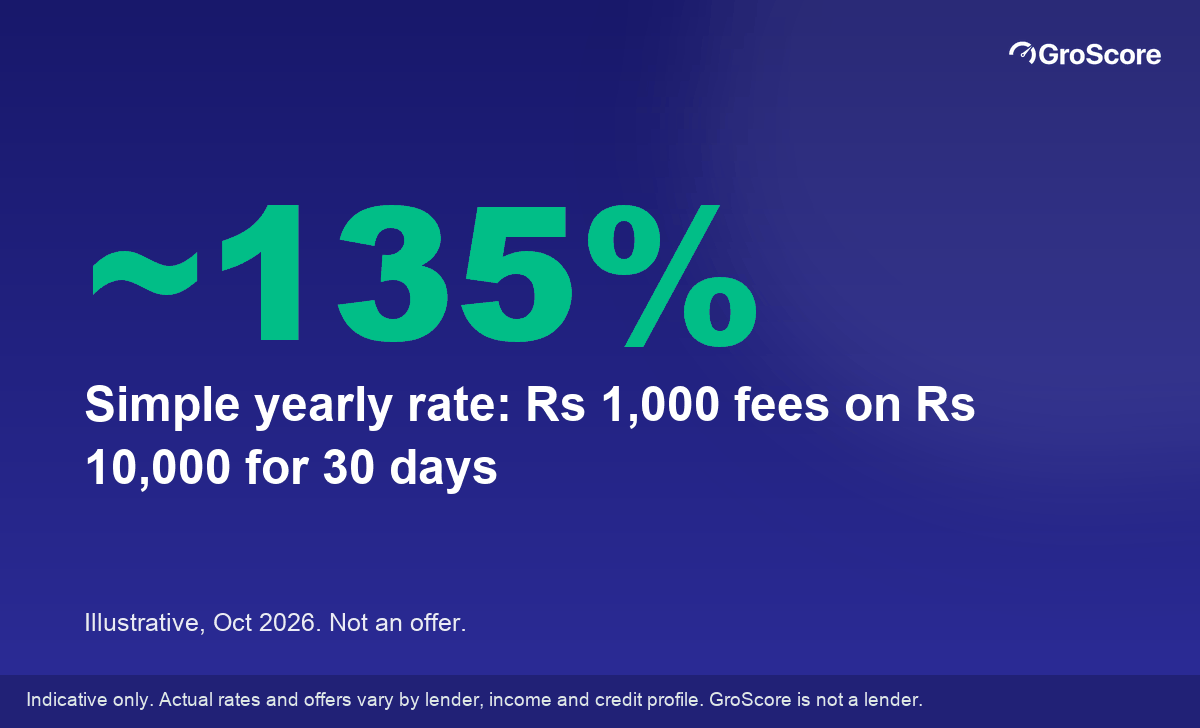
A small fee on a short loan is a big annual rate (illustrative, October 2026).
Before you borrow from any app, confirm its lender is RBI-regulated. Our guide to fake loan apps shows how to check.
Are "Zero Interest" Instant Loans Real?
Sometimes, but zero interest rarely means zero cost. Some offers waive interest and charge a processing fee instead. Others build the cost into the price of what you're buying, as with some no-cost EMI deals.
The test is the same: read the KFS. If the APR is above zero, the loan isn't free. If there's no KFS at all, walk away.
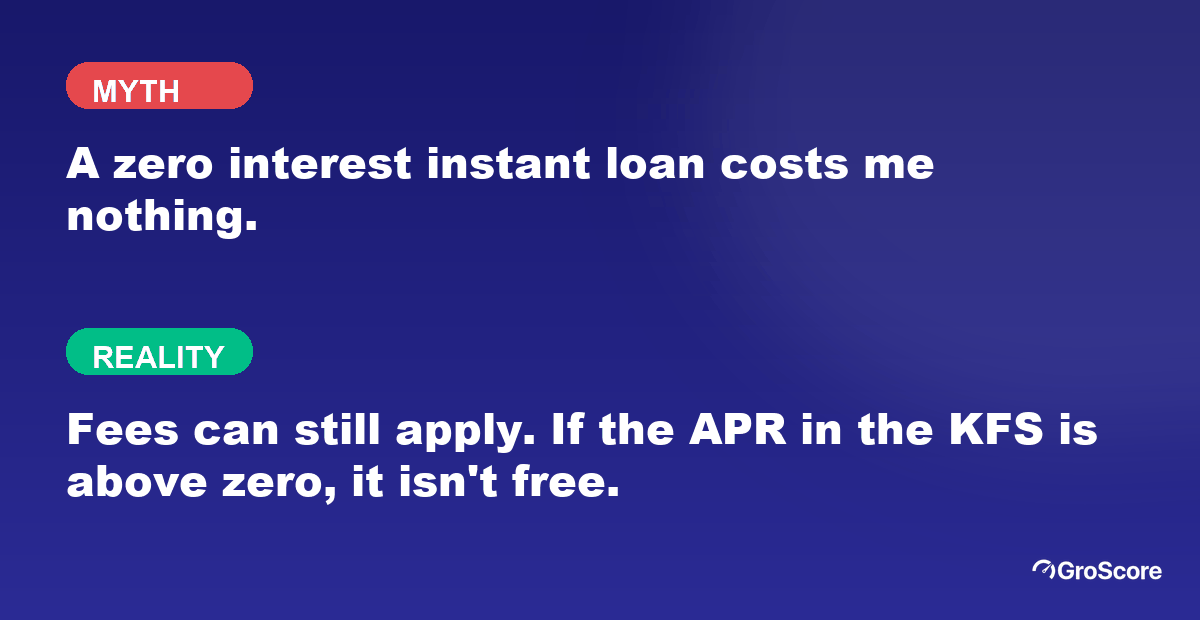
Zero interest and zero cost are not the same thing.
How Does Your Credit Score Change the Rate You Get?
Most lenders price by risk, and your credit report is their main window into it. A strong score with a clean repayment record usually gets a lower rate and fees than a fair or thin file. For how lenders tend to read each band, see our guide to the CIBIL score for a personal loan.
Illustrative example. Say your Equifax score is 690 and you want Rs 1 lakh next month. Arjun, GroScore's credit coach, would flag these on your report, in this order:
- A card at 85% of its limit. GroScore's guidance is to keep card use under 30% (groscore.in, retrieved 2026-10-05). Paying it down before you apply is usually the quickest fix.
- Four loan enquiries in six weeks. Each application is a hard enquiry, and a cluster of them reads as credit hunger. Pause new applications.
- An old account showing an overdue amount you already paid. That's an error, and errors can be disputed.
None of this guarantees a better rate. But it changes what a lender sees, and price follows that. If you're self-employed or paid irregularly, also read our guide to an instant personal loan without income proof, because income documents affect the rate too.
How to Compare Instant Loan Offers in Five Steps
- Get a KFS from every lender you're considering. Without a KFS, there's no deal.
- Write down the APR, the cash you'll actually receive and the total you'll repay.
- Compare total cost in rupees, not just the EMI.
- Check the lender is an RBI-regulated bank or NBFC.
- Apply to the one or two best offers, not to every app that shows you a number.
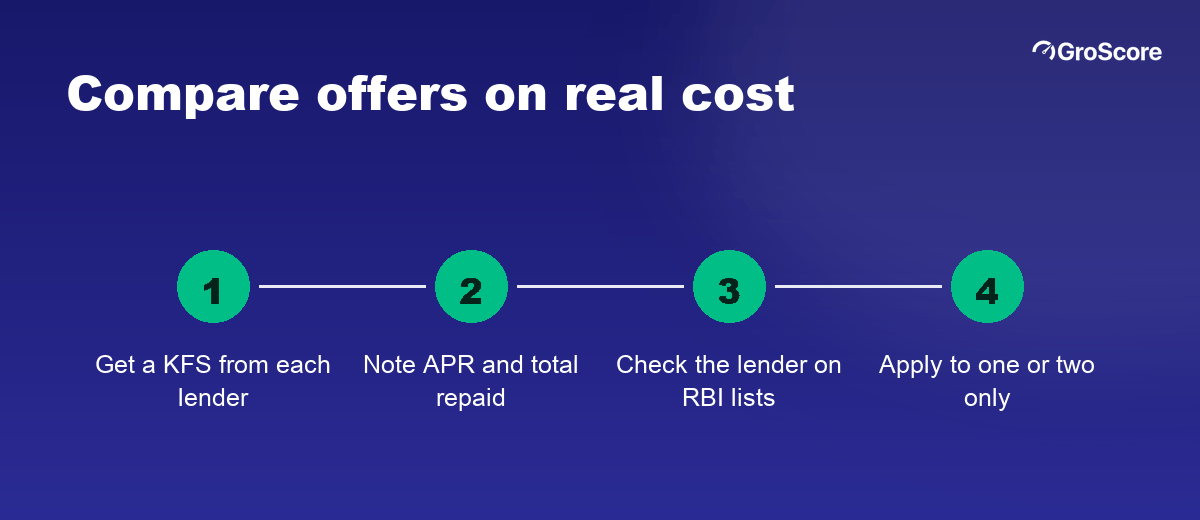
Compare on APR and total rupees, then apply once or twice.
Frequently Asked Questions
What is a normal interest rate for an instant personal loan?
There's no single normal rate. It depends on the lender, your score, income and the loan size, and app loans for small amounts often cost far more than bank loans. Compare the APR in each Key Fact Statement, and treat any rate as indicative until the lender confirms it in writing.
What is APR and why does it matter?
APR is the yearly cost of a loan with interest and the lender's fees combined. RBI rules require lenders to show it in the Key Fact Statement. For example, in our illustration a flat 12% loan with a 2% fee had an APR of about 26%.
Are 'zero interest' instant loans real?
Some are, but most still carry a processing fee or a cost built into the product price. Check the APR in the Key Fact Statement: if it's above zero, the loan isn't free.
How does my CIBIL score change the rate I get?
A higher score usually gets a lower rate, because lenders price by risk. CIBIL is one of four RBI-registered credit bureaus, alongside Equifax, Experian and CRIF High Mark, and a lender may check any of them. A good score helps, but it never guarantees a rate or approval.
The Bottom Line
A low headline rate isn't the same as a cheap loan. Ask for the Key Fact Statement, compare APRs and total rupees, and watch for flat rates and big upfront fees. Borrow only from RBI-regulated lenders. If you have a few weeks before you need the money, cleaning up your credit report is often the best way to qualify for a lower rate; our guide on how to improve your credit score shows where to start.
Disclaimer
This GroScore article is for general education and is not financial advice. GroScore provides credit scores and reports sourced from Equifax, an RBI-licensed credit bureau; scores differ between bureaus and change as lenders report new data. Credit score improvement depends on your individual credit behaviour and bureau reporting timelines, and results are not guaranteed. Loan and card decisions are made by lenders on their own criteria. GroScore is not a lender. Figures and rates shown are indicative.
