Check My Active Loans: Unknown Loan on Your Credit Report?
A loan you never took is either an error or fraud. Either way, the fix starts today.

To check my active loans, the quickest route is your credit report. It lists every loan and credit card reported against your PAN, with the lender, the amount and the status. If you spot a loan you never took, treat it as possible fraud: contact the lender, dispute it with the bureau and report it to the cyber-crime helpline, 1930.
Key TakeawaysRBI rules require lenders to report your loans to all four credit bureaus, so one full report should show them (RBI).Every bureau must give you one free full credit report a year, and must alert you by SMS or email when a lender pulls your report (RBI).A dispute must be resolved within 30 days, or you're owed Rs 100 for every day of delay (RBI).GroScore says about 1 in 5 credit reports carries an error, so not every unknown loan is fraud (groscore.in).
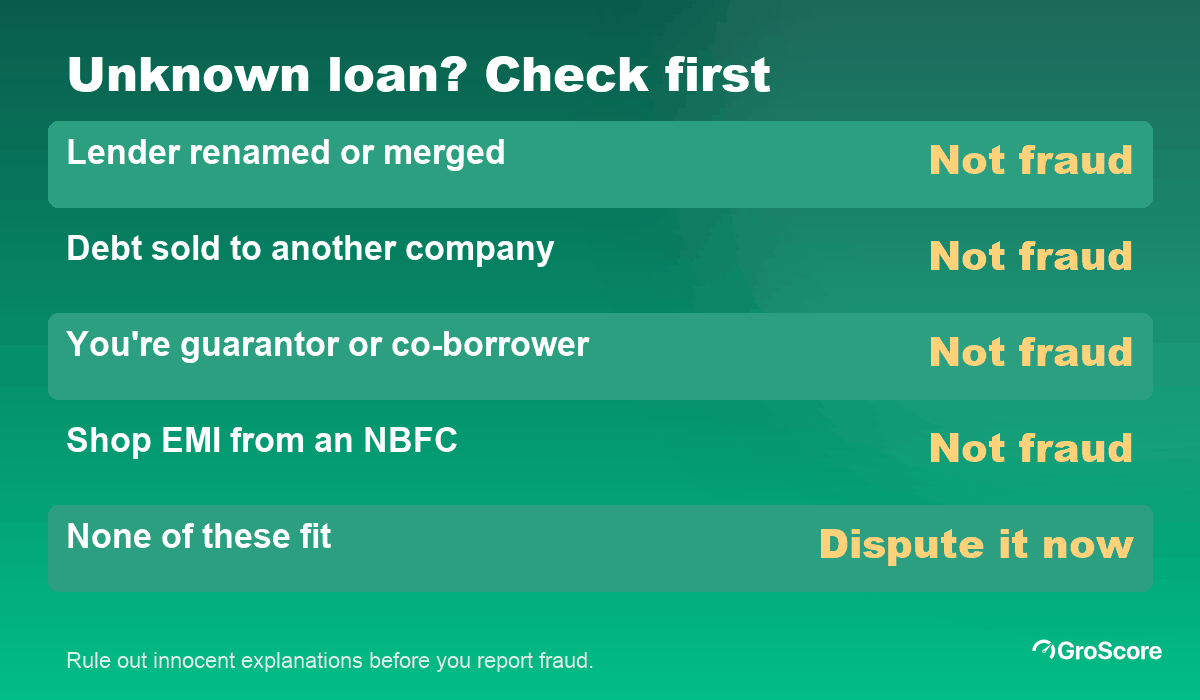
Rule out the innocent explanations before you report fraud.
How to Check My Active Loans on My PAN Card
Your credit report is the record of every loan and card in your name. Banks and NBFCs report each account against identifiers such as your PAN. Under the RBI's credit information rules (2025), every lender must be a member of all four bureaus and send them its borrowers' data. So one full report is the simplest way to check loans in your name.
Here's how to check active loan on your PAN card:
- Use a free app. GroScore shows your Equifax report with your PAN and mobile number, as a soft check that never affects your score.
- Get your free annual report from each bureau. TransUnion CIBIL, Equifax, Experian and CRIF High Mark must each give you one free full report a year.
- Open the accounts section. Live accounts are listed first, then closed ones (RBI). Each shows the lender, account type, date opened, amount and current balance.
Our step-by-step guide to a PAN card credit score check walks through each route with screenshots.
Want to check all credit cards in your name too? They're in the same accounts section, marked as credit cards with their limits.
GroScore is a free credit score app and personal credit coach from Vitrak Technologies (GroMo). It shows your Equifax credit score and full report with a soft check, and alerts you to a new enquiry, a report error or possible fraud. GroScore is not a lender and not a credit bureau. It can't change a bureau's data or remove an accurate entry, and the score it shows is your Equifax score, not a CIBIL score.
What Your Active Loan Details Should Show
Go line by line. For each account, ask yourself whether you recognise it.
| Field on the report | What to check |
|---|---|
| Lender name | Did you borrow from them, or from a company they bought? |
| Account type | Personal loan, card, consumer durable, gold loan, two-wheeler |
| Date opened | Were you applying for anything around then? |
| Ownership | Individual, joint, or guarantor |
| Current balance and DPD | Is anything overdue? DPD means days past due |
Also scroll to the enquiries section. A hard enquiry from a lender you never approached can be an early sign that someone is applying in your name. Our guide to hard vs soft enquiry explains how to read that section.
Unknown Loan on Your Report? First Rule Out These Four
Before you assume fraud, check the innocent explanations. They're more common than you'd think.
- The lender changed its name. Banks merge and NBFCs rebrand. Your old loan may now carry a name you don't know.
- The debt was sold. Lenders sometimes sell overdue loans to asset reconstruction companies, which then report them under their own name.
- You're a guarantor or co-borrower. Your report lists loans where you're a borrower, a co-borrower or a guarantor (RBI). A loan you signed for years ago will show.
- It was a shop EMI. A phone or TV bought on EMI is often a loan from an NBFC, not from the shop.
None of these fit? Then it's either a reporting error or a fraudulent account, and the next steps are the same for both.
Can Someone Take a Loan on My PAN Without My Consent?
Yes, it happens. Fraudsters use stolen or forged KYC documents, such as a copied PAN and Aadhaar, to borrow in someone else's name. That's identity theft. You only find out when the loan goes unpaid and the overdue shows up on your report, or when a recovery agent calls.
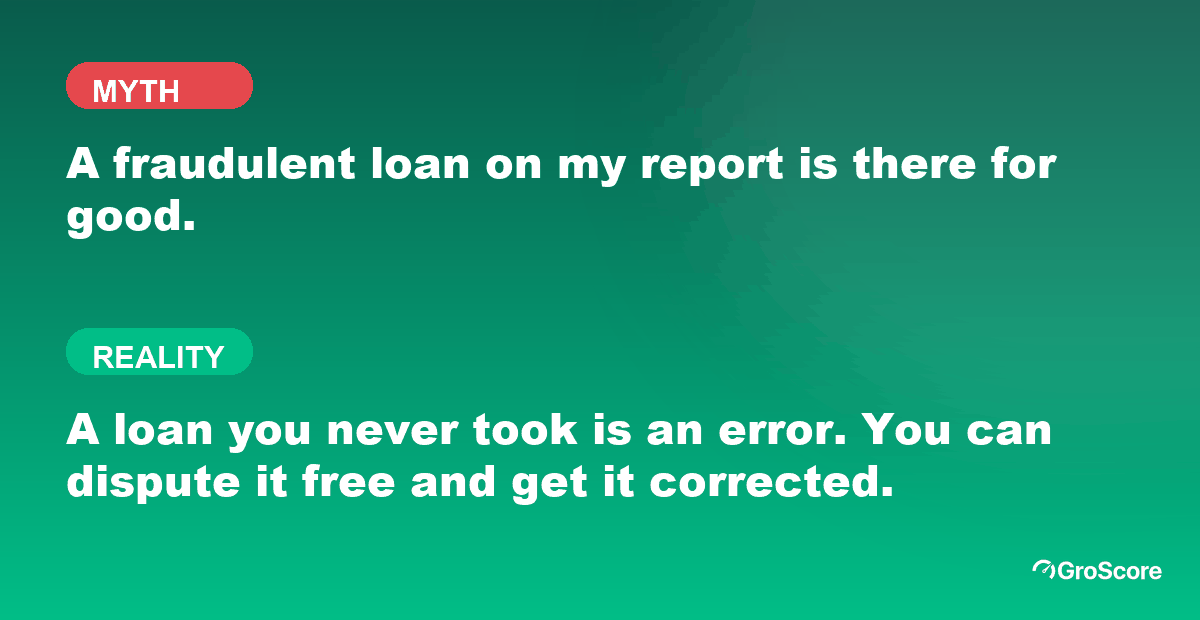
A loan you never took is an error, and errors can be corrected.
A fraudulent account hurts your score the same way a real one would. Its missed payments are reported under your PAN as DPD, to each of the credit reporting agencies in India. The good news is that it's an error you can get corrected, unlike a late payment you really made.
Two RBI rules help you catch it early. Bureaus must alert you by SMS or email when a lender pulls your report. Lenders must alert you when they report a default or DPD on your account (RBI). Treat either alert about a lender you don't know as urgent.
What to Do if You See a Loan You Never Took
Act the same day. Follow these steps in order, and keep copies of everything.
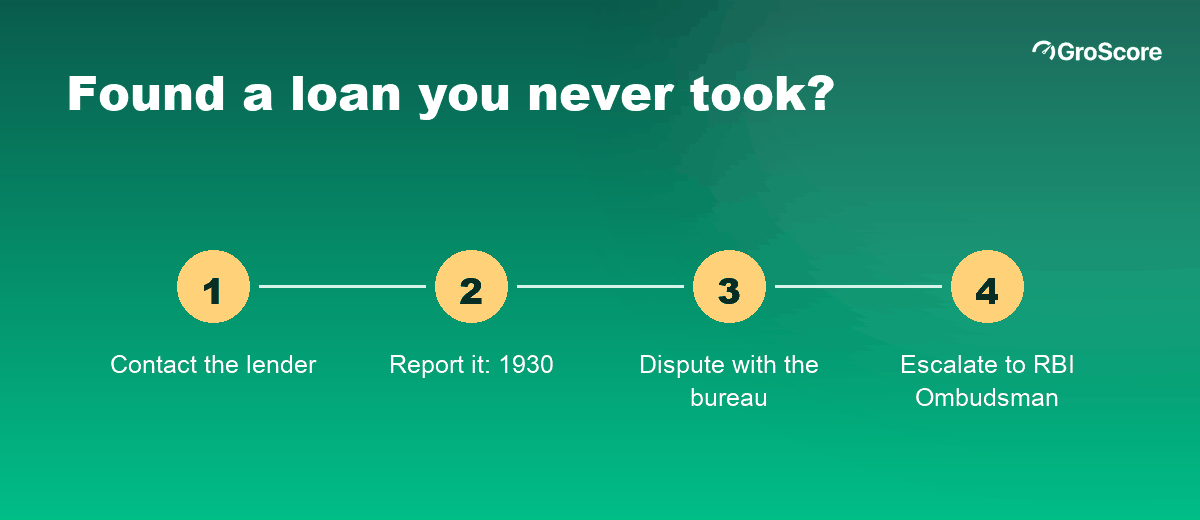
Speed matters. Every month unpaid adds another late entry.
- Contact the lender. Write to its customer care and grievance officer. Say you didn't take the loan, ask for the application documents, and ask them to block any further activity.
- Report the fraud. Call the national cyber-crime helpline on 1930, or file a complaint on the National Cyber Crime Reporting Portal, cybercrime.gov.in. File a police complaint too, and keep the acknowledgement or FIR copy.
- Dispute it with each bureau that shows it. Choose the "ownership" or "account does not belong to me" option and attach your complaint copy. Our guide on how to fix errors in your credit report covers each bureau's process.
- Escalate if it stalls. If the lender doesn't respond within 30 days, or you're unhappy with the reply, complain to the RBI Ombudsman through cms.rbi.org.in.
Don't pay a fraudulent loan to make the calls stop. Paying can look like you accept the debt. A bureau dispute is free, so never pay a fee to anyone who offers to "remove" the loan for you.
How the RBI's Rs 100-a-Day Rule Works for Fraud Disputes
Once you file a complaint, the clock starts. The lender gets 21 days to send corrected data to the bureau, and the whole complaint must close within 30 days of your first filing. After that, you're owed Rs 100 for every calendar day of delay (RBI).
Here's an illustrative example. Say Ravi, 38, gets a possible-fraud alert from GroScore. His Equifax report shows a Rs 40,000 personal loan from an NBFC he's never heard of, with a DPD of 60. Arjun, GroScore's credit coach, takes him through the steps above, and Ravi files his dispute on 5 June.
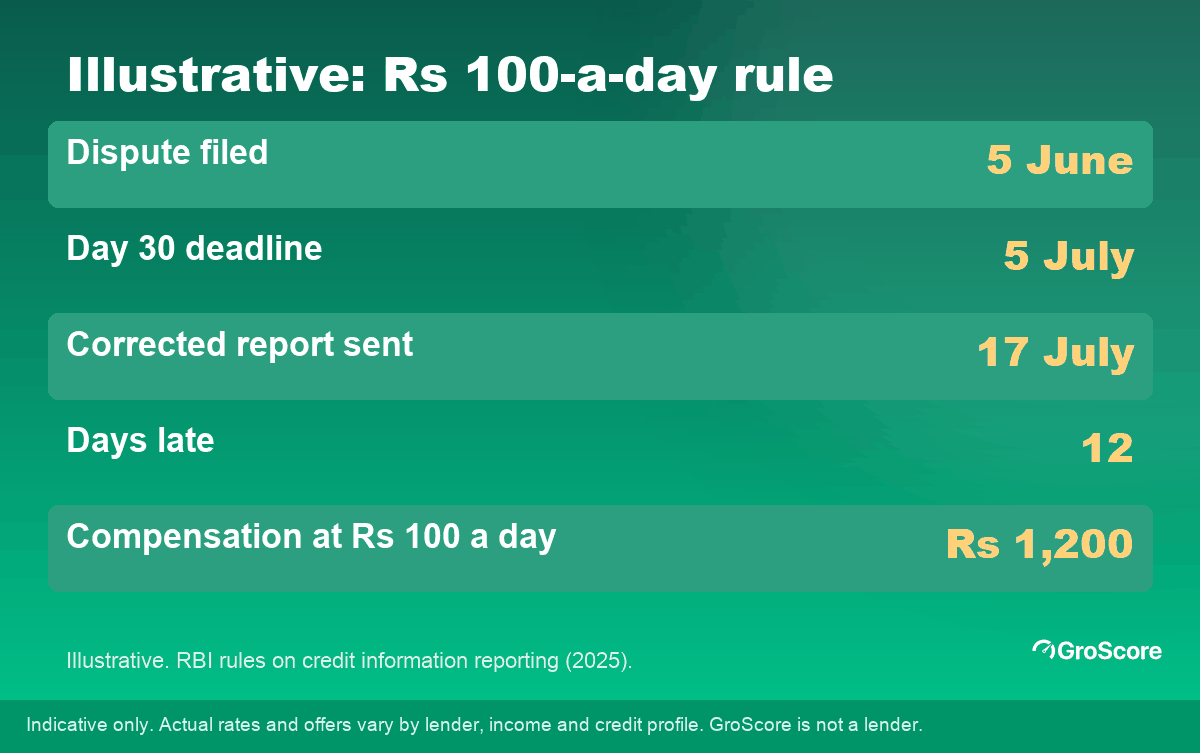
Illustrative example of the RBI's compensation rule.
Day 30 falls on 5 July. The corrected report arrives on 17 July, 12 days late. At Rs 100 a day, that works out to Rs 1,200. It's paid into his bank account within five working days of resolution, so he gives his bank or UPI details in the complaint form. Who pays depends on where the delay happened: the lender, if it missed its 21 days, or the bureau otherwise.
If the complaint is rejected, you must be told why (RBI). If you're wrongly denied the compensation, the RBI Ombudsman is the next step.
How to Keep Your Active Loans Clean From Now On
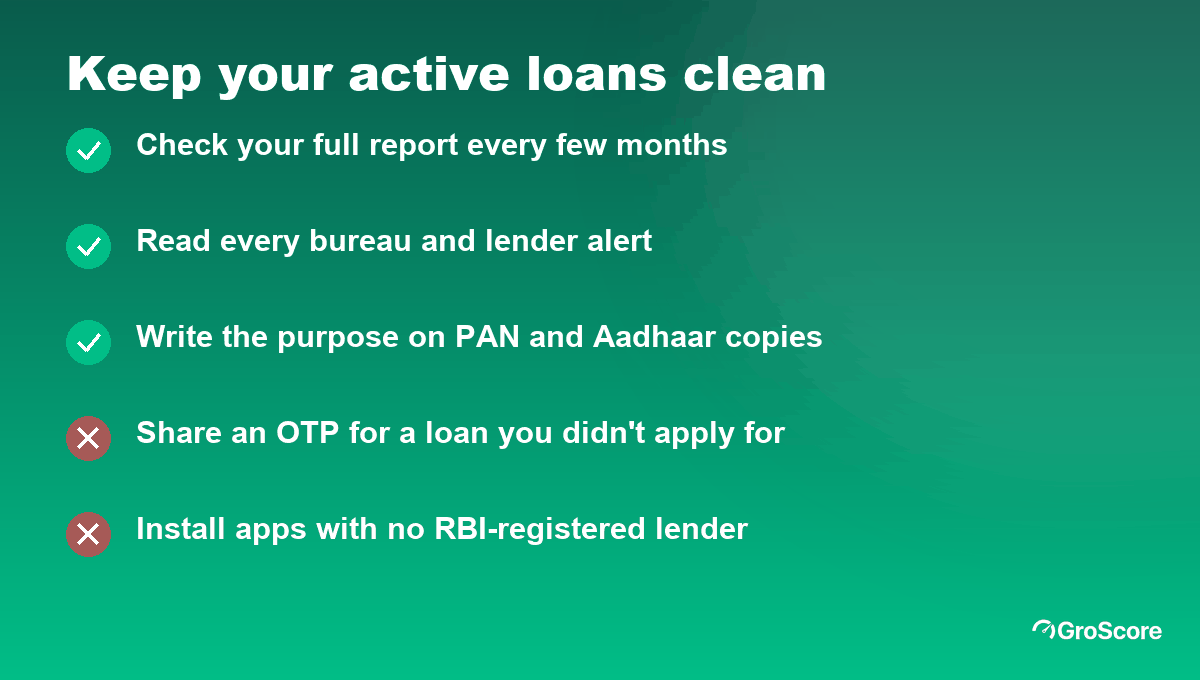
Fraud is easier to stop early than to clean up later. A few habits help:
- Check your full report every few months, not just your score. You can download your credit report free from each bureau once a year.
- Read every SMS or email from a bureau or lender, especially about a lender you don't know.
- Share PAN and Aadhaar copies only where needed, and write the purpose and date across any photocopy you hand over.
- Never share an OTP to "verify" a loan you didn't apply for.
- Check that any lending app is backed by an RBI-registered bank or NBFC before you install it.
Small habits catch fraud before it costs you.
Report suspicious lending schemes on the RBI's Sachet portal, sachet.rbi.org.in. Our guide to fake loan apps shows how to check whether an app is RBI-registered. And if you're asking how to check my active loans because a recovery agent called about a debt you don't know, start with your report today.
Frequently Asked Questions
How can I check all loans taken on my PAN card?
Get your credit report. Every bureau must give you one free full report a year, and lenders must report to all four bureaus, so one report should list every loan and card on your PAN. A free app like GroScore also shows your Equifax report with a soft check.
What should I do if I see a loan I never took?
Rule out a renamed lender, a sold debt or a loan you guaranteed. If none fits, contact the lender's grievance officer, report it on the 1930 cyber-crime helpline or cybercrime.gov.in, file a police complaint and dispute the account with each bureau that shows it.
Can someone take a loan on my PAN without my consent?
Yes. Fraudsters sometimes use stolen or forged KYC documents to borrow in another person's name. Lenders are expected to verify identity, but checks can be beaten. That's why checking your report regularly and acting on enquiry alerts matters.
Does a fraudulent loan hurt my CIBIL score?
A fraudulent loan can hurt your score. If it goes unpaid, missed payments are reported under your PAN and lower your score with every bureau that holds it. Once your dispute succeeds, the account is corrected, and you can ask each bureau to update its records.
Where do I report loan fraud in India?
Call the national cyber-crime helpline on 1930 or file online at cybercrime.gov.in, and lodge a police complaint. Tell the lender in writing. If the lender doesn't resolve it within 30 days, complain to the RBI Ombudsman through cms.rbi.org.in.
The Bottom Line
Your credit report is the only complete list of loans in your name. Check it, question every line you don't recognise, and act fast if something's wrong. A fraudulent loan is an error, and errors can be corrected for free, with the RBI's 30-day clock on your side.
Disclaimer
This GroScore article is for general education and is not financial advice. GroScore provides credit scores and reports sourced from Equifax, an RBI-licensed credit bureau; scores differ between bureaus and change as lenders report new data. Credit score improvement depends on your individual credit behaviour and bureau reporting timelines, and results are not guaranteed. Loan and card decisions are made by lenders on their own criteria. GroScore is not a lender. Figures and rates shown are indicative.
