Real Credit Score Check: Why Scores Differ Across Apps
Two apps, two different numbers, and both can be right. Here's why, and when a gap is a warning sign.

A real credit score check means getting your score from one of India's four RBI-registered credit bureaus, either directly or through an app that names its bureau. There's no single "real" score. CIBIL, Equifax, Experian and CRIF High Mark each calculate their own, from slightly different data, on different dates, with different models. Each number is genuine. When two differ, compare the reports behind them, not the scores.
Key TakeawaysAll four bureaus use the same 300 to 900 scale, but each runs its own model (RBI).Lenders report to all four bureaus, every week since 1 July 2026 (RBI).An app shows the score of the bureau it pulls from. GroScore shows your Equifax score.A small gap is normal. A large one usually means an account differs between reports.
Each of the four bureaus gives you a genuine number.
Which Credit Score Is the Real One?
Every one of them is real, as long as it comes from a bureau. India has four credit information companies, according to the RBI's list of credit information companies: TransUnion CIBIL, Equifax, Experian and CRIF High Mark (now CRIF Credit Information Services). Each keeps its own file on you and calculates its own score.
A credit score app doesn't make up a number. It fetches your report from one bureau, with your consent, and shows that bureau's score. So when two apps disagree, they're usually showing you two different bureaus, or the same bureau on two different dates.
People often treat the CIBIL score as the real one because it's the oldest name. It's one bureau's score, nothing more. Our guide to a free CIBIL score check shows how to get that exact number from CIBIL itself.
GroScore is a free credit score app and personal credit coach from Vitrak Technologies (GroMo). It shows your Equifax credit score and full report with a soft check that never affects your score, explains in Hindi or English what is holding the score back, and gives a step-by-step plan to fix it. GroScore is not a lender, and the score it shows is your Equifax score, not a CIBIL score. Expect it to be close to your CIBIL score, not identical.
Why Is My CIBIL Score Different From My Experian Score?
There are three reasons, and usually more than one applies at once.
1. Different data. Your lenders must report to all four bureaus. Under the RBI's credit information rules (2025), every bank and NBFC must be a member of all four and submit data to each. In practice, a correction can reach one bureau before another, or a record can be rejected by one bureau's data checks. One file then shows something the other doesn't.
2. Different dates. Your score is a snapshot. A report pulled on the 5th and one pulled on the 25th can see different card balances, a newly closed loan or a fresh enquiry. Lenders have reported every week since 1 July 2026 under RBI rules, which narrows these gaps. An app that refreshes monthly can still be a few weeks behind a bureau's own site. Here's more on when your credit score updates.
3. Different models. The RBI requires every bureau to calibrate scores from 300 to 900, so the scale is common. The formula isn't. Each bureau weighs payment history, card use, account age and enquiries in its own way, so identical data can still produce slightly different numbers.
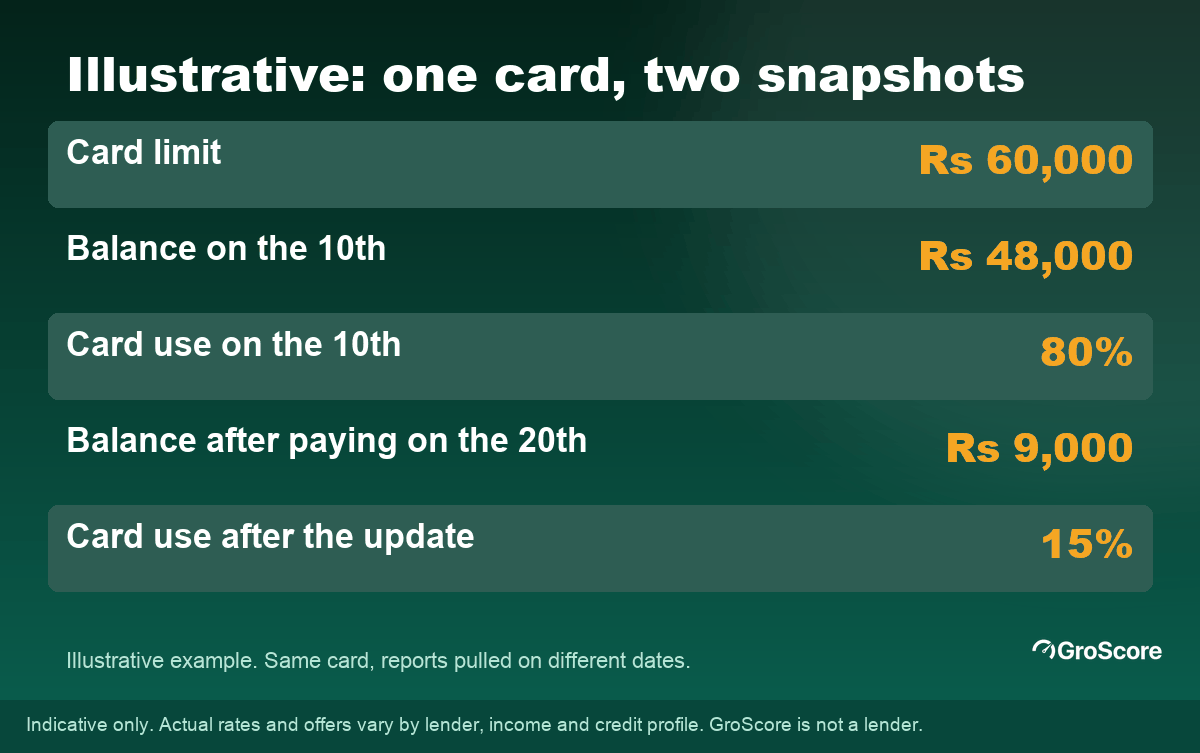
Illustrative example: one card gives two honest readings on two dates.
A Worked Example: Same Card, Two Snapshots
Here's an illustrative example, not a real customer. Neha, 28, has one credit card with a Rs 60,000 limit. Her statement on the 5th shows a balance of Rs 48,000. She pays most of it on the 20th, leaving Rs 9,000.
- On the 10th, her report shows Rs 48,000 of Rs 60,000. That works out to 80% card use.
- Once her lender's next weekly report reaches the bureau (RBI), it shows Rs 9,000 of Rs 60,000, or 15%.
If one app pulled her report on the 10th and another after the next update, they'd show different scores. Neither is wrong. They're two photos of the same habit, taken a fortnight apart. GroScore's guidance is to keep card use under 30% (groscore.in, retrieved 2026-10-05), and paying before the statement date keeps both snapshots low.
Now a gap that does need action. Neha's Equifax report on GroScore shows 724, and her free CIBIL report from cibil.com shows 701. Arjun, GroScore's credit coach, lines up the two reports and flags the reason: a two-wheeler loan she closed in March shows "Closed" on Equifax but still "Active" with Rs 14,000 outstanding on CIBIL. That's an error on one report, and it's the kind worth fixing. She raises a credit report dispute with CIBIL and attaches her closure letter. Under RBI rules, the complaint must be resolved within 30 days, or she's owed Rs 100 for each day of delay.
The lesson: a gap explained by timing fixes itself. A gap explained by a wrong entry doesn't.
Which Bureau Do Banks Check?
Each lender decides. Banks and NBFCs are members of all four bureaus, so they can pull any of them, and some pull more than one. CIBIL is the name most people know, but lenders do use Equifax, Experian and CRIF reports too.
You usually won't know in advance which report a lender will read. That's the practical reason to check more than one. Every bureau must give you one free full report, with your score, each calendar year (RBI). Spread them across the year and you see each file at least once.
If a lender turns you down, ask which bureau's report it used. Lenders should give you the main reasons for a rejection, and the answer tells you which file to check first. For a side-by-side look at the four, see CIBIL vs Experian vs Equifax vs CRIF.
How to Do a Real Credit Score Check
Getting a genuine number is simple. Avoiding the fake ones takes a little care.
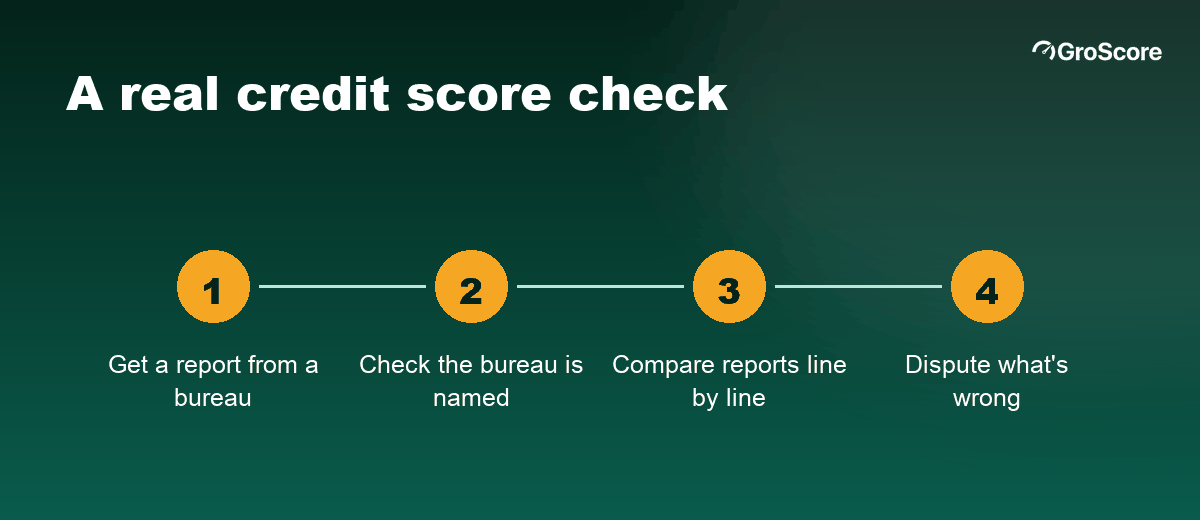
Compare the reports behind the scores, not the scores themselves.
- Get a report from a bureau. Use a bureau's website for its free annual report, or an app that pulls from a named bureau.
- Check the source. A genuine app tells you which bureau the score comes from and asks for an OTP to confirm it's you.
- Compare reports line by line. Look at accounts, balances, the DPD (days past due) grid and enquiries.
- Dispute what's wrong with the bureau that shows the error. Each bureau runs its own process.
Be wary of any site that shows a "real score" from just your PAN, with no OTP, or that charges for a report you can get free once a year. Our guide to a CIBIL score check by PAN number shows the safe, free way to do it. Checking your own score is a soft enquiry, so it never lowers it, however many apps you use.
Should You Worry If Two Scores Differ by 50 Points?
A 50-point gap isn't automatically a problem. Look at why before you act.
| What you find | What it usually means | What to do |
|---|---|---|
| Same accounts, similar balances | Different models or dates | Nothing; track one score monthly |
| A paid-down balance on one report only | A timing gap | Wait for the next update |
| An account on one report only | Missing data at one bureau | Ask your lender to report it |
| A closed loan shown as active | An error | Dispute it with that bureau |
| An account you never opened | A possible fraud | Dispute it and tell the lender |
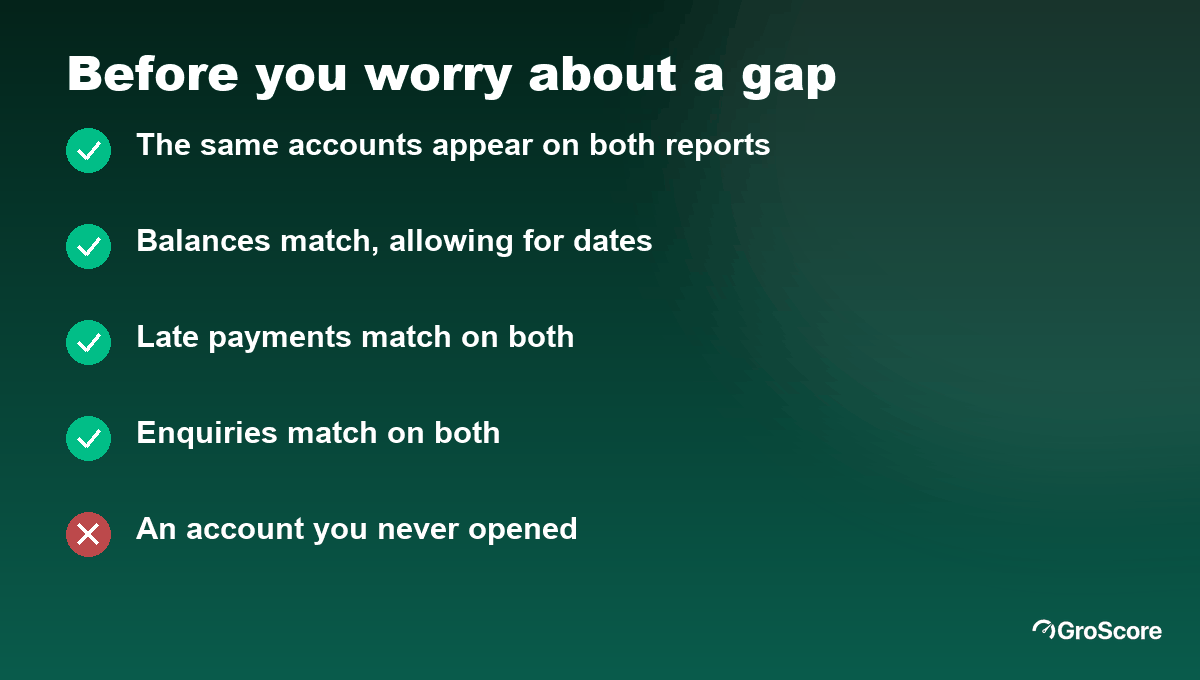
Match these four sections before you worry about the number.
A gap of a few points between bureaus is ordinary. A big gap is a reason to read both reports, because the cause is usually a single account. Fix that, and the scores tend to drift closer. If the odd one out is your CRIF score, our CRIF credit report guide explains how to read it.
Why Is Your Score Different From a Friend's With the Same Salary?
Salary isn't in your credit report. Bureaus don't score income at all.
Your score reflects how you've handled credit: whether you paid on time, how much of your card limits you use, how long you've had credit, and how often you've applied. Two people on the same salary can have very different histories. One may have missed an EMI two years ago. The other may never have had a loan, which can mean no score at all.
Lenders do look at income, but separately, when they decide how much to lend.
Frequently Asked Questions
Why is my CIBIL score different from my Experian score?
Each bureau has its own scoring model, and its file on you can differ slightly in timing or content. A correction may reach one bureau before another. Small gaps are normal; large ones usually trace to a single account.
Which credit score is the real one?
Every score from an RBI-registered bureau is real: TransUnion CIBIL, Equifax, Experian and CRIF High Mark. A real credit score check simply means getting the score from one of them, directly or through an app that names its bureau.
Which bureau do banks check?
Each lender chooses, and some check more than one. Banks and NBFCs are members of all four bureaus. If you're rejected, ask which bureau's report was used so you know which file to check first.
Why is my score different from my friend's with the same salary?
Income isn't part of a credit score. Your score reflects your own repayment record, card use, credit age and applications, so two people on the same salary can score very differently.
Should I worry if two scores differ by 50 points?
Compare the two reports first. If the accounts match, the gap comes from different models or dates. If an account is missing, wrong or unknown, that's worth fixing, because a lender may read the worse report.
The Bottom Line
There's no secret "real" score hiding behind the others. Each bureau's number is genuine, and each is a snapshot of its own file on a particular day. Pick one score to track monthly, pull the other bureaus' free reports through the year, and when two numbers disagree by a lot, read the reports side by side. The gap is usually one account, and that account is worth a look. If Equifax is the score you track, our guide to your Equifax score explains that report in detail.
Disclaimer
This article is for general education and is not financial advice. GroScore provides credit scores and reports sourced from Equifax, an RBI-licensed credit bureau; scores differ between bureaus and change as lenders report new data. Credit score improvement depends on your individual credit behaviour and bureau reporting timelines, and results are not guaranteed. Loan and card decisions are made by lenders on their own criteria. GroScore is not a lender. Figures and rates shown are indicative.
